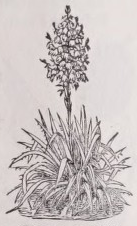
2. A genus of American liliaceous, sometimes arborescent, plants having long, pointed, and often rigid, leaves at the top of a more or less woody stem, and bearing a large panicle of showy white blossoms.
YUCCA, a genus of the order Liliaceae, the species of which are remarkable for their stately appearance and generally magnificent inflorescence. They occur in greatest frequency in Mexico and the south-western States of the American Union, extending also into Central America, and occurring in such numbers in some places as to form “straggling forests.” They have a woody or fibrous stem, sometimes short, and in other cases, even in the same species, attaining a height of 15 to 20 feet, and branching at the top into a series of forks. The leaves are crowded in tufts at the ends of the stem or branches and are generally stiff and sword-shaped, with a sharp point, sometimes flaccid and in other cases fibrous at the edges. The numerous flowers are usually white, bell-shaped, and pendulous, and are borne in much-branched terminal panicles. Each flower consists of a perianth of six regular pieces, as many hypogynous stamens, with dilated filaments, bearing relatively small anthers. The three-celled ovary is surmounted by a short thick style, dividing above into three stigmas, and ripens into a succulentberry in some of the species, and into a dry three-valved capsule in others. The flowers are fertilized by the agency of moths.
A coarse fibre is obtained by the Mexicans from the stem and foliage, which they utilize for cordage. The succulent fruits, which resemble small bananas, are cooked as an article of diet; and the roots contain a saponaceous matter used in place of soap....
Most of the species are hardy in Great Britain, and their striking appearance renders them attractive in gardens even when not in flower. Their rigid foliage, invested by thick epidermis, also enables them to resist the noxious air of towns better than most plants. A popular name for the plant is “Adam’s needle.” The species which split up at the margins of their leaves into filaments are called “Eve’s thread.”
9th ed. Encyclopædia Britannica, vol. 24, p. 760 [326 words — estimated reading time: 2 minutes]
This site uses cookies to remember your display preferences (search sources and editions, Bible version, auto-link, images, light/dark theme). No personal data whatsoever is collected. Privacy Policy