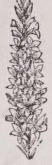
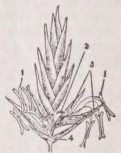
1. A large uail; always in American applied to a nail or pin of metal. A similar thing made of word is called a peg or pin. In England, it is sometimes used for a sharp point of wood.
2. An ear of corn or grain. It is applied to the heads of wheat, rye and barley; and is particularly applicable to the ears of maiz.
1. An aromatic plant. In the United States it is the Aralia racemosa, often called spignet, and used as a medicine. The spikenard of the ancients is the Nardostachys Jatamansi, a native of the Himalayan region. From its blackish roots a perfume for the hair is still prepared in India.
2. A fragrant essential oil, as that from the Nardostachys Jatamansi.
SPIKENARD, or Nard (Hebrew nērd ; Gr. vάρδoς, from Sanskrit naladwitha, the change from “r” to “1” seeming to indicate that the word came through Persia), a celebrated perfume which seems to have formed one of the most durablearomatic ingredients in the costly unguents used by the Romans and Eastern nations. The ointment prepared from it (“ointment of pisticnard”) is mentioned in the New Testament (Mark xiv. 3-5; John xii. 3-5) as being “very costly,” a pound of it being valued at more than 300 denarii (over £10). This appears to represent the prices then current for the best quality of nard, since Pliny (H.N ., xii. 26) mentions that nard spikes reached as much as 100 denarii per lb, and, although he does not mention the price of nardointment, he states (xiii. 2) that the “unguentum cinnamominum,” a similar preparation, ranged from 25 to 300 denarii according to its quality. Nardointment also varied considerably in price from its liability to sophistication (Id., xii. 26, 27; xiii. 2). The ingredients of the genuine ointment (unguentum nardinum sive foliatum), Pliny tells us (xiii. 2), were Indian nard, juncus (the leaves of Andropogon Schοenanthus, L.), costus (the root of Aplotaxis auriculata, DC.), amomum (the fruits of Amomum Cardamomum, L.), myrrh (the gum-resin of Balsamodendron Myrrha, Nees), balm (the oleo-resin of Balsamodendron Opobalsamum), omphacium or oleum omphacinum (the oil expressed from unripe olives), and balaninum (derived from Balanites aegyptiaca ? ). Dioscorides (i. 75) also remarks that malabathrum (the leaf of Cinnamomum Tamala, Nees) was sometimes added. Of these ingredients costus and amomum were most relied upon for increasing the fragrance and the nard for the stimulating and other virtues of the unguent. The ...exact botanical source of the true or Indian nard was long a matter of uncertainty, the descriptions given by ancient authors being somewhat vague. Theophrastus (De Odor., 28) classes nard amongst roots, and states that it came from India (Hist. Plant., ix. 7, 2), had a biting and hot taste, and resembled iris root in perfuming the air near it (De Odor., 12, 56). He also remarks (l.c., 42) that the ointment was one of the most durable of perfumes. Pliny (H.N., xii. 26, 27) gives a somewhat confused account, from which it appears that both “spike” and leaf were in use, although it is not clear whether the spike (spica) consisted of the flower-head or the fibrous lower portion of the stem. The only definite statement he makes concerning it is that the “sincere” nard is known by its red colour, sweet smell, and especially taste, “for it drieth the tongue and leaveth a pleasant relish behind it.” Dioscorides (i. 6) states that the true nard came from India and was collected on mountains beside which the river Ganges flowed. He describes it as blackish with short spikes, smelling something like cyperus. Linnaeus, Blane, Hatchett, and other writers have supposed that spikenard was an Indian grass of the genus Andropogon (A . Nardus, L.); but Sir W. Jones (As. Res., ii. 416, iv. 97) has given convincing reasons for identifying it with Nardostachys Jatamansi, a plant of the Valerian order, the fibrous rootstocks or “spikes” of which are still collected in the mountains of Bhotan and Nepal. Further evidence is afforded by Lambert (Illustr. of the Genus Cinchona, App., p. 177), who found the root under the name of “spikenard” in one of the oldest chemist’s shops in London, also by Dymock (Mat. Med. IF. India, 2d ed., p. 347), who states that the principal use of the drug at the present time is for making hair washes and ointments, the popular opinion being that it promotes the growth and blackness of the hair. The name of “spike” applied to the Indian nard appears to be derived from its resemblance in shape to a spike or ear of bearded corn. The root is crowned by the bases of several stems, each about 2 inches or more in length and as thick as the finger. To these the fibrous tissue of former leaves adheres and gives them a peculiar bristly appearance. It is this portion that is chiefly collected.
Other and inferior varieties of nard are mentioned by Dioscorides and subsequent writers. Celtic nard, obtained from the Ligurian Alps aud Istria, consisted of the roots of plants also belonging to the Valerian order (Valerianα celtiea and V. salicina). This was exported to the East and thence to Egypt, and was used in the preparation of baths. Mountain nard was collected in Cilicia and Syria, and is supposed to have consisted of the root of Valeriana tuberosa. The false nard of Dauphiné, used in later times, and still employed as a charm in Switzerland, is the root-stock of Allium Victorialis. It presents a singular resemblance to the spikes of Indian nard, but is devoid of fragrance. It is remarkable that all the nards belong to the natural order Valerianaceae, the odour of valerian being considered disagreeable at the present day; that of Nardostachys Jatamansi is intermediate between valerian and patchouli, although more agreeable than either.
The name “spikenard” has also been applied in later times to several plants. The spikenard of the United States is Aralia racemosa, and another species of the same genus, A. nudicaulis, is known as “false spikenard.” In the West Indies Hyptis suaveolens is called “spikenard,” and in Great Britain the name “ploughman’s spikenard” is given to Inula Conyza.
9th ed. Encyclopædia Britannica, vol. 22, p. 398 — signed E. M. H. [916 words — estimated reading time: 6 minutes]
נרד. By this was meant a highly aromatic plant growing in the Indies, called “nardostachys,” by Dioscorides and Galen; from whence was made the very valuable extract or unguent, or favourite perfume, used at the ancient baths and feasts, _unguentum nardinum_, _unguentum nardi spicatæ_, [the perfume or unction of spikenard,] which it appears from a passage in Horace, was so valuable, that as much of it as could be contained in a small box of precious stone, was considered as a sort of equivalent for a large vessel of wine, and a handsome quota for a guest to contribute at an entertainment, according to the custom of antiquity:
_Nardo vina merebere: Nardi parvus onyx eliciet cadum._
“Bring you the odours, and a cask is thine. Thy little box of ointment shall produce A mighty cask.” FRANCIS.
St. Mark, xiv, 3, mentions “ointment of spikenard very precious,” which is said to be worth more than three hundred denarii; and John, xii, 3, mentions a pound of ointment of spikenard, very costly; the house was filled with the odour of the ointment; it was worth three hundred denarii. It is not to be supposed that this was a Syrian production, but the true “atar” of Indian spikenard; an unguent, containing the very essence of the plant, and brought at a great expense from a remote country.
And being in Bethany in the house of Simon the leper, as he sat at meat, there came a woman having an alabaster box of ointment of spikenard very precious; and she brake the box, and poured it on his head.
While Jesus was in Bethanyreclining at the table in the home of Simon the Leper, a woman came with an alabasterjar of expensive perfume, made of pure nard. She broke open the jar and poured it on Jesus’ head.
Then took Mary a pound of ointment of spikenard, very costly, and anointed the feet of Jesus, and wiped his feet with her hair: and the house was filled with the odour of the ointment.
Then Mary took about a pint of expensive perfume, made of pure nard, and she anointed Jesus’ feet and wiped them with her hair. And the house was filled with the fragrance of the perfume.
This site uses cookies to remember your display preferences (search sources and editions, Bible version, auto-link, images, light/dark theme). No personal data whatsoever is collected. Privacy Policy