
1. Literally, a driving; hence, the state of acting or moving; exertion of power or force, as when one body acts on another; or action is the effect of power exerted on one body by another; motion produced. Hence, action is opposed to rest. action when produced by one body on another, is mechanical; when produced by the will of living being, spontaneous or voluntary.
2. [See Def. 3.]
3. An act or thing done; a deed.
4. The Lord is a God of knowledge, and by him are actions weighed. 1 Samuel 2:3 .
5. In mechanics, agency; operation; driving impulse; effort of one body upon another; as, the action of wind upon a ship's sails. Also the effect of such action
6. In ethics, the external signs or expression of the sentiments of a moral agent; conduct; behavior; demeanor; that is, motion or movement, with respect to a rule or propriety.
7. In poetry, a series of events, called also the subject or fable; this is of two kinds; the principal action which is more strictly the fable, and the incidental action or episode.
8. In oratory, gesture or gesticulation; the external deportment of the speaker, or the accommodation of his attitude, voice, gestures, and countenance to the subject, or to the thoughts and feelings of the mind.
9. In physiology, the motions or functions of the body, vital, animal and natural; vital and involuntary, as the action of the heart and lungs; animal, as muscular, and all voluntary motions; natural, as manducation, deglutition, and digestion.
10. In law, literally, an urging for right; a suit or process, by which a demand is made of a right; a claim made before a tribunal. Actions are real, personal or mixed; real, or feudal, when the demandant claims a title to real estate; personal when a man demands a debt, personal duty, or damages in lieu of it, or satisfaction for an injury to person or property; and mixed, when real estate is demanded, with damages for a wrong sustained. Actions are also civil or penal; civil, when instituted solely in behalf of private persons, to recover debts or damages; penal, when instituted to recover a penalty, imposed by way of punishment. The word is also used for a right of action; as, the law gives an action for every claim.
11. A chose in action is a right to a thing, in opposition to the possession. A bond or note is a chose in action and gives the owner a right to prosecute his claim to the money, as he has an absolute property in a right, as well as in a thing, in possession.
12. In some countries of Europe, action is a share in the capital stock of a company, or in the public funds, equivalent to our term share; and consequently, in a more general sense, to stocks. The word is also used for movable effects.
13. In painting and sculpture, the attitude or position of the several parts of the body, by which they seem to be actuated by passions; as, the arm extended, to represent the act of giving or receiving.
14. Battle; fight; engagement between troops in war, whether on land or water, or by a greater or smaller number of combatants. This and the 8th definition exhibit the literal meaning of action - a driving or urging.
15. Quantity of action in physics, the product of the mass of a body by the space it runs through and its velocity.
16. In many cases action and act are synonymous; but some distinction between them is observable. action seems to have more relation to the power that acts, and its operation and process of acting; and act, more relation to the effect or operation complete. action is also more generally used for ordinary transactions; and act, for such as are remarkable, or dignified; as, all our actions should be regulated by prudence; a prince is distinguished by acts of heroism or humanity.
17. Action taking, in Shakespeare, is used for litigious.
1. A process or condition of acting or moving, as opposed to rest; the doing of something; exertion of power or force, as when one body acts on another; the effect of power exerted on one body by another; agency; activity; operation; as, the action of heat; a man of action.
2. An act; a thing done; a deed; an enterprise. (pl.): Habitual deeds; hence, conduct; behavior; demeanor.
3. The event or connected series of events, either real or imaginary, forming the subject of a play, poem, or other composition; the unfolding of the drama of events.
4. Movement; as, the horse has a spirited action.
5. Effective motion; also, mechanism; as, the breech action of a gun.
6. Any one of the active processes going on in an organism; the performance of a function; as, the action of the heart, the muscles, or the gastric juice.
7. Gesticulation; the external deportment of the speaker, or the suiting of his attitude, voice, gestures, and countenance, to the subject, or to the feelings.
8. The attitude or position of the several parts of the body as expressive of the sentiment or passion depicted.
9. A suit or process, by which a demand is made of a right in a court of justice; in a broad sense, a judicial proceeding for the enforcement or protection of a right, the redress or prevention of a wrong, or the punishment of a public offense.
10. A right of action; as, the law gives an action for every claim.
11. A share in the capital stock of a joint-stock company, or in the public funds; hence, in the plural, equivalent to stocks.
12. An engagement between troops in war, whether on land or water; a battle; a fight; as, a general action, a partial action.
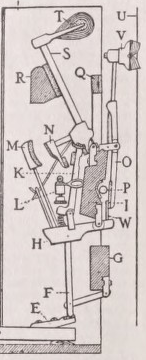
13. The mechanical contrivance by means of which the impulse of the player's finger is transmitted to the strings of a pianoforte or to the valve of an organ pipe.
ACTION, in Law, is the process by which redress is sought in a court of justice for the violation of a legal right. The word is used by jurists in three different senses. Sometimes it is spoken of as a right—the right, namely, of instituting the legal process; sometimes, and more properly, it means the legal process itself; and sometimes the particular form which it assumes. The most universally recognised division of actions is the division established by the Roman lawyers into actions in rem and in personam. An action in rem asserts a right to a particular thing as against all the world; an action in personam asserts a right only as against a particular person. For the sake of convenience, the law relating to actions ought to form a separate section by itself in a properly constructed code.
In Roman law the action passed through three historical stages—
In the first period, which was brought to an end by the Lex Aebutia, about 573 a.u.c., the system of legis actiones prevailed. These were five in number,—the actio sacramenti, per judicis postulationem, per condictionem, per manus injectionem, per pignoris captionem. The first was the primitive and characteristic action of the Roman law, and the others were little more than modes of applying it to cases not contemplated in the original form, or of carrying the result of it into execution when the action had been decided.
Action, in English Law, means the form of civil process hitherto observed in the Courts of Common Law. The procedure in the Court of Chancery is totally distinct, but some account of the former may be desirable in order to explain the new form of action introduced for all the civil courts by the Judicature Act of 1873:—...
Actions at law are divided by Blackstone into three classes, according to the relief which they are respectively intended to obtain. Real actions are those “whereby the plaintiff claims title to have any lands or tenements, rents, commons, or other hereditaments.” In personal actions the claim is “for debt or personal duty, or damages in lieu thereof,” or for “satisfaction in damages for some injury done to person or property.” Mixed actions were supposed to partake of the nature of both of these; that is to say, there was a demand both for real property and for personal damages, as in the case of an action for waste. The distinction has long ceased to be of any value. Blackstone speaks of real actions as being in his time pretty generally laid aside, and successive enactments have obliterated the distinctions altogether. The statute 3 & 4 Will. IV. c. 27, abolished all the real and mixed actions, except three real actions, and ejectment, which was a mixed action. The Common Law Procedure Act of 1860 has assimilated the procedure in the former to an ordinary action, and the Common Law Procedure Act of 1852 now regulates the proceedings in ejectment. In those and other respects the three Common Law Procedure Acts of 1852, 1854, and I860, very greatly simplified the proceedings in an action at law. The first of these rendered it unnecessary any longer to select a form of action in prosecuting a claim, and abolished many of the technicalities which had accompanied the older forme. The divisions now observed may be regarded as indicating, not so much forms of action in the old sense, as the character of the injury sustained and the relief sought.
Action (under the Supreme Court of Judicature Act, 1873). By this Act, which establishes one supreme court in place of the Superior Courts of Common Law and the High Court of Chancery, action is the name given to the proceeding in the High Court of Justice, which takes the place of the old actions at common law, suits instituted by bill or information in the Court of Chancery, causes in rem in the Court of Admiralty, or by citation in the Court of Probate. For these various modes of obtaining redress the Act substitutes one uniform proceeding, which retains most of the essential features of the common law action. The form of action established by the Act is in some measure a compromise between the old action at law and Chancery suit. It may be described as putting an end to the unintelligible and even misleading formulae of the one and reducing the prolixity and redundance of the other. (e. r.)
9th ed. Encyclopædia Britannica, vol. 1, p. 132 [745 words — estimated reading time: 5 minutes]
V. be -in action, operate, work, act, act upon, perform, play, support, sustain, strain, maintain, take effect, quicken, strike, come play, come bring into operation, have play, have free play, bring to bear upon
Adj.operative, efficient, efficacious, practical, effectual, at work, on foot, acting, in operation, in force, in action, in play, in exercise, acted upon, wrought upon
Adv. by the -agency, - of, through, by means of
Phr. "i myself must mix with action lest i wither by despair"
V. do, perform, execute, achieve, transact, enact, commit, perpetrate, inflict, exercise, prosecute, carry on, work, practice, play, employ oneself, ply one's task, officiate, have in hand, labor, be at work, pursue a course, shape one's course, act, operate, take action, take steps, strike a blow, lift a finger, stretch forth one's hand, take in hand, put oneself in motion, put in practice, carry into execution, act upon, be an actor, take a part in, act a part in, play a part in, perform a part in, participate in, have a hand in, have a finger in the pie, have to do with, be a party to, be a participator in, bear a hand, lend a hand, pull an oar, run in a race, mix oneself up with, be in action, come into operation
Adj. doing, acting, in action, in harness, on duty, in operation
Adv. in the act, in the midst of, in the thick of, red-handed, in flagrante delicto, while one's hand is in
Phr. "action is eloquence", actions speak louder than words, actum aiunt ne agas, "awake, arise, or be forever fall'n", dii pia facta vident, faire sans dire, fare fac, fronte capillata post est occasio calva, "our deeds are sometimes better than our thoughts", "the great end of life is not knowledge but action", "thought is the soul of act", vivre-ce nest pas respirer c'est agir, "we live in deeds not years"
V.contend, contest, strive, struggle, scramble, wrestle, spar, square, exchange blows, exchange fisticuffs, fib|, justle, tussle, tilt, box, stave, fence, skirmish, pickeer, fight, wrangle, contend &c. with, grapple with, engage with, close with, buckle with, bandy with, try conclusions with, have a brush, with, tilt with, encounter, fall foul of, pitch into, clapperclaw, run a tilt at, oppose, reluct, join issue, come to blows, go to loggerheads, set to, come to the scratch, exchange shots, measure swords, meet hand to hand, take up the cudgels, take up the glove, take up the gauntlet, enter the lists, couch one's lance, give satisfaction, appeal to arms, lay about one, break the peace, compete with, cope with, vie with, race with, outvie, emulate, rival, run a race, contend &c. for, stipulate for, stickle for, insist upon, make a point of
V. go to law, appeal to the law, bring to justice, bring to trial, bring to the bar, put on trial, pull up, accuse, prefer a claim, file a claim, take the law of, inform against, serve with a writ, cite, apprehend, arraign, sue, prosecute, bring an action against, indict, impeach, attach, distrain, commit, arrest, summon, summons, give in charge, empanel a jury, implead, join issue, close the pleadings, set down for hearing, try, hear a cause, sit in judgment, adjudicate
And Jonathan spake good of David unto Saul his father, and said unto him, Let not the king sin against his servant, against David; because he hath not sinned against thee, and because his works have been to thee-ward very good:
Then Jonathan spoke well of David to his father Saul and said to him, “The king should not sin against his servant David; he has not sinned against you. In fact, his actions have been highly beneficial to you.
Now then do it: for the LORD hath spoken of David, saying, By the hand of my servant David I will save my people Israel out of the hand of the Philistines, and out of the hand of all their enemies.
Now take action, because the LORD has said to David, ‘Through My servant David I will save My people Israel from the hands of the Philistines and of all their enemies.’”
Thy kingdom is an everlasting kingdom, and thy dominion endureth throughout all generations.
Your kingdom is an everlasting kingdom, and Your dominion endures through all generations. The LORD is faithful in all His words and kind in all His actions.
There is a vanity which is done upon the earth; that there be just men, unto whom it happeneth according to the work of the wicked; again, there be wicked men, to whom it happeneth according to the work of the righteous: I said that this also is vanity.
There is a futility that is done on the earth: There are righteous men who get what the actions of the wicked deserve, and there are wicked men who get what the actions of the righteous deserve. I say that this too is futile.
And the harp, and the viol, the tabret, and pipe, and wine, are in their feasts: but they regard not the work of the LORD, neither consider the operation of his hands.
At their feasts are the lyre and harp, tambourines and flutes and wine. They disregard the actions of the LORD and fail to see the work of His hands.
I have sent also unto you all my servants the prophets, rising up early and sending them, saying, Return ye now every man from his evil way, and amend your doings, and go not after other gods to serve them, and ye shall dwell in the land which I have given to you and to your fathers: but ye have not inclined your ear, nor hearkened unto me.
Again and again I have sent you all My servants the prophets, proclaiming: ‘Turn now, each of you, from your wicked ways, and correct your actions. Do not go after other gods to serve them. Live in the land that I have given to you and your fathers.’ But you have not inclined your ear or listened to Me.
Yet, behold, therein shall be left a remnant that shall be brought forth, both sons and daughters: behold, they shall come forth unto you, and ye shall see their way and their doings: and ye shall be comforted concerning the evil that I have brought upon Jerusalem, even concerning all that I have brought upon it.
Yet, behold, some survivors will be left in it—sons and daughters who will be brought out. They will come out to you, and when you see their conduct and actions, you will be comforted regarding the disaster I have brought upon Jerusalem—all that I have brought upon it.
And they shall comfort you, when ye see their ways and their doings: and ye shall know that I have not done without cause all that I have done in it, saith the Lord GOD.
They will bring you consolation when you see their conduct and actions, and you will know that it was not without cause that I have done all these things within it,’ declares the Lord GOD.”
And God saw their works, that they turned from their evil way; and God repented of the evil, that he had said that he would do unto them; and he did it not.
When God saw their actions—that they had turned from their evil ways—He relented from the disaster He had threatened to bring upon them.
The Son of man came eating and drinking, and they say, Behold a man gluttonous, and a winebibber, a friend of publicans and sinners. But wisdom is justified of her children.
The Son of Man came eating and drinking, and they say, ‘Look at this glutton and drunkard, a friend of tax collectors and sinners!’ But wisdom is vindicated by her actions.”
(The same had not consented to the counsel and deed of them;) he was of Arimathaea, a city of the Jews: who also himself waited for the kingdom of God.
who had not consented to their decision or action. He was from the Judean town of Arimathea, and was waiting for the kingdom of God.
And he said unto them, What things? And they said unto him, Concerning Jesus of Nazareth, which was a prophet mighty in deed and word before God and all the people:
“What things?” He asked. “The events involving Jesus of Nazareth,” they answered. “This man was a prophet, powerful in speech and action before God and all the people.
This site uses cookies to remember your display preferences (search sources and editions, Bible version, auto-link, images, light/dark theme). No personal data whatsoever is collected. Privacy Policy