
A stringed instrument of music, a kind of harp much used by the ancients.
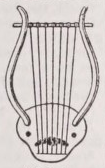
LYRE. Of all musical instruments the lyre has been the most associated with poetry, the recitations of Greeks having been accompanied by it. Yet the lyre was not of Greek origin; no root in the language has been discovered for λυρa, although the special names bestowed upon varieties of the instrument are Hellenic. We have to seek in Asia the birthplace of the genus, and to infer its introduction into Greece through Thrace or Lydia. The historic heroes and improvers of the lyre were of the Aeolian or Ionian colonies, or the adjacent coast bordering on the Lydian empire, while the mythic masters, Orpheus, Musaeus, and Thamyris, were Thracians. Notwithstanding the Hermes tradition of the invention of the lyre in Egypt, the Egyptians seem to have adopted it themselves from Assyria or Babylonia....
To define the lyre, it is necessary clearly to separate it from the allied harp and guitar, both, as far as we have record, instruments of as great antiquity. In its primal form the lyre differs from the harp, of which the earliest, simplest notion is found in the bow and bowstring; while the guitar (and lute) can be traced back to the typical “nefer” of the fourth Egyptian dynasty, the fretted finger-board of which, permitting the production of different notes by the shortening of the string, is as different in conception from the lyre and harp as the flute with holes to shorten the column of air is from the syrinx or Pandean pipes. The frame of a lyre consists of a hollow body or sound-chest (∙7χ∈t0v). From this sound-chest are raised two arms (7r7)χ∈ις), which are sometimes hollow, and are bent both outward and forward. They are bound near the top by a crossbar or yoke (ζυγόν, ζύγωμα, or, from its having once been a reed, κάλαμος). Another crossbar (μdγaς, { ∣ π0λυpL0v), fixed on the sound-chest, forms the bridge which transmits the vibrations of the strings. The deepest note was the farthest from the player; but, as the strings did not differ much in length, more weight may have been gained for the deeper notes by thicker strings, as in the violin and similar modern instruments, or they were tuned with slacker tension. The strings were never of wire, the drawing of which was unknown to the nations of antiquity, but of gut (χop8η, whence chord). They were stretched between the yoke and bridge, or to a tailpiece below the bridge. There were two ways of tuning: one was to fasten the strings to pegs which might be turned (κόλλαβοι., κ0λλoτr(ζ') ; the other was to change the place of the string upon the crossbar; probably both expedients were simultaneously employed. It is doubtful whether η χopδoτ0vo<s meant the tuning key or the part of the instrument where the pegs were inserted. The extensions of the arms above the yoke were known as κέρατα, horns.
Tim number of strings varied at different epochs, and possibly in different localities,—four, seven, and ten having been favourite numbers. They were, as already said, used without a finger-board, no Greek description or representation having ever been met with that can be construed as referring to one. Nor was a bow possible, the flat soundboard being an insuperable impediment. The plectrum, however (πληκτpov), was in constant use at all times. It was held in the right hand to set the upper strings in vibration (κpeκcw, κpoveιv τω πληκτpω) ; at other times it hung from the lyre by a ribbon. The fingers of the left hand touched the lower strings (^dλλeιv).
With Greek authors the lyre has several distinct names; but we are unable to connect these with anything like certainty to the varieties of the instrument. Clιelys (χeλυs, “tortoise”) may mean the smallest lyre, which, borne by one arm or supported by the knees, offered in the sound-chest a decided resemblance to that familiar animal. That there was a difference between ]yre and cithara (κιθάρα) is certain, Plato and other writers separating them. Hermes and Apollo had an altar at Olympia in common because the former had invented the lyre and the latter the cithara. Perhaps the lyre and chelys on the one hand, and the cithara and phorminx on the other, were similar or nearly identical. Apollo is said to have carried a golden phorminx. But lyre has always been accepted as the generic name of the family, and understood to include all varieties. The large lyre was supported by a strong ribbon slung over the player’s shoulder, passing through holes beneath the yoke in the arms of the instrument, and caught by the player’s left hand, the ends hanging in a sash-like fashion. This cithara, or, it may be, phorminx (φopμaγξ, “portable lyre ”), is frequently, by the vase painters, delineated as so held, —the plectrum, attached by another ribbon, being represented, when not in use, as pendent, or as interlaced between the strings.
Passing by the story of the discovery of the lyre from a vibrating tortoise shell by Hermes, we will glance at the real lyres of Egypt and Semitic Asia. The Egyptian lyre is unmistakably Semitic. The oldest representation that has been discovered is in one of the tombs of Beni Hassan, the date of the painting being in the 12th dynasty, that is, shortly before the invasion of the shepherd kings. In this painting, which both Rosellini and Lepsius have reproduced, an undoubted Semite carries a seven or eight stringed lyre of fan-shaped form. The instrument has a four-cornered body and an irregular four-cornered frame above it, and the player carries it horizontally from his breast, just as a modern Nubian would his kissar. He plays as he walks, using both hands, a plectrum being in the right. This ancient lyre, dating 2000 b.c., exists to this day in a remarkable specimen preserved in the Berlin Museum (fig. 3), and is found again in form as well as in manner of holding in the Assyrian lyre of Khorsabad.
During the rule of the shepherds the lyre became naturalized in Egypt, and in the 18th dynasty it is frequently depicted, and with finer grace of form. In the 19th and 20th dynasties the lyre is sometimes still more slender, or is quite unsymmetrical and very strong, the horns surmounted by heads of animals as in the Berlin one, which has horses’ heads at those extremities. Prokesch copied one in the ruins of Wadi Haifa, splendid in blue and gold, with a serpent wound round it. The Egyptians always strung their lyres fan-shaped, like the modern Nubian kissar. Their paintings shew three to eight or nine strings, but the painters’ accuracy may not be unimpeachable; the Berlin instrument had fifteen. The three-stringed lyre typified the three seasons of the Egyptian year—the water, the green, and the harvest; the seven, the planetary system from the moon to Saturn. The Greeks had the same notion of the harmony of the spheres.
There is no evidence as to what the stringing of the Greek lyre was in the heroic age. Plutarch says that Olympus and Terpander used but three strings to accompany their recitation. As the four strings led to seven and eight by doubling the tetrachord, so the trichord is connected with the hexachord or six-stringed lyre depicted on so many archaic Greek vases; We cannot insist on the accuracy of this representation, the vase painters being so little mindful of the complete expression of details; yet we may suppose their tendency would be rather to imitate than to invent a number. It was their constant practice to represent the strings as being damped by the fingers of the left hand of the player, after having been struck by the plectrum which he held in the right hand. Before the Greek civilization had assumed its historic form, there was likely to be great freedom and independence of different localities in the matter of lyre stringing, which is corroborated by the antique use of the chromatic (half-tone) and enharmonic (quartertone) tunings, pointing to an early exuberance, as in language when nations are young and isolated, and perhaps also to an Asiatic bias towards refinements of intonation, from which came the χρόαι, the hues of tuning, old Greek modifications of tetrachords entirely disused in the classic period. The common scale of Olympus
[∣≡≡≡≡⅛Ξ≡≡≡≡≡^ remained, a double trichord which had served as the scaffolding for the enharmonic varieties.
We may regard the Olympus scale, however, as consisting of two tetrachords, eliding one interval in each, for the tetrachord, or series of four notes, was very early adopted as the fundamental principle of Greek music, and its origin in the lyre itself appears sure. The basis of the tetrachord is the employment of the thumb and first three fingers of the left hand to twang as many strings, the little finger not being used on account of natural weakness. As a succession of three whole tones would form the disagreeable and untunable interval of a tritonus, two whole tones and a half-tone were tuned, fixing the tetrachord in the consonant interval of the perfect fourth. This succession of four notes being in the grasp of the hand was called συλλαβή, just as in language a group of letters incapable of further reduction is called syllable. In the combination of two syllables or tetrachords the modern diatonic scales resemble the Greek so-called disjunct scale, but the Greeks knew nothing of our categorical distinctions of major and minor. We might call the octave Greek scale minor, according to our descending minor form, were not the keynote in the middle the thumb note of the deeper tetrachord. The upper tetrachord, whether starting from the keynote (conjunct) or from the note above (disjunct), was of exactly the same form as the lower, the position of the semitones being identical. The semitone was a limma {Kι7μμa), rather less than the semitone of our modern equal temperament, the Greeks tuning both the whole tones in the tetrachord by the same ratio of 8:9, which made the major third a dissonance, or rather would have done so had they combined them in what we call harmony. In melodious sequence the Greek tetrachord is decidedly more agreeable to the ear than the corresponding series of our equal temperament. And although our scales are derived from combined tetrachords, in any system of tuning that we employ, be it just, mean-tone, or equal, they are less logical than the conjunct or disjunct systems accepted by the Greeks. But modern harmony is not compatible with them, and could not have arisen on the Greek melodic lines.
The conjunct scale of seven notes attributed to Terpander, was long the norm for stringing and tuning the lyre. When the disjunct scale the octave scale attributed to Pythagoras, was admitted, to preserve the time-honoured seven strings one note had to be omitted; it was therefore customary to omit the C, which in Greek practice was a dissonance. The Greek names for the strings of seven and eight stringed lyres, the first note being highest in pitch and nearest the player, were as follows:— Nete, Paranete, Paramese ; Mese, Lichanos, Parhypate, Hypate ; or Nete, Paranete, Trite, Paramese ; Mese, Lichanos, Parhypate, Hypate, — the last four from Mese to Hypate being the finger tetrachord, the others touched with the plectrum. The highest string in pitch was called the last, ν^άτη ; the lowest in pitch was called the highest, υπάτη, because it was, in theory at least, the longest string. The keynote and thumb string was μίση, middle; the next lower was λlχavos, the first finger or lickfinger string; τρίτη, the third, being in the plectrum division, was also known as oξeιa, sharp, perhaps from the dissonant quality which we have referred to as the cause of its omission. The plectrum an 1 finger tetrachords together were διαπασών, through all; in the disjunct scale, an octave.
In transcribing the Greek notes into our notation, the absolute pitch cannot be represented; the relative positions of the semitones are alone determined. We have already quoted the scale of Pythagoras, the Dorian or true Greek succession :—
⅝Σ⅛⅞≡ ⅛ ≡Ξ≡
Shifting the semitone one degree upwards in each tetrachord, we have the Phrygian
Another degree gives the Lydian ⅞≡≡≈⅞≡ ⅜⅜⅛≡1 t y r —≡-*≡⅛-=-
which would be our major scale of E were not the keynote A. The names imply an Asiatic origin. We will not pursue further the much debated question of Greek scales and their derivation; it will suffice here to remark that the outside notes of the tetrachords were fixed in their tuning as perfect fourths,—the inner strings being, as stated, in diatonic sequence, or when chromatic two half tones were tuned, when enharmonic two quarter-tones, leaving respectively the wide intervals of a minor and major third, and both impure, to complete the tetrachord. (A. J. H. )
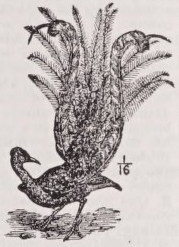
LYRE-BIRD, the name by which one of the most remarkable feathered inhabitants of Australia is commonly known, the Menura superba or Μ. novae-hoUandiae of ornithologists. First discovered, January 24, 1798, on the other side of the river Nepean in New South Wales by an exploring party from Paramatta, under the leadership of one Wilson, a single example was brought into the settlement a few days after, and though called by its finders a “Pheasant ”—from its long tail—the more learned of the colony seem to have regarded it as a Bird-of-Paradise. A specimen having reached England in the following year, it was described by General Davies as forming a new genus of birds, in a paper read before the Linnean Society of London, November 4, 1800, and subsequently published in that Society’s Transactions (vi. p. 207, pl. xxii.), no attempt, however, being made to fix its systematic place. Other examples were soon after received, but Latham, who considered it a Gallinaceous bird, in 1801 knew of only five having arrived. The temporary cessation of hostilities in 1802 permitted Vieillot to become acquainted with this form, though not apparently with any published notice of it, and he figured and described it in a supplement to his Oiseaux Dorés as a Bird of Paradise (ii. pp. 30 sq., pls. 14-16), from drawings by Sydenham Edwards, sent him by Parkinson, the manager of the Leverian Museum....
It would be needless here to enter at any length on the various positions which have been assigned to this singular form by different systematizers—who had to judge merely from its superficial characters. The first to describe any portion of its anatomy was Eyton, who in 1841 {Ann. Hat. History, vii. pp. 49-53) perceived that it was truly a member of the Order then called Insessores, and that it presented some points of affinity to the South American genus PteroptochΛis ; but still there were many who could not take advantage of this step in the right direction. In 1867 Professor Huxley stated that he was disposed to divide his very natural assemblage the Coracomorphae (essentially identical with Eyton’s Insessores') into two groups, “one containing Menura, and the other all the other genera which have yet been examined” {Proc. Zool. Soc., 1867, p. 472)—a still further step in advance. In 1875 the present writer put forth the opinion in this work (Birds, vol. iii. p. 471) that Menura had an ally in another Australian form, Atrichia (see Scrub-Bird), which he had found to present peculiarities hitherto unsuspected, and accordingly regarded them as standing by themselves, though each constituting a distinct Family. This opinion was partially adopted in the following year by Garrod, who {Proc. Zool. Society, 1876, p. 518) formally placed these two genera together in his group of Abnormal Acromyodian Oscines under the name of Menuriηx ; but the author sees no reason to change his mind, and herein he is corroborated by Mr Sclater, who has recently (Ibis, 1880, p. 345) recognized at once the alliance and distinctness of the Families Menuridx and Atrichiidx, forming of them a group which he calls Pseudoscines.
Since the appearance in 1865 of Gould’s Handbook to the Birds of Australia, little if any fresh information has been published concerning the habits of this form, and the account therein given must be drawn upon for what here follows. Of all birds, says that author, the Menura is the most shy and hard to procure. He has been among the rocky and thick “brushes ”—its usual haunts—hearing its loud and liquid call-notes for days together without getting sight of one. Those who wish to see it must advance only while it is occupied in singing or scratching up the earth and leaves; and to watch its actions they must keep perfectly still—though where roads have been made through the bush it may be more often observed and even approached on horseback. The best way of procuring an example seems to be by hunting it with dogs, when it will spring upon a branch to the height of 10 feet and afford an easy shot ere it has time to ascend further or escape as it does by leaps. Another method of stealing upon it is said to be practised by the natives, and is attained by the hunter fixing on his head the erected tail of a cock-bird, which alone is allowed to be seen above the brushwood. The greater part of its time is said to be passed upon the ground, and seldom are more than a pair to be found in company. One of the habits of the cock is to form small round hillocks, which he constantly visits during the day, mounting upon them and displaying his tail by erecting it over his head, drooping his wings, scratching and pecking at the soil, and uttering various cries—some his own natural notes, others an imitation of those of other animals. The wonderful tail, his most characteristic feature, only attains perfection in the bird’s third or fourth year, and then not until the month of June, remaining until October, when the feathers are shed to be renewed the following season. The food consists of insects, especially beetles and myriapods, as well as snails. The nest is always placed near to or on the ground, at the base of a rock or foot of a tree, and is closely woven of fine but strong roots or other fibres, and lined with feathers, around all which is heaped a mass, in shape of an oven, of sticks, grass, moss, and leaves, so as to project over and shelter the interior structure, while an opening in the side affords entrance and exit. Only one egg is laid, and this of rather large size in proportion to the bird, of a purplish-grey colour, suffused and blotched with dark purplish-brown.
Incubation is believed to begin in July or August, and the young is hatched about a month later. It is at first covered with white down, and appears to remain for some weeks in the nest. How much more is needed to be known for a biography of this peculiar and beautiful creature may be inferred by those who are aware of the diligence with which the habits of the much more easily observed birds of the northern hemisphere have been recorded, and of the many interesting points which they present. It is greatly to be hoped that so remarkable a form as the Lyre-bird, the nearly sole survivor apparently of a very ancient race of beings, will not be allowed to become extinct—its almost certain fate so far as can be judged—without many more observations of its manners being made and fuller details of them placed on record. The zoologists of Australia alone can -do this, and the zoologists of other countries expect that they will.
Several examples of Menura have been brought alive to Europe, but none have long survived in captivity. Indeed a bird of such active habits, and requiring doubtless facilities for taking violent exercise, could not possibly be kept long in confinement until the method of menageries is vastly improved, as doubtless will be the case some day, and, we may hope, before the disappearance from the face of the earth of forms of vertebrate life most instructive to the zoologist.
Three species of Menura have been indicated—the old Μ. superba, the Lyre-bird proper, now known for more than eighty years, which inhabits New South Wales, the southern part of Queensland, and perhaps some parts of the colony of Victoria; Μ. victoriae, separated from the former by Gould (Proc. Zool. Soc., 1862, p. 23), and said to take its place near Melbourne; and Μ. alberti, first described by C. L. Bonaparte (Coηsp. Avium, i. p. 215) on Gould’s authority, and, though discovered on the Richmond river in New South Wales, having apparently a more northern range than the other two. All those have the apparent bulk of a hen Pheasant, but are really much smaller, and their general plumage is of a sooty brown, relieved by rufous on the chin, throat, some of the wing-feathers, and the tailcoverts. The wings, consisting of twenty-one remiges, are rather short and rounded; the legs and feet very strong, with long, nearly straight claws. In the immature and female the tail is somewhat long, though affording no very remarkable character, except the possession of sixteen rectrices; but in the fully-plumaged male of Μ. superba and Μ. victoriae, it is developed in the extraordinary fashion that gives the bird its common English name. The two exterior feathers (fig. 1, a, b) have the outer web very narrow, the inner very broad, and they curve at first outwards, then somewhat inwards, and near the tip outwards again, bending round forwards so as to present a lyre-like form. But this is not all; their broad inner web, which is of a lively chestnut colour, is apparently notched at regular intervals by spaces that, according to the angle at which they are viewed, seem either black or transparent; and this effect is, on examination, found to be due to the barbs at those spaces being destitute of barbules. The middle pair of feathers (fig. 2, α, δ) is nearly as abnormal. These have no outer web, and the inner web very narrow; near their base they cross each other, and then diverge, bending round forwards near their tip. The remaining twelve feathers (fig. 3) except near the base are very thinly furnished with barbs, about a quarter of an inch apart, and those they possess, on their greater part, though long and flowing, bear no barbules, and hence have a hair-like appearance. The shafts of all are exceedingly strong. In the male of Μ. alberti the tail is not only not lyriform, but the exterior rectrices are shorter than the rest. (a. n.)