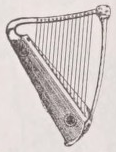
HARP, a musical instrument of the string kind, approximating to triangular form from the strings diminishing in length as they ascend in pitch. While the instrument is of great antiquity, it is yet from northern Europe that the modern harp and its name are derived. The Greeks and Romans preferred to it the lyre in its different varieties, and a Latin writer, Fortunatus (vii. 8), describes it in the seventh century of our era as an instrument of the barbarians—“Romanusque lyra, plaudat tibi barbarus harpa.” This is believed to be the earliest mention of the name, which is clearly Teutonic,—the Old High German “harapha,” the Anglo-Saxon “hearpe,” the Old Norse “harpa.” The modern French “harpe” retains the aspirate; in the Spanish and Italian “arpa” it is dropped.
For the origin of the instrument we have to look to Egypt, and the earliest delineations of it there give no indication that it had not existed long before. There are, indeed, representations in Egyptian paintings of stringed instruments of a bow-form that support the idea of the invention of the harp from the tense string of the warrior’s or hunter’s bow. This primitive-looking instrument was played horizontally, being borne upon the performer’s shoulder. Between it and the grand vertical harps in the frescos of the time of Rameses IIL, more than 3000 years old, paintings discovered by the traveller Bruce (fig. 1), there are varieties that permit us to bind the whole, from the simplest bow-form to the almost triangular harp, into one family (see fig. 2)....
The Egyptian harp had no front pillar, and it, being strung with catgut, the tension and pitch must necessarily have been low. The harps above - mentioned depicted in the tomb at Thebes, assumed from the players to be more than 6 feet high, have not many strings, the one, according to Wilkinson, having ten, the other thirteen. What the accordance was of these strings it would be to no satisfaction to follow Burney and others in trying to recover. We must be content with the knowledge that the old Egyptians possessed harps in principle like our own, the largest having pedestals upon which they bestowed a wealth of decoration, as if to show how much they prized them.
The ancient Assyrians had harps like those of Egypt in being without a front pillar, but differing from them in having the sound-body uppermost, in which we find the early use of soundholes; while the lower portion was a bar to which the strings were tied and by means of which the tuning was apparently effected. What the Hebrew harp was, whether it followed the Egyptian or the Assyrian, we do not know. That King David played upon the harp as commonly depicted is rather a modern idea. Mediaeval artists frequently gave King David the psaltery, a horizontal stringed instrument from which has gradually developed the modern piano. The Hebrew “kinnor” may have been a kind of trigonon, a triangular stringed instrument between a small harp and a psaltery, probably sounded by a plectrum, or, as advocated by Dr Stainer in his essay on the music of the Bible, a kind of lyre.
The earliest records that we possess of the Celtic race, whether Gaelic or Cymric, give the harp a prominent place and hιrpists peculiar veneration and distinction. The names for the harp are, however, quite different from the Teutonic. The Irish “clairseach,” the Highland Scotch “chrsach,” the Welsh, Cornish, Breton, “telyn,” “telein,” “télen,” show no etymological kinship to the other European names. The first syllable in clairseach or clarsach is derived from the Gaelic “clar,” a board or table (soundboard), while the first syllable of telyn is distinctly Old Welsh, and has a tensile meaning; thus resonance supplies the one idea, tension the other.
• ’ ¾ e literature of these Celtic harps may be most directly found 1 J1. ∕ 8 . -Ancient Music of Ireland, Dublin, 1840; Gunn’s Historical Enquiry respecting the Performance on the Earp in the Highlands of Scotland, Edinburgh, 1807; and E. Jones’s Musical and Poetical Memoirs of the Welsh Bards, London, 1784. The treatises of Walker, Dalyell, and others may also be consulted; but in all these authorities due care must be taken of the bias of patriotism and the delusive aim to reconstruct much that we must be content to receive as only vaguely indicated in records and old monuments. There is, however, one early Irish monument about which there can be no mistake, the harp upon a cross belonging to the ancient church of Ullard near Kilkenny, the date of which cannot be later than 830; the sculpture is rude, but the instrument is clearly shown by the drawing in Bunting’s work to have no front pillar. This remarkable structural likeness to the old ' harps of Egypt and Assyria may be accidental, but permits the plausible hypothesis of Eastern descent. The oldest specimen of the beautiful form, the Irish harp is now recognized by, with gracefully curved front pillar and sweep of neck (the latter known as the harmonic curve), is the famous harp in Trinity College, Dublin, the possession of which has been attributed to King Brian Boiroimhe. From this mythic ownership Dr Petrie (see essay in Bunting) has delivered it; but he can only deduce the age from the ornamentation and heraldry, which fix its date in the 14th century or a little later.
There is a cast of it in South Kensington Museum, accurately described in the catalogue by Mr Carl Engel. The next oldest is in the Highlands of Scotland, the Clarsach Lumanach,ox Lamont’s Clarschoe, belonging, with another of later date, to the old Perthshire family of Robertson of Lude. Both are described in detail by Gunn. This Lamont harp was taken by a lady of that family from Argyleshire about 1460, on her marriage into the family of Lude. It had about thirty strings tuned singly, but the scale Was sometimes doubled in pairs of unisons like lutes and other contemporary instruments. The Dalway harp in Ireland (fig. 3) inscribed “Ego sum Regina Cithararum,” and dated 1621, appears to have had pairs of strings in the centre only. These were of brass wire, and played with the pointed finger nails. The Italian contemporary “Arpa Doppia” was entirely upon the duplex principle, but with gut strings played by the fleshy ends of the fingers. When Bunting met at Belfast in 1792 as manyIrish harpers as could be at that late date assembled, he found the compass of their harps to comprise thirty notes which were tuned diatonically in the key of G, under certain circumstances transposable to C and rarely to D, the scales being the major of these keys. The harp first appeared in the coat of arms of Ireland in the reign of Henry VIII.; and some years after in a map of 1567 preserved in a volume of State Papers, we find it truly drawn according to the outlines of the national Irish instrument. References to the Highlands of Scotland are of necessity included with Ireland; and in both we find another name for the harp, viz., “cruit.” Bunting particularly mentions the “cinnard cruit” (harp with a high head) and the “crom cruit” (the curved harp). In the Ossianic MSS. of the Dean of Lismore (1512) the word “crwt” occurs several times, and in Neill M t Alpine ’ s Gaelic Dictionary (1832), which gives the dialect of Islay, closely related to that of Ulster, the word “cruit” is rendered “harp.” In Irish of the 8th and 9th centuries (Zeuss) “cithara” is always glossed by “crot.” True the modern Welsh “crwth” is not a harp; but the expression of Fortunatus, “Chrotta Britanna canat,” has been too readily accepted as meaning the half-fiddle half-lyre which also bears the name of “crwth” or ‘‘ crowd.” An old Welsh harp, not triple strung, exists, which bears a great resemblance to the Irish harp in neck, soundboard, and soundholes. The inference is fair that this was the form, although dimensionsmayhavematerially differed,∙ of the Irish “crom cruit,” while the triple strung harp with its elevated neck might be the form of the “cinnard cruit.” But this does not imply derivation of the harp of Wales from that of Ireland or the reverse. There is really no good historical evidence, and there may have been a common or distinct origin on which ethnology only can throw light. The Welsh like the Irish harp was often an hereditary instrument to be preserved with great care and veneration, and used by the bards of the family, who were alike the poetmusicians and historians. A slave was not allowed to touch a harp, and it was exempted by the Welsh laws from seizure for debt. The old Welsh harp appears to have been at one time strung with horsehair, and by the Eisteddfod laws the pupil spent his noviciate of three years in the practice of a harp with that stringing. The comparatively modern Welsh triple harp (fig. 4) is always strung with gut. It has a rising neck as before stated, and three rows of strings,—the outer rows tuned diatonic, the centre one chromatic for the sharps and flats. Jones gives it 98 strings and a compass of 5 octaves and one note, from violoncello C. As in all Celtic harps, the left is the treble hand, and in the triple harps there are 27 strings on that side, the right or bass hand having 37, and the middle or chromatic row 34.
Turning to the modern harp, the first pattern of it is discovered in German and Anglo-Saxon illuminated MSS. as far back as the 9th century. A diatonic instrument, it must have been common throughout Europe, as Orcagna, Fra Angelico, and other famous Italian painters depict it over and over again in their masterpieces. No accidental semitones were possible with this instrument, unless the strings were shortened by the player’s finger. This lasted until the 17th century, when a Tyrolese maker adapted hooks (perhaps suggested by the fretted or bonded clavichord) that, screwed into the neck, could be turned downwards to fix the desired semitone at pleasure. At last, somewhere about 1720, Hochbrucker, a Bavarian, invented pedals that, acting through the pedestal of the instrument, governed by mechanism the stopping, and thus left the player’s hands free, an indisputable advantage; and it became possible at once to play in no less than eight major scales. By a sequence of improvements, in which two Frenchmen named Cousineau took an important part, the various defects inherent in Hochbrucker’s plan became ameliorated. The pedals were doubled, and, the tuning of the instrument being changed from the key of Eh to Ch, it became possible to play in fifteen keys, thus exceeding the power of the keyboard instruments, over which the harp has another important advantage in the simplicity of the fingering, which is the same for every key.
It is to Sebastian Erard we owe the perfecting of the pedal harp (fig. 5), a triumph he gained in Paris by unremitting studies begun when he adopted a “fork” mechanism in 1786 and ended in 1810 when he had attained complete success. The mechanical perfection of Erard’s apparatus must be seen to be appreciated. The pedals give the extent of movement the disks perform from which the studs project that stop the strings, as it may be required to raise the string in pitch a half tone or a whole tone. Erard’s merit was not confined to this improvement only; he modified the structure of the comb that conceals the mechanism, and constructed the sound-body of the instrument upon a modern principle more advantageous to the tone.
Notwithstanding these improvements and the great beauty of tone the harp possesses, the domestic use of it has for years past been declining. The great cost of a good harp, and the trouble to many amateurs of tuning, may have led to the supplanting of the harp by the more convenient and useful pianoforte. With this comes naturally a diminution in the number of solo-players on the instrument. Were it not for the increasing use of the harp in the orchestra, the colour of its tone having attracted the masters of instrumentation, so that the great scores of Meyerbeer and Gounod, of Berlioz, Liszt, and Wagner are not complete without it, we should perhaps know little more of the harp than of the dulcimer, in spite of the efforts of distinguished virtuosi whose devotion to their instrument maintains its technique on an equality with that of any other, even the most in public favour.
See, in addition to the works already referred to, Engel’s Musical Instruments in the South Kensington Museum, 1874; and the articles ‘ ‘ Harp,” in Rees’s Cyclopoedia, written by Dr Burney, in Stainer and Barrett’s Dictionary of Musical Terms, 1876, and in Grove’s Dictionary of Music and Husiciane, 1879.