
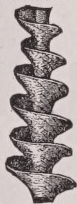
An extinct genus of Bryzoa characteristic of the subcarboniferous rocks. Its form is that of a screw.
ARCHIMEDES, the greatest mathematician and the most inventive genius of antiquity, was born at Syracuse, in Sicily, about 287 B.c. In his youth he went to Alexandria, and completed his education there under Conon, at the royal school of the Ptolemies, of which Euclid had been the ornament some half a century before. On his return to his native city he devoted himself to geometrical investigations, and by his great energy and inventiveness carried the science far beyond the limits it had then attained. Combined with his remarkable faculty of analysis was a power of practical application which enabled him to establish the science of engineering upon a solid mathematical basis. Of the facts of his private life we have but a few disconnected notices. He was the devoted friend, and, according to some accounts, the relative of Hiero, king of Syracuse; and he was ever ready to exercise his ingenuity in the service of his admirer and patron. Popularly, Archimedes is best known as the inventor of ingenious contrivances, though many of the ßtories handed down about these are probably fabulous. He devised for Hiero engines of war, which almost terrified the Romans, and which protracted the siege of Syracuse for three years. There is a story that he constructed a burning mirror which set the Roman ships on fire when they were within a bow-shot of the wall. This has been discredited because neither Polybius, Livy, nor Plutarch mention it; mirrors may, however, as Buffon showed, be so arranged as to burn at a considerable distance, and it is probable that Archimedes had constructed some such burning instrument, though the connection of it with the destruction of the Roman fleet is more than doubtful. Among the most celebrated of his contributions to practical science are his ...discoveries in hydrostatics and hydraulics. The account usually given of one of these is remarkable. Hiero, it is said, had set him to discover whether or not the gold which he had given to an artist to work into a crown for him had been mixed with baser metal. Archimedes was puzzled till one day, as he was stepping into a bath and observed the water running over, it occurred to him that the excess of bulk occasioned by the introduction of alloy could be measured by putting the crown and an equal weight of gold separately into a vessel filled with water, and observing the difference of overflow. He was so overjoyed when this happy thought struck him that he ran home without his clothes, shouting, “eυpηκa, ζvρηκa,"— I have found it, I have found it. It may have been this that led to his establishing the fundamental principle still known by his name, that a body immersed in a liquid sustains an upward pressure equal to the weight of the liquid displaced. Among a number of other mechanical inventions ascribed to him, the water-screw may be mentioned, which still bears his name. His estimate of the capabilities of the lever is expressed in the saying attr.buted to him, ∆os 7roi) ∏τω, και την γην κινήσω, ti Give me a fulcrum on which to rest, and I will move the earth.”
The life of this philosopher ends with the capture of Syracuse by Marcellus, 212 b.c. In the general massacre which followed the fall of the city, Archimedes, while engaged in drawing a mathematical figure on the sand, was run through the body by a Roman soldier. No blame attaches to the Roman general, Marcellus, since he had given orders to his men to spare the house and person of the sage; and in the midst of his triumph he lamented the death of so illustrious a person, directed an honourable burial to be given him, and befriended his surviving relatives. In accordance with the expressed desire of the philosopher, his tomb w as marked by the figure of a sphere inscribed in a cylinder—the discovery of the relation between the volumes of a sphere and its circumscribing cylinder being regarded by him as his most valuable achievement. When Cicero was quaestor in Sicily (75 B.C.), he found the tomb of Archimedes, near the Agrigentine gate, overgrown with thorns and briers. “Thus,” says Cicero (Tusc. Disp. v. 23), “would this most famous and once most learned city of Greece have remained a stranger to the tomb of one of its most ingenious citizens, had it not been discovered by a man of Arpinum.” The range and importance of the scientific labours of Archimedes will be best understood from a brief account of those wτitings which have come down to us; and it may be remarked that though some useful and important works may have perished, it is probable that these are chiefly details of his mechanical inventions, and that all his most valuable mathematical discoveries have been preserved. The following treatises have escaped the ravages of time :—
(1.) On the Sphere and Cylinder (τrep ∖ της σφαίρας και του κυλίνδρου). This treatise consists of two books, dedicated to Dositheus, and containing a number of propositions relative to the dimensions of spheres, cones, and cylinders, all demonstrated in a strictly geometrical method. The first book contains fifty propositions, the most important of which are :—Prop. XIV. on the measure of the curve surface of a cylinder; Props. XV. and XVI. on the surface of a cone; Prop XVII. of a frustrum of a cone; Prop. XXII. of a circle; Prop. XXXV. of the surface of a sphere; and Prop. XXXVII. of the relation between a sphere and its circumscribing cylinder. The second book contains ten propositions, which chiefly relate to plane spherical sections.
(2.) The Measure of the Circle (κυκλoυ μiτρησις) is a short book of three propositions. Prop. I. proves that the area of a circle is that of a triangle whose base is equal to its circumference, and height equal toits radius; Prop. II. shows that the circumference of a circle exceeds three times its diameter by a small fraction, which is less than and greater than ∣⅜; and Prop. III. that a circle is to its circumscribing square nearly as 11 to 14. He arrived at these wonderfully accurate results by inscribing in and circumscribing about a circle two polygons, each of 96 sides; and, assuming that the perimeter of the circle lay between these of the polygons, he obtained by actual measurement the limits he has assigned.
(3.) Conoids and Spheroids (πepι κωvoeι8eωv κaι σφaιρotι- δεωv) is a treatise in forty propositions, on the superficial and solid dimensions of the solids generated by the revolutions of the conic sections about their axes.
(4.) On Spirals (πepi tλiκωv), is a book, in twenty-eight propositions, upon the properties of the curve now known as the spiral of Archimedes, which is traced out by a radius vector, whose length is proportional to the angle through which it has turned from the initial position.
(5.) Equiponderants and Centres of Gravity (πtpι lπιτrl8ωv lσoppoπικωv η κlvτρa βaρωv tτrt7reδωv). This COΠ-si st s of two books, and may be called the foundation of theoretical mechanics, for the previous contributions of Aristotle were comparatively vague and unscientific. In the first book there are fifteen propositions, with eight postulates; and demonstrations are given, much the same as those still employed, of the centres of gravity—(1) of any two weights, (2) of any parallelogram, (3) of any triangle, (4) of any trapezoid. The second book is devoted to the finding the centres of gravity of parabolic segments.
(6.) The Quadrature of the Parabola (Τετραγωνισμός παραβολής) is a book in twenty-four propositions, demonstrating that the area of a parabola is ⅜ of the triangle having its double ordinate for base and abscissa for height His method of arriving at this result is most interesting, as being a sort of rude approximation to the modem process of area summation by integration. The expedients to which he resorted to avoid the idea of infinity are no less curious than they are admirable.
(7.) On Bodies floating in Liquids (∏∈pι τωv v8aτι εφιστaμεvωv), is a treatise in two books, on the principles of floating, and the positions of equilibrium of floating parabolic conoids.
(8.) The Psammites (ύ ψαμμίτης, Lat. Arenarius, or sand counter), a small treatise, dedicated to Gelo, the eldest son of Hiero, on arithmetical numeration, applied to reckoning grains of sand x is curious as containing the germ of the modem system of logarithms.
(9.) A collection of Lemmas, consisting of fifteen propositions in plane geometry. This has come down to us through a Latin version of an Arabic manuscript, and its authenticity has been questioned.
In the edition of Archimedes, published by Revault at Paris in 1G15, the following works are said to be lost :— On the Crown of Hiero ; on the Cochleon, or Water-Screw; on the Helicon, or Endless Screw; on the Trispaston, or Combination of Wheels and Axles; on the Machines employed at the Siege of Syracuse; on the Burning Mirror; on the Machines moved by Air and Water; and on the Material Sphere. We do not know, however, that he ever committed accounts of his mechanical inventions to writing.
The Edito princeps of the works of Archimedes, with the commen-tιry of Eutocius, is that printed at Basil, in 1544, in Greek and Latin, by Hervagius. A Latin translation of them was published by Isaac Barrow in 1675 (London, 4to). Nicholas Tartalea (a celebrated algebraist), published in Greek and Latin the treatises on the Centre of Gravity, on the Quadrature of the Parabola, and on Floating Bodies (Venice, 1543). Frederic Commandine edited the beautiful Aldine edition of 1558, 4to, which contains Circuli Dimensio, De Lineis Spiralibus, Quadratura Paraboles, <L∙c., Conoidibus et Spheroidibus, and De numero Arcnoe ; and in 1565 the same mathematician published the two books De iis quoe vehuntur in Aqud. The most complete and magnificent edition of the works is that edited by Torelli, and published with the commentaries of Eutocius at Oxford, in 1792, folio. The most valuable edition of the Arenarius, which is also the first modem translation of any part of Archimedes, is that published in English by Anderson (London, 1784), with useful notes and illustrations. The first modem translation of the works is the French edition published by F. Peyrard (Paris, 1808, 2 vols. 8vo). A German translation, by Nizze, was published at Stralsund in 1824, and another by Gutenacker, at Wurzburg, 1828, 8vo. See Quart. Rev., vol. iii. p. 89; Plutarch’s Life of Marcellus; Pope Blount’s Censura Celebrium Authorum (London, 1690); the Arenarius of Archimedes, Oxford, 1837; Ed. Rev., vol. xi. p. 185; Powell’3 History of Natural Philosophy (Lardner’s Cycl.), p. 40.
ARCHIMEDES, Screw of, a machine for raising water, said to have been invented by Archimedes, for the purpose of removing water from the hold of a large ship that had been built by King Hiero. It consists of a watertight cylinder, enclosing a chamber walled off by spiral divisions running from end to end, inclined to the horizon, with its lower open end placed in the water to be raised. A section of it is shown in the accompanying woodcut. The water, while occupying the lowest portion in each successive division of the spiral chamber, is lifted mechanically by the turning of the machine. Another form of the screw has the spiral revolving free in a fixed cylinder, but neither of the machines is now much used.