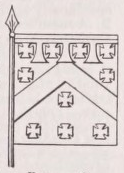
BANN, a considerable river of Ireland, which rises in the Mourne Mountains, County Down, and falls into Lough Neagh. From this it emerges as the Lower Bann, and, flowing between the counties of Antrim and Londonderry, falls into the Atlantic, four miles S.W. of Portrush. The Upper Bann is navigable for vessels of 50 tons to its junction with the Newry canal, a little above Portadown. The Lower Bann flows in a northerly direction; it is navigable up to Coleraine for vessels of 200 tons, but the bar at its mouth renders it difficult of access in rough weather, and its course is broken by a fall of 13 feet about a mile above Coleraine. The salmon and éel fisheries are of considerable value. Measured in a direct line, the Upper Bann is about 35 miles long, and the Lower 30 miles.
9th ed. Encyclopædia Britannica, vol. 3, p. 346 [143 words — estimated reading time: 1 minute]
Banned[Imperfect tense and past participle]Webster's Dictionary 1913
1. A kind of flag attached to a spear or pike by a crosspiece, and used by a chief as his standard in battle.
2. A large piece of silk or other cloth, with a device or motto, extended on a crosspiece, and borne in a procession, or suspended in some conspicuous place.
3. Any flag or standard; as, the star-spangled banner.
an ensign, or standard, used by armies or caravans on their journeys in the eastern countries. The original דגל, is rendered by lexicographers and translators under this word, as a noun, in which form it often occurs, _a standard_, _banner_; as a verb, once, _to set up a banner_; Psalm xx, 5; as a participle pahul, _vexillatus_, one distinguished by a banner, the chief; as a participle niphal, bannered, or with banners. The meaning of the root is illustrated by the very ingenious and sensible author of “Observations on Divers Passages of Scripture,” who shows, from Pitts and Pococke, that, “as in Arabia and the neighbouring countries, on account of the intense heat of the sun by day, people generally choose to travel in the night; so, to prevent confusion in their large caravans, particularly in the annual one to Mecca, each company, of which the caravan consists, has its distinct portable beacon, which is carried on the top of a pole, and consists of several lights, which are somewhat like iron stoves, into which they put short dry wood, with which some of the camels are loaded. Every company has one of these poles belonging to it; some of which have ten, some twelve, of these lights on their tops, more or less; and they are likewise of different figures, as well as numbers; one, perhaps, in an oval shape; another, triangular, or in the form of an M, or N, &c, so that by these every one knows his respective company. They are carried in the front, and set up in the place where the caravan is to pitch, before that comes up, at some distance from one another. As travelling then in the night must be, generally speaking, more agreeable to a great multitude in that desert, we may believe a compassionate God, for the most part, directed Israel to move in the night. ...And in consequence, must we not rather suppose the standards of the tribes were movable beacons, like those of the Mecca pilgrims, than flags or any thing of that kind?” This ingenious author seems, however, to forget, 1. That the pillar of fire was with the Israelites to direct their marches. 2. That the Israelites were not a mere caravan, but an army; and, as such, for order, required standards as well by day as by night. See ARMIES.
A knight made in the field. Bannerets formerly constituted an order of knights or feudal lords, who led their vassals to battle under their own flags. On the day of battle, the candidates presented their flags to the king or general, who cut off the train or skirt, and made it square. They were then called knights of the square flag. They were a middle order between barons and simple knights.
BANNERETS. In the early ages of chivalry there w r ere two kinds of knights, called respectively Bachelors and Bannerets. The former carried pennons terminating in a point or points; the latter, banners,—that is to say, pennons rendered square by having the points cut off. This process of converting the pennon into the banner was done by the sovereign himself on the field of battle, standing beneath his own royal standard displayed. The distinction, awarded for peculiar gallantry, was a very high one: and those who enjoyed it ranked above all other knights except those of the Garter. The banner bore the coat armour of the banneret himself, and served as an ensign for the followers and retainers whom he took with him into the camp or court. The king himself and the greatest nobles were members of the order; and we have in the Roll of Caerlaverock the blazon of nearly one hundred bannerets (including the king, eleven earls, and the bishop of Durham) who were present with Edward I. in his campaign against Scotland in 1300. The etymology of the word is clear; and Selden, after expressing his opinion that baro is equivalent to vir, remarks that “the Germans have also the name of banner-heer or panner-heer, as if you would say dominus vexillifer, or the like, or as the title of banneret” (Titles of Honour, part ii. 1, 52). Nevertheless the term banneret, either from simple misapprehension or in order to mark the relative rank of the knight, has been translated baronettus (quasi baro minor) in some old statutes; and the historian Walsingham, in describing the prisoners at the battle of Stirling, speaks of Barones et Baronetti viginti duo, Ac. Indeed, in a patent granted to Sir RalphVane so late as 4 Edward VI., his grade of banneret is Latinized by Baronettus. In ...France, it is said, the dignity was hereditary; but in England it died with the person who gained it. On the institution of baronets by King James I., the order dwindled, and at length became extinct. The last banneret created was Sir John Smith, who received the dignity after the battle of Edgehill, for his gallantry in rescuing the standard of Charles I.
9th ed. Encyclopædia Britannica, vol. 3, p. 346 [373 words — estimated reading time: 3 minutes]
A kind of cake or bread, in shape flat and roundish, commonly made of oatmeal or barley meal and baked on an iron plate, or griddle; -- used in Scotland and the northern counties of England.
BANNOCKBURN, a village of Scotland, on the Bannock, an affluent of the Forth, three miles S. of Stirling. In 1871 its population amounted to 2564, principally employed in the manufacture of tweeds and carpets. In the neighbourhood, on the 24th of June 1314, was fought the memorable battle which secured the independence of Scotland, and established Bruce upon the throne. A fragment of the “bore stone” in which the royal standard w r as placed, is still to be seen, protected by an iron framework. At Sauchieburn, in the neighbourhood, James III. was defeated by his subjects in 1488. See Scotland.
9th ed. Encyclopædia Britannica, vol. 3, p. 347 [101 words — estimated reading time: 1 minute]
Notice of a proposed marriage, proclaimed in a church, or other place prescribed by law, in order that any person may object, if he knows of just cause why the marriage should not take place.
Every man of the children of Israel shall pitch by his own standard, with the ensign of their father’s house: far off about the tabernacle of the congregation shall they pitch.
“The Israelites are to camp around the Tent of Meeting at a distance from it, each man under his standard, with the banners of his family.
And he will lift up an ensign to the nations from far, and will hiss unto them from the end of the earth: and, behold, they shall come with speed swiftly:
He lifts a banner for the distant nations and whistles for those at the ends of the earth. Behold—how speedily and swiftly they come!
And in that day there shall be a root of Jesse, which shall stand for an ensign of the people; to it shall the Gentiles seek: and his rest shall be glorious.
On that day the Root of Jesse will stand as a banner for the peoples. The nations will seek Him, and His place of rest will be glorious.
And he shall set up an ensign for the nations, and shall assemble the outcasts of Israel, and gather together the dispersed of Judah from the four corners of the earth.
He will raise a banner for the nations and gather the exiles of Israel; He will collect the scattered of Judah from the four corners of the earth.
All ye inhabitants of the world, and dwellers on the earth, see ye, when he lifteth up an ensign on the mountains; and when he bloweth a trumpet, hear ye.
All you people of the world and dwellers of the earth, when a banner is raised on the mountains, you will see it; when a ram’s horn sounds, you will hear it.
One thousand shall flee at the rebuke of one; at the rebuke of five shall ye flee: till ye be left as a beacon upon the top of a mountain, and as an ensign on an hill.
A thousand will flee at the threat of one; at the threat of five you will all flee, until you are left alone like a pole on a mountaintop, like a banner on a hill.
Thus saith the Lord GOD, Behold, I will lift up mine hand to the Gentiles, and set up my standard to the people: and they shall bring thy sons in their arms, and thy daughters shall be carried upon their shoulders.
This is what the Lord GOD says: “Behold, I will lift up My hand to the nations, and raise My banner to the peoples. They will bring your sons in their arms and carry your daughters on their shoulders.
Go through, go through the gates; prepare ye the way of the people; cast up, cast up the highways; gather out the stones; lift up a standard for the people.
Go out, go out through the gates; prepare the way for the people! Build it up, build up the highway; clear away the stones; raise a banner for the nations!
Declare ye among the nations, and publish, and set up a standard; publish, and conceal not: say, Babylon is taken, Bel is confounded, Merodach is broken in pieces; her idols are confounded, her images are broken in pieces.
“Announce and declare to the nations; lift up a banner and proclaim it; hold nothing back when you say, ‘Babylon is captured; Bel is put to shame; Marduk is shattered, her images are disgraced, her idols are broken in pieces.’
Set up the standard upon the walls of Babylon, make the watch strong, set up the watchmen, prepare the ambushes: for the LORD hath both devised and done that which he spake against the inhabitants of Babylon.
Raise a banner against the walls of Babylon; post the guard; station the watchmen; prepare the ambush. For the LORD has both devised and accomplished what He spoke against the people of Babylon.
Set ye up a standard in the land, blow the trumpet among the nations, prepare the nations against her, call together against her the kingdoms of Ararat, Minni, and Ashchenaz; appoint a captain against her; cause the horses to come up as the rough caterpillers.
“Raise a banner in the land! Blow the ram’s horn among the nations! Prepare the nations against her. Summon the kingdoms against her— Ararat, Minni, and Ashkenaz. Appoint a captain against her; bring up horses like swarming locusts.
Fine linen with broidered work from Egypt was that which thou spreadest forth to be thy sail; blue and purple from the isles of Elishah was that which covered thee.
Of embroidered fine linen from Egypt they made your sail, which served as your banner. Of blue and purple from the coasts of Elishah they made your awning.
This site uses cookies to remember your display preferences (search sources and editions, Bible version, auto-link, images, light/dark theme). No personal data whatsoever is collected. Privacy Policy