3. Notice of a marriage proposed, or of a matrimonial contract, proclaimed in a church, that any person may object, if he knows of any kindred between the parties, of any precontract or other just cause, why the marriage should not take place.
4. An edict of interdiction or proscription. Hence to put a prince under the ban of the empire, is to divest him of his dignities, and to interdict all intercourse and all offices of humanity with the offender. Sometimes whole cities have been put under the ban that is, deprived of their rights and privileges.
8. A mulct paid to the bishop by one guilty of sacrilege and other crimes.
9. In military affairs, a proclamation by beat of drum, requiring a strict observance of discipline, either for declaring a new officer, or for punishing an offender.
10. In commerce, a smooth fine muslin, imported from the E.Indies.
2. A calling together of the king's (esp. the French king's) vassals for military service; also, the body of vassals thus assembled or summoned. In present usage, in France and Prussia, the most effective part of the population liable to military duty and not in the standing army.
3. Notice of a proposed marriage, proclaimed in church. See Banns (the common spelling in this sense).
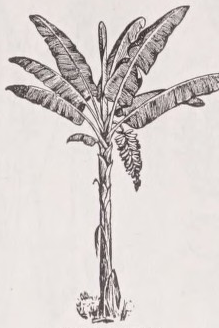
1. A species of the genus Musa, or plantain tree, and its fruit. It rises 15 or 20 feet high, with a soft stalk, marked with dark purple stripes and spots, with leaves six feet long, and a foot broad. The flowers grow in bunches, covered with a sheath of a fine purple color.
2. The fruit is four or five inches long, and an inch or more in diameter; the pulp soft and of a luscious taste. When ripe, it is eaten raw, or fried in slices. Bananas grow in large bunches weighing a dozen pounds or more. This tree is the native of tropical countries, and on many isles, constitutes an important article of food.
BANANA(Musa sapientum), a gigantic herbaceous plant belonging to the natural order Hfusaceoe, originally a native of the tropical parts of the East, but now cultivated in all tropical and sub-tropical climate3. It forms a spurious kind of stem, rising 15 or 20 feet by the sheathing bases of the leaves, the blades of which sometimes measure as much as 10 feet in length by 2 feet across. The stem bears several clusters of fruit, which somewhat resemble cucumbers in size and form; it dies down after maturing the fruit. The weight of the produce of a single cluster is sometimes as much as 80 ft>, and it was calculated by Humboldt that the productiveness of the banana as compared with wheat is as 133 to 1, and as against potatoes 44 to 1. The varieties of banana cultivated in the tropics are as numerous as the varieties of apples in temperate regions, and the best authorities now agree that no specific difference exists between it and the plantain. The fruit is extensively used as food; and in many of the Pacific islands it is the staple on which the natives depend. In its immature condition it contains much starch, which on ripening changes into sugar; and as a ripe fruit it has a sweet but somewhat flavourless taste. From the unripe fruit, dried in the sun, a useful and nutritious flour is prepared. The following represents the percentage composition of the pulp of the ripe fruit :—Nitrogenous matter, 4'820; sugar, pectin, &c., 19'657; fatty matter, 0'632; cellulose, 0'200; saline matter, 0'791; water, 73'900. An analysis of the flour by Dr Murray Thomson yielded the following results :—Water, 12'33; starch, 7Γ60; gum and sugar, 6'82; nitrogenous matter, 2'01; cellulose, 5'99; oil, 0'50; salts, 0∙64....
' BANAT, a district in the south-east of Hungary, consisting of the three counties of Thorontai, Temeswar, and Krasso i which has strangely acquired this title, though it was never governed by a “ban.” It is bounded by the Theiss, the Maros, and the Danube, forming almost a regular parallelogram. The soil is in many parts a remarkably rich alluvial deposit. Under the Turkish yoke it was allowed to lie almost desolate in marsh and heath and forest; but Joseph II. determined to render it, if possible, a populous and prosperous district. He accordingly offered land, at a very low rate, to all who were willing to settle within its borders. Germans, Greeks, Turks, Servians, Italians, and Frenchmenresponded to his call, and soon developed the agricultural resources of the region. Canals were formed at great expense of labour; marshes and forests were cleared; and now the Banat is one of the most highly cultivated parts of the Austrian empire. Wheat, barley, oats, rye, rice, maize, flax, hemp, rape, sun-flowers, tobacco, grapes, and, in short, nearly all the productions of Europe, are successfully raised. The climate in summer is very like that of Italy, and in winter is milder than in other parts of Hungary. Nor is it any longer unhealthy, though, in 1777, Born spoke of it with horror as a realm of death, and the account given of it in 1802 by Dr Samuel Clarke was not much better. The scenery is extremely diversified, from the plains of Thorontai to the snowy mountains of Krasso. The mineral wealth is considerable, including copper, tin, lead, zinc, iron, and especially coal. Among its numerous mineral springs the most important are those of Menadia, which were known to the Romans as Thermae, Herculis. Not only there but in other parts of the Banat numerous remains of the Roman occupation still exist. The various origin of its inhabitants may still be easily traced,—the separate settlements having kept remarkably distinct, and in many cases preserving their native languages and customs. The chief town is Temeswar, and other places of importance are Lugos, Kikinda, Becskereh, and Werschitz. Population about 1,500,000.
See Griselini, Versuch einer Gesch. des Temeswar Banats, Vienna, 1785; Hietzinger, Versuch einer Statistik der Militärgrenze des Oesterreich. Kaiserth., Vienna, 1781; Böhm, Geschichte des Temeswar Banats, Leipsic, 1861; Paget, Hungary, 1855.
9th ed. Encyclopædia Britannica, vol. 3, p. 307 [701 words — estimated reading time: 5 minutes]
BANBRIDGE, a town of Ireland, county of Down, on the Bann, 23 miles S.W. of Belfast, standing on the summit of an eminence. To facilitate access, a central carriageway, 200 yards long, has been cut through the main street to a depth of 15 feet, the opposite terraces being connected by a bridge. Banbridge is a neat town, with a handsome church, several chapels, a market-house (built in 1831), and a court-house. It is the principal seat of the linen trade in the county, and has extensive cloth and thread factories, bleachfields, and chemical works. Population in 1871, 5600.
9th ed. Encyclopædia Britannica, vol. 3, p. 308 [102 words — estimated reading time: 1 minute]
BANBURY, a market-town, municipaland parliamentary borough, and railway junction, in the county of Oxford, 71 miles from London, and a little to the west of the River Cherwell and the Oxford and Birmingham canal. It is well built, and has two or three foundries, several breweries, and some other manufactures, but is chiefly dependent on the neighbouring villages which send their agricultural produce to its market. It was formerly famous for its cheese, and gives its name to a kind of cake of considerable repute. Its ancient cross, now destroyed, is celebrated in the well-known nurseryrhyme. During the 17th century the inhabitants of Banbury seem to have been zealousPuritans, and are frequently satirized by contemporary dramatists (Chambers’s Book of Days, vol. ii. p. 316). At a somewhat earlier period the grammar school, which is now defunct, was of such repute as to be chosen as the model for the constitution of the school of St Paul’s. A school of science was erected in 1861. Banbury returns one member to parliament, and the borough (which is partly in Northamptonshire) had, in 1872, a population of 11,726, of whom 4122 were in the town.
9th ed. Encyclopædia Britannica, vol. 3, p. 308 [199 words — estimated reading time: 2 minutes]
BANC A, Banka, or Bangka, an island off the east coast of Sumatra, and separated from it by the Strait of Banca, lies between lat. 1° 30' and 3° 7' S., and long. 105° 9' and 106° 54' E. It varies from 8 to 20 miles in breadth, and has an area of 5000 English square miles. Its mines of tin, which were discovered in 1710, are remarkably productive, and in 1872 yielded no less than 68,148 piculs, the average yield during the previous ten years being 73,961 piculs. The washing is almost wholly carried on by Chinese, and a large part of the metal finds its way to their country. Iron, copper, lead, silver, and arsenic, are also found in the island. The soil is generally dry and stony, and the greater part of the surface is covered with forests, in which the logwood tree especially abounds. Its mountains, which scarcely exceed 2000 feet in height, are covered with vegetation to their summits. They are of granitic formation, containing felspar, quartz, mica, and tourmaline. Population, 54,339, including 17,070 Chinese, 37,070 natives, 116 Europeans, and 56 Arabs. Muntak, the capital, has upwards of 3000 inhabitants. “The houses, which mostly belong to Chinamen, are neatly built and well painted; the streets are kept in good repair, and the whole place has an air of enterprise and thrift” (vide Bickmore’s Bast Indian Archip., 1868). There are several other forts on the island. It belongs to the Dutch, who derive from it upwards of 3,000,000 guilders, or £250,000, of annual income, after the expenses of the administration are paid.
9th ed. Encyclopædia Britannica, vol. 3, p. 308 [275 words — estimated reading time: 2 minutes]
BANCROFT, Richard, Archbishop of Canterbury in the reign of James I., distinguished as an inflexible opponent of Puritanism, was born at Farnworth in Lancashire in 1544. He was educated at Cambridge University, studying first at Christ’s College, and afterwards at Jesus College. He took his degree of B.A. in 1567, and that of M.A. in 1570. Ordained about that time, he was named chaplain to Dr Cox, then bishop of Ely, and in 1575 was presented to the rectory of Teversham in Cambridgeshire. The next year he was one of the preachers to the university, and in 1584 was presented to the rectory of St Andrew’s, Holborn. His unquestionable abilities, and his zeal as a champion of the church in those unsettled times, secured him rapid promotion, and at length the highest ecclesiastical position in the land. He graduated B.D. in 1580, and D.D. five years later. In 1585 he was appointed treasurer of St Paul’s Cathedral, London. On February 9, 1589, he preached at Paul’s Cross a sermon on 1 John iv. 1, the substance of which was a passionate attack on the Puritans. He described their speeches and proceedings, caricatured their motives, denounced the exercise of the right of private judgment, and set forth the divine right of bishops in such strong language that one of the queen’s councillors held it to amount to a threat against the supremacy of the Crown. Sixteen days after the publication of this ecclesiastical manifesto, Bancroft was made a prebendary of St Paul’s. Within a few years he was advanced to the same dignity in the collegiate church of Westminster, and in the cathedral church of Canterbury. He was chaplain successively to Lord Chancellor Hatton and Archbishop Whitgift. In May 1597 he was consecrated bishop of London; and from this time, in consequence of ...the age and incapacity for business of Archbishop Whitgift, he was virtually invested with the power of primate, and had the sole management of ecclesiastical affairs. Among the more noteworthy cases which fell under his direction were the proceedings against Martin Mar-Prelate, Cartwright and his friends, and the pious Penry, whose “seditious writings” he caused to be intercepted and given upto the Lord Keeper. In 1600 he was sent on an embassy, with others, to Embden, for the purpose of settling certain matters in dispute between the English and the Danes. This mission, however, failed. Bishop Bancroft was present· at the death of Queen Elizabeth. He took a prominent part in the famous conference of the prelates and the Presbyterian divines held at Hampton Court in 1604. By the king’s desire he undertook the vindication of the practices of confirmation, absolution, private baptism, and lay excommunication; he urged, but in vain, the re-inforcement of an ancient canon, “that schismatics are not to be heard against bishops;” and in opposition to the Puritans’ demand of certain alterations in doctrine and discipline, he besought the king that care might be taken for a praying clergy; and that, till men of learning and sufficiency could be found, godly homilies might be read and their number increased. In the capacity of a commissioner for ecclesiastical causes (1603), he advocated severe measures for the suppression of “heresy and schism,” treating books against Episcopacy as acts of sedition, and persecuting their authors as enemies of the state. In March 1604, Bancroft, in consequence of the death of the primate, was appointed by royal writ president of Convocation then assembled; and he there presented for adoption a book of canons collected by himself. In the following November he was elected successor to Whit gift in the see of Canterbury. He had now but six years of life before him. He continued to show the same zeal and βeverity as before, and with so much success that Lord Clarendon, writing in his praise, expressed the opinion that “if Bancroft had lived, he would quickly have extinguished all that fire in England which had been kindled at Geneva.” In 1605 he was sworn a member of the Privy Council. The same year he engaged in a contest with the judges, and exhibited articles of complaint against them before the lords of the council; but these complaints were overruled. He enforced discipline and exact conformity within the church with an iron hand; and forty-nine ministers of the church were deprived of their livings for disobedience to hi3 injunctions. In 1608 he was chosen chancellor of the University of Oxford. One of his latest public acts was a proposal laid before the parliament for improving the revenues of the church. In the last few months of his life he took part in the discussion about the consecration of certain Scottish bishops, and it was in pursuance of his advice that they were consecrated by several bishops of the English Church. By this act were laid the foundations of the Scottish Episcopal Church. Archbishop Bancroft was “the chief overseer” of the authorised version of the Bible, published within a year of his death. He died at Lambeth Palace, November 2,1610. His literary remains are very few and unimportant.
9th ed. Encyclopædia Britannica, vol. 3, p. 308 [863 words — estimated reading time: 5 minutes]
1. A fillet; a cord; a tie; a chain; any narrow ligament with which a thing is bound, tied or fastened, or by which a number of things are confined together.
2. In architecture, any flat low member of molding, broad but not deep, called also fascia, face or plinth.
3. Figuratively, any chain; any means of restraint; that which draws or confines.
4. Means of union or connection between persons; as, Hymen's bands.
11. The band of pensioners in England, is a company of 120 gentlemen, who receive a yearly allowance of f100st., for attending the king on solemn occasions.
12. The bands of a saddle are two pieces of iron nailed upon the bows, to hold them in their proper situation.
1. A fillet, strap, or any narrow ligament with which a thing is encircled, or fastened, or by which a number of things are tied, bound together, or confined; a fetter.
2. A continuous tablet, stripe, or series of ornaments, as of carved foliage, of color, or of brickwork, etc.
3. In Gothic architecture, the molding, or suite of moldings, which encircles the pillars and small shafts.
4. That which serves as the means of union or connection between persons; a tie.
5. A linen collar or ruff worn in the 16th and 17th centuries.
6. Two strips of linen hanging from the neck in front as part of a clerical, legal, or academic dress.
7. A narrow strip of cloth or other material on any article of dress, to bind, strengthen, ornament, or complete it.
8. A company of persons united in any common design, especially a body of armed men.
9. A number of musicians who play together upon portable musical instruments, especially those making a loud sound, as certain wind instruments (trumpets, clarinets, etc.), and drums, or cymbals.
10. A space between elevated lines or ribs, as of the fruits of umbelliferous plants.
11. A stripe, streak, or other mark transverse to the axis of the body.
BANDA ISLANDS, a group in the East Indian Archipelago, lying to the S. of Ceram, in lat. 4° 30' S. and long. 129° 50' E. They are ten or twelve in number, and have an area of about 7150 square miles. Their volcanic origin is distinctly marked. Banda Lantoir, which derives its name from the lontar or Palmyra palm, is the largest of the group. From the sea this island appears lofty,— its sides being steep, and crowned by a sort of table-land which extends nearly from one end to the other. The whole is one continuous forest of nutmeg and Canari trees, the latter being planted to screen the former from the wind. The unhealthiness of Lantoir has prevented it from becoming the seat of government, for which in other respects it would naturally be chosen. The village of Selam contains the ruins of the chief Portuguese settlement. A considerable fort, called Hollandia, commands the harbour. Banda Neira lies S.∙ of Lantoir. It is the seat of the Dutch resident, whose jurisdiction extends not only over the Banda Islands, but also over a part of Ceram and several other small groups. Fort Nassau, which was built in 1609, is the chief defence of the islands; and to the right and left of it extends the village of Neira. Gunong Api is to the north of Neira, and derives its name—Fire Mountain— from its large cone-shaped volcano, which rises 2320 feet above the level of the sea, and is constantly emitting smoke. The peak was ascended by Professor Rein ward t in 1821, by Μ. S. Müller in 1828, and in 1865 by Mr Bickmore, who has given an interesting account of the adventure. Eruptions took place in 1586, 1598, 1609, 1615, 1632, 1690, 1696, 1712, 1765, 1775, 1778, 1820, 1824; and earthquakes without eruptions occurred in 1629, 1683, 1710, 1767, 1816, and 1852. On the last ...occasion the sea swept up in an enormous wave over Fort Nassau. Pulo Way—The Water Island—lies north of Neira. It is about 400 or 500 feet high, consists of coral rock, and is esteemed the healthiest of the group. Pulo Rond or Roon—the Chamber Island—is about four miles further N., and was at one time the seat of an English “factory.” Rosyngain, about seven miles S.E. of Lantoir, is likely to become of some importance for its gold-mines. It was formerly a convict station for Amboyna. Pulo Pisang—Banana Island—two miles N.E. of Neira, produces fine fruits. The other islands Craka, Capella, Sonangy, &c., are uninhabited. In the space between Banda Lantoir and the islands of Banda Neira and Gunong Api there is a very good harbour, formed with entrances both from the E. and W., which enable vessels to enter it from either of the monsoons. These channels are well defended with several batteries, particularly the western one, which is very narrow. Between Gunong Api and Banda Neira there is a third channel into this harbour from the N., but it is navigable for small vessels only. The principal articles of commerce in the Banda group are nutmegs and mace. The native population having been cleared off by the Dutch, the plantations were worked by slaves and convicts till the emancipation of 1860. The introduction of Malay and Chinese labourers has since taken place. The plantations or perken can neither be sold nor divided. About 700,000 ft or upwards of nutmegs are obtained in a year, with a proportionate quantity of mace. The imports are provisions, cloth, and iron-ware from Batavia, and various native productions from the Aru Islands, Ceram, &c.
The Banda Islands were discovered and annexed by the Portuguese Abreus about 1511; but in the beginning of the 17th century his countrymen were expelled by the Dutch. In 1608 the English built a factory on Pulo Way, which was demolished by the Dutch as soon as the English vessel left. Shortly after, however, Banda Neira and Lantoir were resigned by the natives to the English, and in 1620 Pulo Roon aud Pulo Way were added to their dominions; but, in spite of treaties into which they had entered, the Dutch attacked and expelled their British rivals. In 1654 they were compelled by Cromwell to restore Pulo Roon, and to make satisfaction for the massacre of Amboyna; but the English settlers not being adequately supported from home, the island was retaken by the Dutch in 1664. They retained undisturbed possession of their conquests in this quarter of the globe until the year 1796, when the Banda Islands, along with all the other Dutch colonies, were conquered by the British. They were restored by the treaty of Amiens in the year 1800, again captured, and finally restored by the treaty of Paris concluded in 1814. In the Presidency of Banda there are 111,194 inhabitants of whom 6000 belong to Neira.
See Wallace's Malay Archipelago; Bickmore’s Indian Archipelago; Linden’s Banda en Zijnc bcwoners, 1873; Trans, of Lueth Geog. Soc., 1874.
9th ed. Encyclopædia Britannica, vol. 3, p. 309 [844 words — estimated reading time: 5 minutes]
1. A fillet, roller, or swath, used in dressing and binding up wounds, restraining hemorrhages, and joining fractured and dislocated bones. Sometimes, the act or practice of applying bandages.
2. Something resembling a bandage; that which is bound over another
N. five, cinque, quint, quincux, six, half-a-dozen, half dozen, seven, eight, nine, three times three, dicker, ten, decade, eleven, twelve, dozen, thirteen, long dozen, baker's dozen, quintuplet, twenty, score, twenty-four, four and twenty, two dozen, twenty- five, five and twenty, quarter of a hundred, forty, two score, fifty, half a hundred, sixty, three score, seventy, three score and ten, eighty, four score, ninety, fourscore and ten, sestiad, hundred, centenary, hecatomb, century, hundredweight, cwt, one hundred and forty-four, gross, thousand, chiliad, millennium, thousand years, grand, myriad, ten thousand, ban, man, ten thousand years, banzai, lac, one hundred thousand, plum, million, thousand million, milliard, billion, trillion &c
V.prohibit, inhibit, forbid, put one's veto upon, disallow, enjoin, ban, outlaw, taboo, proscribe, estop, bar, debar, forefend, keep in, keep within bounds, restrain, cohibit, withhold, limit, circumscribe, clip the wings of, restrict, interdict, taboo, put under an interdiction, place under an interdiction, put under the ban, place under the ban, proscribe, exclude, shut out, shut the door, bolt the door, show the door, warn off, dash the cup from one's lips, forbid the banns
Int. forbid it heaven, &c. (deprecation) 766, hands off, keep off, hold, stop, desist, cease and desist, avast, phr, that will never do, don't you dare, forget it, don't even think about doing it, "go ahead; make my day "
Int. woe to, beshrew, ruat coelum, ill betide, woe betide, confusion seize, damn, damn it, damn you, damn you to hell, go to hell, go to blazes, confound, blast, curse, devil take, hang, out with, a plague upon, out upon, aroynt, honi soit, parbleu, phr, delenda est carthago
I am not worthy of the least of all the mercies, and of all the truth, which thou hast shewed unto thy servant; for with my staff I passed over this Jordan; and now I am become two bands.
I am unworthy of all the kindness and faithfulness You have shown Your servant. Indeed, with only my staff I came across the Jordan, but now I have become two camps.
And, behold, seven other kine came up after them out of the river, ill favoured and leanfleshed; and stood by the other kine upon the brink of the river.
After them, seven other cows, sickly and thin, came up from the Nile and stood beside the well-fed cows on the bank of the river.
And when she could not longer hide him, she took for him an ark of bulrushes, and daubed it with slime and with pitch, and put the child therein; and she laid it in the flags by the river’s brink.
But when she could no longer hide him, she got him a papyrusbasket and coated it with tar and pitch. Then she placed the child in the basket and set it among the reeds along the bank of the Nile.
Get thee unto Pharaoh in the morning; lo, he goeth out unto the water; and thou shalt stand by the river’s brink against he come; and the rod which was turned to a serpent shalt thou take in thine hand.
Go to Pharaoh in the morning as you see him walking out to the water. Wait on the bank of the Nile to meet him, and take in your hand the staff that was changed into a snake.
And likewise for the north side in length there shall be hangings of an hundred cubits long, and his twenty pillars and their twenty sockets of brass; the hooks of the pillars and their fillets of silver.
Likewise there are to be curtains on the north side, a hundred cubits long, with twenty posts and twenty bronze bases, and with silver hooks and bands on the posts.
And for the north side the hangings were an hundred cubits, their pillars were twenty, and their sockets of brass twenty; the hooks of the pillars and their fillets of silver.
The north side was also a hundred cubits long, with twenty posts and twenty bronze bases. The hooks and bands of the posts were silver.
And the sockets for the pillars were of brass; the hooks of the pillars and their fillets of silver; and the overlaying of their chapiters of silver; and all the pillars of the court were filleted with silver.
The bases for the posts were bronze, the hooks and bands were silver, and the plating for the tops of the posts was silver. So all the posts of the courtyard were banded with silver.
And their pillars were four, and their sockets of brass four; their hooks of silver, and the overlaying of their chapiters and their fillets of silver.
with four posts and four bronze bases. Their hooks were silver, as well as the bands and the plating of their tops.
And there was an hole in the midst of the robe, as the hole of an habergeon, with a band round about the hole, that it should not rend.
with an opening in the center of the robe like that of a garment, with a collar around the opening so that it would not tear.
This site uses cookies to remember your display preferences (search sources and editions, Bible version, auto-link, images, light/dark theme). No personal data whatsoever is collected. Privacy Policy