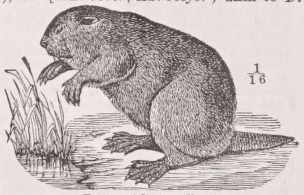
1. An amphibiousquadruped, of the genus Castor. It has short ears, a blunt nose, small fore feet, large hind feet, with a flat ovate tail. It is remarkable for its ingenuity in construction its lodges or habitations, and from this animal is obtained the castor of the shops, which is taken from cods or bags in the groin. Its fur, which is mostly of a chestnut brown, is the material of the best hats.
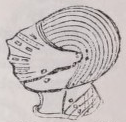
2. The fur of the beaver and a hat made of the fur; also, a part of a helmet that covers the face.
3. A hat, formerly made of the fur of the beaver, but now usually of silk.
4. Beaver cloth, a heavy felted woolen cloth, used chiefly for making overcoats.
5. That piece of armor which protected the lower part of the face, whether forming a part of the helmet or fixed to the breastplate. It was so constructed (with joints or otherwise) that the wearer could raise or lower it to eat and drink.
BEAVER, the English name of a genus of Mammals belonging to the order Rodentia, the two known species of which are among the largest members of that group. Both beavers, European and American, measure about 2 feet in length, exclusive of the tail, which is about 10 inches long, and are covered with the fur to which they owe their chief commercial value. This consists of two kinds of hair,— the one close-set, silky, and of a greyish colour; the other much coarser and longer, and of a reddish brown. Beavers are essentially aquatic in their habits, never travelling by land unless driven to it by necessity. Their hind feet are webbed to the nails, and in swimming those only are used, the front legs remaining motionless by the side. They differ from all other rodents in possessing a broad horizontally flattened tail, somewhat oval in form and covered with scales, which they use as an aid to their progress through the water, and not as a trowel for plastering their mud houses as was formerly supposed. The front incisor teeth in each jaw have a sharp chisel-like edge, and are so formed as to preserve this through life. They consist of an outer layer of orange-coloured enamel, and a broad inner layer of a softer substance. As the creature gnaws, the softer material is worn away more rapidly than the enamel, which thus protrudes in a sharp ridge. There is a continuous growth at the roots of those teeth to repair the constant waste that goes on at the cutting edge, so that should one of the incisors be destroyed, the opposite tooth, meeting with no check to its enlargement, will grow to an enormous length; and beavers have been found in which this abnormal growth had proved fatal by preventing the other teeth from coming together. The enamel is exceedingly hard; and, until ...superseded by English files, those teeth, fixed in wooden handles, were used by the North American Indians in carving their weapons of bone. The question whether the American and European beavers are the same or different species, has given rise to some controversy; but it is now generally conceded, chiefly on anatomical grounds, that they are distinct, although in outward appearance they are almost identical.
The European Beaver {Castorfiber) was at one time an inhabitant of the British Isles, having been found, according to Pennant, in certain Welsh rivers as late as the 12th century, while fossil remains of it occur in various parts of the country. In Scandinavia beavers are now extinct,—the last known specimen having been killed in 1844. Isolated pairs are still occasionally met with on the banks of the Rhone, the Weser, and the Elbe; and a considerable number are to be found in one of the parks belonging to the emperor of Austria, on the banks of the Danube, where they are strictly preserved. They also occur, though sparingly, in Russia and Poland, in the streams of the Ural Mountains, and in those which flow into the Caspian Sea. They are said to live in burrows on the banks of rivers, like the common water rat, and to show little of the architectural instinct so conspicuous in the American species; this, however, is probably more owing to unfavourable external conditions than to want of the faculty, for there is at least one well-authenticated instance of a colony of beavers, on a small stream near Magdeburg, whose habitations and dam were exactly similar to those found in America.
The American Beaver {Castor canadensis) extends over that part of the American continent included between the Arctic circle and the tropic of Cancer; owing, however, to the gradual spread of population over part of this area, and still more to the enormous quantity of skins that, towards the end of last century and the beginning øf the present, were exported to Europe, numbering about 200,000 annually, this species was in imminent danger of extirpation. More recently the employment of silk and of the fur of the South American Coypu in the manufacture of hats, so lessened the demand for beaver skins that the trapping of these animals became unprofitable; and being thus little sought after for many years, they have again become abundant in such of their old haunts as have not yet been occupied by man, so that the trade in beaver skins has now nearly attained its former proportions. Solitary beavers, always males, and known as “old bachelors,” or idlers, are found inhabiting burrows similar to those seen in Europe. These are generally found in the neighbourhood of new townships, and are supposed to be individuals that have remained after the colony had broken up, or that from some cause or another have been expelled from the society of their fellows. The American Beaver, however, is essentially social, inhabiting lakes, ponds, and rivers, as well as those narrow creeks which connect the lakes together. They generally, however, prefer flowing waters, probably on account of the advantages afforded by the current for transporting the materials of their dwellings. They also prefer deepish water, no doubt because it yields a better protection from the frost. When they build in small creeks or rivers, the waters of which are liable to dry or to be drained off, instinct leads them to the formation of dams. These differ in shape according to the nature of particular localities. Where the water has little motion the dam is almost straight; where the current is considerable it is curved, with its convexity towards the stream. The materials made use of are drift wood, green willows, birch, and poplars; also mud and stones intermixed in such a manner as must evidently contribute to the strength of the dam; but there is no particular method observed, except that the work is carried on with a regular sweep, and that all the parts are made of equal strength. “In places,” says Hearne, “which have been long frequented by beavers undisturbed, their dams, by frequent repairing, become a solid bank, capable of resisting a great force both of ice and water; and as the willow, poplar, and birch generally take root and shoot up, they by degrees form a kind of regular planted hedge, which I have seen in some places so tall that birds have built their nests among the branches.” Their houses are formed of the same materials as the dams, with little order or regularity of structure, and seldom contain more than four old, and six or eight young beavers. It not unfrequently happens that some of the larger houses have one or more partitions, but these are only posts of the main building left by the sagacity of the builders to support the roof, for the apartments, as some call them, have usually no communication with each other except by water. The beavers carry the mud and stones with their fore-paws, and the timber between their teeth. They always work in the night, and with great expedition. They cover their houses late every autumn with fresh mud, which freezing when the frost sets in, becomes almost as hard as stone, and thus neither wolves nor wolverines can disturb their well-earnedrepose.
The favourite food of the American Beaver is the plant called √V^ uphar luteum, which bears a resemblance to a cabbagestalk, and grows at the bottom of lakes and rivers. They also gnaw the bark of birch, poplar, and willow trees. But during the bright summer days which clothe even the far northern regions with a luxuriant vegetation, a more varied herbage, with the addition of berries, is consumed. When the ice breaks up in spring they always leave their embankments, and rove about until a little before the fall of the leaf, when they return again to their old habitations, and lay in their winter stock of wood. They seldom begin to repair the houses till the frost sets in, and never finish the outer coating till the cold becomes pretty severe. When they erect a new habitation they fell the wood early in summer, but seldom begin building till towards the end of August.
The flesh of the American Beaver is usually eaten by the Indians and the Canadian voyageurs; and when roasted in the skin it is esteemed a delicacy. It is said to taste like pork. The castoreum, of the beaver is a substance contained in two pyriform sacs, situated near the organs of reproduction, of a bitter taste, and slightly foetid odour, at one time largely employed as a medicine for derangement of the nervous system, as hysteria, &c., but now little used. Fossil remains of both beavers are found in the Tertiary beds of the continents still inhabited by them, accompanied in each case by remains of an extinct species. The latter appear from their remains to have been much larger than those now existing.
9th ed. Encyclopædia Britannica, vol. 3, p. 475 [1,494 words — estimated reading time: 9 minutes]
This site uses cookies to remember your display preferences (search sources and editions, Bible version, auto-link, images, light/dark theme). No personal data whatsoever is collected. Privacy Policy