
1. The oenas, or domestic pigeon, a species of Columba. Its color is a deep bluish ash color; the breast is dashed with a fine changeable green and purple; the sides of the neck, with a copper color. In a wild state, it builds its nest in holes of rocks or in hollow trees, but it is easily domesticated, and forms one of the luxuries of the table.
Word of the Day: Catachrestical
2. A word of endearment for one regarded as pure and gentle.
Dove
Encyclopedia Britannica
DOVE (Dutch, Dwjve; Danish, Due; Icelandic, Dufa; German, Taube), a name which seems to be most commonly applied to the smaller members of the group of birds by ornithologists usually called Pigeons (Columbae) ; but no sharp distinction can be drawn between Pigeons and Doves, and in general literature the two words are used almost indifferently, while no one species can be pointed out to which the word Dove, taken alone, seems to be absolutely proper. The largest of the group to which the name is applicable is perhaps the Ring-Dove, or Wood-Pigeon, also called in many parts of Britain Cushat and Queest (Columba palumbus, Linn.), a very common bird throughout these islands and most parts of Europe. It associates in winter in large flocks, the numbers of which (owing partly to the destruction of predacious animals, but still more to the modern system of agriculture, and the growth of plantations in many districts that were before treeless) have of late years increased enormously, so that their depredations are very serious. In former days, when the breadth of land in Britain under green crops was comparatively small, these birds found little food in the dead season, and this scarcity was a natural check on their superabundance. But since the extended cultivation of turnips and plants of similar use the case is altered, and perhaps at no time of the year has provender become more plentiful than in winter. The Ring-Dove may be easily distinguished from other European species by its larger size, and especially by the white spot on either side of its neck, forming a nearly continuous “ring,” whence the bird takes its name, and the large white patches in its wings, which are very conspicuous in flight. It breeds several times in the year, making for its nest a slight ...platform of sticks on the horizontal bough of a tree, and laying therein two eggs—which, as in all the Columbae, are white.
The Stock-Dove (C. aenas of most authors) is a smaller species, with many of the habits of the former, but breeding by preference in the stocks of hollow trees or in rabbitholes. It is darker in colour than the Ring-Dove, without any white on its neck or wings, and is much less common and more locally distributed.
The Rock-Dove (C. livia, Temm.) much resembles the Stock-Dove, but is of a lighter colour, with two black bars on its wings, and a white rump. In its wild state it haunts most of the rocky parts of the coast of Europe, from the Faeroes to the Cyclades, and, seldom going inland, is comparatively rare. Yet, as it is without contradiction the parent-stem of all our domestic Pigeons, its numbers must far exceed those of both the former put together. In Egypt and various parts of Asia it is represented by what Mr Darwin has called “Wild Races,” which are commonly accounted good “species” (C. schimperi, C. affinis, C. intermedia, C. leuconota, and so forth), though they differ from one another far less than do nearly all the domestic forms, of which more than 150 kinds that “breed true,” and have been separately named, are known to exist. Very many of these, if found wild, would have unquestionably been ranked by the best ornithologists as distinct “species,” and several of them would as undoubtedly have been placed in different genera. These various breeds arc classified by Mr Darwin in four groups as follows :—
Group I. composed of a single Race, that of the “Pouters,” having the gullet of great size, barely separated from the crop, and often inflated, the body and legs elongated, and a moderate bill. The most strongly marked subrace, the Improved English Pouter, is considered to be the most distinct of all domesticated pigeons.
Group II. includes three Races :—(1.) “Camers,” with along pointed hill, the eyes surrounded by much bare skin, and the neck and body much elongated; (2.) “Runts,” with a long, massive bill, and the body of great size; and (3.) “Barbs,” with a short, broad bill, much bare skin round the eyes, and the skin over the nostrils swollen. Of the first four and of the second five subraces are distinguished.
Group III. is confessedly artificial, and to it are assigned five Races :—(1.) “Fan-tails,” remarkable for the extraordinary development of their tails, which may consist of as many as forty-two rectrices in place of the ordinary twelve; (2.) “Turbits” and “Owls,” with the feathers of the throat diverging, and a short thick bill; (3.) “Tumblers,” possessing the marvellous habit of tumbling backwards during flight or, in some breeds, eyen on the ground, and having a short, conical bill; (4.) “Frill-backs,” in which the feathers are reversed; and (5.) “Jacobins,” with the feathers of the neck forming a hood, and the wings and tail long.
Group IV. greatly resembles the normal form, and comprises two Races :—(1.) Trumpeters,” with a tuft of feathers at the base of the neck curling forward, the face much feathered, and a very peculiar voice, and (2.) Pigeons scarcely differing in structure from the wild stock.
Besides these some three or four other little-known breeds exist, and the whole number of breeds and sub-breeds almost defies computation. The difference between them is in many cases far from being superficial, for Mr Darwin has shown that there is scarcely any part of the skeleton which is constant, and the modifications that have been effected in the proportions of the head and sternal apparatus are very remarkable. Yet the proof that all these different birds have descended from one common stock is nearly certain. Here there is no need to point out its bearing upon the “Theory of Natural Selection” which that eminent naturalist and Mr Wallace have rendered so well known. The antiquity of some of these breeds is not the least interesting part of the subject, nor is the use to which one at least of them has long been applied. The Dove from the earliest period in history has been associated with the idea of a messenger (Genesis viii. 8-12), and its employment in that capacity, developed successively by Greeks, Romans, Mussulmans, and Christians, has never been more fully made available than in our own day, as witness the “Pigeon-post” established during the recent siege of Paris.
Leaving, then, this interesting subject, space does not permit our here dwelling on various foreign species, which, if not truly belonging to the genus Columba, are barely separable therefrom. Of these examples may be found in the Indian, Ethiopian, and Neotropical Regions. Still less can we here enter upon the innumerable other forms, though they may be entitled to the name of “Dove,” which are to be found in almost every part of the world, and nowhere more abundantly than in the Australian Region. Mr Wallace (Ibis, 1865, pp. 365-400) considers that they attain their maximum development in the Papuan Subregion, where, though the land-area is less than one-sixth that of Europe, more than a quarter of all the species (some 300 in number) known to exist are found—owing, he suggests, to the absence of forest-haunting and fruit-eating Mammals.
It would, however, be impossible to conclude this article without noticing a small group of birds to which in some minds the name Dove will seem especially applicable. This is the group containing the Turtle-Doves—the time-honoured emblem of tenderness and conjugal love. The common Turtle-Dove of Europe (Turtur auritus) is one of those species which is gradually extending its area. In England, not much more than a century ago, it seems to have been chiefly, if not solely, known in the southern and western counties. Though in the character of a straggler only, it now reaches the extreme north of Scotland, and is perhaps nowhere more abundant than in many of the midland and eastern counties of England. On the continent the same thing has been observed, though indeed not so definitely; and this species has within the last twenty years or so appeared as a casual visitor within the Arctic Circle. The probable causes of its extension cannot here be discussed; and there is no need to dwell upon its graceful form and the delicate harmony of its modest colouring, for they are proverbial. The species is migratory, reaching Europe late in April and retiring in September. Another species, and one perhaps better known from being commonly kept in confinement, is that called by many the Collared or Barbary Dove (T. risorius) — the second English name probably indicating that it was by way of that country that it was brought to us, for it is not an African bird. This is distinguished by its cream-coloured plumage and black necklace. Some uncertainty seems to exist about its original home, but it is found from Constantinople to India, and is abundant in the Holy Land, though there a third species (T. senegalensis) also occurs, which Canon Tristram thinks is the Turtle-Dove of Scripture. (a. n.)
9th ed. Encyclopædia Britannica, vol. 7, p. 379
[1,521 words — estimated reading time: 9 minutes]
[1,521 words — estimated reading time: 9 minutes]
Dove
Watson's Biblical & Theological Dictionary
יונה. This beautiful genus of birds is very numerous in the east. In the wild state they generally build their nests in the holes or clefts of rocks, or in excavated trees; but they are easily taught submission and familiarity with mankind; and, when domesticated, build in structures erected for their accommodation, called “dove-cotes.” They are classed by Moses among the clean birds; and it appears from the sacred as well as other writers, that doves were always held in the highest estimation among the eastern nations. Rosenmuller, in a note upon Bochart, derives the name from the Arabic, where it signifies _mildness_, _gentleness_, &c. The dove is mentioned in Scripture as the symbol of simplicity, innocence, gentleness, and fidelity, Hosea vii, 11; Matt. x, 16. The following extract from Morier’s Persian Travels illustrates a passage in Isaiah: “In the environs of the city, to the westward, near the Zainderood, are many pigeon houses, erected at a distance from habitations, for the sole purpose of collecting pigeons’ dung for manure. They are large round towers, rather broader at the bottom than the top, and crowned by conical spiracles, through which the pigeons descend. Their interior resembles a honey-comb, pierced with a thousand holes, each of which forms a snug retreat for a nest. More care appears to have been bestowed upon their outside than upon that of the generality of the dwelling houses; for they are painted and ornamented. The extraordinary flights of pigeons which I have seen alight upon one of these buildings afford, perhaps, a good illustration for the passage in Isaiah lx, 8: ‘Who are these that fly as a cloud, and as the doves to their windows?’ Their great numbers, and the compactness of their mass, literally look like a cloud at ...a distance, and obscure the sun in their passage.” The first mention of the dove in the Scripture is Genesis viii, 8, 10–12, where Noah sent one from the ark to ascertain if the waters of the deluge had assuaged. She was sent forth thrice. The first time she speedily returned; having, in all probability, gone but a little way from the ark, as she must naturally be terrified at the appearance of the waters. After seven days, being sent out a second time, she returned with an olive leaf plucked off, whereby it became evident that the flood was considerably abated, and had sank below the tops of the trees; and thus relieved the fears and cheered the heart of Noah and his family. And hence the olive branch has ever been among the forerunners of peace, and chief of those emblems by which a happy state of renovation and restoration to prosperity has been signified to mankind. At the end of other seven days, the dove, being sent out a third time, returned no more; from which Noah conjectured that the earth was so far drained as to afford sustenance for the birds and fowls; and he therefore removed the covering of the ark, which probably gave liberty to many of the fowls to fly off; and these circumstances afforded him the greater facility for making arrangements for disembarking the other animals. Doves might be offered in sacrifice, when those who were poor could not bring a more costly offering.
Watson's Biblical & Theological Dictionary
[548 words — estimated reading time: 4 minutes]
[548 words — estimated reading time: 4 minutes]
Dove plant
Webster's Dictionary 1913
A Central American orchid (Peristeria elata), having a flower stem five or six feet high, with numerous globose white fragrant flowers. The column in the center of the flower resembles a dove; -- called also Holy Spirit plant.
1. A small annual species of Geranium, native in England; -- so called from the shape of the leaf.
2. The columbine.
A small building or box in which domestic pigeons breed.
A house or shelter for doves.
To unite by a tenon in form of a pigeons tail spread, let into a board or timber.
United by a tenon in form of a doves tail.
Uniting by a dove-tail.
A small house or box, raised to a considerable height above the ground, and having compartments, in which domestic pigeons breed; a dove house.
Dover
Encyclopedia Britannica
DOVER (the ancient Dubris), principal cinque port of England, is situated close to the South Foreland, 72 miles from Loudon, in a main valley of the chalk hills corresponding with the opposite cliffs between Calais and Boulogne. Its dominant object is the castle, on the east heights. Withiu its walls stands the Roman pharos; the Romano-British fortress church, remaining not only in situ, but (excepting roof) integrally in statu quo, forming a primitive Christian relic, unique in Christendom; some remains of the Saxon fort; and the massive keep and subsidiary defences of Norman building. These ancient works provide for a garrison of 758; but they are now covered by the superior site of Fort Burgoyne, a position of great strength for 221 men. The western heights, where is still the foundation of a consort Roman pharos, form a circuit of elaborate fortifications, with provision for 3010 troops. Between these, and stretching inland, lies the town, of which the following are the principal features. 1. The harbour, once at the eastern, is now at the western extremity,—its three considerable basins being fit for mail steamers and ordinary trading vessels. 2. The admiralty pier is a massive struc ture of solid concrete and masonry extending about one-third of a mile into the sea, affording lee and landing accommodation for vessels of almost any burthen, made for ultimate connection by break-water with a horn east of the castle, so inclosing the bay as a vast harbour. 3. The visitors’ quarter consists of ranges of good houses along the length of the seaboard and elsewhere, notably a fine elevation newly built on a western spur of the Castle Hill. 4. Of old Dover, within its walls and gates, but little remains, except a remnant of the Saxon collegiate church of the canons of ...St Martin, and the parish church of St Mary the Virgin—rebuilt and enlarged in 1843-44, but preserving the three bays of the Anglo-Saxon church, with its western narthex, on which had been superimposed the Norman tower, still presenting its rich front to the street. 5. A later Norman church stands under the Castle Hill, which has been partially restored, but its parochial status trans-ferrod to the new parish church of St James. There are two other modern churches—Holy Trinity and Christchurch, and, further up the valley, the parish church of Charlton (originally Norman)and Buckland (Early English), which, including the Castle Church, completes the former number of seven for the town. There are also 13 chapels of nonconformist worship, representing most denominations, and placed in various parts of the borough. 6. The remains of the once (12th century) splendid foundation of St Martin’s priory include the great gate, the house refectory with campanile, and the spacious strangers’ refectory, lately converted into the college school-room. 7. Just across the High Street stand the tower and truncated fabric of the noble hall of the hospital Maison Dieu, founded (13th century) for the reception of pilgrims of all nations, long used as a Crown victualling office, but latterly purchased by the corporation and adapted for a town hall, with prison cells as basements, and other prison buildings annexed, the former chapel of the society serving now as a court of sessions. 8. The ground work of a round (Holy Sepulchre) church of the Templars is on the opposite heights, approaching the citadel. 9. Among the centres of educational work are a proprietary college, occupying the site and remaining buildings of St Martin’s Priory, for a cheap but sound education of town boys, and for boarders in the masters’ houses, and also a strong array of national schools, worked up to a high mark, according to H. Μ. Inspectors’ rèports, and providing means for a good practical education of about 3400 children. In physical conditions the place is exceptionally healthy, the registrargeneral’s returns showing them in some years to be little below those of the Malvern Hills. The steep shore and open downs make it agreeable for bathing and summer resort; and it has constant sea-going interest from the Continental mail service, and the course of vessels up and down channel lying within two miles of the shore. Objects of interest within easy reach are—the S. Foreland electric light-houses; the (florid Norman) church of St Margaret’s; the Templars’ Manor, Ewell; St Radigund’s Abbey; the Preceptory of Knights of St John, Swingfield; rich Norman votive chapel, Barfreystone. There are two lines of railway to London—one traversing the Weald of Kent, the other following the old Roman road, via Canterbury and Rochester. Dover returns 2 members to Parliament, and is governed by a mayor, 6 aidermen, and 18 councillors. The area of the borough is 1262 acres. Population (1871), 28,590.
DOVER, a city of the United States, capital of Strafford county, New Hampshire, situated on the Cocheco, a tributary of the Piscataqua, at a railway junction twelve miles north-west of Portsmouth. It has eight churches, a high school, a city hall, and a public library; and the water-power furnished by the falls of the Cocheco encourages its industrial activity, the principal results of which are prints and other cotton goods to the value of upwards of £200,000 annually, woollens, leather, boots and shoes, hats, oil-cloth, sand-paper, iron and brass wares, and carriages. The town was founded in 1623, and received its city charter in 1855. Population in 1870, 9294.
DOVER, a town of the United States, the capital of Delaware, on Jones Creek, 9 miles inland from Delaware Bay, and 48 miles south of Wilmington. It is a regular brick-built place, with broad, well-shaded streets, has a State house, a court-house, six churches, an academy, and several other public buildings, and carries on a brisk trade in preserved fruits. Population in 1870, 1906, of whom 501 were people of colour.
DOVER, George James Welbore Agar Ellis, Baron (1797-1833), born on the 14th January 1797, was the eldest son of the second Viscount CHfden. He was educated at Christ Church, Oxford, and in 1818 he was* returned to Parliament as member for Heytesbury. He afterwards represented Seaford (1820), Ludgershall (1826), and Oakhampton (1830). In party politics he took little interest; but he was a zealous and enlightened advocate in Parliament and elsewhere of state encouragement being given to the cause of literature and the fine arts. In 1824 he was the leading promoter of the grant of £57,000 for the purchase of Mr Angerstein’s collection of pictures, which formed the foundation of the National Gallery. On the formation of Lord Grey’s administration, in November 1830, he was appointed chief commissioner of woods and forests. The post was one for which his tastes well fitted him, but he was compelled by delicate health to resign it after two months’ occupancy. In June 1831, during the lifetime of his father, he was raised to the House of Lords under the title of Baron Dover. His services to the cause of learning and the fine arts, as well as his own distinction as an author, led in 1832 to his election to the presidency of the Royal Society of Literature. He died on the 10th July 1833. Lord Dover’s literary works were chiefly historical, and included The True History of the Iron Mask, extracted from, Documents in the French Archives (1826), Historical Inquiries respecting the Character of Clarendon (1827), and a Life of Frederick the Great (1831). He also edited the Ellis Correspondence and Walpole's Letters to Sir Horace Mann. He left in manuscript a volume written for the instruction of his son, which was published posthumously under the title Lives of the Most Eminent Sovereigns of Modern Europe. A fourth edition of this work appeared in 1853.
9th ed. Encyclopædia Britannica, vol. 7, p. 380
[803 words — estimated reading time: 5 minutes]
[803 words — estimated reading time: 5 minutes]
Dover's powder
Webster's Dictionary 1913
A powder of ipecac and opium, compounded, in the United States, with sugar of milk, but in England (as formerly in the United States) with sulphate of potash, and in France (as in Dr. Dover's original prescription) with nitrate and sulphate of potash and licorice. It is an anodyne diaphoretic.
A plant, a species of Geranium.
A flaring tenon, or tongue (shaped like a bird's tail spread), and a mortise, or socket, into which it fits tightly, making an interlocking joint between two pieces which resists pulling a part in all directions except one.
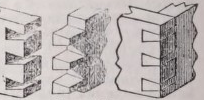
1. To cut to a dovetail.
2. To join by means of dovetails.
3. To fit in or connect strongly, skillfully, or nicely; to fit ingeniously or complexly.
of Dovetail
Peace Roget’s Thesaurus §721
N. peace, amity, harmony &c. # (concord) 714, tranquility, calm, truce, peace treaty, accord, peace pipe, pipe of peace, calumet of peace, piping time of peace, quiet life, neutrality, dove of peace, white dove, dove, pax romana, pax americana
V. be at peace, keep the peace, make peace
Phr. the storm blown over, the lion lies down with the lamb, "all quiet on the potomac", paritur pax bello, "peace hath her victories no less renowned than war", "they make a desert and they call it peace"
Innocence Roget’s Thesaurus §946
N. innocence, guiltlessness, # incorruption, impeccability, clean hands, clear conscience, mens sibi conscia recti, innocent, lamb, dove
Adj. innocent, not guilty, unguilty, guiltless, faultless, sinless, stainless, bloodless, spotless, clear, immaculate, rectus in curia, unspotted, unblemished, unerring, undefiled, unhardened, saturnian, arcadian, inculpable, unculpable, unblamed, unblamable, blameless, unfallen, inerrable, above suspicion, irreproachable, irreprovable, irreprehensible, unexceptionable, unobjectionable, unimpeachable, salvable, venial, harmless, inoffensive, innoxious, innocuous, dove-like, lamb- like, pure, harmless as doves, innocent as a lamb, innocent as the babe unborn, "more sinned against than sinning", virtuous, unreproved, unimpeached, unreproached
Adv. innocently, with clean hands, with a clear conscience, with a safe conscience
Phr. murus aeneus conscientia sana
King James Bible KJV Bible
Berean Standard Bible BSB Bible
32 KJV and 32 BSB verses contain “DOVE” — showing the first 20. Show all 33 verses (searchable)
But the dove found no rest for the sole of her foot, and she returned unto him into the ark, for the waters were on the face of the whole earth: then he put forth his hand, and took her, and pulled her in unto him into the ark.
But the dove found no place to rest her foot, and she returned to him in the ark, because the waters were still covering the surface of all the earth. So he reached out his hand and brought her back inside the ark.
And he stayed yet other seven days; and again he sent forth the dove out of the ark;
Noah waited seven more days and again sent out the dove from the ark.
And he stayed yet other seven days; and sent forth the dove; which returned not again unto him any more.
And Noah waited seven more days and sent out the dove again, but this time she did not return to him.
And I said, Oh that I had wings like a dove! for then would I fly away, and be at rest.
I said, “Oh, that I had wings like a dove! I would fly away and find rest.
Though ye have lien among the pots, yet shall ye be as the wings of a dove covered with silver, and her feathers with yellow gold.
Though you lie down among the sheepfolds, the wings of the dove are covered with silver, and her feathers with shimmering gold.”
O deliver not the soul of thy turtledove unto the multitude of the wicked: forget not the congregation of thy poor for ever.
Behold, thou art fair, my love; behold, thou art fair; thou hast doves’ eyes.
How beautiful you are, my darling! Oh, how very beautiful! Your eyes are like doves.
O my dove, that art in the clefts of the rock, in the secret places of the stairs, let me see thy countenance, let me hear thy voice; for sweet is thy voice, and thy countenance is comely.
O my dove in the clefts of the rock, in the crevices of the cliff, let me see your face, let me hear your voice; for your voice is sweet, and your countenance is lovely.
Behold, thou art fair, my love; behold, thou art fair; thou hast doves’ eyes within thy locks: thy hair is as a flock of goats, that appear from mount Gilead.
His eyes are as the eyes of doves by the rivers of waters, washed with milk, and fitly set.
His eyes are like doves beside the streams of water, bathed in milk and mounted like jewels.
My dove, my undefiled is but one; she is the only one of her mother, she is the choice one of her that bare her. The daughters saw her, and blessed her; yea, the queens and the concubines, and they praised her.
but my dove, my perfect one, is unique, the favorite of the mother who bore her. The maidens see her and call her blessed; the queens and concubines sing her praises.
Who are these that fly as a cloud, and as the doves to their windows?
Who are these who fly like clouds, like doves to their shelters?
O ye that dwell in Moab, leave the cities, and dwell in the rock, and be like the dove that maketh her nest in the sides of the hole’s mouth.
Abandon the towns and settle among the rocks, O dwellers of Moab! Be like a dove that nests at the mouth of a cave.