
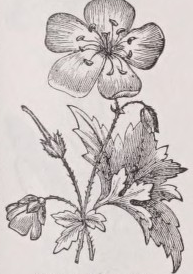
GERANIUM is the name of a genus of poly petalous exogenous plants, which is taken by botanists as the type of the natural order Geraniaceae. The name, as a scientific appellation, has a much more restricted application than when taken in its popular sense. Formerly the genus Geranium was almost conterminous with the order Geraniaceae, which latter had then a more limited meaning than is given to it by those of our leading botanists of the present day who include in it the Tropaeolaceae, the 0xali- daceae, and the Balsaminaceae. Then as now the geranium was very popular as a garden plant, and the species included in the original genus became widely known under that name, which has more or less clung to them ever since, in spite of scientific changes which have removed the larger number of them to the genus Pelargonium. This result has been probably brought about in some degree by an error of the nurserymen, who seem in many cases to have acted on the conclusion that the group commonly known as Scarlet Geraniums were really geraniums and not pelargoniums, and have in consequence inserted them under the former name in their trade catalogues. In fact it may be said that, from a popular point of view, the pelargoniums of the botanist are better known as geraniums than are the geraniums themselves....
The species of Geranium bear the English name of Cranesbill, and consist mostly of herbs, of annual or perennial duration, dispersed throughout the temperate regions of the world. They number nearly a hundred, and bear a considerable family resemblance. The leaves are for the most part palmately-lobed, and the flowers are regular, consisting of five sepals, five imbricating petals, alternating with five glandules at their base, ten stamens, and a beaked ovary. Some dozen or more species are natives of the British Isles; and many of those of exotic origin form handsome border plants in our gardens of hardy perennials. Amongst these G. ibericum, G. platypetalum, G. sanguineum, G. Backhousianum, and the double-flowered varieties of G. pratense are conspicuous. The genus is not without its virtues, G. maculatum being the alum-root of North America, used there as an astringent in diarrhoea, dysentery, and such like complaints, while the native Herb Robert of English hedgesides, G. Robertianum, which is both astringent and aromatic, is used as a remedy in nephritic disorders.
From these regular-flowered herbs, with which they had been mixed up by the earlier botanists, L’Heritier in 1787 separated those plants which have since borne the name of Pelargonium, and which, though agreeing with them in certain points of structure, differ in others which are admitted to be of generic value. One obvious distinction of Pelargonium is that the flowers are irregular, the two petals which stand uppermost being different—larger, smaller, or differently marked—from the other three, which latter are occasionally wanting. This difference of irregularity the modern florist has done very much to annul, for the increased size given to the flowers by high breeding has usually been accompanied by the enlargement of the smaller petals, so that a very near approach to regularity has been in some cases attained. Another well-marked difference however remains in Pelargonium: the back or dorsal sepal is furnished with a hollow spur, which spur is adnate, i.e., joined for its whole length with the flower-stalk; while in Geranium there is no spur. This peculiarity is best seen by cutting clean through the flower-stalk just behind the flower, when in Pelargonium there will be seen the hollow tube of the spur, which in the case of Geranium will not be found as it does not exist, but the stalk will appear as a solid mass. There are other characters which support those already pointed out, such as the absence of the glandules, and the declination of the stamens; but the features already described offer the most ready and obvious distinctions.
To recapitulate, the geraniums properly so-called are regular-flowered herbs with the flower stalks solid, while many geraniums falsely so-called in popular language are really pelargoniums, and may be distinguished by their irregular flowers and hollow flower stalks. In a great majority of cases too, the pelargoniums so commonly met with in greenhouses and summer parterres are of shrubby or sub-shrubby habit.
[728 words — estimated reading time: 5 minutes]