
Word of the Day: Catachrestical
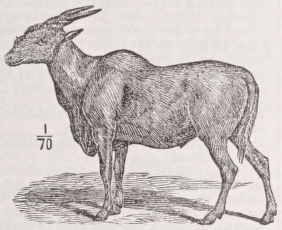
Eland
Encyclopedia Britannica
EL-ARAISH, L'Araish, or in French Laracπe, a town of Morocco en the Atlantic coast, about 45 miles S. of Tangier, is picturesquely situated on a rocky height to the south of the embouchure of the Wady Loukhus or Lixus. It is the seat of a military governor, and has a number of well-kept though practically useless defences. The impress of Spanish occupation is still evident, and all the main points described in the 17th century by Pidon de Saint Olon can easily be distinguished—such as the church, the fort of St Jacques, the castle of St Etienne with its four cupolas, the Jew’s Tower, and the castle of Notre Dame d’Europe, now the Kasba or citadel. The market-place is surrounded with arcades of monolithic sandstone pillars. In spite of the bar at the entrance of the river preventing the passage of all vessels of more than 150 tons, the port is one of the most frequented on that part of the coast. The exports, gradually increasing in value, consist mainly of millet, drà, and other cereals, canary-seed, beans, pease, cork, and wool. In 1875, 136 vessels entered and cleared, 26 being British and 58 Spanish. The population of the town at the same date was estimated at 5000, of whom nearly 4000 were Mahometans, about 1000 Spanish-speaking Jews, and 60 Christians....
Though the name of El-Araish is comparatively modern, and is mentioned neither by El-Bikri nor by Edrisi, it seems not improbable from a passage in Scylax that the site of the town was occupied by a Libyan settlement at an early date; and about 3⅛ miles up the river there still exist on the hill of Tchemmish very considerable ruins of the Punico-Roman city of Lixus. The modern town was finally taken from the Portuguese in 1689 by Mulei Ismael after a five months’ siege; in 1785 it was attacked by the French, and in 1829 saw the destruction of the Morocco fleet by the Austrians. A convent in connection with the Spanish mission was maintained till 1822.
See Barth, Wanderungen durch die Küstenländer des Mittelmeeres, 1S49j Rohlf’s Adventures in Morocco, 1874; Tissot, u Itinéraire de Tanger à R’ba-t,” in Bull, de la Soc. de Geogr., 1876.
1. I il LASTICITY of matter is that property in virtue of
J_J which a body requires force to change its bulk or shape, and requires a continued application of the force to maintain the change, and springs back when the force is removed, and, if left at rest without the force, does not remain at rest except in its previous bulk and shape. The elasticity is said to be perfect when the body always requires the same force to keep it at rest in the same bulk and shape and at the same temperature through whatever variations of bulk, shape, and temperature it be brought. A body is said to possess some degree of elasticity if it requires any force to keep it in any particular bulk or shape. It is convenient to discuss elasticity of bulk and elasticity of shape sometimes separately and sometimes jointly.
2. Every body has some degree of elasticity of bulk. If a body possesses any degree of elasticity of shape it is called a solid; if it possesses no degree of elasticity of shape it is called a fluid.
3. All fluids possess elasticity of bulk to perfection. Probably so do all homogeneous solids, such as crystals and glasses. It is not probable that any degree of fluid pressure (or pressure acting equally in all directions) on a piece of common glass, or rock crystal, or of diamond, or on a crystal of bismuth, or of copper, or of lead, or of silver, would make it denser after the pressure is removed, or put it into a condition in which at any particular intermediate pressure it would be denser than it was at that pressure before the application of the extreme pressure. Malleable metals and alloys, on the other hand, may have their densities considerably increased and diminished by hammering and by mere traction. By compression between the dies used iu coining, the density of gold may be raised from 19 ’ 258 to 19 φ 367, and the density of copper from 8 ’ 535 to 8’916; and Mr M'Farlane's experiments quoted below (section 78), show a piece of copper wire decreasing in density from 8 ’ 91 to 8 ’ 835 after successive simple tractions, by which its length was increased from 287 centimetres to 317 centimetres, while its modulus of rigidity decreased from 443 to 426 million grammes per square centimetre. Later experiments, recently made for this article by the same experimenter, have shown augmentation of density from 8 ’ 85 to 8 ’ 95, produced by successive tractions which elongated a piece of copper wire from weighing 16 ’ 4 grammes per metre to weighing 13 - 5 grammes per metre, the wire having been first annealed by heating it to redness in sand, and allowing it to cool slowly. Augmentation of density by traction is a somewhat surprising result, but not altogether so when we consider that the wire had been reduced to an abnormally small density by the previous thermal treatment (the “annealing”). The common explanation of these changes of density in metals, which attributes them to porosity, is probably true; by porosity being understood a porous structure with such vast numbers of the ultimate molecules in the portions of the solid substance between pores or interstices that these portions may be called homogeneous in the sense that a crystal or a liquid can be called homogeneous (compare section 40 below).
4. The elasticity of shape of many solids is not perfect: it is not known whether it is perfect for any. It might be expected to ba perfect for glass and rock crystal and diamond and other hard, brittle, homogeneous substances; but experiment proves that at all events for glass it is not so, and shows on the contrary a notable degree of imperfection in the torsional elasticity of glass fibres. It might be expected that in copper and soft iron and other plastic metals the elasticity of shape would be very imperfect; experiment shows, on the contrary, that in copper, brass, soft iron, steel, platinum, provided the distortion does not exceed a certain limit in each case, elasticity of shape is remarkably perfect, much more perfect than in glass. It is quite probable that even in the softer metals—zinc, tin, lead, cadmium, potassium, sodium, &c.—the elasticity of shape may be as perfect as in the metals mentioned above, but within narrower limits as to degree of distortion. Accurate experiment is utterly wanting, to discover what is the degree of imperfection, if any, of the elasticity of any metal or alloy, when tested within sufficiently narrow limits of distortion.
5. The “viscosity of metals” described below (sections 21- 25) does not demonstrate any imperfectness of elasticity according to the definition of section 1, which is purely statical. The viscosity of solids may (for all we yet know by experiment) depend, as does the viscosity of fluids, upon a resistance varying with the velocity of the change, and vanishing when the velocity of the change is zero, that is to say, when the body is at rest in any configuration; if so, the elasticity of the substance concerned is perfect within the limits of the experiment in question. If, on the other hand (as the discovery of elastic fatigue described below seems to indicate may be to some degree the case), the loss of energy from the vibrations in the experiments described is due to a dependence of the elastic resilient force upon previous conditions of the substance in respect to strain, the “viscosity” would be continuous with a true imperfectness of static elasticity. Here, then, we have a definite question which can be answered by experiment only :—Consider a certain definite stress applied to a solid substance; as, for example, a certain “couple” twisting a wire or rod; or a certain weight pulling it out, or compressing it lengthwise; or a certain weight placed on the middle of a beam supported by trestles under its ends. Let it be applied and removed a great many times, and suppose it to be seen that after each application and removal of the stress the body comes to rest in exactly the same configuration as after the previous application or removal of the stress. If now the body be left to itself with the stress removed, and if it be found to remain at rest in the same configuration for minutes, or hours, or days, or years after the removal of the stres3, a part of the definition of perfect elasticity is fulfilled. Or, again, if the stress be applied, and kept applied with absolute constancy, and if the body remain permanently in a constant configuration, another item of the definition of perfect elasticity is proved. When any such experiment is made on any metal, unless some of the softer metals (section 4) is to be excepted, there is certainly very little if any change of configuration in the circumstances now supposed. The writer believes, indeed, that nothing of the kind has hitherto been discovered by experiment, provided the stress has been considerably less than that which would break or give a notable permanent twist, or elongation, or bend, to the body, that is to say, provided the action has been kept decidedly within the limits of the body’s elasticity as commonly understood (sections 7-20). Mr J. T. Bottomley, with the assistance of a grant of money from thθ British Association, has commenced making arrangements for secular experiments on the elasticity of metals, in the tower of the university of Glasgow, to answer this question in respect to permanence or non-permanence through minutes, or hours, or days, or years, or centuries. If several gold wires are hung side by side, one of them bearing the smallest weight that will keep it approximately straight, another wire - 5 1 0 of the breaking weight, another wire - 5 2 σ of the breaking weight, and so on; the one of them bearing ⅜4 of the breaking weight will probably, in the course of a few hours or days, show very sensible elongation. Will it go on becoming longer and longer till it breaks, or will the time-curve of its elongation be asymptotic? Even with considerably less than ∙j-⅜ of the breaking weight there will probably be a continually augmenting elongation, but with asymptotic time-curve indicating a limit beyond which the elongation never goes, but which it infinitely nearly reaches in an infinite time. It is not probable that a gold wire stretched by 1 1 σ of its present breaking weight, or by £ of its present breaking weight, or even by ⅜ of its present breaking weight, would break in a thousand or in a million years. The existence of gold ornaments which have been fouud in ancient tombs and cities, and have preserved their shapes for thousands of years without running down glacier-wise (as does brittle pitch or sealing-wax in the course of a few years in moderately warm climates), seems to prove that for gold (and therefore leaves no doubt also for many other metals) the time-curve is asymptotic, if indeed there is any slow change of shape at all after the application of a moderate stress well within the limits of elasticity. Egyptian and Greek statues, Etruscan vases, Egyptian obelisks, and other stone monuments with their engraved hieroglyphics, flint implements and boulders, and mountains with the geological evidence we have of their antiquity, prove for stones, and pottery, and rocks of various kinds, a permanence for thousands and millions of years of resistance to distorting stress.
6. The complete fulfilment of the definition of perfect elasticity is not proved by mere permanence of the extreme configurations assumed by the substance when a stated amount of the stress is alternately applied and removed. This condition might be fulfilled, and yet the amount of elastic force might be different with the same palpable configuration of the body during gradual augmentation and during gradual diminution of the stress. That it is so in fact is proved by the discovery of viscosity referred to below; but it is not yet proved that if, after increasing the stress to a certain definite amount, the body is brought to rest in the same palpable configuration as before, the amounts of stress required to hold it in this configuration are different in the two cases. If they are (section 1) the elasticity is imperfect; if they are not the elasticity is perfect within the limits of the experiment (compare section 36 below).
7. Limits of Elasticity— Elasticity of Shape.— The degree of distortion within which elasticity of shape is found is essentially limited in every solid. Within sufficiently narrow limits of distortion every solid shows elasticity of shape to some degree—some solids to perfection, so far as we know at present. When the distortion is too great, the body either breaks or receives a permanent bend (that is, such a molecular disturbance that it does not return to its original figure when the bending force is removed). If the first notable dereliction from perfectness of elasticity is a breakage, the body is called brittle,—if a permanent bend, plastic or malleable or ductile. The metals are generally ductile; some metals and metallic alloys and compounds of metals with small proportions of other substances, are brittle; some of them brittle only in certain states of temper, others it seems essentially brittle. The steel of before the days of Bessemer and Siemens is a remarkable instance. When slowly cooled from a bright red heat, it is remarkably tough and ductile. When heated to redness and cooled suddenly by being plunged in oil or water or mercury, it becomes exceedingly brittle and hard (glass-hard, as it is called), and to ordinary observation seems incapable of taking a permanent bend (though probably careful observation would prove it not quite so). The definition of steel used to be approximately pure iron capable of being tempered glass-hard, and again softened to different degrees by different degrees of heat. Now, the excellent qualities of iron made by Bessemer’s and Siemens’s processes are called steel, and are reckoned best when incapable of being tempered glass-hard, the possibility of brittleness supervening in the course of any treatment which the metal may meet with in its manufacture being an objection against the use of what was formerly called steel for ship’s plates, ribs, stringers, &c., and for many applications of land engineering, even if the material could be had in sufficient abundance.
8. Limits of Elasticity (continued)— Elasticity of Bulk.— If we reckon by the amount of pressure, there is probably no limit to the elasticity of bulk in the direction of increase of pressure for any solid or fluid; but whether continued augmentation produces continued diminution of bulk towards zero without limit, or whether for any or every solid or fluid there is a limit towards which it may be reduced in bulk, but smaller than which no degree of pressure, however great, can condense it, is a question which cannot be answered in the present state of science. Would any pressure, however tremendous, give to gold a density greater than 19*6, or to copper a density greater than 9Ό, after the pressure is removed (section 3 above)? But whether the body be fluid or a continuous non-porous solid, it probably recovers the same density, however tremendously it may have been pressed, and probably shows perfect elasticity of bulk (section 3 above) through the whole range of positive pressure from zero to infinity, provided the pressure has been equal in all directions like fluid pressure. As for negative pressure, we have no knowledge of what limit, if any, there may be to the amount of force which can be applied to a body pulling its surface out equally in all directions. The question of how to apply the negative pressure is inextricably involved with that of the body’s power to resist, The upper part of the mercury of a barometer adhering to the glass above the level corresponding to the atmospheric pressure is a familiar example of what is called negative pressure in liquids. Water and other transparent liquids show similar phenomena, another of which is the warming of water above its boiling point in an open glass or metal vessel varnished w ith shellac. Attempts to produce great degrees of this so-called negative pressure are baffled by what seems an instability of the equilibrium which supervenes wflιen the negative pressure is too much augmented. It is a very interesting subject for experimental inquiry to find how high mercury or water or any other liquid can be got to stand above the level corresponding to the atmospheric pressure in a tall hermetically sealed tube, and how many degrees a liquid can, with all precautions, be warmed above its boiling point. In each case ib⅛eems to be by a minute bubble forming and expanding somewhere at the boundary of the liquid, where it is in contact with the containing vessel, that the possible range of the negative pressure is limited, judging from what we see when we carefully examine a transparent liquid, or the surface of separation between mercury and glass, in any such experiment. The contrast of the amounts of negative pressure practically obtainable or obtained hitherto in such experiments on liquids (which are at the most those corresponding to the weight of a few metres of the substance), with that obtainable in the case of even the weakest solids, is remarkable; and as for the strongest, consider for instance (sec. 22 below) 17 nautical miles of steel pianoforte wire hanging by one end. When a cord, or rod, or ware of any solid substance hangs vertically, the negative pressure (for example, 23,000 atmospheres in the case just cited) in any transverse section is equal to the weight of the part hanging below it. It is an interesting question not to be answered by any experiment easily made or even devised,—How much would the longitudinal pull which can be applied to a cord, rod, or wire without breaking it be augmented (probably augmented, but possibly diminished) by lateral pull applied all round the sides so as to give equal negative pressure in all directions?
9. Limits of Elasticity (continued)— Elasticity of Shape for Distortions not Uniform through the Substance, and for Compound Distortions; and Elasticity corresponding to Co-existent Distortion and Change of Bulk :— Example 1.—A round wire twisted, or a cylindrical shaft transmitting revolutional motive in machinery, presents, as we shall see (sec. 64), an instance of simple distortion, but to different degrees in different parts of the substance, increasing from the axis where it is zero, uniformly to the surface where it is greatest.
Example 2.—Elongation of a wire or rod by direct pull, is (sec. 23) an instance of a compound distortion co-existing with a rarefaction of the substance, both distortion and rarefaction uniform throughout.
Example 3.—Shortening of a column by end pressure is an instance of a similar compound distortion combined with condensation of the substance, both distortion and condensation uniform throughout.
Example 4.—Flexure of a round wire or of a bar, or beam, or girder, of any shape of normal section, by opposite bending couples applied at the two ends, is an instance in which one-half of the sιtb-stance is stretched, and the other half shortened with exactly the same combination of distortions and changes of bulk as in examples 2 and 3. The strain More nearly what is now called stress than what is now called strain is meant by “strain " in this article, which was written before Rankine’s introduction of the word stress, and distinct definition of the word strain (see chap. i. of Mathematical Theory below). ] is uniform along the length of the bar, but varies in the cross section in simple proportion to distance from a certain line (sec. 62) through the centre of gravity of the sectional area, which, in the case of a round bar, is the diameter perpendicular to the plane of curvature.
The limits of elasticity in the cases of these four examples are subjects of vital importance in practical mechanics, and a vast amount of careful and accurate observation and experiment, which has given much valuable practical information regarding them, has been gone through by engineers, in their necessary dealings with questions regarding strength of materials. Still there is great want of definite scientific information on the subject of limits of elasticity generally, and particularly on many elementary questions (section 21 below), which force themselves upon us when we endeavour to analyze the molecular actions concerned in such cases as the four examples now before us. Some principles of much importance for guidance in practical as well as theoretical...
9th ed. Encyclopædia Britannica, vol. 7, p. 796
[34,638 words — estimated reading time: 3.3 hours]
[34,638 words — estimated reading time: 3.3 hours]
No thesaurus entries found for "Eland".
No Bible verses found for "Eland".