
Alt. of Ferrer
Word of the Day: Catachrestical
Ferreira
Encyclopedia Britannica
FERREIRA, Antonio (1528-1569), Portuguese poet, was born at Lisbon in 1528. He was of a noble family, and completed his education at the university of Coimbra. Destined for the public service, he applied himself to the study of the law; but although he obtained the degree of doctor, and held a high legal office at Lisbon, he was far more deeply interested in literature than in jurisprudence. The poetry of Horace especially fascinated him; and, resolving to write in the Portuguese tongue alone, he set before him as his special task to give to Portuguese poetry a classical purity, precision, and elegance of style. While still at the university he composed most of his Sonnets, in which the influence of Petrarch appears, without, however, his passion or his grace. At the same period he produced his comedy of Bristo, which he is supposed to have afterwards retouched and perfected. His chief dramatic work is the tragedy of Inez de Castro, the first Portuguese tragedy, and the second in modern European literature, the only one of earlier date being the Italian tragedy of Sofonisba by Trissino. Ferreira’s elegies are numerous, but few of them bear the impress of sincerity of feeling. One of the most admired is that on “May” and the return of spring. The Epistles of Ferreira, forming the largest portion of his works, were the first of their kind in Portuguese literature. They were addressed to many illustrious persons during his residence at court, in the maturity of his powers and knowledge of the world. Usually didactic and serious in tone, studious of correctness and classical elegance of form, the poetry of Ferreira lacked the inspiration of genuine passion and the power to touch the hearts of his countrymen. It never became popular. He was looked up to, however, as an ...oracle by the critics of his own day, enjoyed the special favour of King John III. and two of his successors, and had reason to hope for a long and honourable career. But he was carried off suddenly in the prime of life, by the plague which raged in 1569. His Poemas Lusitanos were published in 1598, and a complete collection of his works appeared at Lisbon in 1771.
9th ed. Encyclopædia Britannica, vol. 9, p. 109
[374 words — estimated reading time: 3 minutes]
[374 words — estimated reading time: 3 minutes]
Partaking of iron; pertaining to iron; like iron; made of iron.
Partaking of, made of, or pertaining to, iron; like iron.
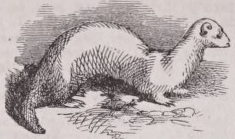
1. An animal of the genus Mustela, or Weasel kind, about 14 inches in length, of a pale yellow color with red eyes. It is a native of Africa, but has been introduced into Europe. It cannot however bear cold, and cannot subsist even in France, except in a domestic state. Ferrets are used to catch rabbits.
3. Among glass makers, the iron used to try the melted matter, to see if it is fit to work, and to make the rings at the mouths of bottles.
1. An animal of the Weasel family (Mustela / Putorius furo), about fourteen inches in length, of a pale yellow or white color, with red eyes. It is a native of Africa, but has been domesticated in Europe. Ferrets are used to drive rabbits and rats out of their holes.
2. To drive or hunt out of a lurking place, as a ferret does the cony; to search out by patient and sagacious efforts; -- often used with out; as, to ferret out a secret.
3. A kind of narrow tape, usually made of woolen; sometimes of cotton or silk; -- called also ferreting.
4. The iron used for trying the melted glass to see if is fit to work, and for shaping the rings at the mouths of bottles.
Ferret
Encyclopedia Britannica
FERRET(Mustela furo) i an albino variety of weasel, regarded by some as the descendant of a wild species originally brought from Africa, and now only known in the domesticated state, and by others, as a variety of the polecat (Mustela putorius), which it closely resembles in size, form, and habits, and with which it is said to interbreed freely. It differs, however, from the polecat in the colour of its fur, which is usually yellowish-white, and of its eyes which are pinky-red. A more important difference, as bearing on the question of its specific distinctness, lies in the fact that while the polecat thrives in the severe climate of northern Europe, the ferret is peculiarly intolerant of cold, and only survives the English winter by means of the artificial warmth to which, under domestication, it is accustomed. The ferret attains a length of about fourteen inches, exclusive of the tail, which measures about five inches. Although exhibiting considerable tameness, it seems incapable of attachment, and when not properly fed or when otherwise irritated is apt to give painful evidence of its native ferocity. Tempted by the opportunity of the mother’s absence it has been known to attack the child in the cradle, and having once tasted blood it seems to lose all its acquired shyness, and will then boldly attack any one interfering with the gratification of its bloodthirsty propensity. It is chiefly employed in destroying rats and other vermin, and in driving rabbits from their burrows into nets spread for their reception. For the latter purpose it is usually muzzled, to prevent it devouring its prey and thereafter going to sleep at the bottom of a burrow until roused by hunger to renewed exertion. The ferret is remarkably prolific, the female bringing forth two broods ...annually, each numbering from six to nine young. It is said to devour its young occasionally immediately after birth, and in this case it produces another brood soon after. The ferret was well known to the Romans, Strabo stating that it was brought from Africa into Spain, and Pliny that it was employed in his time in rabbit hunting, under the name Viverra, of which the English name is probably a corruption.
9th ed. Encyclopædia Britannica, vol. 9, p. 109
[372 words — estimated reading time: 3 minutes]
[372 words — estimated reading time: 3 minutes]
Ferret
Watson's Biblical & Theological Dictionary
אנקה, from אנק, or _cry out_, Lev. xi, 30. The ferret is a species of the weasel; but Bochart will have the _anakah_ to be the spotted lizard, called by Pliny _stellio_. Dr. James takes it for the frog, in allusion to the name, which literally signifies _the crier_, befitting the croaking of that animal; but we shall find the frog mentioned under another name. Dr. Geddes renders it _the newt_, or rather _the lizard of the Nile_; and it evidently must be of the lizard species. Pliny mentions “the _galleotes_, covered with red spots, whose cries are sharp,” which may be the _gekko_, which is probably the animal here intended. As its name, in the Indies _tockai_, and in Egypt _gekko_, is formed from its voice, so the Hebrew name _anakah_, or perhaps _anakkah_, seems to be formed in like manner; the double k being equally observable in all these appellations. If these remarks are admissible, this lizard is sufficiently identified.
Watson's Biblical & Theological Dictionary
[162 words — estimated reading time: 1 minute]
[162 words — estimated reading time: 1 minute]
One that hunts another in his private retreat.
One who ferrets.
No thesaurus entries found for "Ferre".