
FIE , pronounced fi, an exclamation denoting comtempt or dislike.
Word of the Day: Catachrestical
An exclamation denoting contempt or dislike. See Fy.
A fee; a feud; an estate held of a superior on condition of military service.
1. A piece of land inclosed for tillage or pasture; any part of a farm, except the garden and appurtenances of the mansion; properly land not covered with wood, and more strictly applicable to tillage land than to mowing land, which is often called meadow. But we say, the master of the house is in the field with his laborers, when he is at a distance from his house on his farm. He is in the field plowing, sowing, reaping or making hay.
2. Ground not inclosed.
3. The ground where a battle is fought.
4. We say, the field of battle; these veterans are excellent soldiers in the field
5. A battle; action in the field
6. What though the field be lost.
7. To keep the field is to keep the campaign open; to live in tents, or to be in a state of active operations. At the approach of cold weather, the troops, unable to keep the field were ordered into winter quarters.
8. A wide expanse.
9. Ask of yonder argent fields above.
10. Open space for action or operation; compass; extent. This subject opens a wide field for contemplation.
11. A piece or tract of land.
12. The field I give thee and the cave that is therein.
13. Genesis 23:9 .
14. The ground or blank space on which figures are drawn; as the field or ground of a picture.
15. In heraldry, the whole surface of the shield, or the continent.
16. In scripture, field often signifies the open country, ground not inclosed, as it may in some countries in modern times.
17. A field of ice, a large body of floating ice.
1. Cleared land; land suitable for tillage or pasture; cultivated ground; the open country.
2. A piece of land of considerable size; esp., a piece inclosed for tillage or pasture.
3. A place where a battle is fought; also, the battle itself.
4. An open space; an extent; an expanse.
5. Any blank space or ground on which figures are drawn or projected.
6. The space covered by an optical instrument at one view.
7. The whole surface of an escutcheon; also, so much of it is shown unconcealed by the different bearings upon it. See Illust. of Fess, where the field is represented as gules (red), while the fess is argent (silver).
8. An unresticted or favorable opportunity for action, operation, or achievement; province; room.
9. A collective term for all the competitors in any outdoor contest or trial, or for all except the favorites in the betting.
10. That part of the grounds reserved for the players which is outside of the diamond; -- called also outfield.
1. To take the field.
2. To stand out in the field, ready to catch, stop, or throw the ball.
To catch, stop, throw, etc. (the ball), as a fielder.
Field
Encyclopedia Britannica
FIELD, John (1782-1837), one of the most remarkable pianists of his time and of the few composers of British origin whose works have acquired European reputation, was born at Dublin in 1782. He was descended from a musical family, his father being a violinist, and his grandfather the organist in one of the churches of Dublin. From the latter the boy received his first musical education. When a few years later the family settled in London, Field became the favourite pupil of the celebrated Clementi, whom he accompanied to Paris, and later, in 1802, on his great concert tour through France, Germany, and Russia. Under the auspices of his master Field appeared in public in most of the great European capitals, especially in St Petersburg, and in that city he remained when Clementi returned to England. During his stay with the great pianist Field had to suffer many privations, owing to Clementi’s all but unexampled parsimony; but when the latter left Russia his splendid connexion amongst the highest circles of the capital became Field’s inheritance. Fame and wealth were now within his grasp, but owing to his extravagant and dissipated way of life the composer was never free from care; and to the same cause his early end must no doubt be attributed. His marriage with a French lady of the name of Charpentier was anything but happy, and had soon to be dissolved. Field made frequent concert tours to the chief cities of Russia, and in 1820 settled permanently in Moscow. In 1831 he came to England for a short time, and for the next four years led a migratory life in France, Germany, and Italy, exciting the admiration of amateurs wherever he appeared in public. In Naples he fell seriously ill, and lay several months in the hospital, till a Russian family discovered him and ...brought him back to Moscow.
There he lingered for several years till his death on January 11, 1837. Field was not a prolific writer, but he has left many works which will not easily be forgotten. His training and the cast of his genius were not of a kind to enable him to excel in the larger forms of instrumental music, and of his seven concerti for the pianoforte few if any are heard in concert-rooms now-a-days. Neither do his quartets for strings and pianoforte hold their own by the side of those of the great masters. But in the minor forms of composition he has shown gifts surpassed by few of his contemporaries. Especially his “nocturnes,” a form of music highly developed if not actually created by him, remain all but unrivalled for their tenderness and dreaminess of conception, combined with a continuous flow of beautiful melody. But their best claim to immortality is the fact that they have been the models of Chopin’s still higher efforts in the same direction. Field’s execution on the pianoforte was nearly allied to the nature of his compositions, beauty and poetical charm of touch being mentioned by contemporaries as one of the chief characteristics of his style. A certain monotony was the almost necessary complement of these qualities. Moscheles, who heard Field in 1831, speaks of his “enchanting legato.” “I again,” he writes on another occasion, “admired his tenderness and elegance and his beautiful touch; but he wants spirit and accent, light and shade, and intensity of feeling.”
FIELD, Nathan, a dramatist and actor of the time of Elizabeth, was probably born about but not later than 1587. He was the son of the rector of Cripplegate, the Rev. John Field, and early became one of the children of Queen Elizabeth’s chapel, and in 1600 he played one of the principal parts in Ben Jonson’s Cynthia's Bevels, which was acted by children. Next year he played in the Poetaster, in 1607 in Bussy d,'Ambois, and in 1608 in Epicene, on which occasion his is the only name among the “children” of 1600 which still remains. In 1612, when he must have been very young, he brought out his first play, the original comedy of A Woman is α Weathercock, in which the inconstancy of woman is made a theme fertile in humour. In 1613 he was engaged with Daborne in writing a play which has not been handed down to us; and soon afterwards we find these two authors, in conjunction with Massinger, praying Henslowe for a small sum of money to free them from imprisonment. In 1618 Field printed Amends far Ladies, in which he reversed the judgment of his first comedy, and, in the persons of a virtuous maid, wife, and widow, vindicated womankind against himself. It has been supposed that Field had some hand in editing the first folio Shakespeare in 1623; he certainly assisted Massinger in that year in composing his tragedy of The Fatal Dowry, and the play bears evident traces of his co-operation. In 1639 he reprinted the Amends for Ladies, and in 1641 he was dead. There exists a portrait of Field in Dulwich College. He was the poetic “son” of George Chapman, and the associate of many dramatic poets of that age. His elder brother Theophilus, also a writer of verse, entered the church, and rose to be bishop of Llandaff and afterwards of Hereford. The two unassisted plays of Nathan Field are comedies of contemporary London life, and are mainly written in very smooth and flowing blank verse. They contain one or two lyrics, which, in conjunction which certain passages in The Fatal Dowry, prove Field to have surpassed Massinger in lyrical power. Amends for Ladies is greatly superior to its companion play in animation, plausibility, and humour; but the passages between Scudmore and Bellafront in A Woman is a Weathercock perhaps display the serious style of Field at its best. His song “Rise, lady mistress, rise,” in Amends for Ladies, is a charming aubade. It is to be regretted that we possess so little of the work of this bright and sensible writer. His plays have never been collected.
9th ed. Encyclopædia Britannica, vol. 9, p. 141
[571 words — estimated reading time: 4 minutes]
[571 words — estimated reading time: 4 minutes]
A plant of several kinds.
A bed for the field.
A book used in surveying, in which are set down the angles, stations, distances, etc.
plural In war, small flags of about a foot and half square, carried along with the quarter-master general, for marking out the ground for the squadrons and battalions.
The commander of an army; a military officer of high rank in France and Germany, and the highest military officer in England.
A military officer above the rank of captain, as a major or colonel.
A small cannon which is carried along with armies, and used in the field of battle.
One who preaches in the open air.
A preaching in the field or open air.
plural Diversions of the field, as shooting and hunting.
In the military art, works thrown up by an army in besieging a fortress, or by the besieged to defend the place.
Consisting of fields.
A ball payer who stands out in the field to catch or stop balls.
A bird of the genus Turdus or thrush, about ten inches in length, the head ash-colored, the back and greater coverts of the wings, of a fine deep chestnut, and the tail black. These birds pass the summer in the northern parts of Europe, but visit Great Britain in winter.
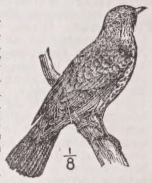
Fieldfare
Encyclopedia Britannica
FIELDFARE, Anglo-Saxon Fealo-for ( = Fallow-farer), a largo species of Thrush, the Turdus pilaris of Linnaeus— well known as a regular and common autumnal visitor throughout the British Islands and a great part of Europe, besides Western Asia, and even reaching Northern Africa. It is the Veldjakkeτ and Velddyster of the Dutch, the Wachholderdrossel and Kramtsvogel of Germans, the Litorne of the French, and the Cesena of Italians. This bird is of all Thrushes the most gregarious in habit, not only migrating in large bands and keeping in flocks during the winter, but even commonly breeding in society—200 nests or more having been seen within a very small space. The birch-forests of Norway, Sweden, and Russia are its chief resorts in summer, but it is known also to breed sparingly in some districts of Germany. Though its nest has been many times reported to have been found in Scotland, there is perhaps no record of such an incident that is not open to doubt; and unquestionably the Mistletoe-Thrush (T. visciυorus) has been often mistaken for the Fieldfare by indifferent observers. The head, neck, upper part of the back, and the rump are grey; the wings, wing-coverts, and middle of the back are rich hazel-brown; the throat is ochraceous, and the breast reddish-brown—both being streaked or spotted with black, while the belly and lower wing-coverts are white, and the legs and toes very dark brown. The nest and eggs resemble those of the Blackbird (7 τ . merula), but the former is usually built high up in a tree, The Fieldfare’s call-note is harsh and loud, sounding like echaid ’ chat: its song is low, twittering, and poor. It usually arrives in Britain about the middle or end of October, but sometimes earlier, and often remains till the middle of May before ...departing for its northern breeding-places. In hard weather it throngs to the berry-bearing bushes which then afford it sustenance, but in open winters the flocks spread over the fields in search of animal food—worms, slugs, and the larvae of insects. In very severe seasons it will altogether leave the country, and then return for a shorter or longer time as spring approaches. From the author of William of Palerne to the writers of our own day the Fieldfare has occasionally been noticed by British poets with varying propriety. Thus Chaucer’s association of its name with frost is as happy as true, while Scott was more than unlucky in his well-known reference to its “lowly nest” in the Highlands.
Structurally very like the Fieldfare, but differing greatly in many other respects, is the bird known in North America as the “Robin”—its ruddy breast and familiar habits reminding the early British settlers in the New World of the household favourite of their former homes. This bird, the Turdus migratoriτιs of Linnaeus, has a wide geographical range, extending from the Atlantic to the Pacific, and from Greenland to Guatemala, and, except at its extreme limits, is almost everywhere a very abundant species. As its scientific name imports, it is essentially a migrant, and gathers in flocks to pass the winter in the south, though a few remain in New England throughout the year. Yet its social instincts point rather in the direction of man than of its own kind, and it is not known to breed in companies, while it affects the homesteads, villages, and even the parks and gardens of the large cities, where its fine song, its attractive plumage, and its great services as a destroyer of noxious insects, combine to make it justly popular, (a. n.)
9th ed. Encyclopædia Britannica, vol. 9, p. 142
[613 words — estimated reading time: 4 minutes]
[613 words — estimated reading time: 4 minutes]
Disrepute Roget’s Thesaurus §874
N. disrepute, discredit, ill repute, bad repute, bad name, bad odor, bad favor, ill name, ill odor, ill favor, disapprobation, ingloriousness, derogation, abasement, debasement, abjectness, degradation, dedecoration, a long farewell to all my greatness, odium, obloquy, opprobrium, ignominy, dishonor, disgrace, shame, humiliation, scandal, baseness, vileness, turpitude, infamy, tarnish, taint, defilement, pollution, stain, blot, spot, blur, stigma, brand, reproach, imputation, slur, crying shame, burning shame, scandalum magnatum, badge of infamy, blot in one's escutcheon, bend sinister, bar sinister, champain, point champain, byword of reproach, ichabod, argumentum ad verecundiam, sense of shame
V. be inglorious, incur disgrace, have a bad name, earn a bad name, put a halter round one's neck, wear a halter round one's neck, disgrace oneself, expose oneself, play second fiddle, lose caste, pale one's ineffectual fire, recede into the shade, fall from one's high estate, keep in the background, be conscious of disgrace, look blue, look foolish, look like a fool, cut a poor figure, cut a sorry figure, laugh on the wrong side of the mouth, make a sorry face, go away with a flea in, one's ear, slink away, cause shame, shame, disgrace, put to shame, dishonor, throw dishonor upon, cast dishonor upon, fling dishonor upon, reflect dishonor upon, be a reproach, to, derogate from, tarnish, stain, blot sully, taint, discredit, degrade, debase, defile, beggar, expel, impute shame to, brand, post, stigmatize, vilify, defame, slur, cast a slur upon, hold up to shame, send to coventry, tread under foot, trample under foot, show up, drag through the mire, heap dirt upon, reprehend, bring low, put down, snub, take down a peg, take down a peg lower, take down a peg or two, obscure, eclipse, outshine, take the shine out of, throw into the shade, cast into the shade, overshadow, leave in the background, put in the background, push into a corner, put one's nose out of joint, put out, put out of countenance, upset, throw off one's center, discompose, disconcert, put to the blush
Adj. disgraced, blown upon, "shorn of its beams", shorn of one's glory, overcome, downtrodden, loaded with shame, in bad repute, out of repute, out of favor, out of fashion, out of countenance, at a discount, under a cloud, under an eclipse, unable to show one's face, in the shade, in the background, out at elbows, down at the elbows, down in the world, inglorious, nameless, renownless, obscure, unknown to fame, unnoticed, unnoted, unhonored, unglorified, shameful, disgraceful, discreditable, disreputable, despicable, questionable, unbecoming, unworthy, derogatory, degrading, humiliating, infra dignitatem, dedecorous, scandalous, infamous, too bad, unmentionable, ribald, opprobrious, errant, shocking, outrageous, notorious, ignominious, scrubby, dirty, abject, vile, beggarly, pitiful, low, mean, shabby base
Adv. to one's shame be it spoken
Int. fie, shame, for shame, proh pudor, o tempora, o mores, ough, sic transit gloria mundi
Disapprobation Roget’s Thesaurus §932
N. disapprobation, disapproval, improbation, disesteem, disvaluation, displacency, odium, dislike, dispraise, discommendation, blame, censure, obloquy, detraction, disparagement, depreciation, denunciation, condemnation, ostracism, black list, animadversion, reflection, stricture, objection, exception, criticism, sardonic grin, sardonic laugh, sarcasm, insinuation, innuendo, bad compliment, poor compliment, left-handed compliment, satire, sneer, taunt, cavil, carping, censoriousness, hypercriticism, reprehension, remonstrance, expostulation, reproof, reprobation, admonition, increpation, reproach, rebuke, reprimand, castigation, jobation, lecture, curtain lecture, blow up, wigging, dressing, rating, scolding, trimming, correction, set down, rap on the knuckles, coup de bec, rebuff, slap, slap on the face, home thrust, hit, frown, scowl, black look, diatribe, jeremiad, jeremiade, tirade, philippic, clamor, outcry, hue and cry, hiss, hissing, sibilance, sibilation, catcall, execration, chiding, upbraiding, exprobation, abuse, vituperation, invective, objurgation, contumely, hard words, cutting words, bitter words, evil-speaking, bad language, personality
V. disapprove, dislike, lament, object to, take exception to, be scandalized at, think ill of, view with disfavor, view with dark eyes, view with jaundiced eyes, nil admirari, disvalue, improbate, frown upon, look grave, bend the brows, knit the brows, shake the head at, shrug the shoulders, turn up the nose, look askance, look black upon, look with an evil eye, make a wry face, make a wry mouth at, set one's face against, dispraise, discommend, disparage, deprecate, speak ill of, not speak well of, condemn, blame, lay blame upon, cast blame upon, censure, fronder, reproach, pass censure on, reprobate, impugn, remonstrate, expostulate, recriminate, reprehend, chide, admonish, berate, betongue, bring to account, call to account, call over the coals, rake over the coals, call to order, take to task, reprove, lecture, bring to book, read a lesson, read a lecture to, rebuke, correct, reprimand, chastise, castigate, lash, blow up, trounce, trim, laver la tete, overhaul, give it one, give it one finely, gibbet, accuse, impeach, denounce, hold up to reprobation, hold up to execration, expose, brand, gibbet, stigmatize, show up, pull up, take up, cry "shame" upon, be outspoken, raise a hue and cry against, execrate, exprobate, speak daggers, vituperate, abuse, abuse like a pickpocket, scold, rate, objurgate, upbraid, fall foul of, jaw, rail, rail at, rail in good set terms, bark at, anathematize, call names, call by hard names, call by ugly names, avile|, revile, vilify, vilipend, bespatter, backbite, clapperclaw, rave against, thunder against, fulminate against, load with reproaches, exclaim against, protest against, inveigh against, declaim against, cry out against, raise one's voice against, decry, cry down, run down, frown down, clamor, hiss, hoot, mob, ostracize, blacklist, draw up a round robin, sign a round robin, animadvert upon, reflect upon, glance at, cast reflection, cast reproach, cast a slur upon, insinuate, damn with faint praise, "hint a fault and hesitate dislike", not to be able to say much for, scoff at, point at, twit, taunt, sneer at, satirize, lampoon, defame, depreciate, find fault with, criticize, cut up, pull to pieces, pick to pieces, take exception, cavil, peck at, nibble at, carp at, be censorious, pick holes, pick a hole, pick a hole in one's coat, make a fuss about, take down, take down a peg, set down, snub, snap one up, give a rap on the knuckles, throw a stone at, throw a stone in one's garden, have a fling, have a snap at, have words with, pluck a crow with, give one a wipe, give one a lick with the rough side of the tongue, incur blame, excite disapprobation, scandalize, shock, revolt, get a bad name, forfeit one's good opinion, be under a cloud, come under the ferule, bring a hornet's nest about one's ears, take blame, stand corrected, have to answer for
Adj. disapproving, scandalized, disparaging, condemnatory, damnatory, denunciatory, reproachful, abusive, objurgatory, clamorous, vituperative, defamatory, satirical, sarcastic, sardonic, cynical, dry, sharp, cutting, biting, severe, withering, trenchant, hard upon, censorious, critical, captious, carping, hypercritical, fastidious, sparing of praise, grudging praise, disapproved, chid, in bad odor, blown upon, unapproved, unblest, at a discount, exploded, weighed in the balance and found wanting, blameworthy, reprehensible, to blame, worthy of blame, answerable, uncommendable, exceptionable, not to be thought of, bad, vicious, unlamented, unbewailed, unpitied
Adv. with a wry face, reproachfully
King James Bible KJV Bible
Berean Standard Bible BSB Bible
442 KJV and 376 BSB verses contain “Fie” — showing the first 20. Show all 502 verses (searchable)
And out of the ground the LORD God formed every beast of the field, and every fowl of the air; and brought them unto Adam to see what he would call them: and whatsoever Adam called every living creature, that was the name thereof.
That he may give me the cave of Machpelah, which he hath, which is in the end of his field; for as much money as it is worth he shall give it me for a possession of a buryingplace amongst you.
And the field of Ephron, which was in Machpelah, which was before Mamre, the field, and the cave which was therein, and all the trees that were in the field, that were in all the borders round about, were made sure
So Ephron’s field at Machpelah near Mamre, the cave that was in it, and all the trees within the boundaries of the field were deeded over