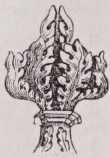
The knot or bunch of foliage, or foliated ornament, that forms the upper extremity of a pinnacle in Gothic architecture; sometimes, the pinnacle itself.
FINIGUERRA, Maso (contraction for Tommaso), a Florentinegoldsmith, is distinguished as the inventor of the method of taking impressions from engraved plates. The date of his birth is not ascertained, and conjectures vary from 1400 to 1426. He was one of the best workers in niello, a form of decorative art then very much in vogue in Italy, which, however, in the next century fell into neglect. He is said to have been a pupil of the famous sculptor Lorenzo Ghiberti, and to have assisted him in the execution of the beautiful bronze gates of the baptistery of Florence; but whether the first or second pair of gates is not stated. Baldinucci makes him a pupil of Masaccio; but it appears probable that he was rather one of those art students who were powerfully influenced by the new style, noble in simplicity, of Masaccio’s works, than a personal disciple of the painter. One indisputably genuine work of Finiguerra is still extant, a silver Pax on which is λvrought in niello a representation of the Coronation of the Virgin. By some writers it is called an Assumption. It was executed for the church of San Giovanni Battista at Florence, and is still preserved there. It is in height a little more than 4 inches, and in breadth about 3 inches; and within this small space is a composition of more than forty figures, marvellous for accuracy of drawing and minute finish. The date of its completion is fixed by an entry in the city archives, under the year 1452. During the progress of the work the artist, according to the custom, took casts in sulphur from the plate, and also impressions upon damped paper. For these impressions he made use of a smooth roller, which passed over the paper on the plate, and produced impressions that looked like pen drawings. This method was followed by ...other workers; and thus copperplate engraving and printing soon became generally practised in Italy. The title of Finiguerra to the discovery was long disputed, especially on the ground that while prints by early German masters were in existence bearing earlier dates than any Italian engravings, not a single print by Finiguerra could be produced in support of his claim. The question was settled by Zani’s discovery in 1797, in the National Cabinet of Paris, of the identical impression taken by the artist himself from the silver Pax of San Giovanni. This print is believed to have been executed as early as 1440. Zani’s account of his discovery (see Ottley’s History of Engraving, vol. i. pp. 306-312) is a singularly fascinating narrative, breathing an enthusiasm as intense and a joy as devout as those of a Columbus who first sights a long-sought world. The date of Maso’s death is not known. Zani places it about 1460, others about 1475.
9th ed. Encyclopædia Britannica, vol. 9, p. 215 [479 words — estimated reading time: 3 minutes]
2. The process of fining or refining; clarification; also (Metal.), the conversion of cast iron into suitable for puddling, in a hearth or charcoal fire.
3. That which is used to refine; especially, a preparation of isinglass, gelatin, etc., for clarifying beer.
Fining[Present participle and verbal noun]Webster's Dictionary 1913
8. To perfect; to accomplish; to polish to the degree of excellence intended. In this sense it is frequently used in the participle of the perfect tense as an adjective. It is a finished performance. He is a finished scholar.
1. That which finishes, puts an end to/ or perfects.
2. The joiner work and other finer work required for the completion of a building, especially of the interior. See Inside finish, and Outside finish.
3. The labor required to give final completion to any work; hence, minute detail, careful elaboration, or the like.
4. See Finishing coat, under Finishing.
5. The result of completed labor, as on the surface of an object; manner or style of finishing; as, a rough, dead, or glossy finish given to cloth, stone, metal, etc.
1. One who finishes, puts an end to, completes, or perfects; esp. used in the trades, as in hatting, weaving, etc., for the workman who gives a finishing touch to the work, or any part of it, and brings it to perfection.
2. Something that gives the finishing touch to, or settles, anything.
FINISTÈRE, or Finisterre, the most western department of France, forming part of the old province of Bretagne or Brittany, is bounded on the N.W. and S. by the ocean, and on the E. by the departments of Côtes-du-Nord and Morbihan. It extends from 47° 44'to 48° 47' N. lat., and from 3’ 22' to 4° 50' W. long., being 78 miles in length from north to south by 63 in width, and having an area of 666,705 hectares, or 2574 square miles. Two chains of hills run nearly parallel from east to west through this department, and divide it into three zones of almost equal extent, conveying the waters in three different directions. North of the Arrez, or more northern of the two chains, the waters of the Douron, Jarleuc, Penzé, and Flèche flow northward to the sea. South of the Noires range, the Odet, Aven, Ioste, and Elie flow southward; while the region inclosed by the two chains having a declination westward, the waters of the Aulne and the Elorn flow into the Brest roads. The rivers are all small, and none of the hills attain a height of 900 feet. The coasts are generally steep and rocky, and indented with numerous bays and inlets, affording some excellent harbours, the principal being those of Brest, La Forest, Morlaix, Landernau, Quimper, and Douarnenez. The only navigable rivers are the Aulne, Elorn, and Odet. Off the coast lie a number of islands and rocky islets, the principal of which are Ushant and Bas. The climate is temperate, but rather humid; the prevailing winds are the W., S.W., aud N.W. More than a third of the soil is under cultivation, and about an equal proportion is heath or waste land, rather the larger proportion of the remainder being pasturage, and the rest woods and forests. Though so small a portion of the land is under cultivation, the produce of ...corn is more than sufficient for the population, and might be greatly increased if the primitive agricultural implements and methods still in use were superseded by the introduction of modern improvements. The chief crops are oats, rye, wheat, and barley; flax, hemp, and pulse are also produced. The farm and dairy produce, though plentiful in quantity, is indifferent in quality; but great attention is paid to the breeding and feeding of cattle. In the department there are a large number of orchards and gardens, and vegetables are largely grown for exportation. The fisheries of the coast, particularly the pilchard fishery, employ a great many hands, and render this department an excellent nursery of seamen for the French navy. Finistère is rich in minerals: iron, coal, lead, bismuth, and zinc mines are worked; and there are quarries of granite, slate, marble, and porphyry. The lead mines of Poullaouen and Huelgoat, which yielded a considerable quantity of silver, have not been worked since 1869. The manufactures are linens, woollens, sailcloth, ropes, paper, leather, earthenware, soda, soap, candles, sugar, &c. Shipbuilding is carried on at Brest and other seaports. Finistère is divided into the arrondissements of Quimperlé, Brest, Châteaulin, Morlaix, and Quimper, the town of Quimper being the capital of the department, The population of Finistère in 1872 was 642,963, and in 1876 it was 666,106.
9th ed. Encyclopædia Britannica, vol. 9, p. 215 [556 words — estimated reading time: 4 minutes]
A window shalt thou make to the ark, and in a cubit shalt thou finish it above; and the door of the ark shalt thou set in the side thereof; with lower, second, and third stories shalt thou make it.
You are to make a roof for the ark, finish its walls a cubit from the top, place a door in the side of the ark, and build lower, middle, and upper decks.
And it came to pass, before he had done speaking, that, behold, Rebekah came out, who was born to Bethuel, son of Milcah, the wife of Nahor, Abraham’s brother, with her pitcher upon her shoulder.
Before the servant had finished praying, Rebekah came out with her jar on her shoulder. She was the daughter of Bethuel son of Milcah, the wife of Abraham’s brother Nahor.
And it came to pass, as the camels had done drinking, that the man took a golden earring of half a shekel weight, and two bracelets for her hands of ten shekels weight of gold;
And after the camels had finished drinking, he took out a gold ring weighing a beka, and two gold bracelets for her wrists weighing ten shekels.
And before I had done speaking in mine heart, behold, Rebekah came forth with her pitcher on her shoulder; and she went down unto the well, and drew water: and I said unto her, Let me drink, I pray thee.
And before I had finished praying in my heart, there was Rebekah coming out with her jar on her shoulder, and she went down to the spring and drew water. So I said to her, ‘Please give me a drink.’
And it came to pass, as soon as Isaac had made an end of blessing Jacob, and Jacob was yet scarce gone out from the presence of Isaac his father, that Esau his brother came in from his hunting.
As soon as Isaac had finished blessing him and Jacob had left his father’s presence, his brother Esau returned from the hunt.
And in process of time the daughter of Shuah Judah’s wife died; and Judah was comforted, and went up unto his sheepshearers to Timnath, he and his friend Hirah the Adullamite.
After a long time Judah’s wife, the daughter of Shua, died. When Judah had finished mourning, he and his friend Hirah the Adullamite went up to his sheepshearers at Timnah.
And when Jacob had made an end of commanding his sons, he gathered up his feet into the bed, and yielded up the ghost, and was gathered unto his people.
When Jacob had finished instructing his sons, he pulled his feet into the bed and breathed his last, and he was gathered to his people.
And he gave unto Moses, when he had made an end of communing with him upon mount Sinai, two tables of testimony, tables of stone, written with the finger of God.
When the LORD had finished speaking with Moses on Mount Sinai, He gave him the two tablets of the Testimony, tablets of stone inscribed by the finger of God.
Thus was all the work of the tabernacle of the tent of the congregation finished: and the children of Israel did according to all that the LORD commanded Moses, so did they.
So all the work for the tabernacle, the Tent of Meeting, was completed. The Israelites did everything just as the LORD had commanded Moses.
And he reared up the court round about the tabernacle and the altar, and set up the hanging of the court gate. So Moses finished the work.
And Moses set up the courtyard around the tabernacle and the altar, and he hung the curtain for the entrance to the courtyard. So Moses finished the work.
And when Aaron and his sons have made an end of covering the sanctuary, and all the vessels of the sanctuary, as the camp is to set forward; after that, the sons of Kohath shall come to bear it: but they shall not touch any holy thing, lest they die. These things are the burden of the sons of Kohath in the tabernacle of the congregation.
When Aaron and his sons have finished covering the holy objects and all their equipment, as soon as the camp is ready to move, the Kohathites shall come and do the carrying. But they must not touch the holy objects, or they will die. These are the transportation duties of the Kohathites regarding the Tent of Meeting.
And it came to pass on the day that Moses had fully set up the tabernacle, and had anointed it, and sanctified it, and all the instruments thereof, both the altar and all the vessels thereof, and had anointed them, and sanctified them;
On the day Moses finished setting up the tabernacle, he anointed and consecrated it and all its furnishings, along with the altar and all its utensils.
This site uses cookies to remember your display preferences (search sources and editions, Bible version, auto-link, images, light/dark theme). No personal data whatsoever is collected. Privacy Policy