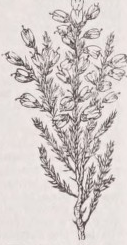
1. A plant of the genus Erica, of many species. It is a shrub which is used in Great Britain for brooms, thatch, beds for the poor, and for heating ovens. Its leaves are small and continue green all the year. It is called also ling.
1. A low shrub (Erica, / Calluna, vulgaris), with minute evergreen leaves, and handsome clusters of pink flowers. It is used in Great Britain for brooms, thatch, beds for the poor, and for heating ovens. It is also called heather, and ling.
2. Also, any species of the genus Erica, of which several are European, and many more are South African, some of great beauty. See Illust. of Heather.
3. A place overgrown with heath; any cheerless tract of country overgrown with shrubs or coarse herbage.
HEATH, the English form of a name given in most Teutonic dialects to the common ling or heather, but now applied to all species of Erica, an extensive genus of monopetalous plants, belonging to the order Ericaceoe. The heaths are evergreen shrubs, with small narrow leaves, in whorls usually set rather thickly on the shoots; the persistent flowers have 4 sepals, and a 4-cleftcampanulate or tubularcorolla, in many species more or less ventricose or inflated; the dry capsule is 4-celled, and opens, in the true Ericae, in 4 segments, to the middle of which the partitions adhere, though in the ling the valves separate at the dissepiments. The plants are mostly of low growth, but several African kinds reach the size of large bushes, and a Spanish variety, E. arborea, occasionally attains almost the aspect and dimensions of a tree....
One of the best known and most interesting of the family is the common heath, heather, or ling, Calluna vulgaris, placed by most botanists in a separate genus on account of the peculiar dehiscence of the fruit, and from the coloured calyx, which extends beyond the corolla, having a whorl of sepal-like bracts beneath. This shrub derives some economic importance from its forming the chief vegetation on many of those extensive wastes that occupy so large a portion of the more sterile lands of northern and western Europe, the usually desolate appearance of which is enlivened in the latter part of summer by its abundant pink blossoms. When growing erect to the height of a yard or more, as it often does in sheltered places, its purple stems, close-leaved green shoots, and feathery spikes of bell-shaped flowers render it one of the handsomest of the heaths; but on the bleaker elevations and more arid slopes it frequently rises only a few inches above the ground. In all moorland countries the ling is applied to many rural purposes; the larger stems are made into brooms, the shorter tied up into bundles that serve as brushes, while the long trailing shoots are woven into baskets. Pared up with the peat about its roots it forms a good fuel, often the only one obtainable on the drier moors. The shielings of the Scotch Highlanders were formerly constructed of heath stems, cemented together with peat mud, worked into a kind of mortar with dry grass or straw; hovels and sheds for temporary purposes are still sometimes built in a similar way, and roofed in with ling. Laid on the ground, with the flowers above, it forms a soft springy bed, the luxuriouscouch of the ancient Gael, still gladly resorted to at times by the hill shepherd or hardy deer-stalker. The young shoots were in former days employed as a substitute for hops in brewing, while their astringency rendered them valuable as a tanning material in Ireland and the Western Isles. They are said also to have been used by the Highlanders for dyeing woollen yarn yellow, and other colours are asserted to have been obtained from them, but some writers appear to confuse the dyer’s-weed, Genista tinctoria, with the heather. The young juicy shoots and the seeds, which remain long in the capsules, furnish the red grouse of Scotland with the larger portion of its sustenance; the ripe seeds are eaten by many birds. The tops of the ling afford a considerable part of the winter fodder of the hill flocks, and are popularly supposed to communicate the fine flavour to Welsh and Highlaud mutton, but sheep seldom crop heather while the mountain grasses and rushes are sweet and accessible. In recent times ling has been suggested as a material for paper, but the stems are hardly sufficiently fibrous for that purpose. The purple or fineleaved heath, E. cinerea, one of the most beautiful of the genus, abounds on the lower moors and commons of Great Britain and western Europe, in such situations being sometimes more prevalent than the ling. The flowers of both these species yield much honey, furnishing a plentiful supply to the bees in moorland districts; from this heath honey the Picts probably brewed the mead said by Boetius to have been made from the flowers themselves.
It was until recently supposed that no species of heath existed in America; but of late years isolated plants of ling have been found in various parts of New England, Nova Scotia, and Cape Breton, while it has been stated to occur in some abundance in several places in Newfoundland; probably in distant ages it may have had a wider range on the American continent. The whole group, as observed by Bentham, is “eminently Atlantic” in its present distribution,—of nearly 500 known species by far the greater part being indigenous to the western districts of South Africa, and nearly all the remainder limited to Europe and its adjacent islands.
The Cape heaths have long been favourite objects of horticulture. In the warmer parts of Britain several will bear exposure to the cold of ordinary winters in a sheltered border, but most need the protection of the conservatory. They are sometimes raised from seed, but are chiefly multiplied by cuttings “struck” in sand, and afterwards transferred to pots filled with a mixture of black peat and sand; the peat should be dry and free from sourness. Much attention is requisite in watering heaths, as they seldom recover if once allowed to droop, while they will not bear much water about their roots: the heath-house should be light and well ventilated, the plants requiring sun, and soon perishing in a close or permanently damp atmosphere; in England little or no heat is needed in ordinary seasons. The European heaths succeed well in English gardens, only requiring a peaty soil and sunny situation to thrive as well as in their native localities: E. carnea, mediterranea, ciliaris, vagans, and the pretty cross-leaved heath of boggy moors, E. tetralix, are among those most worthy of cultivation. The beautiful large-flowered St D⅛beoc , s heath, belonging to the closely allied genus Meηziesia, is likewise often seen in gardens. (c. p. j.)
9th ed. Encyclopædia Britannica, vol. 11, p. 589 [1,027 words — estimated reading time: 6 minutes]
ערער, Jer. xvii, 6; xlviii, 6. “He shall be like the heath in the desert. He shall not see when good cometh; but shall inhabit the parched places in the wilderness, a salt land.” The LXX and Vulgate render _oror_, “the tamarisk;” and this is strengthened by the affinity of the Hebrew name of this tree with the Turkish _œrœr_. Taylor and Parkhurst render it, “a blasted tree stripped of its foliage.” If it be a particular tree, the tamarisk is as likely as any. Celsius thinks it to be the juniper; but from the mention of it as growing in a salt land, in parched places, the author of “Scripture Illustrated” is disposed to seek it among the _lichens_, a species of plants which are the last production of vegetation under the frozen zone, and under the glowing heat of equatorial deserts; so that it seems best qualified to endureparched places, and a salt land. Hasselquist mentions several kinds seen by him in Egypt, Arabia, and Syria. In Jer. xlviii, 6, the original word is ערוער, which the Septuagint translators have read ערור, for they render it ὄνος ἄγριος, _wild ass_; and, as this seems best to agree with the flight recommended in the passage, it is to be preferred. See WILD ASS.
HEATHCOAT, John (1783-1861), the author of important inventions for facilitating the manufacture of Buckingham or French lace, was born at Duffield near Derby in 1783. During his apprenticeship to a framesmith near Loughborough, he made an improvement in the construction of the warp-loom, so as to produce mitts of a lace-like appearance by means of it. He commenced business on his own account at Nottingham, but finding himself subjected to the intrusion of competing inventors he removed to Hathern. There he diligentlyprosecuted his experiments, and in 1808 constructed a machine capable of producing an exact imitation of real pillow-lace. This was by far the most expensive and complex textile apparatus till then existing; and in describing the process of his invention, Heathcoat said in 1836, “The single difficulty of getting the diagonal threads to twist in the allotted space was so great that, if now to be done, I should probably not attempt its accomplishment.” Some time before perfecting his invention, which he patented in 1809, he removed to Loughborough, where he entered into partnership with Mr Lacy, a Nottingham manufacturer; but in 1816 their factory was attacked by the Luddites and the lace frames destroyed. The damages were assessed in the King’s Bench at £10,000; but as Heathcoat declined to expend the money in the county of Leicester he never received any part of it. Undaunted by his loss, he began at once to construct new and greatly improved machines in an unoccupied factory at Tiverton, Devonshire, propelling them by water-power and afterw ards by steam. His claim to the invention of the twisting and traversing lace machine was disputed, and a patent was taken out by a cleverworkman for a similar machine, which was decided at a trial in 1816 to ...be an infringement of Heathcoat’s patent. He followed his great invention by others of much ability, as, for instance, contrivances for ornamenting net w hile. in course of manufacture and for making ribbons and platted and twisted net upon his machines, improved yarn spinning-frames, and methods for winding raw silk from cocoons. He also patented an improved process for extracting and purifying salt. An offer of £10,000 was made to him in 1833 for the use of his processes in dressing and finishing silk nets, but he allowed the highly profitable secret to remain undivulged. In 1832 he patented a steam plough, which stood foremost in public estimation until superseded by those of Fowler and others. Heathcoat was elected member of parliament for Tiverton in 1832. Though he seldom spoke in the House he was constantly engaged on committees, where his thorough know ledge of business and sound judgment were highly valued. He retained his seat until 1859, and after two years of declining health he died in January 1861 at Bolham House, near Tiverton.
9th ed. Encyclopædia Britannica, vol. 11, p. 590 [480 words — estimated reading time: 3 minutes]
1. A pagan; a Gentile; one who worships idols, or is unacquainted with the true God. In the Scriptures, the word seems to comprehend all nations except the Jews or Israelites, as they were all strangers to the true religion, and all addicted to idolatry. The word may now be applied perhaps to all nations, except to Christians and Mohammedans.
2. Heathen, without the plural termination, is used plurally or collectively, for Gentiles or heathen nations.
3. Ask of me, and I will give thee the heathen for thine inheritance. Psalms 2:8 .
4. Heathen, however, has a plural, expressing two or more individuals.
5. If men have reason to be heathens in Japan--
6. The precepts and examples of the ancient heathens.
1. helth'ful. Being in a sound state, as a living or organized being; having the parts or organs entire, and their functions in a free, active and undisturbed operation; free from disease. We speak of a healthful body, a healthful person, a healthful plant.
2. Serving to promote health; wholesome; salubrious; as a healthful air or climate; a healthful diet.
3. Indicating health or soundness; as a healthful condition.
Both thy bondmen, and thy bondmaids, which thou shalt have, shall be of the heathen that are round about you; of them shall ye buybondmen and bondmaids.
Your menservants and maidservants shall come from the nations around you, from whom you may purchase them.
But I will for their sakes remember the covenant of their ancestors, whom I brought forth out of the land of Egypt in the sight of the heathen, that I might be their God: I am the LORD.
But for their sake I will remember the covenant with their fathers, whom I brought out of the land of Egypt in the sight of the nations, that I might be their God. I am the LORD.”
But he walked in the way of the kings of Israel, yea, and made his son to pass through the fire, according to the abominations of the heathen, whom the LORD cast out from before the children of Israel.
Instead, he walked in the ways of the kings of Israel and even sacrificed his son in the fire, according to the abominations of the nations that the LORD had driven out before the Israelites.
And walked in the statutes of the heathen, whom the LORD cast out from before the children of Israel, and of the kings of Israel, which they had made.
and walked in the customs of the nations that the LORD had driven out before the Israelites, as well as in the practices introduced by the kings of Israel.
And there they burnt incense in all the high places, as did the heathen whom the LORD carried away before them; and wrought wicked things to provoke the LORD to anger:
They burned incense on all the high places like the nations that the LORD had driven out before them. They did wicked things, provoking the LORD to anger.
And they rejected his statutes, and his covenant that he made with their fathers, and his testimonies which he testified against them; and they followed vanity, and became vain, and went after the heathen that were round about them, concerning whom the LORD had charged them, that they should not do like them.
They rejected His statutes and the covenant He had made with their fathers, as well as the decrees He had given them. They pursued worthless idols and themselves became worthless, going after the surrounding nations that the LORD had commanded them not to imitate.
And say ye, Save us, O God of our salvation, and gather us together, and deliver us from the heathen, that we may give thanks to thy holy name, and glory in thy praise.
Then cry out: ‘Save us, O God of our salvation; gather and deliver us from the nations, that we may give thanks to Your holy name, that we may glory in Your praise.’
And said, O LORD God of our fathers, art not thou God in heaven? and rulest not thou over all the kingdoms of the heathen? and in thine hand is there not power and might, so that none is able to withstand thee?
and said, “O LORD, God of our fathers, are You not the God who is in heaven, and do You not rule over all the kingdoms of the nations? Power and might are in Your hand, and no one can stand against You.
Moreover he burnt incense in the valley of the son of Hinnom, and burnt his children in the fire, after the abominations of the heathen whom the LORD had cast out before the children of Israel.
Moreover, Ahaz burned incense in the Valley of Hinnom and sacrificed his sons in the fire, according to the abominations of the nations that the LORD had driven out before the Israelites.
But did that which was evil in the sight of the LORD, like unto the abominations of the heathen, whom the LORD had cast out before the children of Israel.
And he did evil in the sight of the LORD by following the abominations of the nations that the LORD had driven out before the Israelites.
So Manasseh made Judah and the inhabitants of Jerusalem to err, and to do worse than the heathen, whom the LORD had destroyed before the children of Israel.
So Manasseh led the people of Judah and Jerusalem astray, so that they did greater evil than the nations that the LORD had destroyed before the Israelites.
Moreover all the chief of the priests, and the people, transgressed very much after all the abominations of the heathen; and polluted the house of the LORD which he had hallowed in Jerusalem.
Furthermore, all the leaders of the priests and the people multiplied their unfaithful deeds, following all the abominations of the nations, and they defiled the house of the LORD, which He had consecrated in Jerusalem.
And the children of Israel, which were come again out of captivity, and all such as had separated themselves unto them from the filthiness of the heathen of the land, to seek the LORD God of Israel, did eat,
The Israelites who had returned from exile ate it, together with all who had separated themselves from the uncleanness of the peoples of the land to seek the LORD, the God of Israel.
This site uses cookies to remember your display preferences (search sources and editions, Bible version, auto-link, images, light/dark theme). No personal data whatsoever is collected. Privacy Policy