Some of the differences between the Caprimulginoe and Podargince have been pointed out by Mr Sclater (Proc. Zοol. Soc., 1866, p. 123), and are very obvious. In the former, the outer toes have four phalanges only, thus presenting a very uncommon character among birds, and the middle claws are pectinated; while in the latter the normal number of five phalanges is found, and the claws are smooth, and other distinctions more recondite have also been indicated by him (tom. cit., p. 582). The Caprinvulginae may be further divided into those having the gape thickly beset by strong bristles, and those in which there are few such bristles or none—the former containing the genera Capri mulgus, Antrostomus, Nyctidromus, and others, and the tatter Podager, Chordiles, Lyncornis, and a few more.
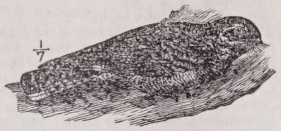
The common Goatsucker of Europe (C cziropoeus) arrives late in spring from its winter retreat in Africa, and its presence is soon made known to us by its habit of chasing its prey, consisting chiefly of moths and cockchafers, in the evening-twilight. As the season advances the song of the cock, from its singularity, attracts attention amid all rural sounds. This song seems to be always uttered when the bird is at rest, though the contrary has been asserted, and is the continuous repetition of a single burring note, as of a thin lath fixed at one end and in a state of vibration at the other, and loud enough to reach in still weather a distance of halfa-mile or more. On the wing, while toying with its mate, or performing its rapid evolutions round the trees where it finds its food, it has the habit of occasionally producing another and equally extraordinary sound, sudden and short, but somewhat resembling that made by swinging a thong in the air, though whether this noise proceeds from its mouth is not ascertained. In general its flight is silent, but at times when disturbed from its repose, its w ings may be heard to smite together. The Goatsucker, or, to use perhaps its commoner English name, Nightjar, passes the day in slumber, crouching on the ground or perching on a tree —in the latter case sitting not across the branch but lengthways, with its head lower than its body. In hot weather, however, its song may sometimes be heard by day and even at noontide, but it is then uttered, as it were, drowsily, and without the vigour that characterizes its crepuscular or nocturnal performance. Towards evening the bird becomes active, and it seems to pursue its prey throughout the night uninterruptedly, or only occasionally pausing for a few seconds to alight on a bare spot—a pathway or road— and then resuming its career. It is one of the few birds that absolutely make no nest, but lays its pair of beautifully-marbled eggs on the ground, generally where the herbage is short, and often actually on the soil. So light is it that the act of brooding, even where there is some vegetable growth, produces no visible depression of the grass, moss, or lichens on which the eggs rest, and the finest sand equally fails to exhibit a trace of the parental act. Yet scarcely any bird shows greater local attachment, and the precise site chosen one year is almost certain to be occupied the next. The young, covered when hatched with dark-spotted down, are not easily found, nor are they more easily discovered on becoming fledged, for their plumage almost entirely resembles that of the adults, being a mixture of reddish-brown, grey, and black, blended and mottled in a manner that passes description. They soon attain their full size and power of flight, and then take to the same manner of life as their parents. In autumn all leave their summer haunts for the south, but the exact time of their departure has hardly been ascertained. The habits of the Nightjar, as thus described, seem to be more or less essentially those of the whole Subfamily—the differences observable being apparently less than are found in other groups ot birds of similar extent.
A second species of Goatsucker (C ’. mιficollis'), which is somewhat larger, and has the neck distinctly marked with rufous, is a summer visitant to the south-western parts of Europe, and especially to Spain and Portugal. The occur, rence of a single example of this bird at Killingworth, near Newcastle-on-Tyne, in October 185G, has been recorded by Mr Hancock (Ibis, 1862, p. 39); but the season of its appearance argues the probability of its being but a casual straggler from its proper home. Many other species of Caprimulgus inhabit Africa, Asia, and their islands, while one (C. macrurus) is found in Australia. Very nearly allied to this genus is Antrostοnus, an American group containing many species, of which the Chuck-wilΓs-widow (A. carol inensis') and the Whip-poor-will (A. voci-ferus) of the eastern United States (the latter also reaching Canada) are familiar examples. Both these birds take their common name from the cry they utter, and their habits seem to be almost identical with those of the Old-World Goatsuckers. Passing over some other forms which need not here be mentioned, the genus Nyctidrοmus, though consisting of only one species (E. albicollis') which inhabits Central and part of South America, requires remark, since it has tarsi of sufficient length to enable it to run swiftly on the ground, while the legs of most birds of the Family are so short that they can make but a shuffling progress. Heleothrep>tfs, with the unique form of wing possessed by the male, needs mention. Notice must also be taken of two African species, referred by some ornithologists to as many genera (Macrodl·pteryx and Cos-metornis), though probably one genus would suffice for both. The males of each of them are characterized by the wonderful development of the ninth primary in either wing, which reaches in fully adult specimens the extraordinary length of 17 inches or more. The former of these birds, the C. macrodipterus of Afzelius, is considered to belong to the west coast of Africa, and the shaft of the elongated remiges is bare for the greater part of its length, retaining the web, in a spatulate form, only near the tip. The latter, to which the specific name of vexillarius was given by Mr Gould, has been found on the east coast of that continent, and is reported to have occurred in Madagascar and Socotra. In this the remigial streamers do not lose their barbs, and as a few of the next quills are also to some extent elongated, the bird, when flying, is said to look as though it had four wings. Specimens of both are rare in collections, and no traveller seems to have had the opportunity of studying the habits of either so as to suggest a reason for this marvellous sexual development.
The second group of Caprimulginoe, those which are but poorly or not at all furnished with rictal bristles, contains about five genera, of which there is here only room to particularize Lyncornis of the Old World and Chοrdiles of the New. The species of the former are remarkable for the tuft of feathers which springs from each side of the head, above and behind the ears, so as to give the bird an appearance like some of the “Horned” Owls—those of the genus Scops, for example; and remarkable as it is to find certain forms of two Families, so distinct as are the Strigidoe and the Caprimulgidoe, resembling each other in this singular external feature, it is yet more remarkable to note that in some groups of the latter, as in some of the former, a very curious kind of dimorphism takes place. In either case this has been frequently asserted to be sexual, but on that point doubt may fairly be entertained. Certain it is that in some groups of Goatsuckers, as in some groups of Owls, inclivi duals of the same species are found in plumage of two entirely different hues—rufous and grey. The only explanation as yet offered of this fact is that the difference is sexual, but, as just hinted, evidence to that effect is conflicting. It must not, however, be supposed that this com mon feature, any more than that of the existence of tufted forms in each group, indicates any close relationship between them. The resemblances may be due to the same causes, concerning which future observers may possibly enlighten us, but at present we must regard them as analogies not homologies. The species of Lyncornis inhabit the Malay Archipelago, one, however, occurring also in China Of Chordiles the best known species is the Night-hawk of North America (C*. virginianus or C. popetud), which has a wide range from Canada to Brazil. Others are found in the Antilles and in South America. The general habits of all these birds agree with those of the typical Goatsuckers.
We have next to consider the birds forming the genus Podargus and those allied to it, whether they be regarded as a distinct Family, or as a Subfamily of Caprimulgidoe. As above stated, they have feet constructed as those of birds normally are, and their sternum seems to present the constant though comparatively trivial difference of having its posterior margin elongated into two pairs of processes, while only one pair is found in the true Goatsuckers. Podargus includes the bird [P. cuνieri) known from its cry as Morepork to Tasmanian colonists, and several other species, the number of which is doubtful, from Australia and New Guinea. They have comparatively powerful bills, and it would seem feed to some extent on fruits and berries, though they mainly subsist on insects, chiefly Cicadoe and Phasmidoe. They also differ from the true Goatsuckers in having the outer toes partially reversible, and they are said to build a flat nest on the horizontal branch of a tree for the reception of their eggs, which are of a spotless white. Apparently allied to Podargus, but differing among other respects in its mode of nidification, is Aegotheles, which belongs also to the Australian Subregion; and further to the northward, extending throughout the Malay Archipelago and into India, comes Batrachostomus, wherein we again meet with species having aural tufts somewhat like Lyηcomis. The Podar-gin<x are thought by some to be represented in the New World by the genus Nyctibius, of which several species occur from the Antilles and Central America to Brazil. Finally, it maybe stated that none of the Caprimulgidoe seem to occur in Polynesia or in New Zealand, though there is scarcely any other part of the world suited to their habits in which members of the Family are not found, (a. n.)