
OWL, the Anglo Saxon Ùle, Swedish Uggla, and German Eule — all allied to the Latin Ulula, and evidently of imitative origin—the general English name for every nocturnal Bird-of-prey, of which group nearly two hundred species have been recognized. The Owls form a very natural assemblage, and one about the limits of which no doubt has for a long while existed. Placed by nearly all systematists for many years as a Family of the Order Accipitres (or whatever may have been the equivalent term used by the particular taxonomers), there has been of late a disposition to regard them as forming a group of higher rank. On many accounts it is plain that they differ from the ordinary diurnal Birds-of-prey, more than the latter do among themselves; and, though in some respects Owls have a superficial likeness to the Goatsuckers (vol. x. p. 711), and a resemblance more deeply seated to the Guacharo (vol. xi. p. 227), even the last has not been made out to have any strong affinity to them. A good deal is therefore to be said for the opinion which would regard the Owls as forming an independent Order, or at any rate Sub-order, Striges. Whatever be the position assigned to the group, its subdivision has always been a fruitful matter of discussion, owing to the great resemblance obtaining among all its members, and the existence of safe characters for its division has only lately been at all generally recognized. By the older naturalists, it is true, Owls were divided, as was first done by Willughby, into two sections—one in which all the species exhibit tufts of feathers on the head, the so-called “ears” or “horns,” and the second in which the head is not tufted. The artificial and therefore untrustworthy nature of this distinction was shewn by Isidore Geoffroy St-Hilaire ...(Ann. Sc. Naturelles, xxi. pp. 194-203) in 1830; but he did not do much good in the arrangement of the Owls which he then proposed; and it was hardly until the publication ten years later of Nitzsch’s Pterylographie that rational grounds on which to base a division of the Owls were adduced. It then became manifest that two very distinct types of pterylosis existed in the group, and further it appeared that certain differences, already partly shewn by Berthold (Beitr. zur Anatomie, pp. 166, 167), of sternal structure coincided with the pterylological distinctions. By degrees other significant differences were pointed out, till, as summed up by Prof. Alphonse Milne-Edwards (Ois. foss. de la France, ii. pp. 474-492), there could no longer be any doubt that the bird known in England as the Screech-Owl or Barn-Owl, with its allies, formed a section which should be most justifiably separated from all the others of the group then known. Space is here wanting to state particularly the pterylological distinctions which will be found described at length in Nitzsch’s classical work (English translation, pp. 70, 71), and even the chief osteological distinctions must be only briefly mentioned. These consist in the Screech-Owl section wanting any manubrial process in front of the sternum, which has its broad keel joined to the clavicles united as a furcula, while posteriorly it presents an unbroken outline. In the other section, of which the bird known in England as the Tawny or Brown Owl is the type, there is a manubrial process; the furcula, far from being joined to the keel of the sternum, often consists but of two stylets which do not even meet one another; and the posterior margin of the sternum presents two pairs of projections, one pair on each side, with corresponding fissures between them. Furthermore the Owls of the same section shew another peculiarity in the bone usually called the tarsus. This is a bony ring or loop bridging the channel in which lies the common extensor tendon of the toes—which does not appear in the Screech-Owl section any more than in the majority of birds. The subsequent examination by Μ. Milne-Edwards (Nouv. Arch, du Museum, ser. 2, i. pp. 185-200) of the skeleton of an Owl known as Phodilus (more correctly Photodilus) badius, hitherto attached to the Screech-Owl section, shews that, though in most of its osteological characters it must be referred to the Tawny Owl section, in several of the particulars mentioned above it resembles the Screech-Owls, and therefore we are bound to deem it a connecting link between them. The pterylological characters of Photodilus seem not to have been investigated, but it is found to want the singular bony tarsal loop, as well as the manubrial process, while its clavicles are not united into a furcula and do not meet the keel, and the posterior margin of the sternum has processes and fissures like those of the Tawny Owl section. Photodilus having thus to be removed from the Screech-Owl section, Prof. Milne-Edwards has been able to replace it by a new form Heliodilus from Madagascar, described at length by him in Μ. Grandidier’s great work on the natural history of that island (Oiseaux, i. pp. 113-118). The unexpected results thus obtained preach caution in regard to the classification of other Owls, and add to the misgivings that every honest ornithologist must feel as to former attempts to methodize the whole group—misgivings that had already arisen from the great diversity of opinion displayed by previous classifiers, no two of whom seem able to agree. Moreover, the difficulties which beset the study of the Owls are not limited to their respective relations, but extend to their scientific terminology, which has long been in a state so bewildering that nothing but the strictest adherence to the very letter of the laws of nomenclature, which are approved in principle by all but an insignificant number of naturalists, can clear up the confusion into which the matter has been thrown by heedless or ignorant writers—some of those who are in general most careful to avoid error being not wholly free from blame in this respect.
A few words are therefore here needed on this most unprofitable subject. Under the generic term Strix Linnaeus placed all the Owls known to him; but Brisson most justifiably divided that genus, and in so doing fixed upon the Ä stridula — the aforesaid Tawny Owl—as its type, while under the name of Asio he established a second genus, of which his contemporary’s S. otus, afterwards to be mentioned, is the type. Some years later Savigny, who had very peculiar notions on nomenclature, disregarding the act of Brisson, chose to regard the Linnaean S. flammea — the Screech-Owl before spoken of—as the type of the genus Strix, which genus he further dissevered, and his example was largely followed until Fleming gave to the Screech-Owl the generic name of Aluco, i by which it had been known for more than three hundred years, and reserved Strix for the Tawny Owl. He thus anticipated Nitzsch, whose editor was probably unacquainted with this, fact when he allowed the name Hybris to be conferred on the Screech-Owl. No doubt inconvenience is caused by changing any general practice; but, as will have been seen, the practice was not universal, and such inconvenience as may arise is not chargeable on those who abide by the law, as it is intended in this article to do. The reader is therefore warned that the word Strix will be here used in what is believed to be the legitimate way, for the genus containing the Strix stridula of Linnaeus, while Aluco is retained for that including the *S , . flammea of the same naturalist.
Except the two main divisions already mentioned, any further arrangement of the Owls must at present be deemed tentative, for the ordinary external characters, to which most systematists trust, are useless if not misleading. Several systematizers have tried to draw characters from the orifice of the ear, and the parts about it; but hitherto these have not been sufficiently studied to make the attempts very successful. If it be true that the predominant organ in any group of animals furnishes for that group the best distinctive characters, we may have some hope of future attempts in this direction, for we know that few birds have the sense of hearing so highly developed as the Owls, and also that the external ear varies considerably in form in several of the genera which have been examined. Thus in Surnia, the Hawk-Owl, and in Nyctea, the Snowy Owl, the external ear is simple in form, and, though proportionally larger than in most birds, it possesses no very remarkable peculiarities,—a fact which may be correlated with the diurnal habits of these Owls—natives of the far north, where the summer is a season of constant daylight, and to effect the capture of prey the eyes are perhaps more employed than the ears. In Bubo, the Eagle-Owl, though certainly more nocturnal in habit, the external ear, however, has no very remarkable development of conch, which may perhaps be accounted for by the ordinary prey of the bird being the larger rodents, that from their size are more readily seen, and hence the growth of the bird’s auditory organs has not been much stimulated. In Strix (as the name is here used), a form depending greatly on its sense of hearing for the capture of its prey, the ear-conch is much enlarged, and it has, moreover, an elevated flap or operculum. In Asio, containing the Long-eared and Short-eared Owls of Europe, Asia, and America, the conch is enormously exaggerated, extending in a semicircular direction from the base of the lower mandible to above the middle of the eye, and is furnished in its whole length with an operculum. But what is more extraordinary in this genus is that the entrance to the ear is asymmetrical— the orifice on one side opening downwards and on the other upwards. This curious adaptation is carried still further in the genus Nyctala, containing two or three small species of the Northern hemisphere, in which the asymmetry that in Asio is only skin-deep extends, in a manner very surprising, to several of the bones of the head, as may be seen in the Zoological Society’s Proceedings (1871, pp. 739- 743), and in the large series of figures given by Messrs Baird, Brewer and Ridgway (N. Am. Birds, iii. pp. 97-102).
Among Owls are found birds which vary in length from 5 inches—as Glaucidiunι cobanense, which is therefore much smaller than a Skylark—to more than 2 feet, a size that is attained by many species. Their plumage, none of the feathers of which possesses an aftershaft, is of the softest kind, rendering their flight almost noiseless. But one of the most characteristic features of this whole group is the ruff, consisting of several rows of small and much-curved feathers with stiff shafts—originating from a fold of the skin, which begins on each side of the base of the beak, runs above the eyes, and passing downwards round and behind the ears turns forward, and ends at the chin— and serving to support the longer feathers of the “disk” or space immediately around the eyes, which extend over it. A considerable number of species of Owls, belonging to various genera, and natives of countries most widely separated, are remarkable for exhibiting two phases of coloration—one in which the prevalent browns have a more or less rusty-red tinge, and the other in which they incline to grey. Another characteristic of nearly all Owls is the reversible property of their outer toes, which are not unfrequently turned at the bird’s pleasure quite backwards. Many forms have the legs and toes thickly clothed to the very claws; others have the toes, and even the tarsi, bare, or only sparsely beset by bristles. Among the bare-legged Owls those of the Indian Ketupa are conspicuous, and this feature is usually correlated with their fish-catching habits; but certainly other Owls that are not known to catch fish present much the same character.
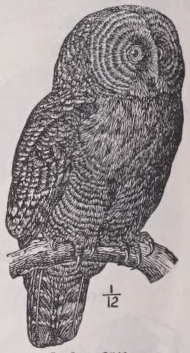
Among the multitude of Owls there is only room here to make further mention of a few of the more interesting. First must be noticed the Tawny Owl—the Strix stridula of Linnaeus, the type, as has been above said, of the whole group, and especially of the Strigine section as here understood. This is the Syrnium aluco of some authors, the Chat-huant of the French, the species whose tremulous hooting “tu-whit, to-who,” has been celebrated by Shakespear, and, as well as the plaintive call, “keewick,” of the young after-leaving the nest, will be familiar sounds to many readers, for the bird is very generally distributed throughout most parts of Europe, extending its range through Asia Minor to Palestine, and also to Barbary—but not belonging to the Ethiopian Region or to the eastern half of the Palaearctic. It is the largest of the species indigenous to Britain, and is strictly a woodland bird, only occasionally choosing any other place for its nest than a hollow tree. Its food consists almost entirely of small mammals, chiefly rodents; but, though on this account most deserving of protection from all classes, it is subject to the stupid persecution of the ignorant, and is rapidly declining in numbers. Its nearest allies in North America are the S. nebulosa, with some kindred forms, one of which, the S. occidentalis of California and Arizona, is figured below; but none of them seem to have the “merry note” that is uttered by the
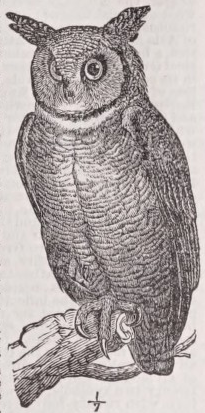
European species. Common to the most northerly forest-tracts of both continents (for, though a slight difference of coloration is observable between American examples and those from the Old World, it is impossible to consider it specific) is the much larger N. cinerea or S. lapponica, whose iron-grey plumage, delicately mottled with dark brown, and the concentric circles of its facial disks make it one of the most remarkable of the group. Then may be noticed the genus Bubo— containing several species which from their size are usually known as Eagle-Owls. Here the Nearctic and Palaearctic forms are sufficiently distinct—the latter, B. ignavus, ' i the Due or Grand Due of the French, ranging over the whole of Europe and Asia north of the Himalayas, while the former, B. virginiamιs, extends over the whole of North America. A contrast to the generally sombre colourof these birds is shown by the Snowy Owl, Nyctea scandiaca, a circumpolar species, and the only one of its genus, which disdains the shelter of forests and braves the most rigorous arctic climate, though compelled to migrate southward in winter when no sustenance is left for it. Its large size and white plumage, more or less mottled with black, distinguish this from every other Owl. Then may be mentioned the birds commonly known in English as “Horned” Owls—the Hibous of the French, belonging to the genus Asio. One, A. otus (the Otus vulgaris of some authors), inhabits woods, and, distinguished by its long tufts, usually borne erected, would seem to be common to both America and Europe—though experts profess their ability to distinguish between examples from each country. Another specieε, A. accipitrinus (the Otus brachyotus of many authors), has much shorter tufts on its head, and they are frequently carried depressed so as to escape observation. This is the ‘‘Woodcock-Owl” of English sportsmen, for, though a good many are bred in Great Britain, the majority arrive in autumn from Scandinavia, just about the time that the immigration of Woodcocks occurs. This species frequents heaths, moors, and the open country generally, to the exclusion of woods, and has an enormous geographical range, including not only all Europe, North Africa, and northern Asia, but the whole of America,—reaching also to the Falklands, the Galapagos, and the Sandwich Islands,—for the attempt to separate specifically examples from those localities only shews that they possess more or less well-defined local races. Commonly placed near Asio, but whether really akin to it cannot be stated, is the genus Scops, of which nearly forty species, coming from different parts of the world, have been described; but this number should probably be reduced by one half. The type of the genus, S. giu, the Petit Due of the French, is a well-known bird in the south of Europe, about as big as a Thrush, with very delicately pencilled plumage, occasionally visiting Britain, emigrating in autumn across the Mediterranean, and ranging very far to the eastward. Further southward, both in Asia and Africa, it is represented by other species of very similar size, and in the eastern part of North America by S. asio, of which there is a tolerably distinct western form, S. kennicotti, besides several local races. S. asio is one of the Owls that especially exhibits the dimorphism of coloration above mentioned, and it was long before the true state of the case was understood. At first the two forms were thought to be distinct, and then for some time the belief obtained that the ruddy birds were the young of the greyer form which was called S. naevia ; but now the “Red Owl” and the “Mottled Owl” of the older American ornithologists are known to be one species. One of the most remarkable of American Owls is Speotyto nmicularia, the bird that in the northern part of the continent inhabits the burrows of the prairie dog, and in the southern those of the biscacha, where the latter occurs—making holes for itself, says Darwin, where that is not the case,—rattlesnakes being often also joint tenants of the same abodes. The odd association of these animals, interesting as it is, cannot here be more than noticed, for a few words must be said, ere we leave the Owls of this section, on the species which has associations of a very different kind—the bird of Pallas Athene, the emblem of the city to which science and art were so welcome. There can be no doubt, from the many representations on coins and sculptures, as to their subject being the Carine noctua of modern ornithologists, but those who know the grotesque actions and ludicrous expression of this veritable buffoon of birds can never cease to wonder at its having been seriously selected as the symbol of learning, and can hardly divest themselves of a suspicion that the choice must have been made in the spirit of sarcasm. This Little Owl (for that is its only name —though it is not even the smallest that appears in England), the Chevêche of the French, is spread throughout the greater part of Europe, but it is not a native of Britain. It has a congener in C. brama, a bird well known to all residents in India.
Finally, we have Owls of the second section, those allied to the Screech-Owl, Aluco flammeus, the Effraie of the French. This, with its discordant scream, its snoring, and its hissing, is far too well known to need description, for it is one of the most widely-spread of birds, and is the Owl that has the greatest geographical range, inhabit!ι g almost every country in the world,—Sweden and Norway, America north of lat. 45°, and New Zealand being the principal exceptions. It varies, however, not inconsiderably, both in size and intensity of colour, and several ornithologists have tried to found on these variations more than half a dozen distinct species. Some, if not most of them, seem, however, hardly worthy to be considered geographical races, for their differences do not always depend on locality. Mr Sharpe, with much labour and in great detail, has given his reasons (Cat. B. Brit. Museum, ii. pp. 291-309; and 0mith. Miscellany, i. pp. 269-298; ii. pp. 1-21) for acknowledging four “subspecies” of A. flammeus, as well as five other species. Of these last, A. tenebricosus is peculiar to Australia, while A. novae-hollandiae inhabits also New Guinea, and has a “subspecies,” A. castanops, found only in Tasmania; a third, A. candidus, has a wide range from Fiji and northern Australia through the Philippines and Formosa to China, Burmah, and India; a fourth, A. capensis, is peculiar to South Africa; while A. thomensis is said to be confined to the African island of St Thomas. To these may perhaps have to be added a species from New Britain, described by Count Salvador! as Strix aurantia, but it may possibly prove on further investigation not to be an Alucine Owl at all.
There are several varieties of this species, all too well known to need a particular description. They are nocturnal birds of prey, and have their eyes better adapted for discerning objects in the evening or twilight than in the glare of day. 1. כוס, Lev. xi, 17; Deut. xiv, 16; Psalm cii, 6, is in our version rendered the little owl.” Aquila, Theodotion, Jerom, Kimchi, and most of the older interpreters, are quoted to justify this rendering. Michaëlis, at some length, supports the opinion that it is the horned owl. Bochart, though with some hesitation, suspected it to be the _onocrotalus_, a kind of pelican, because the Hebrew name signifies _cup_, and the pelican is remarkable for a pouch or bag under the lower jaw; but there are good reasons for supposing that bird to be the קאת of the next verse. Dr. Geddes thinks this bird the cormorant; and as it begins the list of water fowl, and is mentioned always in the same contexts with קאת, confessedly a water bird, his opinion may be adopted. 2. קאת, Lev. xi, 17; Deut. xiv, 16; Isaiah xxxiv, 11. In the two first places our translators render this the great owl,” which is strangely placed after the little owl, and among water birds. Our translators,” says the author of Scripture Illustrated,” “seem to have thought the owl a convenient bird, as we have three owls in two verses.” Some critics think it means a species of night bird, because the word may be derived from נשף, which signifies _the twilight_, the time when owls fly about. But this interpretation, says Parkhurst, seems very forced; and since it is mentioned among water fowls, and the LXX. have, in the first and last of those texts, rendered it by ἴβις, _the ibis_, we are disposed to adopt it here, and think the evidence strengthened ...by this, that in a Coptic version of Lev. xi, 17, it is called _ip_ or _hip_, which, with a Greek termination, would very easily make ιβις. 3. קפון, which occurs only in Isaiah xxxiv, 15, is in our version rendered the great owl.” 4. לילית, Isa. xxxiv, 14, in our version the screech owl.” The root signifies _night_; and as undoubtedly a bird frequenting dark places and ruins is referred to, we must admit some kind of owl.