
1. A fire worshiper; a Gheber or Gueber.
2. See Koulan.
GOUR. See Gaur.
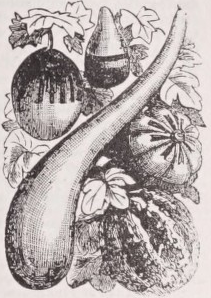
GOURD, a name given to various plants of the order Cuxurbitaceoe, but more strictly applied to those belonging to the genus Cucurbita, monoecious trailing herbs of annual duration, with long succulent stems furnished with tendrils, and large, rough, palmately-lobed leaves; the flowers, reticulated with veins, are generally large and of a bright yellow or orange colour, the barren ones with the stamens united; the fertile are followed by the large, succulent fruit that gives the gourds their chief economic value. Many varieties of Cucurbita are under cultivation in tropical and temperate climates, especially in southern Asia; but it is extremely difficult to refer them to definite specific groups, on account of the facility with which they hybridize; while it is very doubtful whether any of the original forms now exist in the wild state. M. Naudin, who made a careful and interesting series of observations upon this genus, came to the conclusion that all varieties known in European gardens might be referred to six original species; probably three, or at most four, have furnished the edible kinds in ordinary cultivation; and, as all these appear occasionally to hybridize, their limits must be regarded as very uncertain. Adopting the specific names usually given to the more familiar forms, the most important of the gourds, from an economic point of view, is perhaps C. maxima, the Potiron Jaune of the French, the red and yellow gourd of British gardeners, the spheroidal fruit of which is remarkable for its enormous size: the colour of the somewhat rough rind varies from white to bright yellow, while in some kinds it remains green; the fleshy interior is of a deep yellow or orange tint. This valuable gourd is grown extensively in southern Asia and Europe. In Turkey and Asia ...Minor it yields, at some periods of the year, an important article of diet to the people; immense quantities are sold in the markets of Constantinople, where in the winter the heaps of one variety with a white rind are described by Walsh as resembling mounds of snowballs. The yellow kind attains occasionally a weight of upwards of 240 lb. It grows well in central Europe and the United States, while in the south of England it will produce its gigantic fruit in perfection in hot summers. The yellow flesh of this gourd and its numerous varieties yields a considerable amount of nutri ment, and is the more valuable as the fruit can be kept, even in warm climatee, for a long time. In France and in the East it is much used in soups and ragouts, while simply boiled it forms a substitute for other table vegetables; the taβte has been compared to that of a young carrot. In some countries the larger kinds are employed as cattle food. The seeds yield by expression a large quantity of a bland oil, which is used for the same purposes as that of the poppy and olive. The “mammoth” gourds of English and American gardeners appear to belong to this species, or to hybrids between it and another valuable member of the group, the pumpkin, C. Pepo, well known in English cottage gardens, and largely cultivated in continental Europe and North America. The pumpkin varies much in form, being sometimes nearly globular, but more generally oblong or ovoid in shape; the rind is smooth, and very variable in colour. This gourd is a useful plant to the American backwoods farmer, yielding, both in the ripe and unripe condition, a valuable fodder for his cattle and pigs, being frequently planted at intervals among the maize that constitutes his chief crop. The larger kinds acquire a weight of from 40 to 80 B⅛, but smaller varieties are in more esteem for garden culture. When ripe, the pumpkin is boiled or baked, or made into various kinds of pie, alone or mixed with other fruit; while small and green, it may be eaten like the vegetable marrow. Some of the variëties of C. maxima and Pepo contain a considerable quantity of sugar, amounting in the sweetest kinds to 4 or 5 per cent., and in the hot plains of Hungary efforts have been made to make use of them as a commercial source of sugar. The young shoots of both these large gourds may be given to cattle, and admit of being eaten as a green vegetable when boiled. The vegetable marrow, C. ovifera, regarded by Naud in as a variety of C. Pepo, is much esteemed in England for the delicate flavour of its fruit, which is eaten boiled, in the immature state, as a pleasant summer vegetable. A large number of varieties are in cultivation,—the larger oblong or pear-shaped kinds growing a foot or more in length, while some are comparatively small. This useful esculent will succeed in any warm and open situation, if planted over a small trench filled with manure; it is often trained over the fences of cottage gardens, and may be sometimes seen flourishing on the sunny side of railway cuttings in the south of England. C. Melopepo, is the squash or bush gourd, a favourite vegetable in the United States and in parts of continental Europe, but less cultivated in Britain than the preceding. It has a somewhat different habit from most of the family, having more rigid shoots and a tendency towards a shrubby mode of growth; the fruit, yellowish when ripe, is smaller than the pumpkin, and of various shapes, usually with many angles or projections; some sorts resemble a turban, others many-cornered hats, whence fanciful names have been applied to them. The number of kinds is considerable, especially in the United States, where the squashes are much cultivated; the larger kinds are grown as food for pigs and cattle, besides being valued as table esculents; for cooking they should be used in the unripe condition. Many smaller gourds are cultivated in India and other hot climates, and some have been introduced into English gardens, rather for the beauty of their fruit and foliage than for their esculent qualities. Among these is C. Aurantia, the orange gourd, bearing a spheroidal fruit, like a large orange in form and colour; in Britain It is generally too bitter to be palatable, though applied to culinary purposes in Turkey and the Levant. C. ρyτi,∙ formis, C. verrucosa, and C. moschata are likewise occasionally eaten, especially in the immature state; and several other gourds are used as esculents in India and the neighbouring countries.
The bottle-gourds are now generally placed in a separate genus, Lagenaria, chiefly differing from Cucurbita in the anthers being free instead of adherent. The bottle-gourd properly so-called, L. vulgaris, is a climbing plant with downy, heart-shaped leaves and beautiful white flowers: the remarkable fruit first begins to grow in the form of an elongated cylinder, but gradually widens towards the extremity, until, when ripe, it resembles a flask with a narrow neck and large rounded bulb; it sometimes attains a length of 7 feet. When ripe, the pulp is removed from the neck, and the interior cleared by leaving water standing in it; the woody rind that remains is used as a bottle: or the lower part is cut off and cleared out, forming a basin-like vessel applied to the same domestic purposes as the calabash {Crescentia) of the West Indies; the smaller varieties, divided length-wise, form spoons. The ripe fruit is apt to be bitter and cathartic, but while immature it is eaten by the Arabs and Turks. When about the “size of a small cucumber,” Lane says, it is stuffed with rice and minced meat, flavoured with pepper, onions, &c., and then boiled, forming a favourite dish with Eastern epicures. The elongated snake-gourdä of India and China {Trichosanthes) are said to be used in curries and stews.
All the gourds have a tendency to secrete the cathartic principle colocynthin, and in many varieties of Cucurbita and the allied genera it is often elaborated to such an extent as to render them unwholesome, or even poisonous. The seeds of some species possess rather strong anthelmintic properties; those of the common pumpkin are frequently administered in America as a vermifuge. The cultivation of gourds commenced far beyond the dawn of history, and the esculent species have become so modified by culture that the original plants from which they have descended can no longer be traced. The abundance of varieties in India would seem to indicate that-part of Asia as the birthplace of the present edible forms; but some appear to have been cultivated in all the hotter regions of that continent, and in North Africa, from the earliest ages, while the Romans were familiar with at least certain kinds of Cucurbita, and with the bottle-gourd. It is even doubtful whether the culture of gourds had not spread to the American continent before its discovery by Europeans; for the Indian tribes of the interior were certainly in possession of some kinds at a date so early that it is difficult to believe they had received them from the settlers. Dr Asa Gray has even suggested that some of these esculent forms may possibly have been indigenous to the American plains.
Most of the annual gourds may be grown successfully in Britain. They are usually raised in hotbeds or under frames, and planted out in rich soil in the early summer as soon as the nights become warm. The more ornamental kinds may be trained over trellis-work, a favourite mode of displaying them in the East; but the situation must be sheltered and sunny. Even the Lagenarioe will sometimes produce fine fruit when so treated in the southern counties, (c. p. J.)
קיקון, Jonah iv, 6, 7, 9, 10. Michaëlis, in his remarks on this subject, says, “Celsius appears to me to have proved that it is the _kiki_ of the Egyptians.” He refers it to the class of the _ricinus_, the great _catapucus_. According to Dioscorides, it is of rapid growth, and bears a berry from which an oil is expressed. In the Arabic version of this passage, which is to be found in Avicenna, it is rendered, “from thence is pressed the oil which they call oil of _kiki_, which is the oil of Alkeroa.” So Herodotus says: “The inhabitants of the marshy grounds in Egypt make use of an oil, which they term the _kiki_, expressed from the Sillicyprian plant. In Greece this plant springs spontaneously, without any cultivation; but the Egyptians sow it on the banks of the river and of the canals; it there produces fruit in great abundance, but of a very strong odour. When gathered, they obtain from it, either by friction or pressure, an unctuous liquid, which diffuses an offensive smell, but for burning it is equal in quality to the oil of olives.” This plant rises with a strong herbaceous stalk to the height of ten or twelve feet; and is furnished with very large leaves, not unlike those of the plane tree. Rabbi Kimchi says that the people of the east plant them before their shops for the sake of the shade, and to refresh themselves under them. Niebuhr says, “I saw, for the first time at Basra, the plant _ei-keroa_, mentioned in Michaëlis’s ‘Questions.’ It has the form of a tree. The trunk appeared to me rather to resemble leaves than wood; nevertheless, it is harder than that which bears the Adam’s fig. Each branch of the keroa has but one large leaf, with six or seven foldings in it. This plant was near to a rivulet, which watered it amply. At the ...end of October, 1765, it had risen in five months’ time about eight feet, and bore at once flowers and fruit, ripe and unripe. Another tree of this species, which had not had so much water, had not grown more in a whole year. The flowers and leaves of it which I gathered withered in a few minutes; as do all plants of a rapid growth. This tree is called at Aleppo, _palma Christi_. An oil is made from it called _oleum de keroa_; _oleum cicinum_; _oleum ficus infernalis_. The Christians and Jews of Mosul (Nineveh) say, it was not the _keroa_ whose shadow refreshed Jonah, but a sort of gourd, _el-kera_, which has very large leaves, very large fruit, and lasts but about four months.” The epithet which the prophet uses in speaking of the plant, “son of the night it was, and, as a son of the night it died,” does not compel us to believe that it grew in a single night, but, either by a strong oriental figure that it was of rapid growth, or akin to night in the shade it spread for his repose. The figure is not uncommon in the east, and one of our own poets has called the rose “child of the summer.” Nor are we bound to take the expression “on the morrow,” as strictly importing the very next day, since the word has reference to much more distant time, Exod. xiii, 14; Deut. vi, 20; Joshua iv, 6. It might be simply taken as _afterward_. But the author of “Scripture Illustrated” justly remarks, “As the history in Jonah expressly says, _the_ Lord prepared this plant, no doubt we may conceive of it as an extraordinary one of its kind, remarkably rapid in its growth, remarkably hard in its stem, remarkably vigorous in its branches, and remarkable for the extensive spread of its leaves and the deep gloom of their shadow; and, after a certain duration, remarkable for a sudden withering, and a total uselessness to the impatient prophet.”
We read of the wild gourd in 2 Kings iv, 39; that Elisha, being at Gilgal during a great famine, bade one of his servants prepare something for the entertainment of the prophets who were in that place. The servant, going into the field, found, as our translators render it, some _wild gourds_, gathered a lapful of them, and, having brought them with him, cut them in pieces and put them into a pot, not knowing what they were. When they were brought to table, the prophets, having tasted them, thought they were mortal poison. Immediately, the man of God called for flour, threw it into the pot, and desired them to eat without any apprehensions. They did so, and perceived nothing of the bitterness whereof they were before sensible. This plant or fruit is called in Hebrew פקיעות and פקעים. There have been various opinions about it. Celsius supposes it the _colocynth_. The leaves of the plant are large, placed alternate; the flowers white, and the fruit of the gourd kind, of the size of a large apple, which, when ripe, is yellow, and of a pleasant and inviting appearance, but, to the taste intolerably bitter, and proves a drastic purgative. It seems that the fruit, whatever it might have been, was early thought proper for an ornament in architecture. It furnished a model for some of the carved work of cedar in Solomon’s temple, 1 Kings vi, 18; vii, 24.
GOURGAUD, Gaspard, Baron (1783-1852), a French general of artillery, was born at Versailles, 14th September 1783. After studying at the polytechnic school and at the artillery school of Chalons, he joined the artillery in 1802, and, having acquitted himself with distinction in several campaigns, he received in 1807 the cross of honour and the grade of captain. He served in the subsequent Spanish and Austrian campaigns, and in 1811 he was sent to report on the strength of the fortifications of Dantzic, a mission which he fulfilled so much to the satisfaction of Napoleon that he was named one of the emperor’s ordnance officers. During the Russian campaigu he was the first to enter the Kremlin at Moscow, where he removed the match from a large quantity of powder the explosion of which would in all probability have destroyed the emperor’s life. For this service he received the title of baron. He accompanied the emperor in his subsequent campaigns, and in 1814, at the battle of Brienne, was again successful in delivering him from imminent peril. After the accession of Louis XVIII. he was named chief of the staff of the first artillery division, but on the return of Napoleon from Elba he was nevertheless named by him adjutant and general, and took part in the battle of Waterloo. Being one of the three French officers chosen by Napoleon to accompany him to St Helena, he was employed there in collecting materials for a history of Napoleon’s campaigns, but on account of some misunderstanding with Montholon, he left the island, and went to England. He published in 1818 La Campagne de 1815, and he also endeavoured to interest the emperors of Russia and Austria in Napoleon’s behalf. Shortly afterwards he was expelled from England as a spy of Napoleon’s. Returning to ...France in 1821, he published, along with Montholon, in 1823, Mémoires de Napoléon à Sainte-Hélène. His reply in 1825 to Ségur’s Histoire de la Grande Armée was the occasion of a duel between the two authors; and he also, in 1827, became involved in a controversy with Sir Walter Scott regarding some statements made by the latter in his life of Napoleon. After the July revolution of 1830, Gourgaud was appointed to the command of the artillery of Paris and Vincennes; in 1832 he was named aide-de-camp of the king, and in 1835 lieutenant-general. In 1840 he was one of the commissioners sent to bring the remains of Napoleon to France. On the occurrence of the revolution of February 1848 his name was struck off the list of generals, but after the events of the following June he was chosen colonel of the first legion of the national guard of Paris. In 1849 he was elected representative of the legislative assembly for the department of Deux-Sèvres. He died 25th July 1852.