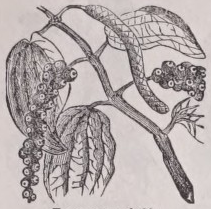
PEPPER, a name applied to several pungent spices known respectively as Black, White, Long, Red or Cayenne, Ashantee, Jamaica, and Melegueta Pepper, but derived from at least three different natural orders of plants.
Black p>epper is the dried fruit of Piper nigrum, L., a perennial climbing shrub indigenous to the forests of Travancore and Malabar, from whence it has been introduced into Java, Sumatra, Borneo, the Malay Peninsula, Siam, the Philippines, and the West Indies. It is one of the earliest spices known to mankind, and for many ages formed a staple article of commerce between India and Europe,—Venice, Genoa, and the commercial cities of central Europe being indebted to it for a large portion of their wealth. Tribute has been levied in pepper; one of the articles demanded in 408 by Alaric as part of the ransom of Rome was 3000 lb of pepper. Pepper-corn rents prevailed during the Middle Ages, and consisted of an obligation to supply a certain quantity of pepper, usually 1 It), at stated times; and the term still lingers in use at the present day. The price of the spice during the Middle Ages was exorbitantly high, and its excessive cost was one of the inducements which led the Portuguese to seek a sea-route to India.
The discovery of the passage round the Cape of Good Hope led (1498) to a considerable fall in the price, and about the same time the cultivation of the plant was extended to the western islands of the Malay Archipelago. Pepper, however, remained a monopoly of the Portuguese crown as late as the 18th century. In Great Britain it was formerly taxed very heavily, the impost in 1623 amounting to 5s., and as late as 1823 to 2s. 6d. per 8>....
The largest quantities of pepper are produced in Penang, the island of Rhio, and Johore near Singapore,—Penang affording on an average about half of the entire crop. Singapore is the great emporium for this spice in the East, the largest proportion being shipped thence to Great Britain. In 1880 the imports into England from Singapore amounted to 21,179,059 ïb, valued at <£385,108, and from other countries 559,909 B>, valued at £12,979, the re-exports being 12,925,886 lb, chiefly to Germany, Italy, Russia, Holland, and Spain. The varieties of black pepper met with in commerce are known as Malabar, Aleppy õr Tellicherry, Cochin, Penang, Singapore, and Siam. The average market value in the London market is—Malabar, 3. 1 ,d to 5∕,d per lb; Penang, 2jd to 4∣d; Singapore, 3∣d to 4∣d.
Pepper owes its pungency to a resin, and its flavour to a volatile oil, of which it yields from 1 ’ 6 to 2'2 per cent. The oil agrees with oil of turpentine in composition as well as in specific gravity and boiling point. In polarized light it deviates the ray, in a column 50 mm. long, 1° ’ 2 to 3° ’ 4 to the left. Pepper also contains a neutral crystalline substance, called piperin, to the extent of 2 to 8 per cent. This substance has the same empirical formula as morphia, C 19 H 19 NO 3 , but differs in constitution and properties. It is insoluble in water when pure, is devoid of colour, flavour, and odour, and may be resolved into piperic acid, C 12 H 10 O 4 , and piperidin, C 5 H 11 N. The latter is a liquid colourless alkaloid, boiling at 106° C., has an odour of pepper and ammonia, and yields crystallizable salts. A fatty oil is found in the pericarp of pepper, and the berries yield on incineration from 4 - l to 5 ’ 7 of ash. The only use of pepper is as a condiment. Notwithstanding its low price and the penalty of £100 to which the manufacturer, possessor, or seller of the adulterated article is liable, powdered pepper is frequently diluted with starch, sago, meal, and other substances, which can be readily detected under the microscope. i. p. 605. ]
In the south-west of India, where the pepper-plant grows wild, it is found in rich, moist, leafy soil, in narrow valleys, propagating itself by running along the ground and giving off roots into the soil. The only method of cultivation adopted by the natives is to tie up the end of the vines to the neighbouring trees at distances of at least 6 feet, especially to those having a rough bark, in order that the roots may easily attach themselves to the surface. The underwood is then cleared away, leaving only sufficient trees to provide shade and permit free ventilation. The roots are manured with a heap of leaves, and the shoots are trained twice a year. In localities where the pepper does not grow wild, ground is selected which permits of free drainage, but which is not too dry nor liable to inundation, and cuttings are planted at about a foot from the trees either in the rainy season in June or in the dry season in February. Sometimes several cuttings about 18 inches long are placed in a basket and buried at the root of the tree, the cuttings being made to slope towards the trunk. In October or November the young plants are manured with a mixture of leaves and cowdung. On dry soils the young plants require watering every other day during the dry season for the first three years. The plants bear in the fourth or fifth year, and if raised from cuttings are fruitful for seven years, if from seed for fourteen years. The pepper from plants raised from cuttings is said to be superior in quantity and quality, and this method is in consequence most frequently adopted. Where there are no trees the ground is made into terraces and enclosed by a mud-wall, and branches of Erythrinα inRica are put into the ground in the rainy season and in the course of a year are capable of supporting the young pepper plants. In the meantime mango trees are planted, these being preferred as supports, since their fruit is not injured by the pepper plant, while the Erythriηa is killed by it in fourteen or fifteen years.
In Sumatra the ground is cleared, ploughed, and sown with rice, and cuttings of the vine are planted in September 5 feet apart each way, together with a sapling of quick growth and rough bark. The plants are now left for twelve or eighteen months and then entirely buried except a small piece of bent stem, whence new shoots arise, three or four of which are allowed to climb the tree near which they are planted. These shoots generally yield flowers and fruits the next year. Two crops are collected every year, the principal one being in December and January and the other in July and August, the latter yielding pepper of inferior quality and in less quantity. Two or three varieties are met with in cultivation; that yielding the best kinds has broadly ovate leaves, five to seven in number, nerved and stalked. The flower-spikes are opposite the leaves, stalked and from 3 to 6 inches long; the fruits are sessile and fleshy. A single stem will bear from twenty to thirty of these spikes. The harvest commences as soon as one or two berries at the base of the spikes begin to turn red, and before the fruit is mature, but when full-grown and still hard; if allowed to ripen, the berries lose pungency, and ultimately fall off and are lost. The spikes are collected in bags or baskets and dried in the sun, on mats or hard ground, for two or three days. When dry the pepper is put into bags containing from 64 to 128 lb, and is then ready for the market. The yield varies in different localities. In Sumatra it is estimated at about 1⅜ lb per plant per annum. In Malabar each vine gives 2 lb a year up to the fifteenth or twentieth year, or about 24 lb from each tree, a single tree sometimes supporting eight or twelve vines; an acre is calculated to bear 2500 plants, to cost about £4 in outlay to bring it into bearing, and to yield a produce of £80 when in its best condition.
White pepper is obtained from the same plant as the black, and differs only in being prepared from the ripe fruits. These, after collection, are kept in the house three days and then bruised and washed in a basket with the hand until the stalks and pulpy matter are removed, after which the seeds are dried. It is, however, sometimes prepared from the dried black pepper by removing the dark outer layer. It is less pungent than the black but possesses a finer flavour. It is chiefly prepared at the island of Rhio, but the finest comes from Tellicherry. The Chinese are the largest consumers. In 1877 Singapore exported 48,461 piculs (apicul = 133⅜ lb) to that country. The London market value is about 4∣d to 7d per ft). White pepper affords on an average not more than 1 · 9 per cent, of essential oil; but, according to Cazeneuve, as much as 9 per cent, of piperin, and of ash not more than 1Ί per cent.
Long pepper is the fruit-spike of Piper officinarum, C.T)C., and P. longum, L., gathered shortly before it reaches maturity and dried. The former is a native of the Indian Archipelago, occurring in Java, Sumatra, Celebes, and Timor. It has oblong, ovate, acuminate leaves, attenuated to the base, which are pinnate and veined. The latter is indigenous to Ceylon, Malabar, eastern Bengal, Timor, and the Philippines; it is distinguished from P. officinarum by the leaves being cordate at the base and five-veined. Long pepper appears to have been known to the ancient Greeks and Romans under the name of τreπeρι μακράν ; and in the 10th century mention is made of long pepper, or macropiper, in conjunction with black and white peppers. The spice consists of a dense spike of minute baccate fruits closely packed around the central axis, the spike being about 1∣ inch long and ∣ inch thick; as met with in commerce they have the appearance of having been limed. In Bengal the plants are cultivated by suckers, which are planted about 5 feet apart on dry rich soil on high ground. An English acre will yield about 3 maunds (80 lb) the first year, 12 the second, and 18 the third year; after this time the yield decreases, and the roots are therefore grubbed up and sold as pipli mul, under which name they are much used as a medicine in India. After the fruit is collected, which is usually in January, the stem and leaves die down to the ground. Long pepper contains piperin, resin, and volatile oil, and yields about 8 per cent, of ash. Penang and Singapore are the principal centres in the East for its sale. In 1871 Singapore shipped 3366 cwt., of which 447 were sent to Great Britain. Penang exports annually about 2000 to 3000 piculs. The value in the London market is from 37s. to 45s. a cwt.
Ashantee or West African pepper is the dried fruit of Piper Clusii, C. DC., a plant widely distributed in tropical Africa, occurring most abundantly in the country of the Niam-niam. It differs from black pepper in being rather smaller, less wrinkled, and in being attenuated into a stalk, like cubebs, to which it bears considerable resemblance externally. The taste, however, is pungent, exactly like that of pepper, and the fruit contains piperin. It was imported from the Grain Coast by the merchants of Rouen and Dieppe as early as 1364, and was exported from Benin by the Portuguese in 1485; but, according to Clusius, its importation was forbidden by the king of Portugal for fear it should depreciate the value of the pepper from India. In tropical Africa it is extensively used as a condiment, and it could easily be collected in large quantities if a demand for it should arise.
Jamaica pepper is the fruit of Pimenta officinalis, Lindl., an evergreen tree of the Myrtle family. It is more correctly termed “pimento,” or “allspice,” as it is not a true pepper.
Melegueta pepper, known also as “Guinea grains,” “grains of paradise,” or “alligator pepper,” is the seed of Amomum Melegueta, Roscoe, a plant of the Ginger family; the seeds are exceedingly pungent, and are used as a spice throughout central and northern Africa. See vol. vi. p. 36.
For Cayenne pepper, see vol. v. p. 280. (e. μ. h.)

[2,123 words — estimated reading time: 13 minutes]
PEPPER TREE. The tree usually so called has no real consanguinity with the true pepper (Piper), but is a member of the Anacard family known botanically as Schinus Molle or Mulli, the latter epithet representing, it is said, the Peruvian name of the plant. It is a small tree with unequally pinnate leaves, the segments linear, entire or finely saw-toothed, the terminal one longer than the rest, and all filled with volatile oil stored in large cells or cysts, which are visible to the naked eye and appear like holes wdιen the leaf is held up to the light. When the leaves are thrown upon the surface of water the resinous or oily fluid escapes with such force as violently to agitate them. The flowers are small, whitish, arranged in terminal clusters, and polygamous or unisexual, with five sepals, as many petals, ten stamens (as large as the petals in the case of the male flower, very small in the female flower, but in both springing from a cushion-like disk surrounding the base of the three-celled ovary). The style is simple or three-cleft, and the fruit a small, globose, pea-like drupe with a bony kernel enclosing a single seed. The fleshy portion of the fruit has a hot aromatic flavour from the abundance of the resin it contains, and to this circumstance the tree probably owes its popular name. The resin is used for medicinal purposes by the Peruvians, and has similar properties to mastic. The Japan pepper tree is Xaηthoxylum piperitum, the fruits of which have also a hot taste. Along the Riviera the tree known as Melia Azedarach, or the “Pride of India,” a very ornamental tree with elegant foliage and dense clusters of fragrant lilac flowers, is also incorrectly called the pepper tree by visitors.
[305 words — estimated reading time: 2 minutes]
PEPPERMINT, an indigenous perennial herb of the natural order Labiatae, and genus Mentha, the specific name being Mentha Piperita, Huds., is distinguished from other species of the genus by its stalked leaves and oblong-obtuse spike-like heads of flowers. It is met with, near streams and in wet places, in several parts of England and on the Continent, and is also extensively cultivated for the sake of its essential oil in England, in several parts of continental Europe, and in the United States. Yet it was only recognized as a distinct species late in the 17th century, when Dr Eales discovered it in Hertfordshire and pointed it out to Ray, who published it in the second edition of his Synopsis Stirpium Britannicarum (1696). The medicinal properties of the plant were speedily recognized, and it was admitted into the London Pharmacopoeia in 1721, under the name of Mentha piperitis sapore.
Two varieties are recognized by growers, the one being known as white and the other as black mint. The former has purplish and the latter green stems; the leaves are more coarsely serrated in the white. The black is the variety more generally cultivated, probably because it is found to yield more oil, but that of the green variety is considered to have a more delicate odour, and obtains a higher price. The green is the kind chiefly dried for herbalists; it is said to be of less vigorous growth than the black. The annual yield of peppermint oil from all parts of the world has been estimated at 90,000 B⅛, but this is probably much below the mark, without taking into consideration the Chinese and Japanese oils of peppermint, which, however, are obtained from a different species of mint....
Peppermint oil varies considerably in commercial value, that of Mitcham commanding nearly three times the price of the finest American. The flavour varies to a slight extent even with particular plots of land, badly drained ground being known to give unfavourable results both as to the quantity and quality of the oil. That of the Japanese and Chinese oil also differs slightly from the English, and is thus distinguishable by experts. In America the oil is liable to be injured in flavour by aromatic weeds which grow freely among the crop, the most troublesome of these being Erigeron canadense, L., and Erechthites hieracifolia, Raf. When pure the oil is nearly colourless and has an agreeable odour and powerful aromatic taste, followed by a sensation of cold when air is drawn into the mouth. It has a specific gravity of 0 - 84 to 0 - 92, and boils at 365° Fahr. Mitcham oil, when examined by polarized light in a column 50 mm. long, deviates from 14°‘2 to 10°'7 to the left, the American 4°*3. When oil of peppermint is cooled to 4° C. it sometimes deposits colourless hexagonal prisms of menthol, C 10 H 20 O, which are soluble in alcohol and ether, almost insoluble in water, and fusible at 92 Fahr. The liquid portion of the oil appears to consist chiefly of the compound C 10 H ιs O, but it has not been thoroughly investigated. Oil of peppermint is often adulterated with a third part of rectified spirit, which may be detected by the milkiness produced when the oil is agitated with water. Oil of rosemary and rectified oil of turpentine are sometimes used for the same purpose. If the oil contains turpentine it will explode with iodine. If quite pure it dissolves in its own weight of rectified spirits of wine. Peppermint oil is largely distilled at Canton, a considerable quantity (about 300 catties annually) being sent to Bombay, also about 600 catties of menthol. The exports from Canton in 1883 amounted to about 1200 ft).
The species cultivated in the neighbourhood of Canton, and probably at Shanghai also, is Mentlιa arvensis, var. glabrata. Peppermint is. chiefly cultivated in the province of Keang-se; and according to native statements as much as 40 piculs of oil of peppermint are sent annually to ports on the coast. In Japan also the distillation of oil of peppermint forms a considerable industry, the plant cultivated being M. arvensis, var. puerascens (see Ph. Joum. [3] vol. ii. p. 324), of which both a purplish and a white form appear to be grown. The oil, under the name of hαkka no abura, is exported from Hiogo and Ozaka, but is said to be frequently adulterated. Since 1872 the peppermint camphor or menthol has been largely exported in the separate state from Japan to Germany and Great Britain. The menthol is obtained by subjecting the oil to a low temperature, when it crystallizes out and is separated. The two varieties of M. arvensis just named yield much more menthol than M. Piperita. It is remarkable, however, that the M. arvensis, var. javanica, Blume, growing in Ceylon, has not the flavour of peppermint but that of garden mint, while the typical form of M. arvensis grown in Great Britain has an odour so different from peppermint that it has to be carefully removed from the field lest it should spoil the flavour of the peppermint oil when the herb is distilled. M. incana, Willd., cultivated near Bombay as a herb, also possesses the flavour of peppermint. In the form in which menthol is imported it bears some resemblance to Epsom salts, with which it is said to be sometimes adulterated. It is usually not entirely free from the essential oil, and consequently undergoes purification and recrystallization in England and on the Continent. The amount of menthol imported by a large firm at Leipsic between September 1883 and April 1884 is stated by them to have been 6380 ft), while it is certain that at least an equal quantity is imported into England from Yokohama. Although the Japanese peppermint plant has been imported by a London merchant, no attempt has as yet been made to cultivate the plant in order to manufacture menthol in England. Menthol is now (1884), however, manufactured from M. Piperita in the United States, where also M. arvensis, var. piperascens, is cultivated.
Oil of peppermint is used in medicine as an antispasmodic for the relief of griping pains in the alimentary canal, to expel flatulence, to relieve nausea, to hide the taste of other medicines, and to act as an adjunct to purgatives. The dose is usually from one to three minims. It forms a most valuable remedy in diarrhoea, acting as an antiseptic, and as a stimulant to the circulation, and as an anodyne. The oil rubbed over the head is used in China to cure sunstroke. Menthol has lately come largely into use as a remedy for neuralgia, being moulded by heat into the form of small cones, which are rubbed over the part affected. A small portion placed on the tongue frequently relieves headache, and catarrh and coryza if placed in the nostril. The largest consumption of the oil is in the manufacture of peppermint lozenges.
The following mode of cultivation is adopted by Mr Holland, at Market Deeping. A rich friable soil, retentive of moisture, is selected, and the ground is well tilled 8 to 10 inches deep. The plants are propagated in the spring, usually in April and May. When the young shoots from the crop of the previous year have attained a height of about 4 inches they are pulled up and transplanted into new soil. They grow vigorously the first year, and throw out numerous stolons on the surface of the ground. After the crop has been removed these are allowed to harden or become woody, and then farmyard manure is scattered over the field and ploughed in. In this way the stolons are divided into numerous pieces, and covered with soil before the frost sets in. If the autumn is wet they are liable to become sodden, and rot, and the next crop fails. In the spring the fields are dressed with Peruvian guano. In new ground the peppermint requires hand-weeding two or three times, as the hoe cannot be used without injury to the plants. Moist heavy weather in August is apt to cause the foliage to drop off and leave the stems almost bare. Under these circumstances rust (Pucciniα Nenthae) also is liable to attack the plants. This is prevented to a certain extent by a rope being drawn across the plants, by two men walking in the furrows, so as to remove excessive moisture. The average yield of peppermint is about 165 cwt. per acre. The first year’s crop is always cut with the sickle to prevent injury to the stolons. The herb of the second and third year is cut with scythes, and then raked by women into loose heaps ready for carting. The field is then gleaned by boys, who add what they collect to the heaps. The plants rarely yield a fourth crop on the same land. The harvest usually commences in the beginning or middle of August, or as soon as the plants begin to flower, and lasts for six weeks, the stills being kept going night and day. The herb is carted direct from the field to the stills, which are made of copper, and contain about 5 cwt. of the herb. Before putting the peppermint into the still water is poured in to a depth of about 2 feet, at which height a false bottom is placed, and on this the herb is thrown and trodden down by men. The lid, which fits into a water-joint, is then let down by pulleys and fastened by two bars, any excess of pressure or temperature being indicated by the water that is ejected at the joint. The distillation is conducted by the application of direct heat at the lowest possible temperature, and is continued for about four and a half hours. When this operation is completed, the lid is removed and a rope is attached to a hook on the false bottom, which, as well as the herb resting on it, is raised bodily by a windlass and the peppermint carried away in the empty carts on their return journey to the fields, where it is placed in heaps and allowed to rot, being subsequently mixed with the manure applied in the autumn as above stated.
At Mitcham extra payment is given to the reapers to induce them to keep the mint free from corn mint {Μentha arvensis) and other herbs, which would injure or spoil the flavour of the oil if not removed before distillation. The usual yield of oil, if the season be warm and dry, is said to be 1 oz. from 5 lb of the fresh flowering herb, but, if wet and unfavourable, the product is barely half that quantity. Mr Holland estimates the yield of a charge of the still at from 1 lb 12 oz. to 5 lb. The oil improves in mellowness even if kept as long as ten or fourteen years. The green colour sometimes present in the oil is stated to be due to a quantity of water larger than necessary having been used in the distillation; on the other hand, if the herb be left in the still from Saturday to Monday, the oil assumes a brown tint
In France peppermint is cultivated on damp rich ground at Sens, in the department of the Yonne. In Germany it is grown in the neighbourhood of Leipsic, where the little town of Cölleda produces annually as much as 40,000 cwt. of the herb. In the United States peppermint is cultivated on a most extensive scale, chiefly in southern Michigan, the west districts of New York State, and Ohio. The amount of peppermint oil now produced in the United States has been estimated at 70,000 lb annually, of which 30,000 lb are exported, about two-thirds of this quantity being produced in New York State and the remaining one-third in Michigan. The yield averages from 10 to 30 lb per acre. The cultivation of peppermint has recently been extended to the southern States. In Michigan the plant was introduced in 1855, and in 1858 there were about ‘2100 acres under cultivation, and 100 distilleries yielding 15,000 tb of oil. In 1870 one of the best-known growers of New York State is said to have sent out as much as 57,365 lb. In 1876 the United States exported to Hamburg 25,840 lb of peppermint oil against 14,890 lb sent by Great Britain to the same port. (E. Μ. H.)
[2,106 words — estimated reading time: 13 minutes]