
A vessel used on the Malabar coast, having two or three masts.
Word of the Day: Catachrestical
1. A vessel used on the Malabar coast, having two or three masts.
3. An instrument for clutching objects for the purpose of raising them; -- specially applied to devices for withdrawing drills, etc., from artesian and other wells that are drilled, bored, or driven.
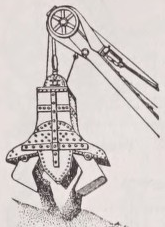
One who seizes or grabs.
1. To grope; to feel with the hands.
1. To grope; to feel with the hands.
Grabe
Encyclopedia Britannica
GRABE, Johann Ernst (1666-1711), a learned divine of the Anglican Church, was born July 10, 1666, at Königsberg, where his father, the author of some treatises now forgotten, was professor of theology and history. In the course of his theological studies Grabe succeeded in persuading himself of the schismatical character of the Reformation of the 16th century, and accordingly presented to the consistory at Samland a memorial in which he compared the position of the evangelical Protestant churches with that of the Simonians, Novatians, and other ancient schismatics. Hardly, however, had he resolved to join the Church of Rome, when his peace was again disturbed by Spener and others, who had pointed out some flaws in his written argument, and called his attention to the English Church as apparently possessing that apostolic succession, and manifesting that fidelity to ancient institutions, which he desired. In 1697, accordingly, he removed to London, and received priest’s orders, attaching himself to the nonjuring party. The learned labours to which the remainder of his life was devoted were rewarded with an Oxford degree and a royal pension. He died on the 3d of November 1711, and in 1726 a monument was erected to him byLord Oxford in Westminster Abbey....
Some account of Grabe’s life is given by Dr Hickes in a discourse prefixed to the pamphlet against Whiston’s Collection of Testimonies against the True Deity of the Son and of the Holy Ghost. His works, which show him to have been learned and laborious but somewhat deficient in critical acumen, include a Spicilegium SS. Patrum el Haereticorum (1698-99), which was designed to cover the first three centuries of the Christian church, but never was continued beyond the close of the second; editions of Justin’s Apologia Prima (1700), of Irenams, Adversus omnes Hoereses (1702), and of the Septuagint {Vet. Test, juxta LXX. interpretes, 4 vols, fol., 1707-1720); also some polemical pieces now of little importance.
9th ed. Encyclopædia Britannica, vol. 11, p. 25
[327 words — estimated reading time: 2 minutes]
[327 words — estimated reading time: 2 minutes]
Grabow
Encyclopedia Britannica
GRABOW, a town of Pomerania, Prussia, government district of Stettin and circle of Randow, is situated on the Oder below Stettin, and closely adjoining its suburbs. Shipbuilding and the manufacture of machinery are the principal industries, and there is also a considerable shipping trade. Grabow did not acquire the rank of a town till 1855. The population in 1875 was 10,238.
9th ed. Encyclopædia Britannica, vol. 11, p. 25
[62 words — estimated reading time: 1 minute]
[62 words — estimated reading time: 1 minute]
Taking Roget’s Thesaurus §789
N. taking, reception, deglutition, appropriation, prehension, prensation|, capture, caption, apprehension, deprehension|, abreption|, seizure, expropriation, abduction, ablation, subtraction, withdrawal, abstraction, ademption, adrolepsy|, dispossession, deprivation, deprivement, bereavement, divestment, disherison, distraint, distress, sequestration, confiscation, eviction, rapacity, rapaciousness, extortion, vampirism, theft, resumption, reprise, reprisal, recovery, clutch, swoop, wrench, grip, haul, take, catch, scramble, taker, captor, subduction
V. take, catch, hook, nab, bag, sack, pocket, put into one's pocket, receive, accept, reap, crop, cull, pluck, gather, draw, appropriate, expropriate, impropriate, assume, possess oneself of, take possession of, commandeer, lay one's hands on, clap one's hands on, help oneself to, make free with, dip one's hands into, lay under contribution, intercept, scramble for, deprive of, take away, carry away, bear away, take off, carry off, bear off, adeem|, abstract, hurry off with, run away with, abduct, steal, ravish, seize, pounce upon, spring upon, swoop to, swoop down upon, take by storm, take by assault, snatch, reave, snap up, nip up, whip up, catch up, kidnap, crimp, capture, lay violent hands on, get hold of, lay hold of, take hold of, catch hold of, lay fast hold of, take firm hold of, lay by the heels, take prisoner, fasten upon, grip, grapple, embrace, gripe, clasp, grab, clutch, collar, throttle, take by the throat, claw, clinch, clench, make sure of, catch at, jump at, make a grab at, snap at, snatch at, reach, make a long arm, stretch forth one's hand, take from, take away from, disseize, deduct, retrench, dispossess, ease one of, snatch from one's grasp, tear from, tear away from, wrench from, wrest from, wring from, extort, deprive of, bereave, disinherit, cut off with a shilling, oust, divest, levy, distrain, confiscate, sequester, sequestrate, accroach, usurp, despoil, strip, fleece, shear, displume, impoverish, eat out of house and home, drain, drain to the dregs, gut, dry, exhaust, swallow up, absorb, draw off, suck the blood of, suck like a leech, retake, resume, recover
Adj. taking, privative, prehensile, predaceous, predal, predatory, predatorial, lupine, rapacious, raptorial, ravenous, parasitic, bereft
Adv. at one fell swoop
Phr. give an inch and take an ell
Parsimony Roget’s Thesaurus §819
N. parsimony, parcity|, parsimoniousness, stinginess, stint, illiberality, tenacity, avarice, greed, miser, niggard, churl, screw, skinflint, crib, codger, muckworm, scrimp, lickpenny, hunks, curmudgeon, harpagon, harpy, extortioner, jew, usurer, hessian, pinch fist, pinch penny
V. be parsimonious, grudge, begrudge, stint, pinch, gripe, screw, dole out, hold back, withhold, starve, famish, live upon nothing, skin a flint, drive a bargain, drive a hard bargain, cheapen, beat down, stop one hole in a sieve, have an itching palm, grasp, grab
Adj. parsimonious, penurious, stingy, miserly, mean, shabby, peddling, scrubby, penny wise, near, niggardly, close, fast handed, close handed, strait handed, close fisted, hard fisted, tight fisted, tight, sparing, chary, grudging, griping, illiberal, ungenerous, churlish, hidebound, sordid, mercenary, venal, covetous, usurious, avaricious, greedy, extortionate, rapacious
Adv. with a sparing hand
Phr. desunt inopioe multa avaritiae omnia, "hoards after hoards his rising raptures fill", "the unsunn'd heaps of miser's treasures", words relating to the sentiment and moral powers
King James Bible KJV Bible
Berean Standard Bible BSB Bible
1 KJV and 12 BSB verses contain “Grab”
And while he lingered, the men laid hold upon his hand, and upon the hand of his wife, and upon the hand of his two daughters; the LORD being merciful unto him: and they brought him forth, and set him without the city.
But when Lot hesitated, the men grabbed his hand and the hands of his wife and his two daughters. And they led them safely out of the city, because of the LORD’s compassion for them.
And the LORD said unto Moses, Put forth thine hand, and take it by the tail. And he put forth his hand, and caught it, and it became a rod in his hand:
“Stretch out your hand and grab it by the tail,” the LORD said to Moses, who reached out his hand and caught the snake, and it turned back into a staff in his hand.
Then Jael Heber’s wife took a nail of the tent, and took an hammer in her hand, and went softly unto him, and smote the nail into his temples, and fastened it into the ground: for he was fast asleep and weary. So he died.
But as he lay sleeping from exhaustion, Heber’s wife Jael took a tent peg, grabbed a hammer, and went silently to Sisera. She drove the peg through his temple and into the ground, and he died.
And I went out after him, and smote him, and delivered it out of his mouth: and when he arose against me, I caught him by his beard, and smote him, and slew him.
I went after it, struck it down, and delivered the lamb from its mouth. If it reared up against me, I would grab it by its fur, strike it down, and kill it.
Therefore David ran, and stood upon the Philistine, and took his sword, and drew it out of the sheath thereof, and slew him, and cut off his head therewith. And when the Philistines saw their champion was dead, they fled.
David ran and stood over him. He grabbed the Philistine’s sword and pulled it from its sheath and killed him; and he cut off his head with the sword. When the Philistines saw that their hero was dead, they turned and ran.
And they caught every one his fellow by the head, and thrust his sword in his fellow’s side; so they fell down together: wherefore that place was called Helkath-hazzurim, which is in Gibeon.
He that passeth by, and meddleth with strife belonging not to him, is like one that taketh a dog by the ears.
Like one who grabs a dog by the ears is a passerby who meddles in a quarrel not his own.
But the same servant went out, and found one of his fellowservants, which owed him an hundred pence: and he laid hands on him, and took him by the throat, saying, Pay me that thou owest.
The servants of the temple: the sons of Esau, the sons of Asipha, the sons of Tabaoth, the sons of Ceras, the sons of Sud, the sons of Phaleas, the sons of Labana, the sons of Graba,