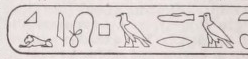
HIEROGLYPHICS Introduction.
THE term hieroglyphics is used, with others, by Greek and Latin writers to describe the sacred characters of the ancient Egyptian language in its classical phase. It is used by the moderns for various systems of writing in which figures of objects take the place of conventional siθ∙ns. This article is limited to an account of Egyptian hieroglyphics, with some notice of the derived systems called hieratic and demotic.
It is no longer necessary in an article like the present to give a history of the interpretation of hieroglyphics and a sketch of the grammar of ancient Egyptian. What students need is a statement of the main results as to the Egyptian characters themselves and a systematic bibliography.
The written language of the ancient Egyptians remained the same from the date of the earliest monuments (Third Dynasty) until the age of the Ethiopian kings (b.c. cir. 700), when a vulgar dialect expressing the common speech is first found in written documents. Then, if not earlier, the older phase of the language became the classical Egyptian, sometimes called the sacred dialect, to distinguish it from the vulgar dialect. The classical Egyptian was used almost as late as the fall of paganism generally for all documents but legal and commercial ones, for which the vulgar dialect was used.
It is necessary to observe that although Egyptian is not proved to be a Semitic language, it contains in its oldest known form undoubted Semitic elements, both in structure and roots. The constant comparison with the Semitic languages which is here necessary is therefore not merely employed for the sake of the analogies that may be discovered, but on the ground of partial affinity, which, however, must not be strained....
It must also be borne in mind that the grammar of ancient Egyptian is in its infancy. We know many of its principal facts, but we do not know them accurately. For instance, we know the forms of many tenses of the verb, and can perhaps place these tenses in groups, as past, present, and future, but we cannot define the different senses of the various tenses of each group. Similarly, in Coptic we do not always know the shades of difference within a group of tenses. It may be that in Coptic these shades have disappeared through the decay of the language, but it would be rash to affirm this of the classical Egyptian. Thus this essential part of the grammar will not be understood until the verb has been thoroughly worked downwards from the oldest texts through ⅛he classical language, then through the demotic, and then the Coptic, and again in inverted order from the Coptic upwards. The same labour has to be performed for the whole grammar in each of the three phases of the language, before we can speak with any certainty of Egyptian grammar. This is said in no disparagement of the admirable work already done, but as a necessary caution to the student.
The following sections are abridged (to p. 806, end of section on “Secret Writing ”), with additions and modifications, which are noted by their being included in parentheses, from Μ. de Rougé’s ChrtS' tomathie Égyptienne, Abrégé Grammatical.
The Systems of Writing.
The elements of Egyptian writing are composed of a certain number of actual objects, natural or artificial, imitated by drawing or engraving.
Egyptian writing falls into three systems—(1) hieroglyphic, (2) hieratic, (3) demotic or enchorial, the hieratic being a simplified form of hieroglyphic, and the demotic of hieratic. The complete designing of hiero∙ glyphics required skill and time. They thus came to be reduced in writing to the simplest forms which retained the leading characteristics. These were called by Champoilion linear hieroglyphics. The linear forms not lending themselves with sufficient readiness to very rapid writing, a further abbreviation was made, by which the forms became almost conventional,—the original type usually ceasing to be immediately recognizable: this cursive system Champoilion called hieratic. The demotic writing is a new abbreviation of the hieratic: it gradually departs so far from the original types as to appear to consist of arbitrary signs.
Hieroglyphics are written either in horizontal lines or vertical columns, and are ordinarily read from the right. The heads of animals and the like shew from what direction to begin reading. Hieratic and demotic are written from right to left, in horizontal lines. In very early times hieratic is sometimes written in vertical columns.
(The hieroglyphic is a lapidary system, the hieratic and demotic purely systems for common writing. Consequently the hieroglyphic is the most difficult of the three to read, as the engraver or painter paid great attention to the symmetrical appearance of each group of signs, and grammatical forms were hence often omitted. In hieratic and demotic the signs follow each other without interruption of the natural order, and the grammatical forms are usually given, and even more fully.)
Characters in Relation to their Use in Writing.
Egyptian writing is composed of a mixture of signs of two distinct classes—(1) ideographic, each sign representing an idea; (2) phonetic, representing a sound, either (a) a simple articulation (alphabetic) or (β) a complete sound, i.e., a complete syllable (syllabic). The two classes were combined according to fixed rules in writing words.
Ideographic Signs.
This class may be best divided into (a) representative signs and (∕3) symbolic (tropical).
The representative signs exactly express the idea of the object of which they present an image, as a star.
The symbolic (tropical) signs represent an idea by the aid of certain analogies which the mind sees between the symbol and the idea attached to it. A simple symbol presents a single object, as the sun Q, when used in the symbolic sense a day.” A symbol is complex when uniting more objects than one to convey to the mind a single idea, thus a star suspended beneath the celestial vault t < represented a night.” Under complex signs should be placed figures of divinities in which the human form has special headdresses or insignia.
The value of ideographic signs may be discovered in various ways. The representative signs only need that the thing represented should be determined. The symbolic signs are often (rather, sometimes) explained by classical authors; they may also be explained by careful study of bilingual documents, as the Rosetta Stone (and the Decree of Canopus). The sense, and more certainly the reading, can be discovered by an exact knowledge of the words written by phonetic combined with ideographic signs, and above all by the variants allowed in writing the same word with signs of different classes.
(The result may be thus tabulated:
[table]
Dr. Brugsch in his Gram. Hier. (p. 3) gives the following scheme:
[table]
Here the ideographic signs are classed, not according to their nature but according to their use, which will be later noticed. Μ. de Rougé’s seems the more logical classification.)
Phonetic Signs.
As the phonetic signs represent either (a) a simple articulation or (∕3) a complete sound, i.e., a complete syllable, the hieroglyphic method comprehends (a) an alphabet and (3) a syllabary.
Champoilion held that the alphabet originated from giving to each object the phonetic value of the initial of its name: thus the mouth <⊂> “ro” would become a r.” This probable principle cannot now be tested for a great part of the alphabet, probably in consequence of the loss of many archaic words.
The alphabet of the Greek and Roman periods presents a great number of homophones .for each articulation. The more we advance towards antiquity the more the method simplifies, and the alphabet of primitive times admits but a very small number of homophones. Dr. Lepsius {Lettre d ßoselhni) first scientifically treated this distinction.
Articulations of the Egyptian Language.
The determination of the exact number of articulations which the scribes distinguished in the Egyptian language presents great difficulties. Comparison with the articulations of languages which occur in bilingual texts cannot give sufficiently precise results, for the shades of sound are far from being the same in the languages thus placed in juxtaposition. The Romans and Greeks had many letters which, though quite distinct in their languages, the Egyptians confounded in their transcriptions. On the other hand, there were some Egyptian articulations preserved in the Coptic language which had no special representative in Greek or Latin; hence certain letters derived from the demotic were added to the Greek alphabet on its adoption by the Copts. (It must also be remarked that the Greek and Roman rule was an age of literary decay and ruin for classical Egyptian, in the depression of which little effort seems to have been made to represent accurately foreign sounds. The student must not be misled by the greater accuracy at this time in rendering the vowels, which was merely due to the decay of the system of writing, by which the Egyptian vowels usually following certain consonant signs came to be disregarded.) Happily those Egyptian articulations which were unknown t□ the Greeks and Romans have at least analogues in thι Semitic languages. Moreover, the many transcriptions of Semitic words (made while the Egyptian was iη full vigour), joined to the traditions of the Coptiα language (which has ceased for a hundred years to be a living speech), enable us to appreciate sufficiently those articulations unknown to the Greeks and Romans (and this indication may be followed in the cases of the rest of the letters).
The words common to Egyptian and Semitic in the earliest known condition of the Egyptian language must be omitted from comparison; the more exact transcriptions of the scribes of the Ramessides (Dynasties XIX., XX.) must take precedence of the looser ones of the earlier period of the Empire (Dynasty XVIII.). Coptic, having long existed in a languishing state and under the influence of Arabic, whence the colouring of the latest dialect, the Bashmuric (Revillout ap. Rossi, Gram. Coρto-Ger., 30, n. l),and certain peculiarities of the present pronunciation, is not an absolutely safe guide.
It might be thought that the study of the various modes in which words are written would furnish an exact table of homophones, and give us at once the list of distinct articulations; thus we might suppose that variants shewing two characters might enable us to assume their identity, as when in reading Greek we assume that θ is the same as θ. But in Egyptian, as in other written languages, there are certain licensed irregularities of orthography, and also oscillations between the different shades of sound in the same class of letters when, used for the same word: a small number of variants between two letters therefore does not prove their perfect homophony. Hence certain differences of opinion among Egyptologists, according to the weight, greater or less, which they give to this or that series of variants. Thus the number of letters under the “t” group differs with different scholars.
Without denying that there may have been some shades of sound in the different signs here called homo* phones, as in the sounds represented by the English “th,” the chief guide should be the estimate the Copts made of the elements of their language, when they adopted the Greek alphabet, completing it for their purpose by adding six special letters taken from demotic writing.
The Egyptian Christians in adopting the Greek alphabet, which had vowels with fixed sounds, made their writing undergo a radical change: up to that time they had only vague vowels which were, as in the Semitic alphabets, simple aspirations, susceptible of being coloured by the sounds of different vowels (but. this vague character must be limited by the vowels falling, as in Semitic, into three groups of sounds; the vagueness was therefore not unlimited. This characteristic of the old Egyptian influenced the Coptic, which presents in the vowels varieties of orthography of the same word, these varieties, however, usually falling within the three ancient groups. It is only in the Coptic helping vowel that absolute vagueness is found, like that of the primitive “shëva” of Hebrew.)
Following these indications we find 15 leading articulations in Egyptian the shades of sound which may be most certainly distinguished would indicate an alphabet of 21 divisions. They are transcribed by letters taken, one, χ, not to be confused with the Coptic excepted, from the Latin alphabet, according to the principles of the Standard Alphabet. Cf. Lepsius, Standard Alphabet- The simple letters used by the Egyptians in the earliest times to write these articulations are as follows:
[table]
During the Pharaonic periods ten homophone letters were added: one is very ancient; some appear under the Ramessides; others under the Saïtic Twenty-sixth Dynasty. Probably they were introduced in order to render it easier to nil spaces in sculptured inscriptions.
It must be observed that all simple letters can in writing radical forms be replaced by syllabic signs.
These articulations have now to be examined under natural classes: their interchange has to be noticed, their use in the transcription of Latin, Greek, and Semitic words, and the rules according to which Egyptian words are transformed into Coptic words in the two chief dialects, the Sahidic and Memphitic. (This branch of the subject is of great importance for comparative philology, as our endeavour should be to ascertain as nearly as we can the fundamental sounds of ancient Egyptian, and then to compare these sounds with those of languages to which it has relation.)
Soft Aspirate, and Vague Vowels.
The Egyptian vowels have two distinct uses—(1) as aspirates, or initials in the syllable, and (2) as vague vowels, either final or medial.
The Copts have marked no difference of aspiration between the initial vowels of syllables in their language, which correspond to ancient words beginning with [∣, or -—o.
When these signs are employed as vowels, or “matres lectionis,’’ it does not appear that one of them was used by preference for one sound more than another: they remain vague in the full force of the term. This vague “a” is unlike the ∣ of prolongation of the Arabs, which (though otherwise susceptible of being coloured by all the vowels) then becomes a true a. (Notwithstanding this vagueness it is safest to transcribe this group by a, as there were special signs for the semi-vowels i and w, and the helping vowel which we write é was not written. The a must, however, be considered a symbol, vague to the extent of the Hebrew X when not vowelled.)
The final vague vowels do not vary much between themselves in the ancient texts; the orthography of each word was very stable, and, besides, the choice of the · final vowel depended much on the preceding consonant, each sign having a vague vowel which it seems to prefer. (See the Section on “Expletive Vowels and Complements of Simple Leiters,” and observe the usage of syllabic signs.) They sometimes interchange, and are even replaced by the vowels u and i, which as finals share their vague character. .This system lasted .to the latest periods of demotic writing. (Coptic shews the same instability of a and the kindred vowels.)
The three signs of the soft aspirate sometimes interchange: (∣ and "⅜X serve equally as initials in Greek and Roman names, as well as in Egyptian words. The group of two a’s, aa, was ordinarily written a ^' a " d * 3 f° un ^ as va " ant °f ^‰ κ ι n *tial∙
ß is used with a marked preference to transcribe the Semitic X.
On the contrary j —o seems preferentially used to express long vowels, or such as were emphatically pronounced. In the Semitic transcriptions it corresponds habitually to V, when that letter is initial. But it was not the same articulation. Under the Nineteenth and Twentieth Dynasties, and particularly in the papyri, a great degree of exactness was sought in the transcription of Semitic words. The scribes often then expressed the ÿ by the syllabic <-=, which has the value of ag,. It seems that the arm alone did not offer them an approximation which they judged sufficient.
The Hebrews transcribed o by y in many words. The (J□ of the Copts answers oftener to .—o than to the other vowels (and this seems a convincing proof that the signs of the u vowel had no stable sound).
There are also some cases of permutation between a and the aspirate h, analogous to the variants between ∏ and X (but we must be careful not to confound true variants with a root in Egyptian augmented by a preformative h).
When the vowel a should form a syllable by itself it is often followed by the sign , which indicates the voice, by the representation of a man, his hand to his mouth. Transcriptions of proper names thus beginning, as °(∣t}> Apoplιis, shew that should a PP i ordinarily be pronounced a.
Ιhe final vague vowels could be omitted in writing; numerous variants shew there was no rule in this matter; but the hieratic, preserves them more habitually. In writing themedial vowel of a syllable of two (or three) consonants, it was very ordinarily placed after the consonants and not between them; this is true of a, a l ä, u, i. Thus the name of the divinity ® ⅛ , ’ X ensu > * s constantly tran scribed by χωvs in proper names. There is a striking instance of this orthography in the word ∖∖ <≡≡≡>, ani for ain, transcription of the Hebrew })V “eye” and “fountain.”—List of cities of Syria taken by Thothmes III.
l7 and i could be initial semi-vowels or vague vowels; «initial answers in many Coptic words to the diphthongs OY(J(J, OYG, &c., without being followed in writing by a second vowel: here it is an initial semi-vowel. Z7 necessarily carried with it its aspiration; there are some variants with the aspirate ∣, h, which recalls i. The two signs , @ , interchange readily, and may be considered to be absolute homophones, but was much more frequently used ir. the earliest times.
U, considered as a vowel, was vague, and in a larger measure than the Hebrew 1, for we find it transcribed even by i and by e. It interchanges with i in Egyptian words, and sometimes even with a. In Hebrew we remark frequently the same oscillation between the sounds w and i in the këri këtib of the Biblical text. In Coptic this vowel has generally produced OY, O, (J□, but very often also G and the other vowels or diphthongs; the group , au, answers to G, e, in the Coptic and the Greek transcriptions; it would be thus equivalent to X in the Masoretic system.
Of the two signs for i, Q and ∖∖ , the second is evidently shorthand for the first. I initial should always be considered to be a semi-vowel with the value ia, iu: in this use we ordinarily find (j > which better fills the initial space; ∖∖ serves oftener for i vague final. Thus the verb i, “to go,” was written with vague a initial for the aspirate, and {j , or ∖∖, as final vowels {∣ , _/\ , or
.A ’ t ^ e lθ ss determinιn S 1 ^ e * dea °f movemcnt: * s transcribed ai; in Coptic I, Gl, “to go,” “come.” We also find the variant
7∖ , «, which is regular in consequence of the vagueness of the vowels. (The two forms are traceable in Coptic.) The signs Q and ∖∖ interchange as much as their forms permit, which fit very differently into the composition of groups.
I, semi-vowel, does not vary with any other letter; it is only found in a very small number of Egyptian words, but it is much used in the Semitic transcriptions; the Coptic derivations are initial I and
Gl.
I, the vague vowel, interchanges with « and a, a, au, ai. The Greek transcriptions oscillate principally between i, e, ei. lhe Semitic transcriptions have a much wider range, which 'comprehends nearly all the vowel sounds.
(The unwritten aspirate or short vowel is not noticed in this place by Μ. de Rouge. It will be seen, under the Section on “the Transcription of Vowels Omitted,” that he does not admit the transcription of an unwritten vowel except as a makeshift, or in other words, that he does not allow the Egyptians to have had a vowel sound never written. The existence of the supposed vowel seems, however, certain on these grounds. Some syllables never take a vowel except for an unusual form,—the root and the ordinary derivatives never being vowelled, and a vowel only appearing in what is obviously a derivative formed by lengthening the vowel. Further, the Coptic has such a vowel marked by peculiar forms v or — above a letter, or in the latter case above a letter or syllable, indicating that the sound, hero generally G, was omitted in writing by the...