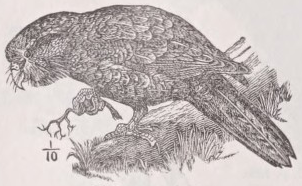
A singular nocturnalparrot (Strigops habroptilus), native of New Zealand. It lives in holes during the day, but is active at night. It resembles an owl in its colors and general appearance. It has large wings, but can fly only a short distance. Called also owlparrot, night parrot, and night kaka.
KAKAPO, the Maori name, signifying “Night-Parrot,” and frequently adopted by English writers, of a bird, commonly called by British colonists in New Zealand the “Ground-Parrot” or “Owl-Parrot.” The existence of this singular form was first made known in 1843 by Dieffenbach (Travels in N. Zealand, ii. p. 194), from some of its tailfeathers obtained by him in the interior of that country, and he suggested that it was one of the Cuculidx, possibly belonging to the genus Centropus, but he added that it was becoming scarce, and that no example had been seen for many years. The late Mr G. R. Gray, noticing it in June 1845 (Zool. Voy. “ .Erebus” and “Terrorf part ix. p. 9), was able to say little more of it, but very soon afterwards a skin was received at the British Museum, of which, in the following September, he published a figure (Ceη. Birds, part xvii.), naming it Strigoρs habroptilus, and rightly placing it among the Parrots, but he did not describe it technically for another eighteen months (Proc. Zool. Society, 1847, p. 61), by which time some further information concerning it had been furnished by Sir George Grey (Ann. Nat. History, xviii. p. 427) and the late Mr Strange (Proc. Zool. Society, 1847, p. 50); while in the same year Jules Verreaux sent an example, with an account of its habits, to the museum of Paris, which was published by Dr Pucheran (Rev. Zooloyique, 1847, p. 385). Various observers, among whom must be especially named Drs Lyall (Proc. Zool. Society, 1852, p. 31) and Haast (Verh. zool.-bot. Gesellsch. Wien, 1863, p. 1115) supplied other particulars, and many specimens have now been received in Europe, so that it is represented in most museums, and at least half a dozen examples have reached England alive. Yet, though much has been ...written about it, there is no detailed description of its internal structure, which fact is the more to be regretted since the bird is obviously doomed to early extinction, and the opportunity of solving several zoological problems of great interest, which a minute examination of its anatomy might afford, will be lost if some one does not speedily take the matter in hand. Few existing birds offer a better subject for a monographer, and it is to be hoped that, if perish the genus and species must, posterity will not have to lament the want of an exhaustive treatise on its many and wonderful characteristics.
In habits the Kakapo is almost wholly nocturnal, hiding in holes (which in some instances it seems to make for itself) under the roots of trees or rocks during the daytime, and only issuing forth about sunset to seek its food, which is solely vegetable in kind, and consists of the twigs, leaves, seeds, and fruits of trees, grass, and fern-roots— some observers say mosses also. It sometimes climbs trees, but generally remains on the ground, only using its comparatively short wings to balance itself in running, or to break its fall when it drops from a tree—though not always then—being apparently quite incapable of real flight. It thus becomes an easy prey to the marauding creatures—cats, rats, and so forth—which European colonists have let loose in New Zealand, so disastrously for its indigenous inhabitants. Sir G. Grey says it had been, within the memory of old people, abundant in every part of that country, but (writing in 1854) was then found only in the unsettled districts. But as the latter are continually suffering from encroachment, so are the haunts of the Kakapo, and it is to be remarked that, from some cause unknown to us, there are localities which, though unsettled, it does not seem to inhabit, and thus little hope can be entertained of its surviving much longer.
The Kakapo is about the size of a Raven, of a green or brownish-green colour, thickly freckled and irregularly barred with dark brown, and dashed here and there with longitudinal stripes of light yellow. Examples are subject to much variation in colour and shade, and in some the lower parts are deeply tinged with yellow. Externally the most striking feature of the bird is its head, armed with a powerful beak, that it well knows how to use, and its face clothed with hairs and elongated feathers that sufficiently resemble the physiognomy of an Owl to justify the generic name bestowed upon it. Of its internal structure little has been described, and that not always correctly. Its furcula has been said {Proc. Zool. Society, 1874, p. 594) to be “lost,” whereas the clavicles, which in most birds unite to form that bone, are present, though they do not meet, while in like manner the bird has been declared {op. cit., 1867, p. 624, note) to furnish among the Carinatae “the only apparent exception to the presence of a keel” to the sternum. The keel, however, is undoubtedly there, as remarked by MM. Blanchard {Ann. Nat. Sc., Zoologie, ser. 4, xi. p. 83) and A. Milne Edwards {Ois. Foss, de la France, ii. p. 516), and, though much reduced in size, is nearly as much developed as in the Dodo and the Weka {<ppvf. The aborted condition of this process can hardly be regarded but in connexion with the incapacity of the bird for flight, and may very likely be, as some have supposed, the result of disuse. There can be scarcely any doubt as to the propriety of considering this genus the type of a separate Family of Psittaci ; but whether it stands alone, or some other forms {Pezoporus or Geopsittacus, for example, which in coloration and habits present some curious analogies) should be placed with it, must await future determination. In captivity the Kakapo is said to shew much intelligence, as well as an affectionate and playful disposition, soon attaching itself to its master and taking pleasure in caressing him and being caressed in turn. Unfortunately it does not seem to share the longevity characteristic of most Parrots, and none that have been held in confinement appear to have long survived, while many succumb speedily. For further details the reader may be referred to Gould’s Pirds of Australia (ii. p. 247) and Handbook (ii. p. 539), Dr Finsch’s Die Papageien (i. p. 241), and Mr Buller’s Birds of New Zealand (p. 26)— in which last work nearly all the information hitherto recorded is to be found. (a. n.)
9th ed. Encyclopædia Britannica, vol. 13, p. 825 [1,081 words — estimated reading time: 7 minutes]
No thesaurus entries found for "Kakapo".
No Bible verses found for "Kakapo".
This site uses cookies to remember your display preferences (search sources and editions, Bible version, auto-link, images, light/dark theme). No personal data whatsoever is collected. Privacy Policy