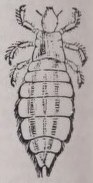
The true lice (or Anoplura) are found on the bodies of many mammalia, and, as is too well known, occasion by their presence intolerable irritation. The number of genera is few. Two species of Pediculus are found on the human body, and are known ordinarily as the head-louse (Z j . capitis) and the body-louse (Z 3 . vestimenti) ; some appear to recognize a third (P. tabescentium), particularly affecting persons suffering from disease, burrowing (at any rate when young) beneath the skin, and setting up what is termed “phthiriasis” in such a terrible form that the unhappy victims at length succumb to its attacks; to this several historical personages both ancient and modern are said to have fallen victims, but it is open to very grave doubts whether this frightful condition of things was due to other than the attacks of myriads of the ordinary bodylouse. P. capitis is found on the head, especially of children. The eggs, laid on the hairs, hatch in about eight days, and the lice are full grown in about a month. Such is the fecundity of lice that it is asserted by Leeuwenhoek that one female (probably of P. vestimenti) may in the course of eight weeks witness the birth of five thousand descendants. Want of cleanliness undoubtedly favours their multiplication in a high degree, but it is scarcely necessary here to allude to the idea once existing, and probably still held by the very ignorant, to the effect that they are directly engendered from dirt. The irritation is caused by the rostrum of the insect being inserted into the skin, from which the blood is rapidly pumped up. Attempts have been made to prove that the head-louse (and, in a smaller degree, the body-louse) is liable to slight variation in structure, and also in colour, according to the races of men infested. This was probably first enunciated by Pouchet in 1841, and the subject received more extended examination by Andrew Murray in a paper published in the Transactions of the Pοyal Society of Edinburgh in 1861 (vol. xxii. pp. 567-577), who apparently shows that some amount of variation does exist, but there is yet need for further investigation. That lice are considered bonnes bouches by certain uncivilized tribes is well known. It would be out of place to discuss here the possible interpretation of the Biblical reference to “lice” {cf. Exodus viii. 16, 17). A third human louse is known as the crab-louse {Phthirius pubis) ; this disgusting creature is found amongst the hairs on other parts of the body, particularly those of the pubic region, but probably never on the head; although its presence may generally be looked upon as indicating dissolute association, it should not be regarded as always resulting therefrom, as it may be accidentally acquired by the most innocent. The louse of monkeys is now generally considered as forming a separate genus {Pedicinus), but the greater part of those infesting domestic and wild quadrupeds are mostly grouped in the large genus Haematopinus, and very rarely is the same species found on different kinds of animals; one species is found on the seal, and even the walrus does not escape, a new species (ZZ. tmchechi) having been recently discovered affecting the axillae (and other parts where the skin is comparatively soft) of that animal.
The bird-lice (or Mallophaga) are far more numerous in species, although the number of genera is comparatively small. With the exception of the genus Tmchodectes, the various species of which are found on mammalia, all infest birds (as their English name implies). As the mouth parts of these creatures are not capable of being extended into a sucking tube, but are clearly mandibulate, it appears probable that they feed more particularly on the scurf of the skin and feathers; nevertheless great irritation must be caused by their presence, for it is notorious that cage-birds, much infested, will peck themselves to such an extent as to cause death in their endeavours to get rid of the parasites. Several hundred species are already known. Sometimes two or three species (ordinarily of different genera) infest the same species of bird, and the same species of louse is not often found in different birds, unless those latter happen to be closely allied. But in aviaries and zoological gardens such cases do occasionally occur, as is natural under the circumstances. These are analogous to the occasional presence of the flea of the cat, dog, domestic fowl, &c., on man; temporary annoyance is caused thereby, but the conditions are not favourable for the permanent location of the parasites. Notwithstanding the marked preference shown by a special kind of bird-lice for a special host, there is also a marked preference shown by the individual species of certain genera or groups of lice for allied species of birds, which bears upon the question of the possible variation of human lice according to the race infested.
Literature.— The following works are the most important:— Denny, Monographia Anoplurorum Britanniae, London, 1843; Giebel, Insecta Eρizoa (which contains the working-up of Nitzsch’s posthumous materials), Leipsic, 1874; Van Beneden, Animal Parasites, London, 1876; Piaget, Les Pédiculincs, Leyden, 1880; Mégnin, Les Parasites et les Maladies Parasitaires, Paris, 1880.