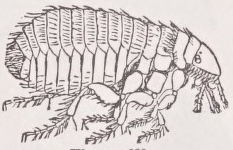
An insect of the genus Pulex. It has two eyes and six feet; the feelers are like threads; the rostrum is inflected, setaceous, and armed with a string. The flea is remarkable for its agility, leaping to a surprising distance, and its bite is very troublesome.
An insect belonging to the genus Pulex, of the order Aphaniptera. Fleas are destitute of wings, but have the power of leapingenergetically. The bite is poisonous to most persons. The human flea (Pulex irritans), abundant in Europe, is rare in America, where the dog flea (P. canis) takes its place. See Aphaniptera, and Dog flea. See Illustration in Appendix.
FLEA, an Anglo-Saxon name, probably derived from fleogan,” to fly, typically applied to Pulex irritans, a blood-sucking insect-parasite of man and other mammal =≈, remarkable for its powers of leaping, and unfortunately too well known, even in our own temperate climate. Its position in classification has long been somewhat undecided; a separate order was erected for it and its allies under the various names of Suctoria, Siphonaptera, Ropfhoteira, and Aphaniptera, by De Geer, Latreille, Clairville, and Kirby respectively; and it is included in the Aptera of Lamarck, MacLeay, and others, and in the Rlιyngota of Fabricius. Various affinities have also been attributed to the group, which has been supposed to have relations with the IIymenoptera, Hemfiptera, and Anoplura, and even with the Coleoptera (beetles). As regards the latter order, it is noteworthy that a recently discovered allied group, Platypsyllidae, founded upon a parasite on the beaver (and considered as a separate order by Westwood, under the name Achreioptera'), has been with considerable show of reason referred to the beetles by so sound an entomologist as Dr Leconte. As regards the flea, however, it is now generally accepted that its true affinities are with the Diptera or two-winged flies, as suggested by Lamarck and Strauss Durckheim. In that order, it is by some held to occupy, as a family PuUcidae (with the Platypsyllidai), the position of a sub-order, at the end, under the name Aplιaniptera (see Diptera, vol. vii. p. 2δ6); but by others it is placed before the Mycetophilidae, at the head of the tribo Encephala of the Nematocerous section of the great division Orthorhapha. The community of parasitic habits with the Ilippoboscidae (forest-flies and sheep-ticks) is to a certain extent the reason ...for the former position; but the earlier transformations seem to indicate a stronger relationship with the Encephala. The general characters have been given under Diptera; but the structure of the mouth of the perfect insect may be specified. The labrum is obsolete; the mandibles are represented by two flat and long processes, strengthened by a mid rib, and having very finely toothed edges, and uniting with the slender central lingua to form a puncturinglancet. When not in use, this is protected by the labialpalpi, which form a sort of tube. The maxillae are small leathery plates, and their palpi, which are four-jointed and large, have been mistaken for antenuae. The power of leaping, as well known, is very great; but there is no apparent development of the hind femora to account for it (as in many jumping beetles), although the posterior legs are saltatorial. The great muscular power of fleas has been long turned to account by public exhibitors in all countries, who have, under the pretence of taming or educating these miuute creatures, made use of various contrivances to render the natural efforts of the insect to escape assume the appearance of trained action. An account of the methods employed will be found in the American Naturalist, vol. xî. p. 7, from the pen of Mr W. H. Dall. In some cases the steady carriage of the flea is to be traced to fracture of its jumping legs. The female flea lays a few oblong white eggs, in dirty places on floors frequented by domestic animals. The larvae, before hatching, have a frontal point, used in breaking the shell of the egg. They are long and worm-like, without feet, but with two small hooks at the tail, and short antennae and mouth organs at the head. They are very active, and apparently feed upon animal substances, forming, when full grown, a silkycocoon. Many species are known, parasitic upon various animals aud birds. They have been recorded as infesting the inside of rabbits’ ears, and the neck of a fowl, from hedgehog, marmot, cat, dog, bat, squirrel, dormouse, ferret, weasel, hare, rabbit, rat, mouse, field-mouse, shrew, moor-hen, jackdaw, thrush, missel-thrush, blackbird, jay, bullfinch, chaffinch, yellow-hammer, pipit, blackcap, whitethroat, skylark, willow-wren, long-tailed titmouse, siskin, stock-dove, woodpigeon, common pigeon, starling, swallow, &c. (though it is by no means certain that these are all necessarily of distinct specific value); and a species has been described from the common fowl in Ceylon. A large species is often found in sandy pits, near the openings of the nests of sand-martins, and a very large one sometimes occurs in wet and marshy places, probably living upon the mole. For the latter parasite, and others in which the antennae exhibit certain supposed peculiarities, a separate genus, Ceratopsyllus, has been proposed. In another flea, also found on the mole, no trace of eyes could be found, even under a high power. A very large species has been found on the Australian porcupine iu Tasmania; and Kirby, in the Fauna Boreali-Americana, described as Pulex gigas a flea two lines long, which he believed to be the largest known. This was taken in 65° N. lat. Westwood has recorded 17 British species; and oddly enough the same number are noted from the Netherlands by Ritsema. Any notice of these parasites would be incomplete without a reference to the “jigger,” “chigoe,” “bicho de pé,” “nigua,” or “earth-flea,”— Dermatophilus, Sarcopsyllus, or Rhynchoprion penetrans, so well known as a burrower into the naked feet of men, in sandy localities in the West Indies and South America. So great is this pest, that serious trouble has been occasioned by it even to military expeditions in South America; and the French army in Mexico was much troubled by it. The entry is effected usually under the nail, by the impregnated female, which thereupon becomes enormously distended with an immense number of eggs. Inflammation and ulceration follow this attack, and unless great care is taken in extracting the insect, serious illness and even death result. A good plate of the metamorphoses of this species is given in the volume of the American Naturalist above quoted, p. 754. For an account of the medical aspects, see Dr Laboulbène’s article on the.“Chique,” in the Dictionnaire Encyclopédique des Sciences Médicales (Paris, 1875), p. 239; and for an exhaustive history, Guyon’s memoir in the Revue et Magasin de Zoologie for 1868 and 1869. Much attention does not appear as yet to have been paid to the Pulicidae by naturalists, except as regards the anatomy of the common species. Dugès’s “Recherches sur les Caractères Zoologiques du genrePulex,” in the Annales des Sciences Naturelles, vol. xxvii. (1832) p. 145, and J. Künckel’s observations in the Annales de la Société Entomologique de France, 5e sér. iii. p. 129, and, as regards P. irritans, W. H. Furlonge’s descriptions in the journal of the Quekett Microscopical Club, 1871, p. 189, and 1873, p. 12, and C. Ritsema’s in the Album der Natuur, xi. (1872), p. 65, may be specially noticed. The name “flea” is frequently erroneously applied to many jumping or lively insects not allied to the Pulicidae; for instance, the “turnip-flea” is a small beetle, Phyllosreta undulata, one of the Halticidae. (e. c. r.)
9th ed. Encyclopædia Britannica, vol. 9, p. 300 [1,194 words — estimated reading time: 7 minutes]
פרעש, 1 Sam. xxiv, 14; xxvi, 20. The LXX, and another Greek version in the _Hexapla_, render it ψύλλον, and the Vulgate _pulex_. It seems, says Mr. Parkhurst, an evident derivative from פרע _free_, and רעש _to leap_, _bound_, or _skip_, on account of its agility in leaping or skipping. The flea is a little wingless insect, equally contemptible and troublesome. It is thus described by an Arabian author: “A black, nimble, extenuated, hunch-backed animal, which being sensible when any one looks on it, jumps incessantly, now on one side, now on the other, till it gets out of sight.” David likens himself to this insect; importing that while it would cost Saul much pains to catch him, he would obtain but very little advantage from it.
A small beetle of the family Halticidae, of many species. They have strong posterior legs and leap like fleas. The turnipflea-beetle (Phyllotreta vittata) and that of the grapevine (Graptodera chalybea) are common injurious species.
Now therefore, let not my blood fall to the earth before the face of the LORD: for the king of Israel is come out to seek a flea, as when one dothhunt a partridge in the mountains.
So do not let my blood fall to the ground far from the presence of the LORD. For the king of Israel has come out to look for a flea, like one who hunts a partridge in the mountains.”
This site uses cookies to remember your display preferences (search sources and editions, Bible version, auto-link, images, light/dark theme). No personal data whatsoever is collected. Privacy Policy