Primarily the Murinae are divisible into the Mures, or those with their molar teeth, as in the Common Rat, and the Sigmodontes, or those with their molars, like those of the Rice-rat of America. Fig. 2 will explain this: A represents the upper molars of a Mus, and B the corresponding teeth of a Sigmodont. It will thus be seen that Mus has molars composed essentially of cusps arranged triserially —that is to say, with three series of cusps across each tooth—while in the Sigmodontes the cusps are arranged biserially in pairs along the teeth. To the first of these groups, the Mures, belong the following genera :—
I. Mus, I.. Incisors narrow, not grooved. Molars small, their structure as shown in fig. 2, A. Incisive foramina long. Coronoid process of lower jaw well developed. Eyes and ears large. Fur soft, though sometimes mixed with spines; pollex with a short nail instead of a claw. No cheek-pouches. Tail long, nearly naked, with rings of overlapping scales.
This, the typical genus of the family, is by far the largest of the order, and indeed of the whole class Mammalia, containing not less than 120 species spread over the whole of the O 1 d World with the exception of Madagascar. Of these, about 30 belong to what is known as the Palaearctic zoological region, 40 to the Oriental, 30 to the Ethiopian, and 20 to the Australian, the number of species being on the whole much more considerable in tropical than in temperate regions, while but very few are found where the climate is excessively cold. It is an interesting fact in connexion with climate that many of the species living in hot countries have their fur more or less mixed with flattened spines, and that these spines appear to be shed during the winter and to be replaced by hairs, the latter naturally affording a warmer covering for the animal than the former.
The most important characters that have been used for the determination of the various species of Mus are the size and proportions of the body, limbs, ears, and tail, the number of mammae, which ranges from 6 to 20, and various more or less important differences in the shape and proportions of the skull and teeth. Of the numerous species the following are those most worthy of note :—
3/us deeumamιs, Pall., the Common Brown or Norway Rat, distinguished by its large size, brownish grey colour, short tail and ears, powerful skull, and the possession of from 10 to 12 mammae. It is extremely fierce and cunning, and easily overcomes in the struggle for existence all the other allied species with which it comes in contact. Its original home would seem to have been some part of Central Asia, an indigenous species recently described from China, Μ. humiliatus, being in fact so extremely like it that in all probability the latter is the original race from which it has sprung. Thence it has spread to all parts of the world, driving out the house-haunting species everywhere, as it has in England all but exterminated the next species.
Μ. rattus, I.., the old English Black Rat, readily distinguishable from the Brown Rat by its smaller size, longer ears and tail, and glossy black colour. It shares the roving habits of Μ. decumanus, frequenting ships, and from them passing to the land in various parts of the world. On this account it, or its tropical representative Μ. alexandrinus, Geof., is extremely common in many places to which Μ. decumanus has not yet penetrated, for instance in South America, where it has had only the far less highly-organized Sigmodontes to compete with, and where it has therefore gained a firm footing. It is extremely interesting to observe that this longtailed rat, originally a native of India, would seem to have first penetrated to all parts of the world and to have overcome and nearly or quite exterminated the indigenous rats, and that then Μ. decumanus, a more recent and powerful development of the House-rat type, has followed, and in its turn has overcome and nearly exterminated it.
Μ. musculus, Linn., the Common House-mouse, is, like the last species, originally a native of India, -whence it has spread to all the inhabited parts of the globe. Its habits and appearance are too well known to need any description.
Μ. sylvaticus, I..,the Wood or Long-tailed Field-mouse,is a species very common in many parts of England, often taking to barns and outhouses for shelter during the winter. It is of about the same size and proportions as Μ. musculus, but of a bright reddish grey colour, with a pure white belly.
Μ. minutus, Pall., the Harvest-mouse, is the smallest of the European mice, seldom exceeding 2⅜ or 3 inches in length. It is of a yellowish red colour, with comparatively short ears and tail. It lives entirely away from houses, commonly taking up its abode in wheat or hay fields, where it builds a round grass nest about the size of a cricket-ball, in which it brings up its young.
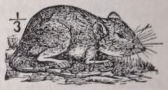
These five English species may be taken as types of the 120 species of Mus. None are much larger than Μ. decumanus or smaller than Μ. minutus, and they all have habits generally similar to those of one or other of the English species, although there are some which either live in trees like squirrels, or in the water like the English Water-voles, among which latter is the species shown in fig. 1, Μ. fuscipes, Waterh., the Brown-footed Rat of western and southern Australia.
II. Nesokia, like Mτιs, but with the incisors and molars very much broader, and the transverse laminae of the latter more clearly defined.
This genus, so closely allied to Mus as to be barely worthy of separation, contains five or six species of clumsily-built rats spread over southern Asia from Palestine to Formosa, and from Cashmere to Ceylon. The most noteworthy member of the group is the Great Bandicoot or Pig-rat of the continent of India (A r . bandicota, Bechs. ), the largest of all the rat tribe, often considerably exceeding a foot in length. The other species vary in size between this and a brown rat. N. bengalensis, Gr., the common Field-rat of India, has no less than eighteen mammse, nearly the largest number found among the Muridae.
III. Golunda, Gray, like Mus, but with a distinct groove down the front of the upper incisors. There are only two species, one from western India, and the other from eastern Africa.
IV. Uromys, Peters., differs from Mus in having the scales of the tail not overlapping, but set edge to edge, so as to form a sort of mosaic work. There are about six species of Uromys, spread over the northern part of the Australian region from the Aru Islands to Queensland.
V. Hapalotis, Licht. Hind-limbs elongated. Incisive foramina very large. No coronoid process to the lower jaw. This genus is confined to Australia, where there are about fifteen species known. They are pretty little animals, with long ears and tail, and in many respects resemble the Jerboas, whose place they seem to take on the sandy Australian deserts.
VI. Mastacomys, Thomas, like Mus, but with the molars remarkably broadened, and with only four mammae. The single species in the genus is as yet only known from Tasmania, though it has been found fossil in New South Wales; it is somewhat similar in size and general appearance to the English Water-vole, but has much longer and softer fur.
VII. Acanthomys, Less. Fur almost entirely composed of flattened spines. Coronoid process very small. There are six species of Spiny-mice known, all of about the size of the Common Mouse. They are found in Syria, Palestine, and eastern Africa as far south as Mozambique.
VIII. Echinothrix, Gray, a very remarkable rat with an extremely elongated muzzle, all the bones of the face being much produced. The incisors are faintly grooved. The only species is E. leucura, an animal of about the size of the Common Bat, with its fur thickly mixed with spines. It is found in Celebes.
The remaining genera belong to the Sigmodontes; they are rather more numerous than those of the Mures, but, on the whole, present somewhat less strongly marked generic differences.
IX. Hypogeomys, Grand., a very peculiar form of large size, with long ears, feet, and tail. There is only one species, H. antimena, a fawn-coloured rat about 9 inches long.
X. Nesomys, Peters., contains two species of long-haired rats, more or less rufous in colour, about the size of the House-rat.
XI. Brachytarsomys, Giinther, contains only B. albicauda, a pretty velvety-haired fawn-coloured rat, with short feet and a long tail.
XII. Hallomys, Jent. The only species, H. audeberti, is very like a Nesomys, but has much longer hind-feet. This and the last three genera are confined to Madagascar.
XIII. Hesperomys, Waterh. Molar structure as shown in fig. 2, B. The Mus of the New World, containing the great mass of the rats and mice of America, and having no very special generic characters common to all its members. This large genus is composed of at least seventy distinct species spread over all America from Canada to Cape Horn, of which none are quite as large as Mus decumanus, while several are considerably smaller than Mus musculus. They have been split up into ten sub-genera, of which perhaps the best marked is Rhipidomys, a small group containing about ten species, remarkably like Dormice in their habits and general appearance, having soft woolly fur and long hairy tails, and living entirely in trees, bushes, or in the roofs of houses. The other Hesperomys are all terrestrial in their habits, much as the Old-World rats and mice are. One only, H spinosus, a native of Peru, has as yet been found with spines in its fur,—a rather remarkable circumstance when we remember how many of the tropical species of the allied genus Mus have more or less spiny fur.
XIV. Holocheilus, Brandt, like Hesperomys, but with the third upper molars proportionately larger and the skull more stoutly built. This genus, confined to Brazil, contains about six species, some of which are the largest indigenous rats of America. Two species are aquatic in their habits, and have therefore developed short webs between the toes of their hind-feet.
XV. Sigmod<m, Say and Ord, differs from Hesperomys in the pattern of the molar teeth. It contains one species only, the Ricerat, S. hispidus, which ranges from the United States to Ecuador.
XVI. and XVII. Reithrodon, Waterh., and Ochetodon, Cones., more or less like Hesperomys, but with grooved upper incisors. The first of these is a South-American genus, and contains four rat-like species, one from Venezuela and the other three from Patagonia. The second consists of three North American mice, of about the size and proportions of the English Wood-mouse, Mus syl·vaticus.
XVIII. Neotoma, Say and Ord, a peculiar North - American group, in which the teeth have the prismatic appearance of those of the Arvicolae (see Vole). There are four species known as “Wood-rats,” all of about the size of Mus decumanus, one of them, N. cinerea, having a tail almost as bushy as a Squirrel’s; the other three with ordinary scaly rat-like tails.
From the ranges of the genera given above it will be seen that all the first group, the Mures, are confined to the Old World, and that of the Sigmodontes four genera are found in Madagascar and the rest in America, thus giving us a very remarkable instance of the peculiar affinity that the fauna of Madagascar has with that of the New World. This affinity is usually explained by the fact that those animals which show it belong as a rule to groups formerly distributed over both the Old and New Worlds, and that since the isolation of Madagascar these, owing to the competition of more highly-organized forms, have been exterminated or strongly modified throughout the continents of the eastern hemisphere, while in the western they have been preserved to the present time. Thus in the present case it seems probable that the original ancestors of the Murinae, if not indeed of the whole family Muridae, were Sigmodontes having molars with their cusps biserially arranged, and that these, being less powerful in the struggle for existence, as is shown by the manner in which roving members of the Mures rapidly multiply at the expense of the indigenous Sigmodontes of any place they may be introduced into, have gradually succumbed to the more recently developed Mures wherever the latter were able to penetrate,—Madagascar having previously become an island, and therefore inaccessible to them. Other groups, however, also probably descendants of Sigmodont Muridae, have become so strongly modified either as to structure or habits as to have been able to avoid the rivalry of the Mures, and thus to exist side by side with the latter; such probably are the Hamsters {Cricetus) and the Voles {Arvicola), both of which have modifications of the biserial arrangement of the molars. As to the Murines from Australia—a region isolated from the rest of the world far earlier than Madagascar—with their very various degrees of specialization, it seems probable, as Mr Wallace has suggested, that from very early times individual rats and mice have drifted on floating trees and other objects from island to island along the Indian archipelago down to Australia, and that the descendants of the earliest arrivals have become the most modified, and that others have been continually joining them, until we get the present state of affairs, namely, one or two genera very markedly different from Mus, others but slightly different, and finally numerous species not generically separable from the European and Asiatic rats and mice. (o. τ.)