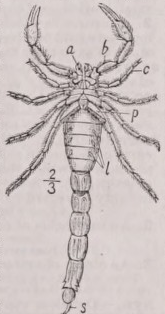
1. In zoology, an insect of the genus Scorpio, or rather the genus itself, containing several species, natives of southern or warm climates. This animal has eight feet, two claws in front, eight eyes, three on each side of the thorax and two on the back, and a long jointed tail ending in a pointed weapon or sting. It is found in the south of Europe, where it seldom exceeds four inches in length. In tropical climates, it grows to a foot in length, and resembles a lobster. The sting of this animal is sometimes fatal to life.
2. In Scripture, a painful scourge; a kind of whip armed with points like a scorpion's tail. 1 Kings 12:11 .
עקרב, Deut. viii, 15; 1 Kings xii, 11, 14; 2 Chron. x, 11, 14; Ezek. ii, 6, σκορϖίος, Luke x, 19; xi, 12; Rev. ix, 3; Ecclus. xxvi, 7; xxxix, 30. Parkhurst derives the name from עק, to _press_, _squeeze_, and רב, _much_, _greatly_, or קרב, _near_, _close_. Calmet remarks, that “it fixes so violently on such persons as it seizes upon, that it cannot be plucked off without difficulty;” and Martinius declares: _Habent scorpii forfices seu furcas tanquam brachia, quibus retinent quod apprehendunt, postquam caudæ aculeo punxerunt_: “Scorpions have pincers or nippers, with which they keep hold of what they seize after they have wounded it with their sting.”
The scorpion, _el-akerb_, is generally two inches in length, and resembles so much the lobster in form, that the latter is called by the Arabs _akerb d’elbahar_, the “sea scorpion.” It has several joints or divisions in its tail, which are supposed to be indicative of its age; thus, if it have five, it is considered to be five years old. The poison of this animal is in its tail, at the end of which is a small, curved, sharp-pointed sting, similar to the prickle of a buckthorn tree; the curve being downward, it turns its tail upward when it strikes a blow. The scorpion delights in stony places and in old ruins. Some are of a yellow colour, others brown, and some black. The yellow possess the strongest poison, but the venom of each affects the part wounded, with frigidity, which takes place soon after the sting has been inflicted. Dioscorides thus describes the effect produced: “Where the scorpion has stung, the place becomes inflamed and hardened; it reddens by tension, and is painful by intervals, being now chilly, now burning. The pain soon rises high, and rages, sometimes more, ...sometimes less. A sweating succeeds, attended by a shivering and trembling; the extremities of the body become cold; the groin swells; the hair stands on end; the visage becomes pale; and the skin feels, throughout it, the sensation of perpetual prickling, as if by needles.” This description strikingly illustrates Revelation ix, 3–5, 10, in its mention of “the torment of a scorpion, when he striketh a man.”
Some writers consider the scorpion as a species of serpent, because the poison of it is equally powerful: so the sacred writers commonly join the scorpion and serpent together in their descriptions. Thus Moses, in his farewell address to Israel, Deut. viii, 15, reminds them, that God “led them through the great and terrible wilderness, wherein were fiery serpents and scorpions.” We find them again united in the commission of our Lord to his disciples, Luke x, 19, “I give you power to tread upon serpents and scorpions, and over all the power of the enemy;” and in his directions concerning the duty of prayer, Luke xi, 11, 12, “If a son shall ask bread of any of you that is a father, will he give him a stone? or if he shall ask an egg, will he offer him a scorpion?”
The scorpion is contrasted with an _egg_, on account of the oval shape of its body. The body of the scorpion, says Lamy, is very like an egg, as its head can scarcely be distinguished; especially if it be a scorpion of the white kind, which is the first species mentioned by Ælian, Avicenna, and others. Bochart has produced testimonies to prove that the scorpions in Judea were about the bigness of an egg. So the similitude is preserved between the thing asked and given. The Greeks have a proverb, ἀντὶ ϖέρκης σκορπίον, _instead of a perch_, or fish, _a scorpion_.
2. SCOR'PION'S TAIL, noun A plant of the genus Scorpiurus, with trailingherbaceous stalks, and producing a pod resembling a caterpillar, whence it is called caterpillars.
N. painfulness, trouble, care, trial, affliction, infliction, blow, stroke, burden, load, curse, bitter pill, bitter draught, waters of bitterness, annoyance, grievance, nuisance, vexation, mortification, sickener, bore, bother, pother, hot water, "sea of troubles", hornet's nest, plague, pest, cancer, ulcer, sting, thorn, canker, scorpion, dagger, scourge, carking care, canker worm of care, mishap, misfortune, desagrement, esclandre, rub, source of irritation, source of annoyance, wound, open sore, sore subject, skeleton in the closet, thorn in the flesh, thorn in one's side, where the shoe pinches, gall and wormwood, sorry sight, heavy news, provocation, affront, "head and front of one's offending", infestation, molestation, malignity
V. cause pain, occasion pain, give pain, bring pain, induce pain, produce pain, create pain, inflict pain, pain, hurt, wound, pinch, prick, gripe, pierce, lancinate, cut, hurt the feelings, wound the feelings, grate upon the feelings, grate upon the nerves, jar upon the feelings, wring the heart, pierce the heart, lacerate the heart, break the heart, rend the heart, make the heart bleed, tear the heart strings, rend the heart strings, draw tears from the eyes, sadden, make unhappy, plunge into sorrow, grieve, fash, afflict, distress, cut up, cut to the heart, displease, annoy, incommode, discompose, trouble, disquiet, faze, feaze, feeze (u .s.), disturb, cross, perplex, molest, tease, tire, irk, vex, mortify, wherret|, worry, plague, bother, pester, bore, pother, harass, harry, badger, heckle, bait, beset, infest, persecute, importune, wring, harrow, torment, torture, bullyrag, put to the rack, put to the question, break on the wheel, rack, scarify, cruciate, crucify, convulse, agonize, barb the dart, plant a dagger in the breast, plant a thorn in one's side, irritate, provoke, sting, nettle, try the patience, pique, fret, rile, tweak the nose, chafe, gall, sting to the quick, wound to the quick, cut to the quick, aggrieve, affront, enchafe, enrage, ruffle, sour the temper, give offense, maltreat, bite, snap at, assail, smite, sicken, disgust, revolt, nauseate, disenchant, repel, offend, shock, stink in the nostrils, go against the stomach, turn the stomach, make one sick, set the teeth on edge, go against the grain, grate on the ear, stick in one's throat, stick in one's gizzard, rankle, gnaw, corrode, horrify, appal, appall, freeze the blood, make the flesh creep, make the hair stand on end, make the blood curdle, make the blood run cold, make one shudder, haunt the memory, weigh on the heart, prey on the heart, weigh on the mind, prey on the mind, weigh on the spirits, prey on the spirits, bring one's gray hairs with sorrow to the grave, add a nail to one's coffin
Int. hinc illae lachrymae, phr, surgit amari aliquid, the place being too hot to hold one, the iron entering into the soul, "he jests at scars that never felt a wound", "i must be cruel only to be kind", "what deep wounds ever closed without a scar?"
Who led thee through that great and terrible wilderness, wherein were fiery serpents, and scorpions, and drought, where there was no water; who brought thee forth water out of the rock of flint;
He led you through the vast and terrifying wilderness with its venomous snakes and scorpions, a thirsty and waterless land. He brought you water from the rock of flint.
And now whereas my father did lade you with a heavy yoke, I will add to your yoke: my father hath chastised you with whips, but I will chastise you with scorpions.
Whereas my father burdened you with a heavy yoke, I will add to your yoke. Whereas my father scourged you with whips, I will scourge you with scorpions.’”
And spake to them after the counsel of the young men, saying, My father made your yoke heavy, and I will add to your yoke: my father also chastised you with whips, but I will chastise you with scorpions.
and spoke to them as the young men had advised, saying, “Whereas my father made your yoke heavy, I will add to your yoke. Whereas my father scourged you with whips, I will scourge you with scorpions.”
For whereas my father put a heavy yoke upon you, I will put more to your yoke: my father chastised you with whips, but I will chastise you with scorpions.
Whereas my father burdened you with a heavy yoke, I will add to your yoke. Whereas my father scourged you with whips, I will scourge you with scorpions.’”
And answered them after the advice of the young men, saying, My father made your yoke heavy, but I will add thereto: my father chastised you with whips, but I will chastise you with scorpions.
and spoke to them as the young men had advised, saying, “Whereas my father made your yoke heavy, I will add to your yoke. Whereas my father scourged you with whips, I will scourge you with scorpions.”
And thou, son of man, be not afraid of them, neither be afraid of their words, though briers and thorns be with thee, and thou dost dwell among scorpions: be not afraid of their words, nor be dismayed at their looks, though they be a rebellious house.
But you, son of man, do not be afraid of them or their words. Do not be afraid, though briers and thorns surround you, and you dwell among scorpions. Do not be afraid of their words or dismayed by their presence, though they are a rebellious house.
And to them it was given that they should not kill them, but that they should be tormented five months: and their torment was as the torment of a scorpion, when he striketh a man.
The locusts were not given power to kill them, but only to torment them for five months, and their torment was like the stinging of a scorpion.
Teeth of wild beasts, and scorpions, serpents, and the sword punishing the wicked to destruction.
This site uses cookies to remember your display preferences (search sources and editions, Bible version, auto-link, images, light/dark theme). No personal data whatsoever is collected. Privacy Policy