
A plant of the genus Atropa, growing naturally in Spain, Italy and the Levant. It is a narcotic, and its fresh roots are a violent cathartic. Its effect in rendering barren women prolific is supposed to be imaginary.
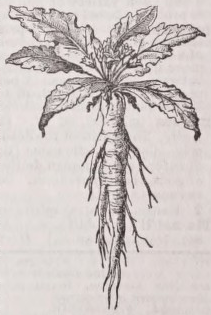
MANDRAKE, Mandragora officinarum, I.., of the potato family, order Solanaceae, is a native of Spain, Sicily, Crete, Cilicia, Syria, &c., and North Africa (Benth, et Hook., Gen. Pl., ii. p. 900; and DC., Prod., xiii. p. 466). It has a short stem bearing a tuft of ovate leaves, with a thick fleshy and often forked root. The flowers are solitary, with a purple bell-shaped corolla. The fruit is a fleshy orange-coloured berry. The mandrake has b⅛en long known for its poisonous properties and supposed virtues. It acts as an emetic, purgative, and narcotic, and was much esteemed in old times; but, except in Africa and the East, where it is used as a narcotic and antispasmodic, it has fallen into disrepute (Pickering’s Chron. Hist, of Plants, p. 247). In ancient times, according to Isidorus and Serapion, it was used as a narcotic to diminish sensibility under surgical operations, and the same use is mentioned by Kazwini, i. 297, s.v. “Luffâh.” Shakespeare more than once alludes to this plant, as when Banquo in Macbeth says—“Or have we eaten of the iïlsane root that takes the reason prisoner 1” and again in Antony and Cleopatra— “Give me to drink mandragora.” The notion that the plant shrieked when touched, so that those who desired to pluck it up had to stop their ears with pitch, is alluded to in Romeo and Juliet— “And shrieks like mandrakes torn out of the earth, that living mortals, hearing them, run mad.” The mandrake, often growing like the lower limbs of a man, was supposed to have other virtues, and was much used for love philtres (Diosc., iv. 76), while the fruit was supposed, and in the East is still supposed, to facilitate pregnancy (Aug., C. Faust., xxii. 56; compare Gen. xxx. 14, where the Hebrew 0 ’ K ’ T∏ is undoubtedly the ...mandrake). Like the mallow, the mandrake was potent in all kinds of enchantment (see Maimonides in Chwolson, Ssabier, ii. 459, and the notes). Dioscorides identifies it with the κιpκaia, the root named after the enchantress Circe. To it appears to apply the fable of the magical herb Baaras, which cured demoniacs, and was procured at great risk or by the death of a dog employed to drag it up, in Josephus (B. J., vii. 6, § 3). The German name of the plant (Alraune; O. H. G. Alrûna) indicates the prophetic power supposed to be in little images (homunculi, Goldmännchen, Galgenmännchen) made of this root which were cherished as oracles. The possession of such roots was thought to ensure prosperity. (See Ducange, s.v. “Mandragora,” and Littré.)
Gerard, in 1597 (Herball, p. 280) described the male and female mandrakes. Dioscorides also recognizes two such plants apparently corresponding to the spring and autumn species (Μ. vernalis, Bert., and Μ. officinarum, I.., respectively), differing as he says in the colour of the foliage and shape of fruit. He alludes to the ‘ ‘ ridiculous tales” and “doltish dreames” about it merely to scout them. He notes that the root is often single, or with two to many branches. Even in his day, as now, the root of the wild bryony was trimmed to represent the human form, miscalled mandrake, and then sold as such to the ignorant.
דודאים, Gen. xxx, 14–16; Cant. vii, 13. Interpreters have wasted much time and pains in endeavouring to ascertain what is intended by the Hebrew word _dudaim_. Some translate it by violet,” others, lilies,” jasmines,” truffle or mushroom,” and some think that the word means flowers,” or fine flowers,” in general. Bochart, Calmet, and Sir Thomas Browne, suppose the citron intended; Celsius is persuaded that it is the fruit of the lote tree; Hiller, that cherries are spoken of; and Ludolf maintains that it is the fruit which the Syrians call mauz, resembling in figure and taste the Indian fig; but the generality of interpreters and commentators understand by _dudaim_, mandrakes, a species of melon; and it is so rendered in the Septuagint, and in both the Targums, on Gen. xxx, 14. It appears from Scripture, that they were in perfection about the time of wheat harvest, have an agreeable odour, may be preserved, and are placed with pomegranates. Hasselquist, the pupil and intimate friend of Linnæus, who travelled into the Holy Land to make discoveries in natural history, imagines that the plant commonly called mandrake, is intended. Speaking of Nazareth, in Galilee, he says, “What I found most remarkable at this village was the great number of mandrakes which grew in a vale below it. I had not the pleasure to see this plant in blossom, the fruit now (May 5th, O. S.) hanging ripe on the stem, which lay withered on the ground. From the season in which this mandrake blossoms and ripens fruit, one may form a conjecture that it was Rachel’s _dudaim_. These were brought her in the wheat harvest, which in Galilee is in the month of May, about this time, and the mandrake was now in fruit.” MANICHÆANS, or MANICHEES, a denomination founded in the latter ...part of the third century, by Mani, Manes, or Manichæus. Being a Persian or Chaldean by birth, and educated among the magi, he attempted a coalition of their doctrine with the Christian system, or rather, the explication of the one by the other. Dr. Lardner, so far from taking Mani and his followers for enthusiasts, as some have done, thinks they erred on the other side, and were rather a sect of reasoners and philosophers, than visionaries and enthusiasts. So Faustus, one of their leaders, says, the doctrine of Mani taught him not to receive every thing recommended as said by our Saviour, but first to examine and consider whether it be true, sound, right, genuine; while the Catholics, he says, swallowed every thing, and acted as if they despised the benefit of human reason, and were afraid to examine and distinguish between truth and falsehood. St. Augustine, it is well known, was for some time among this sect; but they were not pretensions to inspiration, but specious and alluring promises of rational discoveries, by which Augustine was deluded, as he particularly states in his letter to his friend Honoratus. So Beausobre remarks: These heretics were philosophers, who, having formed certain systems, accommodated revelation to them, which was the servant of their reason, not the mistress.” Mani, according to Dr. Lardner, believed in an eternal self-existent Being, completely happy and perfect in goodness, whom alone he called God, in a strict and proper sense; but he believed, also, in an evil principle or being, which he called _hyle_, or the devil, whom he considered as the god of this world, blinding the eyes of them that believe not, 2 Cor. iv, 4. God, the supreme and good, they considered as the Author of the universe; and, according to St. Augustine, they believed, also, in a consubstantial trinity, though they strangely supposed the Father to dwell in light inaccessible, the Son to have his residence in the solar orb, and the Holy Spirit to be diffused throughout the atmosphere; on which account they paid a superstitious, and perhaps an idolatrous, reverence to the sun and moon. Their belief in the evil principle was, no doubt, adopted to solve the mysterious question of the origin of evil, which, says Dr. Lardner, was the ruin of these men, and of many others. As to the _hyle_, or the devil, though they dared not to consider him as the creature of God, neither did they believe in his eternity; for they contended, from the Greek text of John viii, 44, that he had a father. But they admitted the eternity of matter, which they called darkness; and supposed _hyle_ to be the result of some wonderful and unaccountable commotion in the kingdom of darkness, which idea seems to be borrowed from the Mosaic chaos. In this commotion darkness became mingled with light, and thus they account for good and evil being so mixed together in the world. Having thus brought _hyle_, or Satan, into being, they next found an empire and employment for him. Every thing, therefore, which they conceived unworthy of the fountain of goodness, they attributed to the evil being; particularly the material world, the Mosaic dispensation, and the Scriptures on which it was founded. This accounts for their rejecting the Old Testament. Dr. Lardner contends, however, that they received generally the books of the New Testament, though they objected to particular passages as corrupted, which they could not reconcile to their system. On Rom. vii, Mani founded the doctrine of two souls in man, two active principles; one, the source and cause of vicious passions, deriving its origin from matter; the other, the cause of the ideas of just and right, and of inclinations to follow those ideas, deriving its origin from God. Considering all sensual enjoyments to be in some degree criminal, they were enemies to marriage; though, at the same time, knowing that all men cannot receive this saying, they allowed it to the second class of their disciples, called auditors; but by no means to the perfect or confirmed believers. Another absurd consequence of believing the moral evil of matter was, that they denied the real existence of Christ’s human nature, and supposed him to suffer and die in appearance only. According to them, he took the form only of man; a notion that was afterward adopted by Mohammed, and which necessarily excludes all faith in the atonement. Construing too literally the assertion that flesh and blood could not inherit the kingdom of God, they denied the doctrine of the resurrection. Christ came, they said, to save the souls of men, and not the bodies. No part of matter, according to them, could be worthy of salvation. In many leading principles they thus evidently agreed with the Gnostics, of whom, indeed, they may be considered a branch.