
The sun god of the Persians.
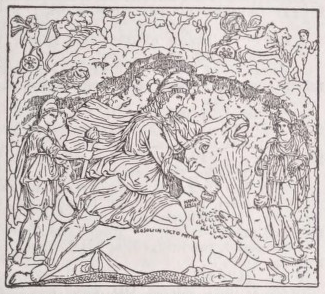
MITHRAS was a Persian god whose worship spread over the Roman world during the 2d and 3d centuries after Christ. His name is found in the oldest records of the East Aryan races. In the Rig-Veda, Mitra, i.e., the friend, and Varuna, i.e., Ουρανός, are a pair of gods regularly associated: they denote the heaven of day and the heaven of night. Mithras is therefore by origin the god of the bright heaven and of day, closely related in conception to, and yet expressly distinguished from, the sun. In the developed Old Persian religion of Zoroaster Mithras retained a place; he was not one of the greatest gods, but was first of a triad which, while less pure embodiments of the divine nature, were more easy for men to comprehend and to worship. The seventh month, which bears his name, and the sixteenth day of every month were sacred to Mithras; prayers were offered to him at sunrise, at mid-day, and at sunset. When the Persians conquered Assyria and Babylonia their religion was much affected by the worship of these more educated races. The worship of foreign deities was introduced, that of Persian deities was changed in character; and the gods were represented by images. The cultus of Mithras now became far more prominent, he was identified with the sun, and an elaborate ritual with the non-Aryan accompaniment of mysteries was established. This revolution had begun before Herodotus (i. 131) could identify Mithras with the Assyrian goddess Mylitta, and it became more thorough during the 4th century b.c....
It is in this most developed form that we know the cultus of Mithras. The god of light becomes by a ready transition, which is made in the very oldest Aryan records, the god of purity, of moral goodness, of knowledge. There goes on in the world as a whole, and in the life of each man, a continual struggle between the power of good and the power of evil; Mithras is always engaged in this contest, and his religion teaches all, men and women alike, to aid in the battle. Victory in this battle can be gained only by sacrifice and probation, and Mithras is conceived as always performing the mystic sacrifice through which the good will triumph. The human soul, which has been separated from the divine nature and has descended to earth, can reascend and attain union with God through a process of fasting and penance which is taught in the mysteries; the sacrifice which is being always offered by Mithras makes this ascent and union possible. Those who were initiated in the mysteries of Mithras had to pass through a long probation, with scourging, fasting, and ordeal by water, and were then admitted as soldiers fighting on behalf of Mithras. This was the lowest terrestrial grade, but there were still two others to attain, the Bull and the Lion, each involving further probation, before the soul could rise above the earth. It then ascended by the grades of Vulture, Ostrich, and Crow through the region of aether; and then it strove to become pure fire through the grades of Gryphon, of Perses, and of the Sun. Finally the soul attained complete union with the divine nature through the grades of Father Eagle, of Father Falcon, and of Father of Fathers. A holy cave on a hill was the central point in the worship; and the mystic rites involved watching and fasting all night till sunrise brought the •triumph of light.
The worship of Mithras became known to the Romans through the Cilician pirates captured by Pompey about 7 0 b.c. It gained a footing in Rome under Domitian, was regularly established by Trajan about 100 a.d., and by Commodus about 190. Finally the mysteries were prohibited and the holy cave destroyed in 378. Dedicatory inscriptions to Deo Soli Invicto Mithrae, and votive reliefs of Roman work, are very common. The usual representation shows Mithras in the mystic cave performing the mystic sacrifice; a young man in Oriental costume kneels with one knee on a prostrate bull, grasping the head and pulling it back with the left hand, while with the right he plunges his sword into its neck. A dog, a snake, and a scorpion drink the blood that flows from the bull; a crow sits on the rock behind Mithras; the figures of the sun and of the moon occupy the two sides of the relief.
See Lajarde, Recherches sur le Culte de Mithras.