RAT. Under the article Mouse (vol. xvii. p. 5) an account has been already given of the relationships and chief allies of the animals known as rats, and the present article is confined to the two species to which the name rat is most strictly applicable. These are the so-called old English black rat, Mus rattus, and the common brown or Norway rat, M. decumanus. The first of these is a comparatively small and lightly built animal, seldom exceeding about 7 inches in length, with a slender head, large ears (see fig., A), and a long thin scaly tail about 8 or 9 inches in length.
Its colour is, at least in all temperate climates, a peculiar shining bluish black, rather lighter on the belly, the ears, feet, and tail being also black; but in tropical regions it is represented by a grey or rufous-backed and white-bellied race to which the name of Alexandrian rat ( M. alexandrinus) has been applied, owing to its having been first discovered at Alexandria, but which cannot be considered to be really specifically distinct from the true black rat. Its disposition is milder and more tamable than that of M. decumanus, and it is therefore the species to which the tame white and pied rats kept as pets commonly belong. It is said that in some parts of Germany M. raft us has been lately reasserting itself and increasing at the expense of M. decumanus ,, but this seems very unlikely from the previous history of the two animals (compare Mouse, vol. xvii. p. 5)....
The brown or Norway rat, M. decumanus, is a heavily built animal, growing to 8 or 9 inches in length, with a bluff rounded head, small ears (see fig., B), and a comparatively short tail,—always shorter than the head and body combined, and generally not longer than the body alone. Its colour is a uniform greyish brown above, and white below, the ears, feet, and tail being flesh-coloured; melanistic varieties are by no means rare, and these are often mistaken for true black rats, but the differences in size and proportions form a ready means of distinguishing the two. The brown rat is believed to be a native of western China, where a wild race has been recently discovered so like it as to be practically indistinguishable. The two species agree fully in their predaceous habits, omnivorous diet, and great fecundity. They bear four or five times in the year from four to ten blind and naked young, which are in their turn able to breed at an age of about six months. The time of gestation is about twenty days. (o. T.)
[447 words — estimated reading time: 3 minutes]
RATAFIA is a term applied to a flavouring essence, the basis of which is the essential oil of bitter almonds. Peach kernels are properly the source of ratafia, but any of the other substances yielding bitter almond oil is used. The name “ratafia” is also applied in France to a variety of liquors, and from Dantzic a special liqueur is sent out under the name of “ratafia” (see vol. xiv. p. 686).
[72 words — estimated reading time: 1 minute]
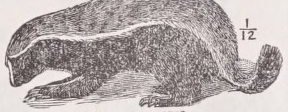
RATEL. The animals known as Ratels or Honey-badgers are small clumsy-looking creatures of about the size and appearance of the true badgers, and belong to the same natural group of the Carnivora, namely, the subfamily Melinas of the large family Mustelidse, which contains the otters, badgers, stoats, weasels, <kc. (see Mammalia, vol. xv. p. 440). Of the ratels two species are generally recognized, viz., the Indian Ratel ( Mellivora indica), a native of all the peninsula of India, and the African (M. ratel), which ranges over the whole of the African continent —although by some authors the West African race is considered to represent a third distinct species, which has been named M. leueonota. All the ratels are of very much the same colour, namely, iron-grey on the upper parts of the head, body, and tail, and black below, a style of coloration rather rare among mammals, as the upper side of the body is in the great majority darker than the lower. Their body is stout and thickly built; the legs are short and strong, and armed, especially on the anterior pair, with long curved fossorial claws; the tail is short; and the ear-conches are reduced to mere rudiments. These modifications are all in relation to a burrowing mode of life, for which the ratels are among the best adapted of all carnivores. The skull is conical, stout, and heavy, and the teeth, although sharper and less rounded than those of their allies the badgers, are yet far less suited to a purely carnivorous diet than those of such typical Mustelidae as the stoats, weasels, and martens. The two species of ratel may be distinguished by the fact that the African has a distinct white line round the body at the junction of the grey of the upper side with the black of the lower, while in the Indian this line is ...absejit; the teeth also of the former are on the whole decidedly larger, rounder, and heavier than those of the latter. In spite of these differences, however, the two ratels are so nearly allied that they might almost be considered to be merely geographical races of a single widely spread species.
The following account of the Indian ratel is extracted from Dr Judson’s Mammals of India·. — “The Indian badger is found throughout the whole of India, from the extreme south to the foot of the Himalayas, chiefly in hilly districts, where it has greater facilities for constructing the holes and dens in which it lives; but also in the north of India in alluvial plains, where the banks of large rivers afford equally suitable localities wherein to make its lair. It is stated to live usually in pairs, and to eat rats, birds, frogs, white ants, and various insects, and in the north of India it is accused of digging out dead bodies, and is popularly known as the grave-digger. It doubtless also, like its Cape congener, occasionally partakes of honey. It is often very destructive to poultry, and I have known of several having been trapped and killed whilst committing such depredations in Central India and in the northern Circars. In confinement the Indian badger is quiet and will partake of vegetable food, fruits, rice, &c.” ' (O. T. )
[547 words — estimated reading time: 4 minutes]