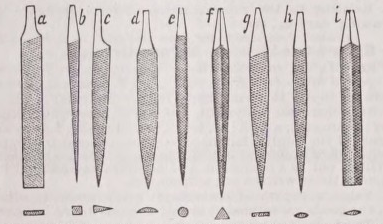
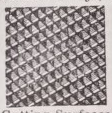
FILE, a bar of steel having sharp teeth on its surface, and used for abrading or smoothing hard substances. Some uncivilized tribes polish their weapons with such things as rough stones, pieces of shark skiu, or fishes’ teeth. The operation of filing is recorded in 1 Sam. xiii. 21; and, among other facts, the similarity of the name for the filing instrument among various European peoples points to an early practice of the art. A file differs from a rasp (which is chiefly used for working wood, horn, and the like) in having its teeth cut with a chisel whose straight edge extends across its surface, while the teeth of the rasp are formed by solitary indentations of a pointed chisel. According to the form of their teeth, files may be single-cut or double-cut; the former have only one set of parallel ridges (either at right angles or at some other angle with the length); the latter (and more common) have a second set cut at an angle with the first. The double-cut file presents sharp angles to the filed surface, and is better suited for hard metals. Files are also classed according to fineness of teeth, being known (in order of increasing fineness) as rough, bastard, second-cut, smooth, and superfine or dead smooth. The shapes of files present almost endless varieties. Common forms are—the fiat file, of parallelogram section, with uniform breadth and thickness, or tapering, or “bellied”; the four-square file, of square section, sometimes with one side “safe,” or left smooth; the so-called three-square file, having its cross section an equilateral triangle, the half-round file, a segment of a circle, the round or rat-tail file, a circle; these are generally tapered. The float file is like the flat, but single-cut. There are many others. Files vary in length from ...three-quarters of an inch (watchmakers’) to two or three feet and upwards (engineers’). The length is reckoned exclusively of the spike or tang which enters the handle. Most files are tapered; the blunt are nearly parallel, with larger section near the middle; a few are parallel. The rifflers of sculptors and a few other files are curvilinear in their central line.
Cast-steel is the material chiefly used for files, though the larger and rougher varieties are sometimes made from blister-steel. In manufacture, the blanks are forged from bars that have been tilted or rolled as nearly as possible to the sections required. They are then annealed with great care, and when sufficiently softened are taken out, straightened, if necessary, with hand hammers, and then reudered clean and accurate in form by filing or grinding. They are now ready for cutting. In this process, as performed by hand, the cutter sits before a square stake or anvil, on which the blank, slightly greased, is held (having its tang towards him) by means of two leather straps passed round its ends, and held fast below, one by each foot. He holds in his left hand a short chisel (the edge of which always exceeds the width of the file), placing it on the blank with a slight inclination from him, and beginning near the further end. He strikes the chisel sharply with a hammer, an indentation is thus made, and the steel, slightly thrown up on the side next the tang, forms a ridge. The chisel is then transferred to the uncut surface, and slid from the operator till it reaches the ridge just made; thus the position of the next cut is determined; the chisel is again struck, and so on. (The end part of the file is dealt with separately.) The workman seeks to give his blows as uniformly as possible. Sixty to eighty cuts are made in one minute. After finishing. the first course of cuts, he proceeds, if the file is to be double-cut, to make the second course, the cuts of the latter being generally somewhat finer. Thus the surface is covered with teeth inclined towards the point of the file. If the file is flat and is to be cut on the other side, it is turned over, and a thin plate of pewter placed below it to protect the teeth. Triangular and other files are supported in grooves in lead. In cutting round and half-round files, a straight chisel is applied as tangent to the curve. The round face of a half-round file requires eight, ten, or more courses to complete it.
The file is next hardened. Being first covered with a paste to protect the teeth from the direct action of fire, Ac. (e.g., passed through beer-grounds to make it sticky, then through a mixture of common salt with roasted and pounded cow’s hoof), it is heated to an even red heat, and then suddenly cooled by plunging in cold water or brine. It is removed before cooling throughout, that it may be straightened if necessary (which is done by pressure). Then it is cooled in oil. The tang is next submitted to a softening process, and the file, after being wiped, and the teeth brushed clean, is ready for fixing into the handle and for use.
In England files are chiefly made in Sheffield and Warrington, those of the latter place being generally known as Lancashire files. It is remarkable that while many other operations that appear more difficult than file-cutting are now effected by machinery, and while numerous file-cutting machines have been invented, the work continues (in England) to be largely done by hand. This is perhaps partly due to strong opposition on the part of operatives to introduction of machinery, and also to a foolish prejudice in favour of hand-cut files (machine-cut files, indeed, are not unfrequently sold as hand-cut), but probably also to the problem of cutting files by machinery being really somewhat difficult. In most of the machines invented for that purpose, the idea has been to construct an iron arm and hand to hold the chisel, and a hammer to strike the blow, and so to imitate, as closely as possible, the manual process. Barnot’s machine is an improvement on this. In it the blow is given by pressure of a flat steel spring pressing on the top of a vertical slide, at the lower end of which the chisel is firmly fixed. The slide is acted on by a cam making about one thousand revolutions a minute, and the chisel consequently strikes that number of blows per minute. The vibration is thus lessened. The history of file-making by machinery in America (where it has been extensively practised) seems to indicate that much of the failure experienced has been due to the fatal defect in. the machinery used, of producing extreme regularity in the teeth. This gives rise to complaints by artisans about files “running in grooves,” “chattering,” &c. The grooves produced by the file (if double-cut especially) at the beginning of its movement are deepened as it is moved further. With irregular teeth, on the other hand, such as are found in all hand-made files, the grooves made in the first instance have their sides cut away as the file is advanced. The Nicholson File Company, in Providence, Rhode Islaud, have used, with large and increasing success, a machine which imitates, to some extent, this irregular result of the hand process, cutting the file so that no two spaces are found exactly alike in the entire length.
The filing of a flat surface perfectly true is the test of a good filer; and this is no easy matter to the beginner. The piece to be operated upon is generally fixed about the level of the elbow, the operator standing, and, except in the case of small files, grasping the file with both hands, the handle with the right, the further end with the left. The great point is to be able to move the file forward with pressure in horizontal straight lines; from the tendency of the hands to move in arcs of circles, the heel and point of the file are apt to be alternately raised. This is partially compensated by the bellied form given to many files (which also counteracts the frequent warping effect of the hardening process, by which one side of a flat file may be rendered concave and useless). In bringing back the file for the next thrust it is nearly lifted off the work. Further, much delicacy aud skill are required in adapting the pressure and velocity, ascertaining if foreign matters or filings remain interposed between the file and the work, &c. Files can be cleaned with a peace of the so-called cotton-card (used in combing cotton wool) nailed to a piece of wood. In draw-filing, which is sometimes resorted to to give a neat finish, the file is drawn sideways to and fro over the work. New files are generally used for a time on brass or cast-iron, and when partially worn they are still available for filing wrought iron and steeL
An interesting application of the sandblast to sharpening the ~ teeth of files has recently been made by M. Tilghmann. (a. b. μ.)
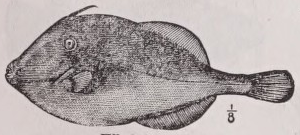
FILE-FISH and Trigger-fish are names given to fishes of the genus Batistes (and Monαcαnthus) inhabiting all tropical and subtropical seas. Their body is compressed and not covered with ordinary scales, but with small juxtaposed scutes. Their other principal characteristics consist in the structure of their first dorsal fin (which consists of three spines) and in their peculiar dentition. The first of the three dorsal spines is very strong, roughened in front like a file, and hollowed out behind to receive the second much smaller spine, which, besides, has a projection in front, at its base, fitting into a notch of the first. Thus these two spines can only be raised or depressed simultaneously, in such a manner that the first cannot be forced down unless the second has been previously depressed. The latter has been compared to a trigger, hence the name of Trigger fish. Also the generic name Batistes and the...
Italian name of “Pesce balistra” refer to this structure. Both jaws are armed with eight strong incisor-like and sometimes pointed teeth, by which these fishes are enabled, not only to break off pieces of madrepores aud other corals on which they feed, but also to chisel a hole into the hard shells of Mollusca, iu order to extract the soft parts. In this way they destroy an immense number of mollusks, and become most injurious to the pearl-fisheries. ' The gradual failure of those fisheries in Ceylon has been ascribed to this cause, although evidently other agencies must have been at work at the same time. The Monacanthi are distinguished from the Batistes in having only one dorsal spine and a velvety covering of the skin. Some 30 different species are known of Batistes, and about 50 of Monacanthus. Two species (B. maculatus and caρriscuP), common in the Atlantic, sometimes wander to the British coasts.
FILELFO, Francesco (1398-1481), was born in 1398 at Tolentino, in the March of Ancona. When he appeared upon the scene of human life, Petrarch and the students of Florence had already brought the first act in the recovery of classic culture to conclusion. They had created an eager appetite for the antique, had disinterred many important Roman authors, and had freed Latin scholarship to some extent from the barbarism of the Middle Ages. Filelfo was destined to carry on their work in the field of Latin literature, and to be an important agent in the still unaccomplished recovery of Greek culture. His earliest studies in grammar, rhetoric, and the Latin language were conducted at Padua, where he acquired so great a reputation for learning that in 1417 he was invited to teach eloquence and moral philosophy at Venice. According to the custom of that age in Italy, it now became his duty to explain the language, and to illustrate the beauties of the principal Latin authors, Cicero and Virgil being considered the chief masters of moral science and of elegant dictioD. Filelfo made his mark at once in Venice. He was admitted to the society of the first scholars and the most eminent nobles of that city; and in 1419 he received an appointment from the state, which enabled him to reside as secretary to the consul-general of the Venetians in Constantinople. This appointment was not only honourable to Filelfo as a man of trust and general ability, but it also gave him the opportunity of acquiring the most coveted of all possessions at that moment for a scholar—a knowledge of the Greek language. Immediately after his arrival in Constantinople, Filelfo placed himself under the tuition of John Chrysoloras, whose name was already well known in Italy as brother of Manuel, the first Greek ...to profess the literature of his ancestors in Florence. At the recommendation of Chrysoloras he was employed in several diplomatic missions by the emperor John Palaeologus. Before very long the friendship between Filelfo and his tutor was cemented by the marriage of the former to Theodora, the daughter of John Chrysoloras. He had now acquired a thorough knowledge of the Greek language, and had formed a large collection of Greek manuscripts. There was no reason why he should not return to his native country. Accordingly, in 1427 he accepted an invitation from the republic of Venice, and set sail for Italy, intending to resume his professorial career. From this time forward until the date of his death, Filelfo’s history consists of a record of the various towns in which he lectured, the masters whom he served, the books he wrote, the authors he illustrated, the friendships he contracted, and the wars he waged with rival scholars. He was a man of vast physical energy, of inexhaustible mental activity, of quick passions, and violent appetites; vain, restless, greedy of gold and pleasure and fame; unable to stay quiet in one place, and perpetually engaged in quarrels with his compeers.
When Filelfo arrived at Venice with his family in 1427, he found that the city had almost been emptied by the plague, and that his scholars would be few. He therefore removed to Bologna; but here also he was met with drawbacks. The city was too much disturbed with political dissensions to attend to him; so Filelfo crossed the Apennines and settled in Florence. At Florence began one of the most brilliant and eventful periods of his life. During the week he lectured to large audiences of young and old on the principal Greek and Latin authors, and on Sundays he explained Dante to the people in the Duomo. In addition to these labours of the chair, he found time to translate portions of Aristotle, Plutarch, Xenophon, and Lysias from the Greek. Nor was he dead to the claims of society. At first he seems to have lived with the Florentine scholars on tolerably good terms; but his temper was so arrogant that Cosimo αe , Medici’s friends were not long able to put up with him. Filelfo hereupon broke out into open and violent animosity; and when Cosimo was exiled by the Albizzi party in 1433, he urged the signoria of Florence to pronounce upon him the sentence of death. On the return of Cosimo to Florence, Filelfo’s position in that city was no longer tenable. His life, he asserted, had been already once attempted by a cut-throat in the pay of the Medici; and now he readily accepted an invitation from the state of Siena. In Siena, however, he was not destined to remain more than four years. His fame as a professor had grown great in Italy, and he daily received tempting offers from princes and republics. The most alluring of these, made him by the duke of Milan, Filippo Maria Visconti, he decided on accepting; and in 1440 he was received with honour by his new master in the capital of Lombardy.
Filelfo’s life at Milan curiously illustrates the multifarious importance of the scholars of that age in Italy. It was his duty to celebrate his princely patrons in panegyrics and epics, to abuse their enemies in libels and invectives, to salute them with encomiastic odes on their birthdays, and to compose poems on their favourite themes. For their courtiers he wrote epithalamial and funeral orations; ambassadors and visitors from foreign states he greeted with the rhetorical lucubrations then so much in vogue. The students of the university he taught in daily lectures, passing in review the weightiest and lightest authors of antiquity, and pouring forth a flood of miscellaneous erudition. Not satisfied with these outlets for his mental energy, Filelfo went on translating from the Greek, and prosecuted a paper warfare with his enemies in Florence. He wrote, moreover, political pamphlets on the great events of Italian history; and when Constantinople was taken by the Turks, he procured the liberation of his wife’s mother by a message addressed in his own name to the sultan. In addition to a fixed stipend of some 700 golden florins yearly, he was continually in receipt of special payments for the orations and. poems he produced; so that, had he been a man of frugal habits or of moderate economy, he might have amassed a considerable fortune. As it was, he spent his money as fast as he received it, living in a style of splendour ill befitting a simple scholar, and indulging his taste for pleasure in more than questionable amusements. In consequence of this prodigality, he was always poor. His letters and his poems abound in impudent demands for money from patrons, some of them couched in language of the lowest adulation, and others savouring of literary brigandage.
During the second year of his Milanese residence Filelfo lost his first wife, Theodora. He soon married again; and this time he chose for his bride a young lady of good Lombard family, called Orsina Osnaga. When she died, he took in wedlock for the third time a woman of Lombard birth, Laura Magiolini. To all his three wives, in spite of numerous infidelities, he seems to have been warmly attached; and this is perhaps the best trait in a character otherwise more remarkable for arrogance and heat than for any amiable qualities.
On the death of Filippo Maria Visconti, Filelfo, after a short hesitation, transferred his allegiance to Francesco Sforza, the new duke of Milan; and in order to curry favour with this parvenu, he began his ponderous epic, the Sforziad, of which 12,800 lines were written, but which was never published. When Francesco Sforza died, Filelfo turned his thoughts towards Rome. He was now an old man of seventy-seven years, honoured with the friendship of princes, recognized as the most distinguished of Italian humanists, courted by pontiffs, and decorated with the laurel wreath and the order of knighthood by kings. Crossing the Apennines and passing through Florence, he reached Rome in the second week of 1475. The terrible Sixtus IV. now ruled in the Vatican; and from this pope Filelfo had received an invitation to occupy the chair of rhetoric with good emoluments. At first he was vastly pleased with the city and court of Rome; but his satisfaction ere long turned to discontent, and he gave vent to his ill humour in a venemous satire on the pope’s treasurer, Milliardo Cicala. Sixtus himself soon fell under the ban of his displeasure; and when a year had passed, he left Rome never to return. Filelfo reached Milan to find that his wife had died of the plague in his absence, and was already buried. His own death followed speedily. For some time past he had been desirous of displaying his abilities and adding to his fame in Florence. Years had healed the breach between him and the Medicean family; and on the occasion of the Pazzi conspiracy against the life of Lorenzo de’ Medici, he had sent violent letters of abuse to his papal patron Sixtus, denouncing his participation in a plot so dangerous to the security of Italy. Lorenzo now invited him to profess Greek at Florence, and thither Filelfo journeyed in 1481. But two weeks after his arrival he succumbed to dysentery, and was buried at the age of eighty-three in the church of the Annunziata.
Filelfo deserves commemoration among the greatest humanists of the Italian Renaissance, not for the beauty of his style, not for the elevation of his genius, not for the accuracy of his learning, but for his energy, and for his complete adaptation to the times in which he lived. His erudition was large but ill-digested; his knowledge of the ancient authors, if extensive, was superficial; his style was vulgar; he had no brilliancy of imagination, no pungency of epigram, no grandeur of rhetoric. Therefore he has left nothing to posterity which the world would not very willingly let die. But in his own days he did excellent service to learning by his untiring activity, and by the facility with which he used his stores of knowledge. It was an age of accumulation and preparation, when the world was still amassing and cataloguing the fragments rescued from the wrecks of Greece and Rome. Men had to receive the very rudiments of culture before they could appreciate its niceties. And in this work of collection and instruction Filelfo excelled, passing rapidly from place to place, stirring up the zeal for learning by the passion of his own enthusiastic temperament, and acting as a pioneer for men like Poliziano and Erasmus. All that is worth knowing about Filelfo is contained in Rosmini’s admirable Vita di Filelfo, Milan, 1808; but the student may also consult Roscoe’s Life of Lorenzo de! Medici, Vespas iano’s Vite di Uomini Illustri, and Burckhardt’s Italian Renaissance, with profit. (J. A. s.)