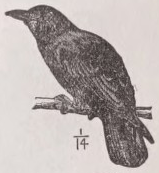
1. A fowl of the genus Corvus, the fowl mentioned by Virgil under this name. This fowl resembles the crow, but differs from it in not feeding on carrion, but on insects and grain. In crows also the nostrils and root of the bill are clothed with feathers, but in rooks the same parts are naked, or have only a few bristly hairs. The rook is gregarious.
2. One of the four pieces placed on the corner squares of the board; a castle.
3. A European bird (Corvus frugilegus) resembling the crow, but smaller. It is black, with purple and violet reflections. The base of the beak and the region around it are covered with a rough, scabrous skin, which in old birds is whitish. It is gregarious in its habits. The name is also applied to related Asiatic species.
ROOK (Anglo-Saxon Hroc, Icelandic Hrokr, Swedish Raka, Dutch Roek, Gaelic Rocas), the Corvus Jrugilegus of ornithology, and throughout a great part of Europe the commonest and best-known of the Crow-tribe. Besides its pre-eminently gregarious habits, which did not escape the notice of Virgil (Georg, i. 382) and are so unlike those of nearly every other member of the Corvidae, the Rook is at once distinguishable from the rest by commonly losing at an early age the feathers from its face, leaving a bare, scabrous, and greyish-white skin that is sufficiently visible at some distance. In the comparatively rare cases in which these feathers persist, the Rook may be readily known from the black form of Crow (vol. vi. p. 618) by the rich purple gloss of its black plumage, especially on the head and neck, the feathers of which are soft and not pointed. In a general way the appearance and manners of the Rook are so well known, to most inhabitants of the British Islands especially, that it is needless here to dwell upon them, and particularly its habit of forming communities in the breeding-season, which it possesses in a measure beyond that of any other land bird of the northern hemisphere. Yet each of these communities, or rookeries, seems to have some custom intrinsically its own, the details of which want of space forbids any attempt to set before the reader. In a general way the least-known part of the Rook’s mode of life are facts relating to its migration and geographical distribution. Though the great majority of Rooks in Britain are sedentary or only change their abode to a very limited extent, it is now certain that a very considerable number visit this country in or towards autumn, not necessarily to abide here, but merely to pass onward, like most other kinds of ...birds, to winter further southwards; and, at the same season or even a little earlier, it cannot be doubted that a large proportion of the young of the year emigrate in the same direction. As a species the Rook on the European continent only resides during the whole year throughout the middle tract of its ordinary range. Further to the northward, as in Sweden and northern Russia, it is a regular summer-immigrant, while further to the southward, as in southern France, Spain, and most parts of Italy, it is, on the contrary, a regular winter-immigrant. The same is found to be the case in Asia, where it extends eastward as far as the upper Irtish and the Ob. It breeds throughout Turkestan, in the cold weather visiting Afghanistan, Cashmere, and the Punjab, and Sir Oliver St John found a rookery of considerable size at Casbin in Persia. In Palestine and in Lower Egypt it is only a winter-visitant, and Canon Tristram noticed that it congregates in great numbers about the mosque of Omar in Jerusalem.
There are several moot points in the natural history of the Rook which it is impossible here to do more than mention. One is the cause of the curious shedding on reaching maturity of the feathers of its face, and another the burning question whether Rooks are on the whole beneficial or detrimental to agriculture. In England the former opinion seems to be generally entertained, but in Scotland the latter has long been popular. The absence of sufficient observations made by persons at once competent and without bias compels the naturalist to withhold his judgment on the matter, but the absence of such observations is eminently discreditable to the numerous Agricultural Societies of the United Kingdom, (a. n.)
9th ed. Encyclopædia Britannica, vol. 20, p. 842 [610 words — estimated reading time: 4 minutes]
ROOKESir George [(1650-1709), naval commander, was born near Canterbury in 1650. Entering the navy as a volunteer, he became post-captain in 1680, and vice-admiral in 1692. In May of this year he greatly distinguished himself in a night attack on the French fleet off Cape La Hogue, when he succeeded in burning six of their ships. Shortly afterwards he received the honour of knighthood and a reward of ,£1000. In 1702 he commanded the expedition against Cadiz, and on the passage home captured the Plate fleet off Vigo. Along with Sir Cloudesley Shovel he took part in the capture of Gibraltar, 21st July 1704. On 13th August of the same year he attacked the French fleet off Malaga, the battle being drawn. On account of the dissatisfaction expressed indirectly at the result of the contest, he retired from the service in February 1705. He died 24th January 1709.
See The Life and Glorious Actions of Sir George Rooke, 1707.
9th ed. Encyclopædia Britannica, vol. 20, p. 843 [162 words — estimated reading time: 1 minute]
Rooked[Imperfect tense and past participle]Webster's Dictionary 1913
This site uses cookies to remember your display preferences (search sources and editions, Bible version, auto-link, images, light/dark theme). No personal data whatsoever is collected. Privacy Policy