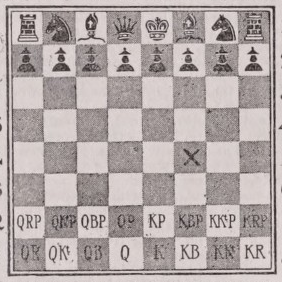
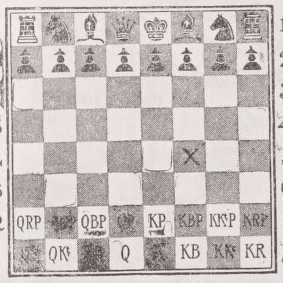
To turn now to the elements of the game. The accompanying diagrams represent chess boards, and it will be perceived that they respectively consist of sixty-four checkered squares
In diagram 1 the chessmen are arranged as they should be at the commencement of the battle, while diagram 2 shows the denomination of the squares according to the English and German systems of notation, to be explained hereafter. Under diagram 1 are the names of the various “^Pieces,” for so the superior officers are termed—each side, white and black, having a king, a queen, two rooks, two knights, and two bishops. The eight common men in front are called Pawns.
Moves of the different Chessmen. —Briefly described, the powers of the various pieces and of the pawns are as follows.
The king may move in any direction—forward, back ward, laterally, or diagonally; but he can move only one square at a time. Under certain conditions he has once in the game a peculiar privilege called castling, which will be explained further on.
The queen moves in any straight or diagonal direction, whether forward, backward, or laterally. There is no limit to her range, except when her progress is stopped by any piece or pawn. She is the most powerful piece on the board, for her action is a union of those of the rook and bishop. At the commencement of the game the queen always stands upon a square of her own colour.
The rooks move in straight lines—forward, backward, or laterally; they cannot move diagonally. Their range is, like the queen’s, unlimited.
The bishops move diagonally in any direction whether backward or forward. They have an unlimited range, with the same exception as before. It is evident that bishops standing originally on differently coloured squares can never meet.
The knights have a mode of moving which it is not easy to describe. Their range is not unlimited, like that of the pieces just noticed, but is restricted in a particular way. They move from one corner of any rectangle of three squares by two to the opposite corner; thus, in diagram 3, the white knight can move to the square occupied by the black one and vice versa. To illustrate the move further, suppose that in diagram 2 a knight stands on the square marked K4 counting from the white side of the board; that knight can move to any of the following squares, viz., to K B 2, Q 2, K Kt 3, Q B 3, K Kt 5, Q B 5, K B 6, and Q 6. The squares which the knight appears to pass over in moving may be occupied by other pieces, but his move has no thing whatever to do with those intervening squares. A knight may thus vault over any piece or pawn, whether adverse or friendly; the knights are the only pieces which possess this privilege. It will be perceived that the locus of the knight, unlike that of the bishop, changes colour at every move.
The king, queen, rooks, and bishops may capture any foeman which stands anywhere within their respective ranges; and the knights can capture the adverse men which stand upon the squares to which they can leap. A capture is effected by the piece which takes occupying the square of the piece which is taken, the latter being then removed from the board. The king cannot capture any man which is protected by another man.
The motions aud capturing powers of the pawns are as follows: —Each pawn for his first move may advance either one or two squares straight forward, but afterwards one square only, and this whether upon starting he exercised his privilege of moving two squares or not. A pawn can never move backwards. He can only capture diagonally,—that is to say, if any adverse piece or pawn stand upon the first diagonal square, either to right or left, such adverse piece or pawn can be captured and removed from the board, the captor taking its place, but a pawn cannot take any man standing directly in front of it. In other words, a pawn moves straight forward except when he captures, in which case he moves diagonally, and for capturing purposes he can only, even for his first move, advance one square. When a pawn arrives at an eighth square, viz., at the extreme limit of the board, he may be promoted, that is to say, he may, at the option of his owner, become a queen, rook, bishop, or knight; and it matters not how many queens or other pieces a player may have on the board at one time.
Check and Checkmate. —The king can never be captured, but when any piece or pawn attacks him, he is said to be “in check,” and the fact of his being so attacked should be announced by the adverse player saying “check,” whereupon the king must move from the square he occupies, or be screened from the check by the interposition of one of his own men, or the attacking piece must be captured. If, however, the king, being thus in check, cannot move to another square without being still in check, and there is no piece or pawn which can be interposed, and the checking piece or pawn cannot be taken, then it is “checkmate,” whereupon the game terminates, the player whose king has been thus checkmated being the loser. The position of the king when in check being the same as that of any piece when exposed to be captured, with the only difference that the king cannot be taken, it follows that the pawn gives check just in the same way that he captures, viz., diagonally. One king cannot give check to the other, nor can a king be moved into check.
Stalemate. —When the king is not in check, but his owner has no move left save such as would place the king in check, this is “stalemate,” and the game is drawn.
Castling. —This is a peculiar move permitted to the king once in the game; it is performed in combination with either the king’s rook or the queen’s rook, and in either case by the king being moved two squares laterally, while the rook is placed on the other side of him. But the king cannot castle after having been moved, nor with a rook that has moved, nor when any piece either white or black stands between him and the rook, nor if he is in check, nor when he has to cross over a square commanded by an adverse piece or pawn; the rook can, however, move from or cross over such a square. It will be perceived that after castling with the king’s rook the latter will occupy the K B square, while the king stands on the K Kt square, and if with the queen’s rook, the latter will occupy the queen’s square while the king stands on the Q B square. This move will easily be understood with the aid of diagram 2.
Taking en Passant. —This is a privilege possessed by any of the pawns under the following circumstances :—If a pawn, say of the white colour, stands upon a fifth square, say upon K 5 counting from the white side, and a black pawn in the supposed case moves to Q 4 or K B4 counting from the black side, the white pawn can take the black pawn “en passant.” For the purposes of such capture the latter is dealt with as though he had only moved to Q 3 or K B 3, and the white pawn taking him diagonally then occupies the square the captured pawn would have reached had he moved but one square.
Drawn Game. —This arises from a stalemate (noticed above), or from either player not having sufficient force wherewith to effect checkmate, as when there are only two kings left on the board, or king and bishop against king, or king and one or even two knights against king. The same consequence follows from either player being able to give perpetual check to the adverse king. There are also cases in which one of the players can call upon the other to give checkmate in fifty moves, the result of failure being that the game is drawn. The right to make this requisition arises in various positions, to explain all of which would take up much space; it is sufficient to say that when, neither side has any pawns left on the board the player with the inferior force may make the fifty moves call Other Chess Terms. —A “minor piece” means either a knight or bishop. “Gaining the exchange” signifies giving a minor piece in exchange for a rook. A “passed pawn” is one that has no adverse pawn either in front or on either of the adjoining files. It may be as well to explain that a “file” is simply a line of squares extending vertically from one end of the board to the other. There are therefore eight files, and they are respectively named after the pieces which occupy the first squares on either side, as, e.g., the “king’s file,” which extends from one king to the other, and so forth. An “open file” is one on which no piece or pawn of either colour is standing. “Gambit” is a word derived from the Italian gambetto, a tripping up of the heels; it is a term used to signify an opening in which a pawn is sacrificed to obtain an attack. An “opening/’ or “début,” is a certain set method of commencing the game; there are regular and irregular openings. A “check by discovery” is given when a player, by moving one of his pieces, checks with another of them. “Double check,” as its name implies, means attacking the king at once with two pieces,—one of the pieces in this case giving check by discovery.
Value of the Pieces. —The relative worth of the chessmen cannot be definitely stated on account of the increase or decrease of their powers according to the position of the game, but striking an average, and taking the pawn as the unit, the following will be an estimate near enough for practical purposes :—pawn 1, bishop 3 , 25, knight 3 - 25, rook 5, queen 9 ’ 50. Three minor pieces may more often than not be advantageously exchanged for the queen. The knight is generally stronger than the bishop in the end game, but two bishops are usually stronger than two knights, more especially in open positions.
Laws. —The laws of chess differ, although not very materially, in different countries. Various steps have been taken, but as yet without success, to secure the adoption of a universally authoritative code. In competitions among English players the particular laws to be observed are specially agreed on,—the regulations most generally adopted being those laid down at length in Staunton’s Chess Praxis, or the modification of the Praxis laws issued in the name of the British Chess Association in 1862.
The following rules may be here indicated. The board must be so placed that each combatant has a white square in his right hand corner. A player touching any of his own men or those of his adversary (except accidentally) without previously saying li j , adoube ,” or “I adjust,” or words to that effect, may be compelled to move or capture (as the case may be) the man so touched; if this cannot be done he must move his king, but if that be likewise impossible, there is then no penalty. If a player make a false or illegal move or capture, he must, at the choice of his opponent, and according to the case, move his own man legally, capture the man legally, or move any other man legally movable. In practice, the usual demand is that the offender shall move his king. After four moves have been made on each side, any such illegality is waived, and the game must be played out as it stands. Should the king be left in check, all the moves subsequently made must be retraced and the check replied to.
Modes of Notation. —The English and German systems of notation (i.e., the manner of describing the moves made in a game) are different. According to the English method each player counts from his own side of the board, and the moves are denoted according to the names of the files and the numbers of the squares. Thus when a player for his first move advances the king’s pawn two squares, it is described as follows :—“I P to K 4;” for the pawn has moved to the fourth square of the king’s file. The following moves of the Giuoco Piano Opening, with the aid of diagram 2, will enable the reader to understand the principles of the British notation, wherein it may also be observed that only the initials of the pieces are now used:—
[table]
It is now usual to express the notation as concisely as possible; thus, the third moves of White and Black would be given as 3 B to B 4, because it is clear that only the fourth square of the queen’s bishop’s file is intended. In like manner White’s fourth move would be described as 4 P to B 3, and Black’s fourth move as 4 Kt to B 3. Sometimes instead of the word “takes” a cross is used, thus—6 P × P.
The German notation employs the alphabetical characters a, b, c, cl, e, f, g, and h, proceeding from left to right, and the numerals 1, 2, 3, 4, 5, 6, 7, and 8, running upwards, these being always calculated from the White side of the board (see diagram 2). Thus the White Queen’s Rook’s square is al; the Black Queen’s Rook’s square, α8; the White Queen’s square is c∏; the Black Queen’s square, c?8; the White King’s square, el; the Black King’s square, e8, and so with the other pieces and squares. The German names of the pieces are as follows :—King, König; Queen, Dame; Rook, Thurm; Bishop, Läufer; Knight, Springer; Pawn, Bauer.
The initals only of the pieces are given, the pawns (Bauern) being understood. The Germans use the following signs in their notation, viz.:—for “check” (+); “checkmate ' , (i) ; “takes” (:); “castles on King’s side” (0-0); “castles on Queen’s side” (0-0-0); for “best move” a note of admiration (!); for “weak move” a note of interrogation (î). The Giuoco Piano Opening moves just rendered in the English will now be given in the German notation, which will make the latter easily intelligible :—
[table]
Both in the English and German notations the moves are often rendered in a tabular form, thus :—1. - τ ,. v .» r to h. 4
1. ——-∙, the moves above the line being White’s and e7-e5
below the line Black’s.
Illustrative Games. —There are various text-books upon the beginnings and endings of games, to one or other of which the learner should have recourse. Some of them are mentioned further on; but it would be invidious to enter upon any comparison of merits, or to recommend any work in particular. The following are given as indicative illustrations of certain of the leading openings; but, necessarily, no attempt can be made here to impart detailed instruction on this important branch of the game :—
[table]
[table]
The position here arrived at is the same as in the Giuoco Piano opening above.
[table]
White has for his ninth move three approved continuations, viz., B to Kt 2, P to Q 5, and Kt to B 3. To take one of them,—
[table]
The game may be considered about even.
Kina's Kηiaht's Gambit (proper).
[table]
Black has the advantage.
Allgaier-Kieseriizki Gambit.
[table]
Black has the better game.
Kinds Bishop's Gambit.
[table]
Drawn game.
Salvio Gambit.
[table]
White has a slight advantage.
Muzio Gambit.
[table]
[table]
And Black has the better game.
Queen! s Gambit.
[table]
[table]
The game is about equal, though White has a somewhat freer position.
The two following games are brilliant specimens of the style of those eminent players, Herr Anderssen and Mr Paul Morphy. The manner in which White in the first game forces the victory, though losing piece after piece, scarcely finds a parallel in the records of chess strategy.
King's Bishop's Gambit.
[table]
White gives checkmate in three moves.
Plιilidor's Defence.
[table]
And White resigns.
End-Games and Problems. —Considerable attention has been devoted by writers on chess to the examination of end-games, and many of the particular combinations of forces that are apt to occur have been fuUy and carefully analyzed. The study of and taste for problems have become very general in the chess community, especially within the last twenty years; and to minister to the growing public demand for such compositions is now an important function of chess periodicals, and of the numerous serial publications that devote a column to chess. The six problems given below 1 are prize-winners. The solutions (necessarily the leading variations only) will be found at the close of the article, p. 603.
Various Theories as to the Invention of Chess. — The origin of the game of chess is lost in obscurity, a fact which has rather invited than repelled learned speculations on the subject. The invention of the pastime has been variously ascribed to the Greeks, Romans, Babylonians, Scythians, Egyptians, Jews, Persians, Chinese, Hindus, Arabians, Araucanians, Castilians, Irish, and Welsh. Not content with upholding the claims of nations or races, some have endeavoured to fix upon particular individuals as the originators of the game; and, amongst others, the following have found supporters :—Japhet, Shem, King Solomon, the wife of Ravan king of Ceylon, the philosopher Xerxes, the Grecian prince Palamedes, Hermes, Aristotle, the brothers Lydo and Tyrrhene, Semiramis, Zenobia, Attalus who died about 200 b.c., the...