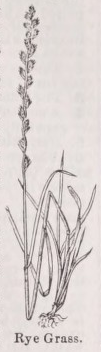
RYE. As in the case of other cereals, it is doubtful if rye (Secale cereale) exists at the present time in a truly wild state. The best evidence on this point goes to show that the plant is a native of the regions between the Black and Caspian Seas. It is also recorded from Afghanistan and Turkestan; but botanists are very chary about admitting the validity of the evidence hitherto adduced. Aitchison, the latest investigator of the flora of Afghanistan, mentions it as growing in wheat-fields, where it is considered as a weed, not being intentionally sown. In some fields “it almost eradicates the wheat crop.” But this merely shows that the conditions are more favourable to the growth of rye than to that of wheat. In spite of the uncertainty as to the precise origin of the cultivated plant, its cultivation does not appear to have been practised at a very early date, relatively speaking. Alphonse de Candolle, who has collected the evidence on this point, draws attention to the fact that no traces of this cereal have hitherto been found in Egyptian monuments or in the earlier Swiss dwellings, though seeds have been found in association with weapons of the Bronze period at...
Olmiitz. The absence of any special name for it in the Semitic, Chinese, and Sanskrit languages is also adduced as an indication of its comparatively recent culture. On the other hand, the general occurrence of the name in the more modern languages of northern Europe, under various modifications, points to the cultivation of the plant then, as now, in those regions. The origin of the Latin name secale, which exists in a modified form among the Basques and Bretons, is not explained. The circumstances that the cultivation of rye is relatively not of great antiquity and that it is confined to a relatively restricted area must be taken into account, in connexion with the fact that the variations of this cereal are much fewer than are noted in the case of other plants of like character.
The fact stated by Müller that the anthers and stigmas of the flowers come to maturity at the same time would tend to “close fertilization” and a consequent constancy of “characters” in the offspring, and, as a matter of fact, the varieties of this grass are not numerous. Rye is a tall-growing annual grass, with fibrous roots, flat, narrow, ribbon-like bluish-green leaves, and erect or decurved cylindrical slender spikes like those of barley. The spikelets contain two or three flowers, of which the uppermost is usually imperfect. The outer glumes are acute glabrous, the flowering glumes lance-shaped, with a comb-like keel at the back, and the outer or lower one prolonged at the apex into a very long bristly awn. AVithin these are three stamens surrounding a compressed ovary, with two feathery stigmas. AA τ hen ripe, the grain is of an elongated oval form, with a few hairs at the summit.
In the southern parts of Great Britain rye is chiefly or solely cultivated as a forage-plant for cattle and horses, being usually sown in autumn for spring use, after the crop of roots, turnips, &c., is exhausted, and before the clover and lucerne are ready. For forage purposes it is best to cut early, before the leaves and haulms have been exhausted of their supplies to benefit the grain. In the northern parts of Europe, and more especially in Scandinavia, Russia, and parts of northern Germany, rye is the principal cereal; and in nutritive value, as measured by the amount of gluten it contains, it stands next to wheat, a fact which furnishes the explanation of its culture in northern latitudes ill-suited for the growth of wheat. Rye-bread or black-bread is in general use in northern Europe, but finds little favour with those unaccustomed to its use, owing to its sour taste, the sugar it contains rapidly passing into the acetous fermentation.
When the ovaries of the plant become affected with a peculiar fungus (Cordyceps), they become blackened and distorted, constituting Ergot (q.ν.).
RYE a municipal town and seaport at the eastern extremity of the county of Sussex, 63 miles south-southeast of London, is built upon a rocky eminence which two or three centuries ago was washed on all sides by the influx of the tide, but now, in consequence of the gradual recession of the sea, lies two miles inland. It is surrounded by rich marsh land through which flows the river Rother, uniting at the south-east foot of the rock with two rivulets to form a small serpentine estuary, Rye harbour, the mouth of which is connected with the town by means of a branch line of railway. In bygone years, when the adjacent marshes were flooded with tidal water, the efflux was so powerful as to effectually maintain safe and free entrance into Rye harbour; and in the reign of Charles II. a frigate of 50 guns could enter and ride at anchor. Now the harbour suffers seriously from the shifting sand and shingle, and considerable sums of money have been expended by the harbour commissioners with the view of overcoming these impediments, with but partial success. The trade is chiefly in coal, timber,
and bark, and shipbuilding is carried on as well as fishing. There is a large market every alternate Wednesday, and considerable business in cattle, sheep, corn, wool, and hops is transacted. Rye is a quaint, compactly-built town perched upon the rock to which for centuries it was restricted, but in the course of the last half-century it has gradually extended itself over the northern slopes beyond the town wall. It is excellently drained, abundantly supplied with clear spring water, and very healthy. The church, said to be the largest parish church in England, is of very mixed architecture, chiefly Transitional, Norman, and Early English; the nave and high chancel were judiciously restored in 1882, according to designs by the late Mr G. E. Street. Of the old fortifications there still remain portions of the town wall, much hidden by newer buildings, a strong quadrangular tower built by William of Ypres, earl of Kent, and lord warden in the time of Stephen, and now forming part of the police station, and a handsome gate with a round tower on each side, known as the Sandgate, at the entrance into Rye from the London road. Rye ceased in 1885 to be a parliamentary borough, but gives its name to the eastern division of the county. The population in 1881 was 4224.
Of the early history of Rye little is known. In the mediaeval French chronicles it is always mentioned as “La Rie.” Having been conferred upon the abbey of Fecamp by Edward the Confessor, it was taken back by King Henry III. into his own hands, “for the better defence of his realm,” and received from that sovereign the full rights and privileges of a Cinque Port under the title of “Ancient Town.” In consequence of the frequent incursions of the French, by whom it was sacked and burnt three times in the 14th century, it was fortified by order of Edward III. on the landward side, the steep precipitous sides of the rock affording ample protection towards the sea. In addition to the naval services rendered by Rye as a Cinque Port under the Plantagenet and Tudor sovereigns, it was a principal port of communication with France in times of peace,—for which reason successive bands of Huguenots fled thither between 1562 and 1685, many of whom settled at Rye and have left representatives now living.