
a dry mealy substance or granulated paste, imported from Java and the Philippine and Molucca isles. It is the pith or marrow of a species of palm tree, and much used in medicine as a restorative diet.
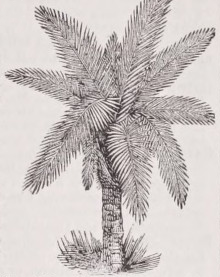
SAGO is a food-starch prepared from a deposit in the trunk of several palms, the principal source being the sago palm, Metroxylon Rumphii (Mart.), and M. laeve (Mart.). These palms are natives of the East Indian Archipelago, the sago forests being especially extensive in the island of Ceram. The trees flourish only in low marshy situations, seldom attaining a height of thirty feet, with a thick-set trunk. They attain maturity as starch-yielding plants at the age of about fifteen years, when the stem is gorged with an enormous mass of spongy medullary matter, around which is an outer rind consisting of a hard dense woody wall about two inches thick. When the fruit is allowed to form and ripen, the whole of this starchy core disappears, leaving the stem a mere hollow shell; and the tree immediately after ripening its fruit dies. When ripe the palms are cut down, the stems divided into sections and split up, and the starchy pith extracted and grated to a powder. The powder is then kneaded with water over a strainer, through which the starch passes, leaving the woody fibre behind. The starch settles in the bottom of a trough, in which it is floated, and after one or two washings is fit for use by the natives for their cakes and soups. That intended for exportation is mixed into a paste with water and rubbed through sieves into small grains, from the size of a coriander seed and larger, whence it is known according to size as pearl sago, bullet sago, &c. A large proportion of the sago imported into Europe comes from Borneo, and the increasing demand has led to a large extension of sago-palm planting along the marshy river banks of Sarawak....
Various palms, in addition to the two above named, yield sago, but of an inferior quality. Among them may be mentioned the Gomuti palm (Arenga saccharifera), the Kittul palm (Paryota wrens), the cabbage palm (Corypha umbraculifera), besides Corypha Gebanga, Eaphiaflabelliformis, Pbwenix farinifera, and dfetroxylon fllare— all East Indian palms—and Mauritia flexuosa and Guilielma speciosa, two South-American species. The imports of sago into the United Kingdom for 1884 amounted to 346,188 cwt., valued at £195,680, the whole of which, excepting less than 300 tons, is entered as coming from the Straits Settlements.