MARTEN, the name of a group of animals constituting a small but well-defined section of the family Mustelidae, belonging to the Arctoid or Bear-like division of the order Carnivora (see Mammalia, pp. 439, 440 of the present volume)....
The genus Mustela, as restricted by Cuvier {Règne Animal, 1817), contains a very natural assemblage of animals commonly called Martens, Sables, Polecats, Stoats, Ermines, and Weasels, all closely allied in structure and habits. A structural division, however, occurs between the two first-named and all the others, especially shown in the presence of an additional small premolar tooth on each side of each jaw; and, availing himself of this and some other minor characters, Cuvier divided the genus into two subgenera, for the first of which he retained the name of Mustela, and to the second assigned that of Putorvus. Three years later Nilsson (Skand. Fauna, 1820) definitely constituted the two groups into genera, applying to the first the name of Martes, by which the animals composing it had been generally designated by the Latin-writing zoologists of the preceding century, and keeping Mustela for the' more typical Weasels and their immediate allies. Later zoologists have been divided between the nomenclature of Cuvier, which has the priority, and that of Nilsson, which on other grounds is preferable. Those who adopt the latter affirm that Cuvier’s names, being only used by him in a subgeneric sense, and not binomially, need not be applied generically; but this is contrary to the practice usually followed in such cases. Others avoid the difficulty by not breaking up the genus at all, and so apply the term Mustela to all the species. The result is that the generic name of the Martens in modern zoological works oscillates between Martes and Mustela, according to the views of the writer.
The following characters apply to the restricted group of Martens proper, by whatever name they are called. Body long, slender, and very flexible, though less so than in the true Weasels. Head somewhat triangular; muzzle pointed, the nose extending a little beyond the lips; eyes large and prominent; ears conspicuous, broad, somewhat triangular, rounded at the ends, furred outside and in; limbs short; feet rounded; toes short, five on each foot, all with short, compressed, curved, sharp-pointed claws. Soles densely furred between the naked pads. Tail moderately long, more or less bushy. Outer fur long, strong, and glossy; a very abundant soft under fur.
Vertebrae: C 7, D 14, I. 6, S 3, C 18-23. Skull elongated and depressed. Facial portion moderate and rather compressed. Zygomata arched and wide but slender. Postorbital processes small. Auditory bullae large, but not very globose. Mandible with a strong triangular vertical coronoid process and a well-developed angular process.
Dentition: i ∣ , c ∣ , p ∣ , m ∣; total 38. Upper incisors in a straight transverse line, rather long and compressed; first and second subequal, third considerably larger. Lower incisors very small, especially the first, and crowded together, the second placed rather behind the others. Canines long and sharp-pointed. Upper premolars: first very small, with simple crown and one root; second and third nearly equal in size and two-rooted, with simple compressed sharp-pointed crowns, with very slightly developed accessory cusps; fourth (the sectorial) with blade consisting chiefly of the central and posterior cusps, the anterior being rudimentary, inner tubercle small and confined to the anterior part of the tooth. True molar tubercular, about twice as wide transversely as in the antero-posterior direction, having an outer, more elevated, but smaller portion, bearing three blunt tubercles; to the inner side of this the crown is contracted, and its surface deeply hollowed; it then expands again into a broad low lobe, with the central part elevated, and a raised, even, semicircular, .slightly crenated internal border. Lower premolars: first very small, simple, and one-rooted; second, third, and fourth increasing slightly in size, with high compressed pointed crowns and posterior accessory cusps, best marked in the'third. First molar (sectorial) with well-marked bilobed blade,—heel scarcely more than one-third of the length of the tooth, and a very small inner tubercle. Second molar small, single-rooted, with a low, flattened, subcircular or oval tubercular crown.
In geographical distribution the Martens are limited to the northern hemisphere, ranging throughout the greater part of the northern temperate regions of both Old and New Worlds, as far north as conditions of existence suited to their habits are met with, and southwards in America to 35° N. lat., while in Asia one species is met with as far as the island of Java.
The various species appear to be very similar in their habits. They live in woods and rocky places, and are thoroughly arboreal, spending most of their time in trees, although descending to the ground in quest of prey. They climb with great facility, and are agile and graceful in their movements. Some species are said occasionally to resort to berries and other fruit for food, but as a rule they are strictly carnivorous, feeding chiefly on birds and their eggs, small mammals, as squirrels, hares, rabbits, and moles, but chiefly mice of various kinds, of which they destroy great numbers, and occasionally snakes, lizards, and frogs. In proportion to their size they are among the most bloodthirsty of animals, though less so than the true Weasels. The female usually makes her nest of moss, dried leaves, and grass in the hollow of a tree, but sometimes in a hole among rocks or ruined buildings, and produces several young at a birth, usually from four to six. Though wild and untameable to a great degree if captured when fully grown, when taken young they are very docile, and have frequently been made pets of, not having the strong unpleasant odour of the smaller Mustelidae. The common European Marten appears to have been partially domesticated by the Greeks and Romans, and to have been used to keep houses clear from rats and mice before cats were introduced. In the same way, according to Hodgson, an allied species, the Yellow-bellied Weasel (Mustela kathialι), “is exceedingly prized by the Nepalese for its service in ridding houses of rats. It is easily tamed; and such is the dread of it common to all murine animals that not one will approach a house where it is domiciled.” It is, however, to the great value attached to the pelts of these animals that their importance to man is chiefly due. Though all yield fur of serviceable quality, the commercial value varies immensely, not only according to the particular species from which it is obtained, but according to individual variation, depending upon age, sex, season, and other trifling circumstances. The skins from northern regions are more full and of a finer colour and gloss than those from more temperate climates, as are those of animals killed in winter compared to the same individuals in the summer season. The caprices of fashion have, moreover, set wholly factitious values upon slight shades of colour, recognized and named by experienced furriers, but not indicating any specific or other distinctions of which zoologists have any cognizance. Enormous numbers of animals are annually caught, chiefly in traps, to supply the demand of the fur trade, Siberia and North America being the principal localities from which they are obtained.
With the exception of the Pekan (J∕. penn anti) all the Martens are so much alike in size, general colouring, and cranial and dental characters that the discrimination of the species, and assignment of the proper geographical distribution to each, has been a subject which has sorely perplexed the ingenuity and patience of zoologists. The following description by Dr Elliott Coues of the external characters of the American Pine Marten (JZ. americana) will apply almost equally well to most of the others. “It is almost impossible to describe the colour of the Pine Marten, except in general terms, without going into the details of the endless diversities occasioned by age, sex, season, or other incidents. The animal is ‘brown,’ of a shade from orange or tawny to quite blackish; the tail and feet are ordinarily the darkest, the head lightest, often quite whitish; the ears are usually rimmed with whitish; on the throat there is usually a large tawny-yellowish or orange-brown patch, from the chin to the fore legs, sometimes entire, sometimes broken into a number of smaller, irregular blotches, sometimes wanting, sometimes prolonged on the whole under surface, when the animal is bicolor like a Stoat in summer. The general ‘ brown ’ has a greyish cast, as far as the under fur is concerned, and is overlaid with rich lustrous blackish-brown in places where the long bristly hairs prevail. The claws are whitish; the naked nose pad and whiskers are black. The tail occasionally shows interspersed white hairs, or a white tip.”
The species generally recognized as distinct are the following, the first five belonging to the Old and the last two to the New World.
1. Mustela foina, Erxleben; the Beech Marten, Stone Marten, or White-breasted Marten.—Distinguished from the following by the greater breadth of the skull, and some minute but constant dental characters, by the dull greyish-brown colour of the fur of the upper parts, and the pure white of the throat and breast. It inhabits the greater part of the Continent of Europe, but is more southern than the next in its distribution, not being found in Sweden or Norway, nor, according to the recent investigations of Mr Alston, in the British Isles, although included in their fauna by all earlier writers.
2. Μ. martes, Linn; Martes sylvatica, Nilsson; Μ. abietum, Fleming; the Pine Marten (see figure).—Outer fur rich dark brown; under fur reddish-grey, with clear yellow tips; breast spot usually yellow, varying from bright orange to pale cream-colour or yellowish-white. Length of head and body 16 to 18 inches; of tail (including the hair) 9 to 12 inches. This species is extensively distributed throughout northern Europe and Asia, and was formerly common in most parts of Great Britain and Ireland. Though commonly called “Pine Marten,” it does not appear to have any special preference for coniferous trees, except that, inasmuch as they constitute the greater proportion of the forests of the countries which it inhabits, it is more often met with in them than in any other. With regard to its recent occurrence in the British Isles, Mr Alston writes in Proc, of Zool. Society of London, 1879 :—
“Athough greatly reduced in numbers by persecution, it still maintains its ground in the wilder districts of Scotland, the north of England, Wales, and Ireland; and occasionally specimens are killed in counties where the species was thought to have been long extinct. In Scotland it is still found, though comparatively rarely, in the Lews and in most of the Highland mainland counties, being perhaps most abundant in Sutherland and Ross-shire, especially in the deer forests. In the Lowlands a Marten is now a very great rarity; but a fine example was killed in Ayrshire in the winter of 1875-76. In the north of England MrW. A. Durnford says the species is ‘still plentiful’ in the wilder parts of Cumberland, Westmoreland, and Lancashire, and in Lincolnshire several have been recorded, the latest killed in 1865, by Mr Cordeaux. In Norfolk one was shot last year; and I have myself examined a fine example which was shot in Hertfordshire, within 20 miles of London, in December 1872. In Dorsetshire the last is said to have been killed in 1804; but a specimen occurred in Hampshire about forty years ago, and another in Surrey in 1847. In Ireland the following counties were enumerated by Thompson as habitats of this species: Donegal, Londonderry, Antrim, Down, Armagh, Fermanagh, Longford, Galway, Tipperary. Cork, and Kerry. The Cat-crann is probably now a rarer animal in Ireland than it was when Thompson wrote; but it still exists in various districts, especially in County Kerry, whence the society has received several living examples; and Professor A. Leith Adams states that it has been seen of lata years even in county Dublin."
3. Μ. zibellina, Linnaeus; the Sable (German, Zobel and Zebcl ; Swedish, sabel∙, Russian, sobel, a word probably of Turanian origin).—Closely resembling the last, if indeed differing from it except in the quality of the fur, which is the most highly valued of that of all the group. Found chiefly in eastern Siberia.
4. Μ. flavigula, Boddaert; the Indian Marten.—Inhabits the southern slopes of the Himalayas, the Nilgiri Hills, the interior of Ceylon, the Malay Peninsula, and Java.
5. Μ. melampus, Wagner.—Japan.
6. Μ. americana, Turton; the North-American Sable or Marten.—A species so closely allied to the European Pine.Marten and Asiatic Sable that it is very difficult to assign constant distinguishing characters between them. The importance of the fur of this animal as an article of commerce may be judged of from the fact that 15,000 skins were sold in one year by the Hudson’s Bay Company as long ago as 1743, and the more recent annual imports into Great Britain have exceeded 100,000. It is ordinarily caught in wooden traps of very simple construction, being little enclosures of stakes or brush in which the bait is placed upon a trigger, with a short upright stick supporting a log of wood, which falls upon its victim on the slightest disturbance. A line of such traps, several to a mile, often extends many miles. The bait is any kind of meat, a mouse, squirrel, piece of fish, or bird’s head. It is principally trapped during the colder months, from October to April, when the fur is in good condition, as it is nearly valueless during the shedding in summer. Dr Coues tells us that, notwithstanding the persistent and uninterrupted destruction to which the American Sable is subjected, it does not appear to diminish materially in numbers in unsettled parts of the country. It holds its own partly in consequence of its shyness, which keeps it away from the abodes of men, and partly because it is so prolific, bringing forth six to eight young at a litter. Its home is sometimes a den under ground or beneath rocks, but offener the hollow of a tree, and it is said frequently to take forcible possession of a squirrel’s nest, driving off or devouring the rightful proprietor.
7. Μ. pennanti, Erxleben; the Pekan or Pennant’s Marten, also called Fisher Marten, though there appears to be nothing in its habits to justify the appellation. This is the largest species of the group, the head and body measuring from 24 to 30 inches, and the tail 14 to 18 inches. It is also more robust in form than the-others, its general aspect being more that of a Fox than a Weasel; in fact its usual name among the American hunters is ‘ ‘ Black Fox.’* Its general colour is blackish, lighter by mixture of brown or grey on the head and upper fore part of the body, with no light patch on the throat, and unlike the other Martens generally darker below than above. It was generally distributed in wooded districts throughout the greater part of North America, as far north as Great Slave Lake, lat. 63° N., and Alaska, and extending south to the parallel of 35°; but at the present time it is almost exterminated in the settled parts of the United States east of the Mississippi.
See Elliott Coues, Fur-l·earing Animals, a Monograph of North American Mustelidae, 1877; E. R. Alston, “On the British Martens,” Proceedings of the Zoological Society of London, 1879, p. 468.

[2,621 words — estimated reading time: 15 minutes]
was sister of Lazarus and Mary, and mistress of the house where our Saviour was entertained, in the village of Bethany. Martha is always named before Mary, probably because she was the elder sister.
[34 words — estimated reading time: 1 minute]
MARTIAL (Μ. Valerius Martialis) is a writer to whose merits it is difficult to do justice in the present day. His faults are of the most glaring kind; they are exhibited without the least concealment; and they are of the sort of which modern feeling is most intolerant. Living as he did under perhaps the worst of the many bad emperors who ruled the world in the 1st century, he addresses him and his favourites with the most servile flattery in his lifetime, reviles him immediately after his death (xii. 6), and offers equally fulsome incense at the shrine of his successor. No writer of equal genius has ever shown such an absence of dignity and independence of character in his relation to his richer friends and patrons. He is not ashamed to be dependent on them for gifts of money, for his dinner, and even for his dress. We cannot feel sure that even what seem his sincerest tributes of regard may not be prompted by the hope of payment. Further, there is no book in any literature which, both in expression and in the things treated of, sins so flagrantly against all instincts of propriety. A certain proportion of the epigrams in every book—perhaps one-fifth or one-sixth (in some books the proportion is much larger)—can be read by no class of readers with any other feelings than those of extreme distaste....
These faults are so unmistakable and undeniable that many readers of ancient literature have formed their whole estimate of Martial from them, and have declined to make any further acquaintance with him. Even those who greatly admire his genius, who find the freshest interest in his representation of Roman life and his sketches of manners and character, and who, after admitting the unfavourable first impression which he is bound to make, believe that they still can discern sufficient indications of the better nature which made him a popular and likeable man in his day, do not attempt to palliate his faults, though they may partially account for them by reference to the morals of his age and the circumstances of his life. The time when “the last of the Flavian line was tearing in pieces the half-lifeless world, and Rome was a bondslave to a bald Nero,” was one when literature had either to be silent or to be servile. Martial was essentially a man of letters; there was no other métier for which he was fitted; he was bound either to gain favour by his writings or to starve. Tacitus and Juvenal might have chosen the latter alternative, but they were fortunately spared the necessity of making the choice by the possession of independent means. Even Statius, the contemporary of Martial, whose writings are in other respects irreproachable, is nearly as fulsome in his adulation as Martial. The relation of client to patron had been recognized as an honourable one by the best Roman traditions. No blame had attached to Virgil or Horace on account of the favours which they received from Augustus and Maecenas, or of the return which they made for these favours in their verse. That old honourable relationship had, however, greatly changed its character between the era of Augustus and that of Domitian. Men of good birth and education, and sometimes even of high official position (Juv., i. 117), were not ashamed to gain or increase their living by the acceptance of money doles to provide their daily meal. “Atria magna colam” is the resource of a man who was too lazy or too incompetent to become an advocate, and who thought himself too much of a gentleman to adopt any mechanical trade. Martial was merely following a general fashion in paying his court to “a lord.” “Rex” is.the common term used for a patron. He made the best of the custom. In his earlier career he used to accompany his patrons to their villas at Baiae or Tibur, and to attend their morning levées. Later on he went to his own small country house, near Nomentum, and sent a poem, or a small volume of his poems, as his representative, at the early visit. If his patron was courteous and liberal, he became his friend and entertained him with his wit and social vivacity. If he was mean and exacting, he found in him a subject for his epigrams. The fault of grossness Martial shares with nearly all ancient and many modern writers who treat of life from the baser or more ridiculous side. That he offends worse than perhaps any of them is to be explained, not, apparently, on the ground that he was more of a libertine in his life, but on the ground that he had to amuse a public which had become more corrupt than in any other civilized era. Although there is the most cynical effrontery and want of self-respect in Martial’s use of language, there is not much trace of the satyr in him,—much less, many readers will think, than in Juvenal. Neither is it at all true, as is said by historians of Roman literature (W. S. Teuffel, vol. ii. 317, 5), that his epigrams mostly deal with this side of life. At least four-fifths of them are unexceptionable in subject and treatment.
Our knowledge of Martial’s life is derived almost entirely from himself. His writings do not, like those of Horace, supply materials for a continuous biography, nor do they lay bare every secret of his heart with the self-absorption of Catullus. But, as he writes frankly about everything that interested him, he has not only painted a very lifelike picture, or rather drawn a multitude of very life-like sketches of Roman society in his time, but he has clearly marked his own position in and his own relation to that society. His criticism of men and manners enables us to judge of the standard which he applied to life, of the things which he liked and disliked, and of his own temper and disposition. Reference to public events enables us approximately to fix the date of the publication of the different books of epigrams, and from these dates to determine those of various important events in his life. Thus, as in book x., which was published in 97 or perhaps 98 a.d., he is found celebrating his fifty-seventh birthday (x. 24), the date of his birth may be assigned to the year 40 or 41. The place of his birth was Bilbilis, or Augusta Bilbilis, in Spain, in a “barren and rugged country” near the sources of the Tagus. His name seems to imply that he was born with the rights of Roman citizenship, but he speaks of himself as “sprung from the Celts and Iberians, and a countryman of the Tagus ”; and, in contrasting his own masculine appearance with that of an effeminate Greek, he draws especial attention to “his stiff Spanish hair ”—
“Hispanis ego contumax capillis” (x. 65).
In an epigram written nearly thirty years after his removal to Rome he piously commends the soul of a little child, Erotion, to whom he was much attached, to his parents Fronto and Flaccilla, who had gone before to the world of shades (v. 34). Their position in life seems to be indicated by such references to his former home as the phrase “saturae sordida rura casae” (x. 96). His home was evidently one of rude comfort and plenty, sufficiently in the country to afford him the amusements of hunting and fishing, which he often recalls with a keen sense of pleasure, and sufficiently near the town to afford him the companionship of many comrades, the few survivors of whom he looks forward to meet again after his five and thirty years absence (x. 104). The memories of this old home, of Bilbilis on its mountain site, of the shallow, rapid Salo flowing round the base of the hill (“fluctu tenui sed inquieto ”), of “Gaius hoary with snow and sacred Vadavero with its broken cliffs,” of the ilex-grove of Burado (iv. 55) “which even the laziest traveller walks through,” and of other spots the rough names and local associations of which he delights to introduce into his verse, attest the enjoyment which he had in his early life, and were among the influences which kept his spirit thoroughly alive in the midst of the deadening routine of social life in Rome. But his Spanish home could impart, not only the vigorous vitality which was one condition of his success as a wit and poet, but the education which made him so accomplished a writer. The literary distinction obtained by the Senecas, by Lucan, by Quintilian, who belonged to a somewhat older generation, and by his friends and contemporaries Licinianus of Bilbilis, Decianus of Emerita, and Canius of Gades, proves how eagerly the novel impulse of letters was received in Spain in the first century of the empire, just as a similar impulse had been received in Cisalpine Gaul in the first half of the first century before our era. The success of his countrymen may have been the motive which induced Martial’s parents to prepare him for a literary career,—
“At me litterulas stulti docuere parentes” (ix. 73, 7), and which induced Martial himself to remove to Rome when he had completed his education. This he must have done some time before the fall, in 65 a.d., of Seneca and Lucan, who were probably his earliest patrons. He speaks of the halls of the Pisos and of Seneca as having been opened to him when he first went to Rome (iv. 40); and in epigrams, addressed to his widow nearly thirty years after the death of Lucan, he speaks of him with grateful admiration, and applies to her the word ιr, Regina,” “his lady patroness.”
Of the details of his life for the first twenty years or so after he came to Rome we do not know much. He published some juvenile poems of which he thought very little in his maturer years, and he laughs at a foolish bookseller who would not allow them to die a natural death (i. 113). Martial had neither youthful passion nor youthful enthusiasm to make him precociously a poet. His faculty ripened with experience and with the knowledge of that social life which was both his theme and his inspiration; and many of his best epigrams are among those written in his last years. From many answers which he makes to the remonstrances of friends,—among others to those of Quintilian,—it may be inferred that he was urged to practise at the bar, but that he preferred his own lazy Bohemian kind of life to more settled and remunerative modes of industry. He made many influential friends and patrons, and secured the favour both of Titus and Domitian. From them he obtained various privileges, among others the“semestris tribunatus,” which conferred on him equestrian rank. He failed, however, in his application to the latter for more substantial advantages, although he commemorates the glory of having been invited to dinner by him, and also the fact that he procured the privilege of citizenship for many persons in whose behalf he appealed to him. The earliest of his extant works, that known by the name of Liber Spectaculorum, was first published at the opening of the Colosseum in the reign of Titus; but the book as it now stands was given to the world in or about the first year of Domitian, i.e., about 81 a.d. The favour of the emperor procured him the countenance of some of the worst creatures at the imperial court,—among them of the notorious Crispinus, of Parthenius, Earinus, Regulus, and probably of Paris, the supposed author of Juvenal’s exile, on whose death Martial afterwards wrote a eulogistic epitaph. The two books numbered xiii. and xiv., and known by the name of Xenia and Apophoreta, — inscriptions of two lines for presents,—were published between 81 and 86 a.d. In that last year he gave to the world the first two of the twelve books on which his reputation rests. From that time till his return to Spain in 98 a.d. he published a volume almost every year. The first nine books and the first edition of book x. appeared in the reign of Domitian; and book xi..at the end of 96 a.d., shortly after the accession of Nerva. A. revised edition of book x., that which we now possess, appeared in 98 a.d., about the time of the entrance of Trajan into Rome. The last book was written after three years’ absence in Spain, shortly before his death, which happened about the year 102 or 103 a.d.
These twelve books bring Martial’s ordinary mode of life between the age of five-and-forty and sixty very fully before us. His regular home for five-and-thirty years was Rome. He lived at first up three pair of stairs (“et scalis habito tribus sed altis,” i. 117), and his rooms overlooked the laurels in front of the portico of Agrippa. He had a small and not very valuable country house near Nomentum, in the Sabine territory, to which he occasionally retired as a refuge from the bores and noises of the city (ii. 38, xii. 57). In his later years he had a small house on the Quirinal, near the temple of Quirinus. At the time when his third book was brought out he had retired for a short time to Cisalpine Gaul, in weariness, as he tells us, of his unremunerative attendance on the levées of the great—
“Non poterat vanae taedia ferre togae” (iii. 4).
For a time he seems to have felt the charm of the new scenes which he visited, and in a later book (iv. 25) he contemplates, probably with a reminiscence of Horace (fid. ii. 6), the prospect of retiring to the neighbourhood of Aquileia and the Timavus in his old age. But the spell exercised over him by Rome and Roman society was too great to permit of a prolonged absence; and even the epigrams sent from Forum Corneli and thβ Aemilian Way ring much more erf the Roman Forum, and of the streets, baths, porticos, and clubs of Rome, than of the places from which they are dated. So too his motive for his final departure from Rome in 98 a.d. was a weariness of the burdens imposed on him by his social position, and, apparently, the difficulties of meeting the ordinary expenses of living in the metropolis (x. 96); and he looks forward, with a kind of “nostalgia,” to a return to the scenes familiar to his youth. The well-known epigram addressed to Juvenal (xii. 18) shows that for a time his ideal was realized; but the more trustworthy evidence of the prose epistle prefixed to book xii. proves that his contentment was of very short duration, and that he could not live happily away from the literary and social pleasures of Rome (“bibliothecas, theatra, convictus”), which supplied both the impulse to his genius and the material on which it could exercise itself. The one consolation of his exile was the society of a lady, Marcella, of whom he writes rather as if she were his patroness,—and it seems to have been a necessity of his being to have always a patron or patroness,—than his wife or mistress. His delight in her society arose from his finding in her one who, though born and bred in this remote province, yet by her natural grace and accomplishment revived for him the charm of Rome.
During his life there, although he never rose to a position of real independence, and had always a hard struggle with poverty, he seems to have known everybody, especially every one of any eminence at the bar or in literature. In addition to Lucan and Quintilian, he numbered among his friends or more intimate acquaintances Silius Italicus, Juvenal, the younger Pliny; and we find a number of other names, such as those of Julius Martialis, Faustinus, Bassus, Decianus, Melior, Stella, &c., of men holding a high social, legal, or literary position, whose society and patronage he enjoyed. The silence which he and Statius, although authors writing at the same time, having common friends, and treating sometimes of the same subjects, maintain in regard to one another may be explained by mutual dislike or want of sympathy. Martial, in many places, shows an undisguised contempt for. the artificial kind of epic on which Statius’s reputation chiefly rests; and it seems quite natural that the respectable author of the Tlιebaid and the Silvae should feel little admiration for either the life or the works of the Bohemian epigrammatist.
The personal faults of Martial, which deny t∩ his writings, notwithstanding their vivacity, truth, and brilliancy, a place among the best poetry of antiquity, have been sufficiently indicated. It remains to ask, What were those qualities of nature and intellect which enable us to read his best work—even the great body of his work— with the freshest sense of pleasure in the present day 1
He had the keenest capacity for enjoyment, the keenest curiosity and power of observation. The ordinary spectacle of Boman life, as it passed before his eyes, was thus vividly apprehended and reproduced by him in all its details; and the many varieties of character which an over-ripe and decaying civilization produces were quickly seized and graphically sketched. He had also a very just discernment. It is rare to find any one endowed with so quick a perception of the ridiculous who is so little of a caricaturist. He was himself singularly free from cant, pedantry, or affectation of any kind. Though tolerant of most vices, he has a hearty scorn of hypocrisy,—of the combination of outward austerity with secret profligacy,—of the man who, while he wears
“Fuscos colores, galbinos habet mores.”
There are few better satirists of social and literary pretenders either in ancient or modern times. Living in a very artificial age, he was quite natural, hating pomp and show, and desiring to secure in life only what really gave him pleasure. To live one’s own life heartily from day to day without looking before or after, and to be one’s self without trying to be that for which nature did not intend him, is the sum of his philosophy. It is the philosophy of a man who has passed the middle of life, who has outlived any illusions he may ever have had, and who is quite content that whatever remains to him in the future should be like his present. Further, while tolerant of much that is bad and base,—the characters of Crispinus and Regulus, for instance,—he shows himself genuinely grateful for kindness and appreciative of excellence. He has no bitterness, malice, or envy in his composition. He professes to avoid personalities in his satire;—“Ludimus innocui” is the character he claims for it. Pliny, in ths elιort tribute which he pays to him on hearing of his death, says, “He had as much candour as wit and pungency in his writings ” (Ep. iii. 21).
Honour and sincerity (fides and simplicitas} are the qualities which he most admires in his friends. Though many of his epigrams indicate a cynical disbelief in the character of women, yet others prove that he could respect and almost reverence a refined and courteous lady. His own life in Rome afforded him no experience of domestic virtue; but his epigrams show that, even in the age which is known to modern readers chiefly from the Satires of Juvenal, that virtue was recognized as the purest source of happiness. The tenderest element in Martial’s nature seems, however, to have been his affection for children and for his dependants. The pathos with which he has recorded their premature death, combined with his fresh enjoyment of outward nature, give to many of his pieces a rank among the serious poetry of the world—“inter sanctiora carmina,”—to use a phrase of his own.
The permanent literary interest of Martial’s epigrams arises not so much from their verbal point or brilliancy, though in these respects they are unsurpassed, as from the amount of human life and character which they contain. There is no truer painter of social manners in antiquity. He enables us better than any other writer to revive the outward spectacle of the imperial Rome which we see in its ruins, and to repeople its streets, shops, porticos, baths, and amphitheatres. If Juvenal enforces the lesson of that time, and has penetrated more deeply into the heart of society,
Martial has sketched its external aspect with a much fairer pencil and from a much more intimate contact with it. It is from the immediate impressions and comments of the epigrammatist that the satirist has taken the suggestion of many of his more elaborate pictures and more stern denunciations. But it is not only the peculiarities of Roman customs that live in the writings of Martial. His page, to use his...
[4,078 words — estimated reading time: 25 minutes]
MARTIAL LAW. See Military Law.
[5 words — estimated reading time: 1 minute]
MARTIGUES, chief place of a canton in the department of Bouches-du-Rhône, France, stands on the southern shore of the lagoon of Berre, and at the eastern extremity of that of Caronte, by which the former is connected with the Mediterranean. Divided into three quarters by canals with numerous bridges, the place has sometimes been called the Venice of Provence. It has a harbour of 10 acres, an iron foundry, workshops for maritime constructions, oil manufactures, and chemical works; the principal industry, however, consists in the preparation of “boutargue,” which is obtained from the roes of the grey mullet caught in the lagoons, and rivals Russian caviare. The population in 1876 was 8053.
Built in 1232 by Raymond Bérenger, count of Provence, Martigues was made a viscountsliip by Joanna I., queen of Naples. Henry IV. made it a principality, in favour of a princess of the house of Luxembourg. It afterwards passed into the hands of the duke of Villars.
[163 words — estimated reading time: 1 minute]
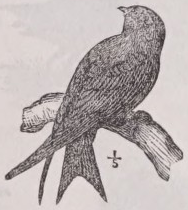
MARTIN (French, Martinet), the Hirundo urbica of Linnaeus and Chelidon urbica of modern ornithologists, a bird very well known throughout Europe, including even Lapland, where it is abundant, retiring in winter to the south of Africa. It also inhabits the western part of Asia, and appears from time to time in large flocks in India; but the boundaries of its range and those of at least one of its Eastern congeners cannot as yet be laid down. The Martin (or House-Martin, as it is often called, to distinguish it from the Sand-Martin presently to be mentioned) commonly reaches its summer-quarters a few days later than the Swallow (q.v.), whose habits its own so much resemble that heedless persons often disregard the very perceptible differences between them, the Martin’s white rump and lower parts being conspicuous as it flies or clings to its “loved mansionry” attached to our houses, for, as Shakespeare wrote—
“No jutty, frieze, Buttress, nor coign of vantage, but this bird Hath made his pendent bed and procreant cradle.”
—Macbeth, act i. sc. 6....
This nest, made of the same material as the Swallow’s, is, however, a far more difficult structure to rear, and a week or more is often occupied in laying its foundations— the builders clinging to the wall while depositing the mud of which it is composed. But, the base once securely fixed, the superstructure is often quickly added till the whole takes the shape of the half or quarter of a hemisphere, and a lining of soft feathers, mixed with a few bents or straws, fits it for its purpose. The Martin sets about building very soon after its return, and a nest that has outlasted the winter’s storms is almost at once reoccupied; though if a new nest be needed its construction often involves great delay, for any excess of wet or drought retards the operation, and the work is generally placed in such an exposed situation that heavy driving rains will frequently wash away the half-dried walls. However, the bird mostly perseveres against these and other untowardnesses, contriving in the course of the summer to raise a second or, rarely, a third brood of offspring—though it is certain that the latest broods often die in the nest—apparently through failure of food. Yet what seem to be adults of this species are observed in England every year so late as November, and there are several instances of its appearance within a few days of the winter solstice; but it is to be remarked that these late birds are almost certainly strangers, and not natives of the locality in which they are seen.
The Sand-Martin, Hirundo riparia of Linnaeus and Cotile riparia of modern writers, differs much in appearance and habits from the former. Its smaller size, mousecoloured upper surface, and jerking flight ought to render it easily recognizable from the other British Hirundinidx; but through carelessness it is seldom discriminated, and, being the first of the Family to return to its northern home, the “early Swallow” of newspaper-writers would seem to be nearly always of this species. Instead of the clay-built nest of the House-Martin, this bird bores, with a degree of regularity and an amount of labour rarely excelled in its Class, horizontal galleries in a natural or artificial escarpment. When beginning its excavation, it clings to the face of the bank, and with its bill loosens the earth, working from the centre outwards, assuming all sorts of positions—as often as not hanging head downwards. The form of the boring and its length depend much on the nature of the soil; but the tunnel may extend to 4, G, or even 9 feet. The gallery seems intended to be straight, but inequalities of the ground, and especially the meeting with stones, often cause it to take a sinuous course. At the end is formed a convenient chamber lined with a few grass stalks and feathers, the latter always beautifully arranged, and upon them the eggs are laid. The Sand-Martin has several broods in the year, and is much more regular than other Hirundinidae in its departure for the south. The kind of soil needed for its nestinghabits makes it a somewhat local bird; but no species of the Order Passeres has a geographical range that can compare with this. In Europe it is found nearly to the North Cape, and thence to the Sea of Okhotsk. In winter it visits many parts of India, and South Africa to the Transvaal territory. In America its range is even more extraordinary, extending (due regard being of course had to the season of the year) from Melville Island to Caiçara in Brazil, and from Newfoundland to Alaska.
The Purple Martin of America, Hirundo or Progne purpurea, requires some remarks as being such a favourite bird in Canada and in the United States. Naturally breeding in hollow trees, it readily adapts itself to the nest-boxes which are very commonly set up for its accommodation; but its numbers are in some years and places subject to diminution in a manner which has not yet been satisfactorily explained. The limits of its range in winter are not determined, chiefly owing to the differences of opinion as to the validity of certain supposed kindred species found in South America; but according to some authorities it reaches the border of Patagonia, while in summer it is known to inhabit lands within the Arctic Circle. The male is almost wholly of a glossy steel-blue, while the female is much duller in colour above, and beneath of a brownish-grey.
Birds that may be called Martins occur almost all over the world except in New Zealand, which is not regularly inhabited by any member of the Family. The ordinary Martin of Australia is the Hirundo or Hylochelidon nigricans of most ornithologists, and another and more beautiful form is the Ariel or Fairy-Martin of the same country, Hirundo or Lagenoplastes ariel. This last builds of mud a bottle-shaped nest, as does also the Bock-Martin of Europe, Hirundo or Biblis rupestris∙, but space fails wherein to tell more of these interesting birds. (a. n.)
MARTIN, St, bishop of Tours, was born of heathen parents at Sabaria (Stein am Anger) in Pannonia, about the year 316. When ten years of age he became a catechumen, and at fifteen, contrary to his own inclination, he entered the army. It was while he was stationed at Amiens that he divided his cloak with the beggar, and on the following night had the vision of Christ making known to his angels this act of charity to Himself on the part of “Martinus, still a catechumen.” Soon afterwards he received baptism, and, two years later, having been permitted to leave the army, he joined Hilary of Poitiers, who wished to make him a deacon, but at his own request ordained him to the humbler office of an exorcist. In the course of the years that followed he undertook a journey to Pannonia for the purpose of converting his parents, and was successful in bringing his mother within the pale of the church. For some time, doubtless during the Arian troubles, he lived, along with a presbyter friend, an ascetic life on the desert island of Gallinaria near Genoa; in 360 he was again with Hilary at Poitiers, and founded in the neighbourhood the monasterium Locociagense (Licugé). Here his miracles, which included more than one case of restoring the dead to life, were very numerous, and made him so famous that in 371 the people of Tours insisted on having him for their bishop. In this capacity he was extremely zealous and enérgetic in seeking to extirpate idolatry from his diocese and from France, and by example as well as by precept he did much for the spread of the monastic system. To obtain the privacy that he required for the maintenance of his personal religion, he established the monastery of Marmoutier-les-Tours (Martini monasterium) on the banks of the Loire. At Treves, in 385, he was importunate in his entreaties that the lives of the Priscillianist heretics should be given them, and he ever afterwards refused to hold ecclesiastical fellowship with those bishops who had sanctioned their execution. He died at Candes about the year 400, and is commemorated by the Roman Church on November 11 (duplex). He is the patron saint of France, and of the cities of Mainz and Würzburg. The Life by his disciple Sulpicius Severus is practically the only source we have for his biography, but it is full of legendary matter and chronological inaccuracies. The feast of St Martin (Martinmas) took the place of an old pagan festival, and inherited some of its usages (such as the Martinsmännchen, Martinsfeuer, Martinshorn, and the like, in various parts of Germany); by this circumstance is most probably to be explained the fact that he is regarded as the patron of drinking and jovial meetings, as well as of reformed drunkards.
MARTIN, John (1789-1854), a popular ‘English painter, was born at Haydon Bridge, near Hexham, on the 19th of July 1789. On account of his early interest in art he was apprenticed by his father to a coachbuilder to learn heraldic painting, but owing to a quarrel the indentures were cancelled, and he was placed under Bonifacio Musso, an Italian artist, father of the well-known enamel painter Charles Musso. With his master Martin removed to London in 1806, where he married at the age of nineteen, and led a struggling life, supporting himself by giving drawing lessons, and by painting in water colours, and on china and glass. His leisure was occupied in the study of perspective and architecture. His first picture, Sadak in Search of the Waters of Oblivion, was executed in a month. It was exhibited in the Royal Academy of 1812, and sold for fifty guineas. It was followed by the Expulsion (1813), Paradise (1813), Clytie (1814), and Joshua (1815). In 1821 appeared the famous Belshazzar’s Feast, which excited much favourable and hostile comment, and was awarded a prize of £200 at the British Institution, where the Joshua had previously carried off a premium of £100. Then came the Destruction of Herculaneum (1822), the Creation (1824), the Eve of the Deluge (1841), and a long series of other Biblical and imaginative subjects, many of which are widely known through engravings. In 1832-33 Martin received £2000 for drawing and engraving a fine series of designs to Milton, and along with Westall he produced a set of Bible illustrations. He was also much occupied with schemes for the improvement of London, and published various pamphlets and plans dealing with the metropolitan water supply, sewage, dock, and railway systems. During the last four years of his life he was engaged upon his large subjects of the Judgment, the Day of Wrath, and the Plains of Heaven. He was attacked with paralysis while painting, and died in the Isle of Man on the 17th of February 1854.
The bold originality of Martin’s productions startled and attracted the public, but they are without the qualities of solid execution and truth to nature upon which a lasting fame in the arts must be built. His figures are badly drawn, his colouring is hot and unpleasant. To most of his professional brethren his works seemed theatrical and tricky; and the best lay critics of his time, like Charles Lamb, were disposed to deny that they evinced true imaginative power. His popularity may be said to have culminated in 1828, the year of his Fall of Nineveh; since then it has been gradually declining.
[1,042 words — estimated reading time: 6 minutes]