
A turning; a time; -- chiefly used in phrases signifying that the part is to be repeated one, two, or more times; as, una volta, once. Seconda volta, second time, points to certain modifications in the close of a repeated strain.
Word of the Day: Catachrestical
Volta
Encyclopedia Britannica
VOLTA, Alessandro (1745-1827), was born at Como on February 18, 1745. In 1774 he was appointed professor of physics in the gymnasium of Como, and in 1777 he left his native town for the first time to travel through Switzerland, where he formed an intimate friendship with De Saussure. In 1779 a chair of physics was founded in Pavia, and Volta was chosen to occupy it. In 1782 he undertook a journey through France, Germany, Holland, and England, and became acquainted with nearly all the scientific celebrities of that day. In 1791 he received the Copley medal of the Royal Society. In 1801 Napoleon called him to Paris, to show his experiments on contact electricity, and a medal was struck in his honour. He was made a senator of the kingdom of Lombardy. In 1815 the emperor of Austria made him director of the philosophical faculty of Padua. In 1819 he retired, and settled down again in his native town. He died on March 5, 1827....
The first published paper of Volta (De Vi Attractiva Ignis Electrici) dates from 1769; it contains no new facts, but deserves our attention as showing us the knowledge with which Volta set cut on his journey of discoveries, and the theoretical speculations which seem to have given him the first impulse to experimental work. Franklin, who was then justly considered the great authority on these matters, had endeavoured to explain electrical phenomena by the mutual repulsion of the particles of an electrical substance and the attraction between that electrical substance and ordinary matter. Volta tried to simplify the theory by assuming an action only between the electrical substance and matter, and he tells us that he explained his views in a letter to the Abbé Nollet when he was nineteen years old. The way in which he endeavoured to account for the phenomena of attraction and repulsion and the phenomena of the Leyden jar have no interest for us to-day, but that part of his paper in which he showed the application of his theory to the generation of electricity is of historical importance, for in it we can trace the germ of many future discoveries. He imagines all bodies in the natural state to contain electricity in such proportion that they are in electrical equilibrium. He believes that his experimental results obtained by rubbing metals with each other show this. But when bodies are brought into close contact, as, for instance, in friction, adopting the views of Boscovich, according to which attraction and repulsion alternate at small distances, he considers that the attractions of electricity and matter may alter and a new electrical equilibrium will establish itself. He asks the question whether during the progress of chemical action, such as solution, mixture of fluids, combustion, in which the particles of matter change their position, there is no disturbance of electrical equilibrium. He expresses his conviction that this is the case, and explains the experimental difficulties which prevent a proof, but expresses a hope that he will succeed in obtaining signs of electrical action during chemical operations. He shows how atmospheric electricity might bc accounted for in accordance with these views.
The principal point of interest in his second paper (Novus ae Simplicissimus Electricorum Tentaminum Apparatus) is the attempt to explain electrical insulation by a repulsion between the insulating matter and electricity. The influence of Boscovich in this attempt to explain everything by forces and centres of force is here apparent. Theory thus seems to have given Volta the first impulse to his electrical inquiries; but as he went on with his experimental work the firm establishment of facts took the first place in his mind, and after the first two papers we find hardly anything speculative in his writings.
On June 10, 1775, Volta announced tho construction of the electrophorus in a letter to Priestley, asking him, as the historian of electricity, how far the discovery was new. The remainder of the year seems to have been taken up with improvements in the mechanical construction of the apparatus. A letter to De Saussure in 1778 treats of the electrostatic capacity of conductors. Although we now know that Cavendish had treated the same subject in a much more complete way, the researches of Cavendish have only recently been published, and Volta’s experiments are a great advance on anything that had been published at the time. The construction of the condenser, and its applications to the study of electrical phenomena, were first published in the Philosophical Transactions (1782). By means of the delicate apparatus at his disposal he returned to the ideas announced in his first paper, and tried to discover signs of electricity during the processes of evaporation and ebullition, and during changes of temperature; after repeated failure he at last believed himself to have succeeded in obtaining electrical effects during the evaporation of water. The first successful experiments were made in Paris in the presence of Lavoisier and Laplace.
We know now that evaporation by itself does not cause a difference in electric potential, and that Volta’s effect was due to friction of the vapour generated against the sides of the vessel; but this has only been established quite recently.
The results on electrical effects due to evaporation led Volta to the closer investigation of the phenomena of atmospheric electricity, a subject which seems always to have had a special attraction for him. Between 1788 and 1790 he wrote nine letters on Meteorologia Elettrica addressed to Lichtenberg. The first two letters treat of electrical measurements. For the pith ball electroscope he substitutes the straw electrometer, in which the angle of divergence of two electrified straws is measured. Different electrometers of various sensitiveness are carefully graduated and compared with each other. Nor is this all: Volta has never as yet received the credit of having constructed the first absolute electrometer, and for having compared his other instruments with it, so that it would be possible now to refer all his measurements to absolute units. His electrometer consisted of a balance, one pane of which was a flat round disk. Below this disk was placed a larger parallel plate, conducted away to earth, and stops were arranged so that the disk could not approach the plate nearer than 2 inches. In the unelectrified state the balance was in a state of equilibrium. When the disk is electrified it is attracted towards the plate but kept at its proper distance by the stops; weights are then added in the other plate of the balance until the disk is torn away from the stops.
The remaining letters addressed to Lichtenberg contain observations on atmospheric electricity and on the action of points and flames in discharging electricity. The reader cannot help feeling how very little more we now know about these matters than Volta did.
It was probably in 1790 that Galvani first made the observations which have rendered him celebrated. He was struck by the muscular contractions of a frog which had recently been killed and skinned, and was lying on a table near an electrical machine, which was accidentally set to work. In order to see whether he could obtain similar contraction from atmospheric electricity, he suspended the thigh of a frog by means of a hook from an iron railing, and found the contraction whenever the muscle touched the railing. He tried to account for the observation by assuming that the nerves and muscles of the animal body formed a kind of Leyden jar, which was discharged whenever an external circuit brought them into electrical contact. Volta at first agreed to this explanation, but his own experiments soon led him to change his opinion. It is very instructive to read the various letters and essays in which Volta describes his observations and his reasoning which gradually led him up to the construction of the electrical pile. His whole experimental training as well as the speculations of his early youth seemed to force him on in the right path, and in this work, as indeed in his whole career, none of the discoveries seems due to chance. The muscle of the frog soon appeared to him to be nothing but a very delicate electrometer, and he made use of it as such. The conductors he divided into two classes. Conductors of the first kind, to which carbon and the metals belong, he showed to become electrified by contact, but in such a way that equilibrium is established in each circuit, so that no current of electricity can be produced by any arrangement containing conductors of this class only. Conductors of the second kind are what we should now call electrolytes. An electric current is produced whenever a circuit is arranged between two conductors of the first kind and one of the second kind. It is impossible here to enter into the history of this now celebrated contact theory, but, although opinions may differ on the interpretation of some of the experiments, there is not much in Volta’s writings on this subject which could be called incorrect even at the present day. Volta’s electric pile was first described in a letter to Sir J. Banks, then president of the Royal Society. The letter is dated March 20, 1800, and it was read before the Society on June 26 of the same year. The pile consisted of a number of disks of tin and an equal number of disks of silver or copper. The zinc and tin plates are in contact, and each pair is separated by some porous matter which is kept moist. He describes a number of experimental results obtained with this pile, and finally shows that all the effects produced are the same as those which can be obtained from electrical machines, and that therefore “galvanism” and “electricity” are identical. Volta lived to see the remarkable development of his science at the hands of Sir Humphry Davy, Oersted, and Ampère, but he was no mathematician, and the subject grew beyond his powers. He recognized this with that frank honesty which is apparent in all his writings, and during the last twenty-five years of his life he published nothing on electrical subjects.
A complete history of Volta’s writings ought to take in much which must be omitted here. His investigations on gas analysis, and his very interesting paper on the expansion of gases by heat, deserve, however, to be mentioned. He showed the causes which had led different experimenters to such inconsistent results, and established independently what is now known as the law of Charles. (A. S.*)
9th ed. Encyclopædia Britannica, vol. 24, p. 284
[1,770 words — estimated reading time: 11 minutes]
[1,770 words — estimated reading time: 11 minutes]
An instrument for the exact measurement of electric currents.
Electric potential or potential difference, expressed in volts.
In electrotypy, the act or art of copying, in metals deposited by electrolytic action, a form or pattern which is made the negative electrode.
2. Volatic apparatus, the apparatus used for accumulating galvanic electricity. the agent itself is denominated galvanism, after its discoverer Galvani, while the instruments used for exciting and accumulating it, are called voltaic in honor of Volta, who first contrived this kind of apparatus.
3. Voltaic pile, a column formed by successive pairs of metallic disks, as silver and zink, with moistened cloth between every two contiguous pairs.
4. Voltaic battery, the larger forms of voltaic apparatus, used for accumulating galvanic electricity.
1. Of or pertaining to Alessandro Volta, who first devised apparatus for developing electric currents by chemical action, and established this branch of electric science; discovered by Volta; as, voltaic electricity.
2. Of or pertaining to voltaism, or voltaic electricity; as, voltaic induction; the voltaic arc.
Voltaire
Encyclopedia Britannica
VOLTAIRE, Francois Marie Arouet de (1694-1778), whose real name was François Marie Arouet simply, was born on the 21st of November 1694 at Paris, and was baptized the next day. His father was François Arouet, a notary; his mother was Marie Marguerite Daumart (sometimes, but less correctly, spelt D’Aumard, apparently because her family was noble). Both father and mother were of Poitevin extraction, but the Arouets had been for two generations established in Paris, the grandfather being a prosperous tradesman, and the father, as has been said, a still more prosperous notary. The Arouet family are heard of in Poitou as far back as the early 16th century, and appear to have always belonged to the yeoman-tradesman class. Their special home was the town of St Loup. Voltaire was the fifth child of his parents—twin boys (of whom one survived), a girl, Marguerite Catherine, and another boy who died young, having preceded him. Not very much is known of the mother, who died when Voltaire himself was but seven years old. She seems, however, to have had delicate health, and she pretty certainly was the chief cause of Voltaire’s early introduction to good society, the Abbé de Châteauneuf (his sponsor in more ways than one) having been her friend. The father appears to have been somewhat peremptory in temper, but neither inhospitable nor tyrannical. Marguerite Arouet, of whom her younger brother was very fond, married early; the elder brother Armand was a strong Jansenist, and there never was any kind of sympathy between him and François....
Voltaire appears to have received no very regular education till he was ten years old; but the Abbé de Châteauneuf instructed him pretty early in belles lettres and deism, and he showed when quite a child the unsurpassed faculty for facile verse-making which always distinguished him, and to which the literary tastes and models of the time lent themselves with especial readiness. But at the age just mentioned he was sent to the Collége Louis-le Grand, which was under the management of the Jesuits. This was in 1704. He remained there till 1711. It was his whim, as part of his general liberalism, to depreciate the education he received; but it seems to have been a very sound and good education, which beyond all doubt formed the basis of his extraordinarily wide, though never extraordinarily accurate, collection of knowledge subsequently, and (a more important thing still) disciplined and exercised his literary faculty and judgment. Nor can there be much doubt that the great attention bestowed on acting—the Jesuits kept up the Renaissance practice of turning schools into theatres for the performance of plays both in Latin and in the vernacular—had much to do with Voltaire’s lifelong devotion to the stage. It must have been in his very earliest school years that the celebrated presentation of him by his godfather to Ninon de Lenclos took place, for Ninon died in 1705. She left him two thousand livres “to buy books with.” Voltaire’s school experience appears to have been much more like that of English schoolboys than like the dreary imprisonment of which in later days Frenchmen have generally complained. He worked fairly, played fairly, lived comfortably, made good and lasting friends. Some curious traits are recorded of this life—one being that in the terrible famine year of Malplaquet a hundred francs a year were added to the usual boarding expenses, and yet the boys had to eat pain bis.
His troubles began when, in August 1711, at the age of 17, he came home, and the usual battle began between a son who desired no profession but literature and a father who, in those days not quite unreasonably, refused to consider literature a profession at all. For a time Voltaire submitted, and read law at least nominally, doing quite other things besides or instead of that study. The Abbé de Châteauneuf died before his godson left school, but he had already introduced him to the famous coterie of the Temple, of which the grand prior Vendôme was the head, and the poets Chaulieu and La Fare the chief literary stars, and which chiefly existed for purposes of sometimes elegant and sometimes by no means elegant dissipation. It does not appear that Voltaire got into any great scrapes, and the anecdotes recorded of this wild oats time of his are harmless enough. But his father naturally prognosticated little good to him from such society, and tried to break him off from it, by sending him first to Caen and then in the suite of the Marquis de Châteauneuf, the abbé’s brother, to the Hague. Here, however, he got into what, in the paternal eyes at least, was a far worse scrape than staying out at night or wasting his substance on the purchase of coaches and horses. He met a certain Olympe Dunoyer (“Pimpette”), a girl apparently of respectable character and not bad connexions, but a Protestant, penniless, and daughter of a literary lady whose literary reputation was not spotless. The mother discouraged the affair, and, though Voltaire, with an early display of his afterwards famous cunning, tried to avail himself of the mania for proselytizing which then distinguished France, his father would not hear of the match, and stopped the whole affair by procuring a lettre de cachet, which, however, he did not use. Voltaire, who had been sent home, submitted, and for a time pretended to work in a Parisian lawyer’s office. But he again manifested a faculty for getting into trouble,—this time in the still more dangerous way of writing libellous poems,—so that his father was glad to send him to stay for nearly a year (1714-1715) with Louis de Caumartin, Marquis de St Ange, in the country. Here he was still supposed to study law, but as usual really devoted himself in part to literary essays, in part to storing up that immense treasure of gossiping history which was afterwards one of his most unique possessions. Almost exactly at the time of the death of Louis XIV. he returned to Paris, to fall once more into literary and Templar society, and to make the tragedy of Oedipe, which he had already written, privately known. He was now introduced to a less questionable and even more distinguished coterie than Vendome’s, to the famous “court of Sceaux,” the circle of the beautiful and ambitious Duchesse du Maine. It seems, though it is not certainly known, that Voltaire lent himself to the duchess’s frantic hatred of the regent Orleans, and helped to compose lampoons on that prince. At any rate, in May 1716 he was exiled, first to Tulle, then to Sully. He was allowed to return, but again fell under suspicion of having been concerned in the composition of two violent libels,— one in Latin and one in French,—called from their first words the Puero Regnante and the Tai vu, was inveigled by a spy named Beauregard into a real or burlesque confession, and on May 16, 1717, was arrested and sent to the Bastille. He remained there for eleven months, recast Oedipe, began the Henriade, and determined to alter his name. Ever after his exit from the Bastille in April 1718 he was known as Arouet de Voltaire, or simply Voltaire, though legally he never abandoned his patronymic. The origin of the famous name has been much debated, and attempts have been made to show that it actually existed in the Daumart pedigree or in some territorial designation. The balance of opinion has, however, always inclined to the hypothesis of an anagram on the name “Arouet le jeune,” or “Arouet l. j.,” u being changed to v and j to i according to the ordinary rules of the game. If it be so, the much despised art of the anagrammatist has the triumph of producing one of the dozen or score most famous names in literary history.
A further “exile” at Châtenay and elsewhere succeeded the imprisonment, and though Voltaire was admitted to an audience by the regent and treated graciously it is clear that he was not trusted, and the inconveniences he had suffered for a time induced even his incorrigibly mischievous nature to keep quiet. Oedipe was acted at the Théâtre Français on 18th November of the year of release, and was very well received, a not dissimilar rivalry between parties to that which not long before had helped Addison’s Cato assisting its success. It had a run of forty-five nights, was acted at court, and brought the author not a little money in profits and presents, besides a gold medal from the regent. Voltaire seems to have begun with these gains his long and (among authors) almost unique series of successful financial speculations. But adversity had by no means done with him. In the spring of next year the production of Lagrange-Chancel’s libels, entitled the Philippiques, again brought suspicion on him. He was informally exiled, and spent much time with Marshal Villars, again increasing his store of “reminiscences.” He returned to Paris in the winter, and his second play, Artémire, was produced in February 1720. It was a failure, and though it was recast with some success Voltaire never published it as a whole, and used parts of it up in other work. He again spent much of his time with Villars, listening to the marshal’s stories and making harmless love to the duchess. In December 1721 his father died, leaving him property (rather more than four thousand livres a year), which was soon increased by a pension of half the amount from the regent. In return for this, or in hopes of more, he offered himself as a spy— or at anyrate as a secret diplomatist—to Dubois. He had, however, an awkward brush with a fellow-servant in this honourable kind of work, for, meeting his old enemy Beauregard in one of the minister’s rooms and making an offensive remark, he was waylaid by Beauregard some time after in a less privileged place and soundly beaten. This unpleasant proceeding was only a preliminary to Voltaire’s second and most important experience of “Black Will with a cudgel,” to use Rochester’s phrase as to the proper mode of dealing with troublesome men of letters. His visiting espionage, as unkind critics put it—his secret diplomatic mission, as he would have liked to have it put himself— began in the summer of 1722, and he set out for it en bonne fortune,— in company, that is to say, with a certain Madame de Rupelmonde, to whom he as usual made love, though it may perhaps be platonic love only (for Voltaire was not fortunate in this way), taught deism, and served as an amusing travelling companion. He stayed at Cambray for some time, where European diplomatists were still in full session, journeyed to Brussels, where he met and quarrelled with Jean Baptiste Rousseau, went on to the Hague, and then returned. It does not seem that he did anything diplomatically important, but from that day to this French Governments have had an amiable weakness for paying the travelling expenses of men of letters who feel inclined to see the world. The Hcnriade had got on considerably during the journey, and, according to his lifelong habit, the poet, with the help of his friend Thiériot and others, had been “working the oracle” of puffery after a fashion not particularly creditable, but perhaps recommended by a knowledge of mankind. During the late autumn and winter of 1722-23 he abode chiefly in Paris, taking a kind of lodging in the town house of M. de Bernières, a nobleman of Rouen, and endeavouring to procure a “privilege” for his poem. In this he was disappointed, but he had the work printed at Rouen nevertheless, and spent the summer of 1723 revising it. In November he caught smallpox and was very seriously ill, so that the book was not given to the world till the spring of 1724 (and then of course, as it had no privilege, appeared privately). Almost at the same time, March 4, his third tragedy, Mamamne, appeared, at first with great success, but before the curtain fell complete damnation fell on it. The regent had died shortly before, not to Voltaire’s advantage; for though that rather hardly treated person had little reason to love the poet he had been a generous patron to him. Voltaire had made, however, a useful friend in another grand seigneur, as profligate and nearly as intelligent, the duke of Richelieu, and with him he passed 1724 and the next year chiefly, recasting Mamamne (which was now successful), writing the comedy of L'Indiscret, and courting the queen, the ministers, the favourites, and everybody who seemed worth courting. The end of 1725 brought a disastrous close to this period of his life. He was insulted in one way or another by the Chevalier de Rohan, replied with his usual sharpness of tongue, and shortly afterwards, when dining at the Hôtel Sully, was called out and bastinadoed by the chevalier’s hirelings, Rohan himself looking on. Nobody would take his part, and at last he challenged Rohan, who accepted the challenge, but on the morning appointed for the duel Voltaire was arrested and sent for the second time to the Bastille. This was nearly three months after the outrage. Voltaire had been ostentatiously taking lessons in fencing meanwhile, and it requires some effort to sympathize with him in all the circumstances. He was only kept in confinement a fortnight, and was then packed off to England in accordance with his own request. In the then state of social matters in France this was probably the best end of the matter, and nobody comes out of it so badly as the duke of Sully, who, by the code of gentlemen of all ages, was clearly bound to take the part of the guest who had been trepanned from his own table, and did not take it. But here also Voltaire took the best means of putting himself in the wrong and his enemies in the right by cutting Maximilien de Béthune’s name out of the Hcnriade.
No competent judges have ever mistaken the importance of Voltaire’s visit to England, and the influence it exercised on his future career. In the first place, the ridiculous and discreditable incident of the beating had time to blow over; in the second (as a previous experience of J. B. Rousseau’s, which a good man of business like Voltaire was not likely to forget, had shown), England was a very favourable place for Frenchmen of note to pick up guineas; in the third, and most important of all, his contact with a people then far more different in every conceivable way from their neighbours than any two peoples of Europe are different now, acted as a sovereign tonic and stimulant on his intellect and literary faculty. Before the English visit Voltaire had been an elegant trifler, an adept in the forms of literature popular in French society, a sort of superior Dorat or Bouffiers of earlier growth. He returned from that visit one of the foremost literary men in Europe, with views, if not profound or accurate, yet wide and acute on all les grands sujets, and with a solid stock of money to make him independent of those great men of his own country who had taught him how dearly their patronage was to be purchased. The visit lasted about three years, from 1726 to 1729; and, as if to make the visitor’s luck certain, George I. died and George II. succeeded soon after his arrival. The new king was not fond of “boetry,” but Queen Caroline was, and the international jealousy (which, though there was no actual war, was never stronger than then) was pleased at the thought of welcoming a distinguished exile from French illiberality. The Walpoles, Bubb Dodington, Bolingbroke especially, Sir Everard Falkener, a merchant and a diplomatist, Young, Congreve, Sarah Marlborough, Pope, were among his English friends. He at least tried to appreciate Shakespeare, and at least attained to the length of now copying and now reviling him. He was much struck (and it would appear not unfrequently hoaxed) by English manners, was deeply penetrated by English toleration for personal freethought and eccentricity, and (though the amount is very variously stated) certainly gained some thousands of pounds from an authorized English edition of the Hcnriade dedicated to the queen. But he visited Paris now and then, without permission (at other times he obtained permission to go without visiting it), and his mind, like the mind of every exiled Frenchman, was always set thereon. He at last gained full licence to return in the spring of 1729.
He was full of literary projects, and immediately after his return he is said to have increased his fortune immensely by a lucky lottery speculation. The Hcnriade was at last licensed in France; Brutus, a play which he had printed in England, was accepted for performance, but kept back for a time by the author; and he began the celebrated poem of the Pucelle, the amusement and the torment of great part of his life. But he had great difficulties with two of his chief works which were ready to appear, and did after a fashion appear in 1731,—to wit, Charles XII. and the Lettres sur les Anglais. With both he took all imaginable pains to avoid offending the censorship; for Voltaire had, more than any other man who ever lived, the ability and the willingness to stoop to conquer. At the end of 1730 Brutus did actually get acted with not inconsiderable but gradually decreasing success. Then in the spring of the next year he went to Rouen to get Charles XII. surreptitiously printed, which he accomplished. In all this nomadic life of his, which had now reached more than “the middle of the way,” he had never had a house of his own, nor had he now, though for a rather unusually long time he was half-guest half-boarder with the Comtesse de Fontaine-Martel. In 1732 another tragedy, Ériphile, appeared with the same kind of halting success which had distinguished the appearance of its elder sisters since Oedipe. But at last, on August 13, 1732, he produced Zaire, the best (with Merope) of all his plays, and one of the ten or twelve best plays of the whole French classical school. Its motive was borrowed to some extent from Othello, but that matters little. In the following winter the death of his hostess turned him out of a comfortable abode. He still, however, did not set up housekeeping, but took lodgings with an agent of his, one Demoulin, in an out-of-the-way part of Paris, and was, for some time at least, as much occupied with contracts, speculation, and all sorts of means of gaining money as with literature.
It was in the middle of this period, however, in 1733, that two important books, the Lettres Philosophiques sur les Anglais and the Temple du Goût appeared. Both were likely to make bad blood, for the latter was, under the mask of easy verse, a satire on contemporary French literature, especially on J. B. Rousseau, and the former was, in the guise of a criticism or rather panegyric of English ways, an attack on everything established in the church and state of France. It was published with certain “remarks” on Pascal, more offensive to orthodoxy than itself, and no mercy was shown to it. The book was condemned (June 10, 1734), the copies seized and burnt, a warrant issued against the author, and his dwelling searched. He himself, as usual henceforward, took care to be out of the way of danger, and was safe in the independent duchy of Lorraine with Madame du Châtelet, not having taken, but very shortly about to take, up his abode with that “respectable Emily” at her famous chateau of Cirey.
If the English visit may be regarded as having finished Voltaire’s education, the Cirey residence may be justly said to be the first stage of his literary manhood. He had written important and characteristic work before; but he had always been in a kind of literary Wanderjahre. He now obtained a settled home for many years, and, taught by his numerous brushes with the authorities, he began and successfully carried out that system of keeping out of personal harm’s way, and of at once denying any awkward responsibility, which made him for nearly half a century at once the chief and the most prosperous of European heretics in regard to all established ideas. He was in no great or immediate danger on this particular occasion, especially as he was perfectly ready to deny his authorship, and he travelled about for some time, visiting the camp at Philippsburg, where some not very important fighting, notable only for being the last campaign of Eugene, was going on. It was not till the summer of 1734 that Cirey, a half-dismantled country house on the borders of Champagne...
9th ed. Encyclopædia Britannica, vol. 24, p. 285 — signed G. SA.
[12,617 words — estimated reading time: 1.3 hours]
[12,617 words — estimated reading time: 1.3 hours]
Of or relating to Voltaire, the French author.
The theories or practice of Voltaire.
That form of electricity which is developed by the chemical action between metals and different liquids; voltaic electricity; also, the science which treats of this form of electricity; -- called also galvanism, from Galvani, on account of his experiments showing the remarkable influence of this agent on animals.
An instrument for measuring the voltaic electricity passing through it, by its effect in decomposing water or some other chemical compound acting as an electrolyte.
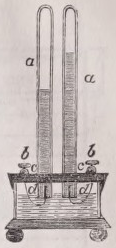
An electrotype.
No thesaurus entries found for "Volta".
No Bible verses found for "Volta".