
A female servant charged with the care of a young child.
Word of the Day: Catachrestical
Bonne bouche
Webster's Dictionary 1913
Bonne val
Encyclopedia Britannica
BONNE VAL, Claude Alexandre, Comte de, a celebrated French adventurer, known also as Achιnet Pasha, was the descendant of au old family of Limousin. He was born on the 14th July 1675 at Coussac, and at the age of thirteen joined the Royal Marine Corps. After three years he entered the Guards, whence he was transferred to the infantry regiment of Latour He served in the Italian campaigns under Catinat, Villeroi, and Vendome, and in the Netherlands under Luxembourg, giving proofs of iudomitable courage and great military ability. His insolent bearing towards Chamillard, minister of war, was made matter for a court-martial. He was condemned to death, but haviug foreseen this sentence, he saved himself by flight to Germany. Through the influence of Prince Eugene he obtained a command in the Austrian army, and fought with great bravery and distinction against France, and afterwards against Turkey. He was severely wounded at Peterwardein, and after his recovery paid a visit to Paris. The proceedings against him in France had been allowed to drop, and he married a daughter of Marshal de Biron, whom, however, he deserted after a week or two. He returned again to the Austrian army, and fought with distinction at Belgrade. He might now have risen to the highest rank, had he not made himself disagreeable to Prince Eugene, who sent him as master of the ordnance to the Low Countries There his ungovernable temper led him into a quarrel with the Marquis de Prié, governor of the Netherlands, who answered his challenge by placing him in confinement. A court-martial was again held upon him, and he was condemned to death; but the emperor commuted the sentence to one year’s imprisonment and banishment from the imperial domains. Bonueval, soon after his release, offered his services to ...the Turkish Government, professed the Mahometan faith, and took the name of Achmet. He was made a pasha of three tails, and appointed to the command of the artillery. He rendered valuable sevices to the sultan in his war with Russia, and with the famous Kouli Khan. As a reward he received the governorship of Chios, but soon fell under the suspicion of the Porte, and was banished for a time to the shores of the Black Sea. He was meditating a return to Europe and Christianity when he died at Constantinople, 27th March 1747. The Memoirs published under his name are spurious. (Sec Prince de Ligne, Mémoire sur la Comte de Bonneval, 1817.)
9th ed. Encyclopædia Britannica, vol. 4, p. 36
[417 words — estimated reading time: 3 minutes]
[417 words — estimated reading time: 3 minutes]
Bonner
Encyclopedia Britannica
BONNER, or Boner, Edmund, an English prelate, notorious for his persecutions of the Protestants during the reign of Queen Mary, was born at Hanley in Worcestershire, about the end of the 15th century, and generally passed for the natural son of George Savage, a∙ priest who was the natural son of Sir John Savage of Clifton in tho same county. Strype in his Memorials of Cranmer, however, says he was positively assured that Bonner was the legitimate offspring of a poor man, who lived in a cottage long afterwards known as Boner’s place. About 1512 he entered as a student of Broadgate Hall (now Pembroke College), Oxford; and in 1519 he was admitted as bachelor of the canon and of the civil law. Having been admitted into orders, he obtained some preferment in the diocese of Worcester. In 1525 he took his degree as doctor, and attracted the notice and patronage of Wolsey. Bonner was with the cardinal at Cawood when he was arrested on charge of high treason. After the death of Wolsey he adopted Lutheran sentiments, and insinuated himself into the favour of Henry VIII., who made him one of his chaplains, and employed him in several embassies abroad. In 1532 he was sent to Rome with Sir Edward Carne, to answer for the king, who had been cited to appear in person or by proxy in regard to the divorce of Queen Catharine. In 1533, being again despatched to Pope Clement VII., then at Marseilles, to intimate Henry’s appeal to a future general council from the sentence pronounced against his divorce, he threatened the Pope with so much resolution, that his holiness talked of having him burned alive or thrown into a cauldron of melted lead. Clement did not foresee that the man whom he had thus menaced with the flames was destined to burn heretics in England in support of the very ...faith which, under Henry, he had lent his aid to overthrow. In 1538, being then ambassador at the court of France, he was nominated bishop of Hereford; but before consecration, he was translated to the see of London, and was enthroned in April 1540. When Henry VIII. died in 1547, Bonner was ambassador at the court of the Emperor Charles V. During Henry’s reign he was constantly zealous in his opposition to the Pope, and favoured the Reformation in obedience to the king, who exacted rigid compliance with all his caprices. On the accession of Edward, however, Bonner refused to take the oath of supremacy, and was committed to the Fleet, where he remained until he promised obedience to the laws. After his release he assented to the Reformation, but with such manifest reluctance, that he was twice reprimanded by the Privy Council, and in 1549 was, after a long trial, committed to the Marshalsea, and deprived of his bishopric, to which, however, he was restored on the accession of Mary; and soon afterwards he was appointed, in place of Cranmer, vicegerent and president of the Convocation. From this time he became the chief instrument of persecution, and is said to have condemned no less than 200 Protestants to the flames in the space of three years. On the accession of Elizabeth he appeared with the rest of the bishops at Highgate, to congratulate her; but the queen refused to permit him to kiss her hand. Having, in the second year of her reign, refused to take the oath of supremacy, he was again committed to the Marshalsea, where he died, September 5, 1569, after a confinement of ten years. The character of Bonner was remarkable for obstinacy and inflexibility in everything save principle; yet even in this respect it exhibits some striking contrasts. In his early career he accommodated his principles to his convenience and ambition; after his return to Catholicism, he remained steadfast to the church, and, when disgraced, bore his deprivation and imprisonment with apparent resignation. The charge of atheism brought against one so defiled with blood was superfluous. He was constitutionally merciless and austere, fitted by nature for a persecutor, and equally capable of employing the same ardent zeal either against or in favour of any cause that he espoused. Among his works oxe, Responsum et Exhortatio in LaudemSacerdotii, a préfaça in Gardeuer’s treatise De Vera Obedιentia, and several homilies.
9th ed. Encyclopædia Britannica, vol. 4, p. 34
[727 words — estimated reading time: 5 minutes]
[727 words — estimated reading time: 5 minutes]
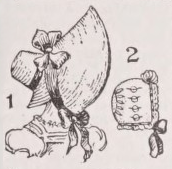
1. A covering for the head, in common use before the introduction of hats. The word, as now used, signifies a cover for the head, worn by females, close at the sides, and projecting over the forehead.
2. In fortification, a small work with two faces, having only a parapet, with two rows of palisades about 10 or 12 feet distant. Generally it is raised above the salient angle of the counterscarp, and communicates with the covered way.
3. Bonnet a pretre, or priest's bonnet is an outwork, having at the head three salient angles and two inwards.
4. In sea language, an addition to sail, or an additional part laced to the foot of a sail, in small vessels, and in moderate winds.
1. A headdress for men and boys; a cap.
2. A soft, elastic, very durable cap, made of thick, seamless woolen stuff, and worn by men in Scotland.
3. A covering for the head, worn by women, usually protecting more or less the back and sides of the head, but no part of the forehead. The shape of the bonnet varies greatly at different times; formerly the front part projected, and spread outward, like the mouth of a funnel.
4. Anything resembling a bonnet in shape or use
5. A small defense work at a salient angle; or a part of a parapet elevated to screen the other part from enfilade fire.
6. A metallic canopy, or projection, over an opening, as a fireplace, or a cowl or hood to increase the draught of a chimney, etc.
8. A roofing over the cage of a mine, to protect its occupants from objects falling down the shaft.
9. In pumps, a metal covering for the openings in the valve chambers.
11. The second stomach of a ruminating animal.
To take off the bonnet or cap as a mark of respect; to uncover.
Bonnet
Encyclopedia Britannica
BONNET, Charles, an eminent naturalist and philosophical writer, was born at Geneva on the 13th March 1720. The Bonnets, a French family whom the religious persecution in the 16 th century had driven into Switzerland, were accustomed to fill important posts in the Genevese Government; and young Charles Bonnet was expected to qualify himself to make use of the family influence by becoming a lawyer. But dry legal technicalities proved to be anything but attractive to his rich and imaginative mind, all the more that he found in the study of nature an employment which was not also a task. He made law his profession, but he never seems to have permitted it to interfere seriously with his favourite pursuits. The account of the ant-lion in Pluche’s Spectacle de la Nature, w hich he chanced to read in his sixteenth year, turned his attention in particular to the wonders of insect life. He procured Réaumur’s work on insects, and with the help of live specimens succeeded, after minute and patient investigation, in adding many observations to those of Réaumur and Pluche The result of two years’ labour he made known to Réaumur, who was naturally not a little surprised to find so much sagacity and power of research in a youth of eighteen In 1740 Bonnet communicated to the Academy of Sciences a paper containing a series of experiments establishing what is now termed parthenogenesis in aphides or tree-lice, which obtained for him the honour of being admitted a corresponding member of the academy. In 1741 he instituted a set of experiments respecting the reproduction of worms by fission; and in the following year he discovered that the respiration of caterpillars and butterflies is performed by pores, to which tho name of stigmata has since been given. In 1743 he was admitted ...a fellow of the Royal Society; and in the same year he became a doctor of laws,—his last act in connection with a profession which had ever been distasteful to him. His first published work appeared in 1745, entitled Traité d’Insectologie, in which were collected his various discoveries regarding insects, along with a preface on the development of germs and the scale of organized beings. Botany, particularly the leaves of plants, next attracted the attention of Bonnet; and after several years of diligent study, rendered irksome by the increasing weakness of his eyesight, he published, in 1754 one of the most original and interesting of his works, Traité de l’usage des feuilles ; in which among other things he advances many considerations tending to show that plants are endowed with powers of sensation and discernment. But Bonnet’s eyesight, which threatened to fail altogether, now caused him to turn his thoughts from investigation to speculation. In 1754 his Essai de Psychologie was published anonymously in London. This was followed in 1760 by the Essai analytique suries facultés de l’âme, in which he develops his views regarding the physiological conditions of mental activity. He returned to physical science, but to the speculative side of it, in his Considérations sur les corps organisés, Amsterdam, 1762. The principal objects of this work were to give, in. an abridged form, all the most interesting and well-ascertained facts respecting the origin, development, and reproduction of organized bodies, to refute the theory of epigenesis, and to explain and defend the doctrine of pre-existent germs. In his Contemplation de la Nature, which next appeared (1764-5), one of his most popular and delightful works, he sets forth, in eloquent language, the theory that all the beings in nature form a gradual scale rising from lowest to highest, without any break in its continuity. His last important work is entitled Palingénésie Philosophique, (Geneva, 1769); in it he treats of the past and future of living beings, and supports the idea of the survival of all animals, and the perfecting of their faculties in a future state. Bonnet’s life was singularly uneventful. He seems never to have passed beyond the limits of his native country; nor does he appear to have taken any part in public affairs except for the comparatively short period between 1752 to 1768, during which he was a member of the council of the republic. The last twenty-five years of his life he spent in the country, simple and regular in his mode of life, easy in his circumstances, and happy in a small circle of friends. His wife, whom he married in 1756, was a lady of the family of De la Rive. They had no children, but Madame Bonnet’s nephew, the celebrated De Saussure, was brought up as their son. Bonnet died, after a long and painful illness, on the 20th May 1793.
The outlines of Bonnet’s philosophical system may be set forth in a few sentences. Man, according to him, is a mixed being, composed of two distinct substances,— mind and body,—the one immaterial and the other material. In what manner the two are connected we do not know, but of this at least we are certain, that bodily activity is a necessary condition of thought. All knowledge originates in sensations; sensations themselves follow (but whether as physical effects or merely as sequents Bonnet will not say) vibrations in the various nerves appropriate to each; and lastly, the nerves are made to vibrate by the action of outward objects upon them. A nerve once set in motion by a particular object contracts a certain tendency to reproduce that motion; so that when it a second time receives an impression from the same object it vibrates with less resistance. It is the sensation accompanying this increased flexibility in the nerve that is, according to Bonnet, the condition of memory. When reflection—that is, the active as distinguished from the merely passive element in mind—is applied to the acquisition and combination of sensations, those abstract ideas are formed which are usually placed in opposition to sensations, but which are thus, no matter how refined they may appear, sensations in combination only. That which puts the mind into activity is pleasure or pain; happiness is the end of human existence. Bonnet’s metaphysical theoryis based on two principles borrowedfrom Leibnitz,—first, that there are not successive acts of creation, but that the universe is completed by the original act of the divine will, and thereafter moves on by its own inherent force; and, secondly, that there is no gap in the continuity of existence. The divine Being, according to Bonnet, originally created a multitude of germs in a graduated scale, each with an inherent power of self-development. At every successive step in the progress of the globe, these germs, or what has been developed in their place, advance nearer to perfection; if some advanced and others did not there would be a gap in the continuity of the chain. Thus not man only but all other forms of existence are immortal. Nor is it man’s mind merely; his body also will pass into the higher stage, not, indeed, the body he now possesses, but a finer one of which the germ at present exists within him. This is equally true of the other animals, who also possess a germ that will develop itself in the next stage; and every individual begins each successive stage with that amount of perfection and of knowledge which he had when he left the previous stage. It is impossible, however, to reach absolute perfection, because the distance is infinite. It is difficult to reconcile this last proposition with the law of continuity, if that law is to be accepted, as Bonnet seems to accept it, as an absolute principle of the universe, embracing all existence divine and created, for surely the interval between the divine Being and the highest created being, constantly lessening though it be, is a break in the continuity of the chain. It is also difficult to understand whether the constant advance to perfection is performed by every individual on his own account, or only by each race of beings as a whole. Is a man when he dies at once translated to the next stage, or must he wait until the time comes when the advancement of the whole human race takes place, before he, at any rate consciously, realizes the new state 1 There seem, in fact, to be two distinct but somewhat analogous doctrines,—that of the constantly increasing advancement of the individual in future stages of existence, and that of the constantly increasing advancement of the race as a whole according to the successive evolutions of the globe.
Bonnet’s complete works appeared at Neufchatel in 1779-1785, partly revised by himself. An English translation of certain portions of the Palingénésie Philosophique was published in 1787, under the title, Philosophical and Critical Inquiries concerning Christianity. (See A. Lemoine, Charles Bonnet, Paris, 1850; and the Due de Carainan’s Charles Bonnet, philosophe et naturaliste, Paris, 1859.)
9th ed. Encyclopædia Britannica, vol. 4, p. 35
[1,511 words — estimated reading time: 9 minutes]
[1,511 words — estimated reading time: 9 minutes]
Bonnet
Watson's Biblical & Theological Dictionary
was a covering for the head, worn by the Jewish priests. Josephus says, that the bonnet worn by the private priests was composed of several rounds of linen cloth, turned in and sewed together, so as to appear like a thick linen crown. The whole was entirely covered with another piece of linen, which came down as low as their forehead, and concealed the deformity of the seams. See Exodus xxviii, 40. The high priest’s bonnet was not much different from that which has been described.
Watson's Biblical & Theological Dictionary
[86 words — estimated reading time: 1 minute]
[86 words — estimated reading time: 1 minute]
1. Wearing a bonnet.
Without a bonnet.
Servant Roget’s Thesaurus §746
N. subject, liegeman, servant, retainer, follower, henchman, servitor, domestic, menial, help, lady help, employe, attache, official, retinue, suite, cortege, staff, court, attendant, squire, usher, page, donzel, footboy, train bearer, cup bearer, waiter, lapster, butler, livery servant, lackey, footman, flunky, flunkey, valet, valet de chambre, equerry, groom, jockey, hostler, ostler, tiger, orderly, messenger, cad, gillie, herdsman, swineherd, barkeeper, bartender, bell boy, boots, boy, counterjumper, khansamah, khansaman, khitmutgar, yardman, bailiff, castellan, seneschal, chamberlain, major-domo, groom of the chambers, secretary, under secretary, assistant secretary, clerk, subsidiary, agent, subaltern, underling, understrapper, man, maid, maidservant, handmaid, confidente, lady's maid, abigail, soubrette, amah, biddy, nurse, bonne, ayah, nursemaid, nursery maid, house maid, parlor maid, waiting maid, chamber maid, kitchen maid, scullery maid, femme de chambre, femme fille, camarista, chef de cuisine, cordon bleu, cook, scullion, cinderella, potwalloper, maid of all work, servant of all work, laundress, bedmaker, journeyman, charwoman, bearer, chokra, gyp, hamal, scout, serf, vassal, slave, negro, helot, bondsman, bondswoman, bondslave, ame damnee, odalisque, ryot, adscriptus gleboe, villian, villein, beadsman, bedesman, sizar, pensioner, pensionary, client, dependant, dependent, hanger on, satellite, parasite, led captain, protege, ward, hireling, mercenary, puppet, tool, creature, badge of slavery, bonds
V. serve, wait upon, attend upon, dance attendance upon, pin oneself upon, squire, tend, hang on the sleeve of, chore
Adj. in the train of, in one's pay, in one's employ, at one's call, in bonds
Keeper Roget’s Thesaurus §753
N. keeper, custodian, custos, ranger, warder, jailer, gaoler, turnkey, castellan, guard, watchdog, watchman, charley, chokidar, durwan, hayward, sentry, sentinel, watch and ward, concierge, coast guard, guarda costa, game keeper, escort, bodyguard, protector, governor, duenna, guardian, governess, nurse, nanny, babysitter, catsitter, dogsitter, bonne, ayah
King James Bible KJV Bible
Berean Standard Bible BSB Bible
6 KJV and 0 BSB verses contain “bonne”
And for Aaron’s sons thou shalt make coats, and thou shalt make for them girdles, and bonnets shalt thou make for them, for glory and for beauty.
Make tunics, sashes, and headbands for Aaron’s sons, to give them glory and splendor.
And thou shalt gird them with girdles, Aaron and his sons, and put the bonnets on them: and the priest’s office shall be theirs for a perpetual statute: and thou shalt consecrate Aaron and his sons.
They shall have linen bonnets upon their heads, and shall have linen breeches upon their loins; they shall not gird themselves with any thing that causeth sweat.
They are to wear linen turbans on their heads and linen undergarments around their waists. They must not wear anything that makes them perspire.