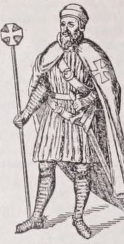
The Templars almost from their foundation had their quarters in the palace of the Latin kings, which had been the mosque of Mount Moriah. This palace was also known as Solomon’s temple, and it was from this templum Salomonis that the Templars took their name.
Paganis, bound himself and eight comrades by a vow to the patriarch of Jerusalem to guard the public roads, to live as regular canons, and to fight for the King of Heaven in chastity, obedience, and self-denial. Baldwin II. granted them quarters on Mount Moriah and recommended their cause to St Bernard. Under his patronage the papal legate, Matthew, bishop of St Albano, presided at the council of Troyes in January 1128 for the purpose of drawing up or confirming the statutes of the new order. The seventy-two statutes then drawn up met with the approval of Pope Honorius II. and the patriarch of Jerusalem, and became the groundwork of the later and more elaborate “Règle du Temple.” Long before St Bernard’s death (1153) the new order was established in almost every kingdom of Latin Christendom. Henry I. granted them lands in Normandy. They seem to have been settled in Castile by 1129, in Rochelle by 1131, in Languedoc by 1136, at Rome by 1138, in Brittany by 1141, and in Germany at perhaps a still earlier date. Alphonso I. of Aragon and Navarre, if we may trust the Spanish historians, bequeathed them the third of his kingdom (Mariana, x. c. 9). Raymond Berengar, count of Barcelona, and Alphonso’s successor in Aragon, whose father had been admitted to the order, granted them the strong castle of Monçon (1143), and established a new chivalry in imitation of theirs. Louis VII. in the latter years of his reign gave them a piece of marsh land outside Paris, which in later times became known as the Temple, and was the headquarters of the order in Europe. Stephen of England granted them the manors of Cressing and Witham in Essex, and his wife Matilda that of Cowley, near Oxford. Eugenius III., Louis VII., and 130 brethren were present at the Paris chapter (1147) when Bernard de Balliol granted the order 15 librates of land near Hitchin; and the list of English benefactors under Stephen and Henry II. includes the noble names of Ferrers, Harcourt, Hastings, Lacy, Clare, Vere, and Mowbray.
After the council of Troyes Hugh de Paganis came to England and induced a number of English knights to follow him to the Holy Land. Amongst these was Fulk, count of Anjou, who would thus seem to have been a Templar before assuming the crown of Jerusalem in 1131. Hugh de Paganis died about the year 1136 and was succeeded by Robert de Craon, who is said to have been Anselm’s nephew. Everard de Barris, the third master, was conspicuous in the second crusade. In the disastrous march from Laodicea to Attalia his troops alone kept up even the show of discipline; and their success prompted Louis VII. to regulate his whole army after the model of the Templar knights. In the French king’s distress for money the Templars lent him large sums, ranging from 2000 silver marks to 30,000 solidi. When Conrad III. of Germany reached Jerusalem he was entertained at their palace (Easter 1148); and in the summer of the same year they took part in the unsuccessful siege of Damascus. The failure of this expedition was ascribed by a contemporary writer to their treachery,—a charge to which Conrad would not assent. This is the first note of the accusations which from this time were of constant recurrence.
Henceforward for 140 years the history of the Templars is the history of the Crusades {q.vf In 1149 the Templars were appointed to guard the fortress of Gaza, the last Christian stronghold on the way towards Egypt. Four years later the new master, Bernard de Tremelai, and forty of his followers, bursting into Ascalon, were surrounded by the Saracens and cut off to a single man. William of Tyre has preserved the scandal of the day when he hints that they met a merited fate in their eagerness to possess themselves of the city treasure. Next year the rumour went abroad that they had sold a noble halfconverted Egyptian prince, who had fallen into their hands, to chains and certain death for 60,000 aurei. In 1166 Amalric, the Latin king of Jerusalem, hanged twelve Templars on a charge of betraying a fortress beyond the Jordan to an emir of Nür al-Din of Damascus. The military power of Nür al-Din (1145-1173) was a standing menace to the Christian settlements in the East. Edessa had fallen to the prowess of his father (1144-45); Damascus was conquered by the son (1153), who four years earlier had carried his depredations almost to the walls of Antioch, and in 1157 laid siege to the Christian town of Paneas near the sources of the Jordan. In the disastrous fight that followed for the safety of the fortress of the Hospitallers, Bertrand de Blanquefort, the master of the Templars, and Odo de St Amand, one of his successors, were taken prisoners. Bertrand was released later when Manuel was preparing to march against Nιir al-Din. The Templars do not seem to have opposed Amalric’s early expeditions against Egypt. It was Geoffrey Fulcher, the Templar correspondent of Louis VII., who brought back (1167) to Jerusalem the glowing accounts of the splendour of the caliph’s court at Cairo with which Gibbon has enlivened his great work. Nor was the order less active at the northern limits of the Latin kingdom. Two English Templars, Gilbert de Lacy and Robert Mansel, “qui Galen-sibus praeerat,” starting from Antioch, surprised Nür al-Din in the neighbourhood of Tripoli and put him barefooted to flight. But jealousy or honour led the Templars to oppose Amalric’s Egyptian expedition of 1168; and the wisdom of their advice became apparent when the renewed discord on the Nile led to the conquest of Egypt by Asad al-Din Shirkùh, and thus indirectly to the accession of Saladin, in 1169. In 1170 they beat Saladin back from their frontier fortress of Gaza; and seven years later they shared in Baldwin IV.’s great victory at Ascalon.
Meanwhile Saladin had possessed himself of Emesa and Damascus (1174-75), and, as he was already lord of Egypt, his power hemmed in the Latin kingdom on every side. In July 1173 Amalric was succeeded by his son Baldwin IV., a boy of twelve. Raymond III., count of Tripoli, a man suspected of being in league with the Saracens, was appointed regent, although in 1176 the masters of the Templars and the Hospitallers united in offering this office to the newly arrived Philip of Flanders. The construction of the Templar fortress at Jacob’s ford on the upper Jordan led to a fresh Saracen invasion and the disastrous battle of Paneas (1179), from which the young king and the Holy Cross escaped with difficulty, while Odo de St Amand, the grand-master, was carried away captive and never returned.
During Odo’s mastership the Old Man of the Mountains sent to Amalric offering to accept the Christian faith if released from the tribute he had paid to the Templars since (according to the reckoning of M. Defrémery) somewhere about 1149. The Templars murdered the envoys on their return (c. 1172). Amalric demanded that the offenders should be given up for justice. Odo refused to yield the chief culprit, though he was well known, and invoked the protection of the pope. Amalric had to vindicate his right by force of arms at Sidon, and died while preparing to take stronger measures. The connexion between the Templars and the Old Man was still vital eighty years later when the two grand-masters rebuked the insolence of the Assassin envoys in the presence of Louis IX. Odo de St Amand was succeeded by Arnold de Torroge, who died at Verona on his way to implore European succour for the Holy Land. The power of Saladin was now (1184) increasing daily; Baldwin IV. was a leper, and his realm was a nrev to rival factions. There were two claimants for the guardianship of the state,—Raymond III. of Tripoli and Guy de Lusignan, who in 1180 had married Sibylla, sister of the young king. Baldwin inclined to the former, against the patriarch and Arnold de Torroge.
There is something Homeric in the story of the fall of the Latin kingdom as related by the historians of the next century. A French knight, Gerard de Riderfort or Bideford, coming to the East in quest of fortune, attached himself to the service of Raymond of Tripoli, looking for the hand of some wealthy widow in reward. But on his claiming the hand of the lady of Botron he was met with a refusal. Angered at this, Gerard enrolled himself among the Templars, biding his time for revenge, and was elected grand-master on the death of Arnold. Baldwin IV. died (1185), leaving the throne to his young nephew Baldwin V., the son of Sibylla, under the guardianship of Raymond, whose office was not of long duration, as the little king died in September 1186. This was Gerard’s opportunity. The Templars carried the body of their dead sovereign to Jerusalem for burial; and then, unknown to the barons of the realm, Gerard and the patriarch crowned Sibylla and her husband Guy. The coronation of Guy was the triumph of Reginald of Châtillon, once prince of Antioch, and Saladin’s deadliest foe. It was at the same time the overthrow of Raymond’s ambition; and both Latin and Arabic writers are agreed that the Christian count and the Mohammedan sultan now entered into an alliance. To break this friendship and so save the kingdom, the two grand-masters were sent north to make terms with Raymond. But the rash valour of the Templars provoked a hopeless contest with 7000 Saracens. The grand-master of the Hospitallers was slain; but Gerard made his escape with three knights to Nazareth (1st May 1187). In this emergency Raymond became reconciled with Guy; and Gerard placed the temple treasures of Henry II. at his king’s disposal. Once more it was the Templars’ rashness that led to the disastrous battle of Hittin (4th July). Gerard and the king fell into the hands of Saladin, but were released about a year later; Raymond of Tripoli made his escape through treachery or fortune; and 230 Templars fell in or after the battle, for the fight was scarcely over before Saladin ordered all the Templars and Hospitallers to be murdered in cold blood. One after another the Christian fortresses of Palestine fell into the hands of Saladin. Jerusalem surrendered on 2d-3d October 1187, and the treasures of the temple coffers were used to purchase the redemption of the poorer Christians, part of whom the Templar warriors guarded on their sad march from the Holy City to Tripoli. Part of their wealth was expended by Conrad of Montferrat in the defence of Tyre; but, when this prince refused to admit Guy to his city, both the Templars and the Hospitallers from the neighbouring parts flocked to the banner of their released king and accompanied him to the siege of Acre (22d August 1189). In his company they bore their part in the two years’ siege and the terrible famine of 1190-91; and their grand-master died in the great battle of 4th October 1189, refusing to survive the slaughter of his brethren.
On the fall of Acre Philip Augustus established himself in the palace of the Templars, who are, however, stated to have sympathized with Richard. This king sold them the island of Cyprus for 100,000 besants; but, unable to pay the purchase money, they transferred the debt and the principality to Guy of Lusignan. The English king consulted them before deciding on any great military movement; and in June 1192 they advocated the bold plan of an advance on Egypt rather than on Jerusalem. In the disputes for the Latin kingdom of the East the Templars seem to have supported Guy, and, like Richard, were credited with having had a hand in the murder of Conrad of Montferrat (April 1192). It was in the disguise of a Templar and in a Templar galley that Richard left the Holy Land. When Acre was recovered, the Templars, like the Hospitallers, received their own quarters in the town, which from this time became the centre of the order. On the death of Henry of Champagne (1197) they vetoed the election of Raoul de Tabarie; after the death of his successor Amalric they refused to renew the truce with Saladin’s brother, Saif al-Din, and led an expedition against the Saracens before the arrival of the new king, John de Brienne, at whose coronation in 1210 William de Chartres, the grand-master, was present. Seven years later, with the aid of Walter de Avennis and of the Teutonic Knights, they commenced the building of their fortress of Castle Pilgrim, near Acre, on a rocky promontory washed by the Mediterranean on every side except the east. This wonderful structure, whose ruins are still to be seen, was fortified with a strong wall, founded on the substructure of a yet more extensive one running from sea to sea, and was flanked by lofty towers of huge squared stones. Within was a spring of pure water, besides fishponds, salt-mines, woods, pastures, orchards, and all things fitted to furnish an abode in which the Templars might await the day of their restoration to Jerusalem.
It was from this castle that in May 1218 the fifth crusade started for the expedition against Egypt. The Templars were the heroes of the siege of Damietta, at which William de Chartres was slain. “First to attack and last to retreat,” they saved the Christian army from annihilation on 29th August 1219; and when the city surrendered (5th November) the only one of its twenty-eight towers that had begun to give way had been shaken by their engines. On the other hand, it was largely owing to their objections that John de Brienne refused the sultan’s offer to restore Jerusalem and Palestine.
From the very first the Templars seem to have been opposed to Frederick II., and when he landed at Acre (7th September 1228) they refused to march under the banners of an excommunicated man, and would only accompany his host from Acre to Joppa in a separate body. They were accused of notifying Frederick’s intended pilgrimage to the Jordan to the sultan, and they were certainly opposed to Frederick’s ten years’ peace with Al-Kâmil, the sultan of Egypt, and refused to be present at his coronation in Jerusalem. Frederick was not slow to avenge himself: he left Jerusalem abruptly, publicly insulted the grand-master, demanded the surrender of their fortresses, and even laid siege to Castle Pilgrim. He left Acre on 3d May 1229, and on landing in Apulia gave orders to seize the estates of the order and chase all its members from the land.
Long before the expiration of Frederick’s peace Europe was preparing for a fresh crusade against the now divided realm of the Ayyubids. Theobald of Navarre and his crusaders reached Palestine about August 1239. The Templars shared in the great defeat near Jaffa, an engagement which their temerity had done much to provoke (13th November 1239). If the king ever accepted the overtures of Salih of Damascus, he was supporting the policy of Hermann of Perigord, the grand-master, who towards the summer of 1244 wrote a triumphant letter to England, telling how he had engaged this sultan and Nâsir of Kerak to make an alliance against the sultan of Egypt and restore the whole of Palestine from the Jordan to the sea. Theobald, however, before leaving the Holy Land (27th September 1240), signed a ten years’ truce with Sâlih of Egypt. The Hospitallers seem to have been won over to his view, and when Richard of Cornwall arrived (11th October) he had to decide between the two rival orders and their opposing policies. After some hesitation he concluded a treaty with the sultan of Egypt, much to the annoyance of the Templars, who openly mocked his efforts. On his departure the three orders came to open discord: the Templars laid siege to the Hospitallers in Acre and drove out the Teutonic Knights “in contumeliam imperatoris.” They were successful on all sides. The negotiations with Damascus and Kerak were reopened, and in 1244 Hermann of Perigord wrote to the princes of Europe that after a “silence of fifty-six years the divine mysteries would once more be celebrated in the Holy City.”
It was in this moment of danger that the sultan of Babylon called in the barbarous Khârizmians, whom the Mongol invasions had driven from their native lands. These savages, entering from the north, flowed like a tide past the newly built and impregnable Templar fortress of Safed, swept down on Jerusalem, and annihilated the Christian army near Gaza on St Luke’s day (18th October) 1244. From this blow the Latin kingdom of the East never recovered; 600 knights took part in the battle; the whole army of the Templars, 300 in number, was present, but only 18 survived, and of 200 Hospitallers only 16. The masters of both orders were slain or taken prisoners. Despite the admirable valour of the Templars, their policy had proved the ruin of the land. Jerusalem was lost to Christendom for ever; and, though the Khârizmians melted away in the course of the next three years, they left the country so weak that all the acquisitions of Theobald and Richard fell an easy prey to the sultan of Babylon.
Recognizing the fact that the true way to Jerusalem lay through Egypt, Louis IX. led his host to the banks of the Nile, being accompanied by the Templars. Their master, William de Sonnac, attempted in vain to restrain the rash advance of the count of Artois at the battle of Mansιira (8th February 1250), which only three Templars survived. St Louis, when captured a few weeks later, owed his speedy release to the generosity with which the order advanced his ransom-money. Shortly after his departure from Acre (April 1254) they consented to an eleven years’ truce with the sultans of Egypt and Damascus.
A new enemy was now threatening Mohammedan and Christian alike. For a time the Mongol advance may have been welcomed by the Christian cities, as one after another the Mohammedan principalities of the north fell before the new invaders. But this new danger stimulated the energies of Egypt, which under the Mameluke Beybars (see vol. vii. p. 755) encroached year after year on the scanty remains of the Latin kingdom. The great Frankish lords, fearing that all was lost, made haste to sell their lands to the Templars and Hospitallers before quitting Palestine for ever. In 1260 the former purchased Sidon and Beaufort; next year the Hospitallers purchased Arsuf. In 1267, by a skilful adaptation of the banners of both orders, Beybars nearly surprised Antioch. The Templar fortress of Safed surrendered with its garrison of 600 knights, all of whom preferred death to apostasy (June 1266). Beaufort fell in April 1268, Antioch six weeks later; and, though the two orders still made occasional brilliant dashes from their Acre stronghold, such as that to Ascalon in 1264 and that with Prince Edward of England to destroy Kâkùn in 1271, they became so enfeebled as to welcome the treaty which secured them the plain of Acre and a free road to Nazareth as the result of the English crusade of 1272.
But, though weak against external foes,...