Any one of several species of large, elongated, marine fishes of the genus Cryptacanthodes, especially C. maculatus of the American coast. A whitish variety is called ghostfish.
1. A twisted or distorted neck; a deformity in which the neck is drawn to one side, and at the same time somewhat forwards.
2. A disease of the spasmodic kind in sheep, in which the head is drawn to one side.
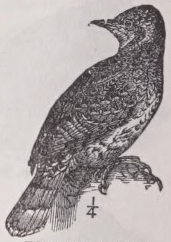
3. In ornithology, a bird resembling the woodpeckers, the Yunx torquilla; so called form the singular manner in which when surprised, it tuns its head over its shoulders.
1. A twisted or distorted neck; a deformity in which the neck is drawn to one side by a rigid contraction of one of the muscles of the neck; torticollis.
2. Any one of several species of Old World birds of the genus Jynx, allied to the woodpeckers; especially, the common European species (J. torguilla); -- so called from its habit of turning the neck around in different directions. Called also cuckoo's mate, snakebird, summer bird, tonguebird, and writheneck.
WRYNECK (Germ. Wendehals, Dutch Draaihalzeη, French Torcoι), a bird so called from its wonderful way of writhing its head and neck, especially when captured, as it may easily be, on its nest in a hollow tree. The lynx torquilla of ornithology, it is a regular summer-visitant to most parts of Europe, generally arriving a few days before the Cuckow, and it is in many countries known by some name associating it with that well-known bird—as in England “Cuckow’s leader” and “Cuckow’s mate”— but occasionally it is called “Snake-bird,” not only from the undulatory motions just mentioned, but from the violent hissing with which it seeks to repel an intruder from its hole....
The very unmistakable note of the Wryneck, without having any intrinsic merit, is always pleasant to hear as a harbinger of spring. It is merely a repetition of what may be syllabled que, que, que, many times in succession, rapidly uttered at first, but gradually slowing and in a continually falling key. This, however, is only heard during a few weeks, and for the rest of the bird’s stay in Europe it seems to be mute. It feeds almost exclusively on insects, especially on ants, and may often be seen on the ground, busily engaged at their nests. Somewhat larger than a Sparrow, its plumage is not easily described, being beautifully variegated with black, brown, buff, and grey—the last produced by minute specks of blackish-brown on a light ground—the darker markings disposed in patches, vermiculated bars, freckles, streaks, or arrow-heads—and the whole blended most harmoniously, so as to recall the coloration of a Goatsucker (q.v.) or of a Woodcock (q.v.). The Wryneck builds no nest, but commonly lays its translucent white eggs on the bare wood of a hole in a tree, and it is one of the few wild birds that can be induced to go on laying by abstracting its eggs day after day, and thus upwards of forty have been taken from a single hole—but the proper complement is from six to ten. As regards Britain, the bird is most common in the south-east, its numbers decreasing rapidly towards the west and north, so that in Cornwall and Wales and beyond Cheshire and Yorkshire its occurrence is but rare, while it appears only by accident in Scotland and Ireland.
Some writers have been inclined to recognize five other species of the genus lynx ; but the so-called I. japonica is specifically indistinguishable from I. tοrquilla ; while that designated, through a mistake in the locality assigned to it, I. indica, has been found to be identical with the I. pectoralis of South Africa. Near to this is I. ρulchricollis, discovered by Emin Pasha in the east of the Bar-el-Djebel {Ibis, 1884, p. 28, pl. iii.). Another distinct African species is the I. aequatorialis, originally described from Abyssinia. The Wrynecks, as already stated (Woodpecker, supra, p. 652), form a Subfamily lynginae, of the Picidae, from the more normal groups of which they differ but little in internal structure, but much in coloration and in having the tail-quills flexible, or at least not stiffened to serve as props as in the climbing Picinae. (a. n.)
9th ed. Encyclopædia Britannica, vol. 24, p. 698 [547 words — estimated reading time: 4 minutes]
Adj.distorted, out of shape, irregular, asymmetric, unsymmetric, awry, wry, askew, crooked, not true, not straight, on one side, crump, deformed, harelipped, misshapen, misbegotten, misproportioned, ill proportioned, ill-made, grotesque, monstrous, crooked as a ram's horn, camel backed, hump backed, hunch backed, bunch backed, crook backed, bandy, bandy legged, bow legged, bow kneed, knock kneed, splay footed, club footed, round shouldered, snub nosed, curtailed of one's fair proportions, stumpy, gaunt, bloated, scalene, simous, taliped, talipedic
Adv. all manner of ways
Phr. crooked as a virginia fence, 2, special form
No Bible verses found for "Wry".
This site uses cookies to remember your display preferences (search sources and editions, Bible version, auto-link, images, light/dark theme). No personal data whatsoever is collected. Privacy Policy