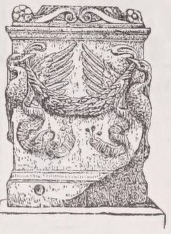
ALTAR, in Classical Antiquity, was a solid base or pedestal on which supplication was made and sacrifice offered to the gods and deified heroes. According to this difference in the service for which they were employed, altars fell into two classes, of which the one, smaller and lower so that the suppliant could kneel upon it, stood inside temples, in front of the sacred image; while the other, destined for burnt sacrifice, was placed in the open air, and, if connected with a temple, in front of the entrance. Possibly altars of the former class were substitutes for, and rendered the same service in historical times as, in an early age, the base of the sacred image within a temple. In this case the altar of Apollo at Delphi, on which Neoptolemus is frequently represented on the Greek vases as taking refuge from Orestes, might be regarded as the pedestal of an invisible image of the god, and as fulfilling the same function as did the base of the actual image of Minerva in Troy, towards which Cassandra fled from Ajax. The other class of altars, called βωμοί by the Greeks and altaria by the Romans, appear to have originated in such temporary constructions as heaps of earth, turf, or stone, made as occasion offered for kindling a fire for sacrifice. The next step was to allow the bones and ashes of the victims sacrificed to accumulate, and upon this to kindle new fires. Altars so raised were viewed with particular sanctity, the most remarkable recorded instances of them being the altars of Juno at Samus and at Olympia (Pausanias, v. 14, 5; V. 15, 6), of Apollo at Thebes (Pausanias, ix. 11, 5), and of Jupiter at Olympia. The last-mentioned stood on a platform (πρόθυσις) measuring 125 feet in circumference, and led up to by steps, the altar itself being 22 feet ...high. Women were excluded from the platform. Where hecatombs were sacrificed, the πρόθυσιs necessarily assumed colossal proportions, as in the case of the altar at Parion, where it measured on each side 600 feet. The altar of Apollo at Delos (ό κεράτινος βωμός) was made of the horns of deer believed to have been slain by Diana; while at Miletus was an altar composed of the blood of victims sacrificed. The altar used at the festival in honour of Daedalus on Mount Cithaeron was of wood, and was consumed along with the sacrifice (Pausanias, ix. 3, 2). Others, of bronze, are mentioned; but while these were exceptional, the usual material of an altar was marble, and its form, both among the Greeks and Romans, either square or round; polygonal altars, of which examples still exist, being exceptions. When sculptured decorations were added they frequently took the form of imitations of the actual festoons with which it was usual to ornament altars, or of symbols, such as crania and horns of oxen, referring to the victims sacrificed.
As a rule, the altars which existed apart from temples bore the name of the person by whom they were dedicated, and the names of the deities in whose service they were; or, if not the name, some obvious representation of the deity. Such is the purpose of the figures of the Muses on an altar to them in the British Museum. An altar was retained for the service of one particular god, except where, through local tradition, two or more deities had become intimately associated, as in the case of the altar at Olympia to Diana and Alpheus jointly, or that of Neptune and Erechtheus in the Erechtheum at Athens, and others. Such deities were styled σvμβωμoι, each having a separate part of the altar, if we may judge from that at the Amphiareum at Oropos (Pausanias, i. 34, 2). Deities of an inferior order, who were conceived as working together— e.g., the wind gods—had an altar in common. In the same way, the “unknown gods” were regarded as a unit, and had in Athens and at Olympia one altar for all (Pausanias, i. 1, 4; v. 14, 5; Acts of Apostles, xvii. 18). An altar to all the gods is mentioned by Aeschylus (Suppl. v. 225). Among the exceptional classes of altars are also to be mentioned those on which fire could not be kindled (βωμoί aπvρoι), and those which were kept free from blood (βωμοί αναίμακτοι), of which in both respects the altar of Zeus Hypatos at Athens was an example. The εστία was a round altar; the ∈σχαρα, one employed apparently for sacrifice to inferior deities or heroes, or on comparatively unimportant occasions, as was also the ara among the Romans; though ara is sometimes used with the same signification as altare, and etymologically would have the same meaning if it is correctly derived from άείρω, not from ardere; while altare is connected with altus, “high.”
Egyptian altars were monoliths, in the form of a truncated cone about four feet in height. Some are extant, made of granite, others of green basalt; in almost every case they bear hieroglyphical inscriptions. In the temple of Jupiter at Babylon there was an altar of massive gold. Assyrian, Egyptian, and Persian altars were either square or oblong.
The most ancient altars of which any record has been preserved are those mentioned in the Bible. As sacrifice implies an altar, there must have been altars for those of Cain and Abel; but the first which is mentioned is that which Noah after the flood “builded unto Jehovah” (Gen. viii. 20). The three patriarchs, Abraham, Isaac, and Jacob, are repeatedly said to have built an altar in the different parts of the land of Canaan in which they sojourned; and though it is not stated expressly, yet it may be inferred from there having evidently been a place where Abraham was accustomed to “stand before Jehovah” (ibid. xix. 27), that, once built, it remained during the whole period of the encampment at the particular place, and was frequently used for the purpose of sacrificing.
But the most remarkable altar mentioned in the book of Genesis is that which Abraham built for the sacrifice of his son Isaac, from which we glean several particulars relative to the patriarchal worship. The altar was evidently something distinct from the wood by whose fire the sacrifice was to be burnt, for Abraham “built an altar and laid the wood in order,” which he had brought with him from Beersheba, as if he could not count upon finding it at the place. The victim also was bound, laid upon the wood, and there slain. This was contrary to the practice under the Levitical dispensation, when the fire on the top of the altar was kept continually burning, and the animal was killed before being carried up to it; but it is probably alluded to in a verse of the Psalms, which has given much trouble to commentators who have tried to reconcile it with the precepts of the Mosaic law—“Bind the sacrifice with cords unto the horns of the altar” (Ps. cxviii. 27). To this simple patriarchal ritual belong also the rules about the construction of altars given to the Israelites shortly after they left Egypt (Exod. xx. 24-26). While sojourning in that country they do not seem to have offered any sacrifice to Jehovah, till, just as they were leaving it, they were commanded to sacrifice the passover. It is not unlikely that they might have despised the simple altars of their forefathers, and tried to imitate those which they had seen in Egypt, as they so soon copied their late oppressors in a still graver matter, the making a supposed likeness of the Deity. They were therefore ordered to make their altars of earth. Stones might also be used, but they were not to be hewn, nor were the altars to be so high as to require the offerer to go up by steps to arrange the sacrifices upon them.
The first altar that is mentioned as having been built after these directions were given, was the one for the solemn covenanting sacrifice between God and the Israelites (Ex. xxiv. 4-8). There it is mentioned that Moses “builded an altar under the hill, and twelve pillars, according to the twelve tribes of Israel.” Its being under the hill may have been a significant protest against the prevalent heathen error of localising the Deity in the sky, and the twelve pillars or rough blocks of stone appear to have been a principal part of the materials used in constructing it. They may be compared with the “twelve stones, according to the number of the tribes of the sons of Jacob,” with which Elijah built his altar on Carmel (1 Kings xviii. 31). We seem to learn from these examples that when an altar was to be constructed for a special occasion, it was fitting that it should bear a symbolism of all in whose name the sacrifice was offered. It is to be observed that this precept about making altars of earth or of unhewn stones was anterior to the Levitical ceremonial, and was superseded by it. After the sin of making the golden calf, the whole ceremonial of the worship of the Israelites was altered. According to the new ritual, two different altars were required, and they were permanent, being carried about in the people’s wanderings, and replaced by others, similar, but larger and more costly, when the ark was placed in the temple on Mount Moriah.
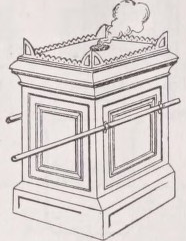
The first of these altars was that for burnt offerings. For the tabernacle this was hollow, made of boards of shittim-wood, covered with brass. It was three cubits or about five feet high, and five cubits or eight feet square. It had a horn at each corner, and was carried about by means of staves. The corresponding altar in the temple was of greatly larger dimensions, ten cubits or about 18 feet high, and in the first temple 20 cubits square, and in the second 24 cubits. The tradition of the Jews is, that it was 32 cubits (about 50 feet) square at the base, contracting to 24 at the top, by several ledges round it at different heights. It must therefore have been an immense structure, and though called “an altar of brass,” was probably built of stones, and merely covered with plates of that metal. From the account of the building of the altar in the second temple given in 1 Macc. iv. 45-47, it is probable that it consisted merely of a mass of masonry of the proper form. Ezekiel, in his vision of the temple, gives a description of the altar of burnt-offerings, from which we learn that it was surrounded by several ledges or steps, each a cubit broad. The uppermost of these was two cubits (about 3 feet) below the top of the altar, so that, standing upon it, the priest was able to arrange the sacrifice upon the fire, which was kept always burning, to supply it with fuel, and to remove the ashes. The lower ledges were to enable him to sprinkle the blood on the sides of the altar, which (according to the Levitical ritual) was sometimes to be done on the upper part of the altar, and sometimes on the lower part. The lowest step is said to have had a raised ledge on the outside, by which the blood poured upon it was confined till it ran through a hole into a subterranean pipe.
One of the most difficult questions about the Levitical altars is their having horns; for these do not seem to have been used in that ritual, yet they are specially ordered to be made, not only in the altar of burnt-offerings, but also in that of incense; and on certain solemn occasions they were sprinkled with blood, as if they were not mere appendages or ornaments of the altar, but had a special significance of their own. From the way they are spoken of in the book of Exodus, we see that they must then have been well known, and it might almost be thought that they were retained from the older ritual, according to which they were used to bind the victim that was slain upon the altar.
The second temple having suffered greatly in the wars between the kings of Syria and Egypt, and been plundered by the Romans, was almost rebuilt by Herod, the restoration occupying forty-six years. The altar of burnt-offering erected then is thus described by Josephus (De Bell. Jud. V. 5, 6) :—“Before this temple stood the altar, 15 cubits high, and equal both in length and breadth, each of which dimensions was 50 cubits. The figure it was built in was a square: it had corners like horns, and the passage up to it was by an insensible acclivity from the south. It was formed without any iron tool, nor did any iron tool so much as touch it at any time.” A pipe was connected with the south-west horn, through which the blood of the victims was discharged by a subterraneous passage into the brook Kedron. Under the altar was a cavity to receive the drink-offerings. This was covered with a marble slab, and cleansed from time to time. On the north side of the altar several iron rings were fixed to fasten the victims. Lastly, a red line was drawn round the middle of the altar to distinguish between the blood that was to be sprinkled above and below it.
The second altar belonging to the Jewish worship was the altar of incense, the golden altar (Ex. xxx. 1). It was placed in the holy place, between the table of shew-bread and the golden candlestick. This altar, in the tabernacle, was made of shittim-wood overlaid with gold plates, 1 cubit in length and breadth, and 2 cubits in height. It had horns of the same materials; and round the flat surface was a border of wrought gold, underneath which were the rings to receive “the staves, made of shittim-wood overlaid with gold, to bear it withal;” (Exod. xxx. 1-5; Joseph. Antiq. iii. 6, 8). The altar in Solomon’s temple was similar in form, but made of cedar overlaid with gold (1 Kings vi. 20). It is a question whether it was hollow or filled up with stones, the construction of the Hebrew being doubtful, but the former supposition appears the more probable. The altar in the second temple was taken away by Antiochus Epiphanes (1 Macc. i. 21), and restored by Judas Maccabaeus (1 Macc. iv. 49). The archangel Gabriel stood at the right side of this altar when he announced the birth of John the Baptist to Zacharias, who was burning incense upon it (Luke i. 11); and it is alluded to in the vision shown to St John (Rev. viii. 3), where it is immediately “before the throne,” the veil, which under the Mosaic dispensation had separated it from the holy of holies, having been rent asunder at the crucifixion.
On this altar incense was offered twice every day, and this was the only use of incense under the Levitical ritual; for though the word “censer” is repeatedly used in our common translation of the Old Testament, neither in the Hebrew nor the Greek has the word any connection with incense, but denotes the fire-pan in which the burning charcoal was carried from the brazen altar to be emptied out upon that of incense. The true equivalent for censer is only used of sinful or heathen worship (2 Chron. xxvi. 14; Ezek. viii. 11, and perhaps 2 Chron. xxx. 14). The firepans used as censers in the story of Korah, and of the atonement subsequently made by Aaron burning incense among the people, do not belong to the Levitical ritual, but were to prove whether it was to be observed or not.
The single exception to the exclusive use of the golden altar for incense was on the great day of atonement, when the high priest went into the holy of hohes, carrying a fire-pan containing lighted charcoal from the great altar, and having set it down, threw incense upon it, and left it for some time before the ark while he went and came back once and again to sprinkle it with the blood of the sacrifices. This fire-pan is accordingly called a golden censer by the author of the Epistle to the Hebrews (ix. 4); but even this is no precedent for the swinging censers which have been used for so many centuries in the Latin churches. Incense, indeed, was put on the loaves of shew-bread; but it does not appear that it was burned upon that table, which is nowhere called an altar. More probably, when the loaves were taken away, the incense was burnt on the proper altar. But the shew-bread was so completely special an appointment of the Mosaic ritual that it is impossible to class it among sacrifices.
Among the early Christians, alike in the East and West, that on which the bread and wine were put in the celebration of the Eucharist appears to have been regarded as an altar, and accordingly sacrificial words were used in connection with it, such as “offering,” “unbloody sacrifice.” It should be observed, however, that the Greek fathers scarcely ever apply the word βωμός to Christian altars, confining themselves to θυσιαστήριον ; while in the West there seems to have been a preference for altare rather than ara, though the latter term is often found. As the Christians generally shrunk from disclosing to the heathen the details of their worship, their enemies used to taunt them with having neither temples nor altars, and some of the apologists admit this; but all they meant by this was that they had no such altars as the heathen had, altars for slain beasts and for the burning of their bodies.
From the privacy with which the early believers had to meet, their altars at first would naturally be simple and unobtrusive. We have seen that the Levitical altars were four-square, but Christian altars seem to have been always longer than they were broad, and to have been placed “athwart” the length of the basilica or church, so as to present one of the broad sides and both the sacred vessels to the eyes of the great body of the worshippers.
There does not seem to have been any rule as to the material of which altars might be made. At first they appear to have been mostly of wood, as being easily procured and fashioned. But when the persecutions ceased, and the Christians began to erect churches for worship, there seems to have sprung up some diversity of usage, each province following its own traditional custom, which perhaps was affected in some degree by the nature of the building-stone found there, and the use commonly made of it. It seems that in Egypt and the region afterwards called Barbary the altars were of wood; and there is a tradition that this was also the case originally at Rome. On the other hand, in the latter half of the 4th century, they were made of stone in Asia Minor. Early in the 6th century a council, held at Epaone in Burgundy, ordered that only altars made of stone should be consecrated with the chrism, which shows that wooden altars also were still made in that province. In England the change from wood to stone seems to have taken place about the time of the Norman Conquest, Wulfstan, bishop of Worcester, being mentioned as having introduced it in his diocese. No doctrinal significance can be ascribed to the change, which was simply in keeping with the greater costliness of the whole structure, when the cessation of the inroads of the Scandinavian sea-kings allowed the nations of Western Europe to accumulate wealth, of which a portion was dedicated to religion. A few exceptional instances are mentioned of altars of silver, and they were sometimes even covered in part with plates of gold; but the current set in steadily in favour of stone as the most suitable material, and by degrees the legislation of the Latin church on this point grew more definite. The altar could only be of stone; not that it was necessary that the whole structure should be so, for it was enough if there was a slab of stone on the top large enough for the sacred vessels to stand upon; the upper face of the altar must have five crosses incised in the stone; before being used, it must have been consecrated by the bishop with the chrism, according to the ritual prescribed in the pontificals, which by degrees grew more elaborate; and at first a plain cross, and afterwards a crucifix, was placed erect upon it.
At the Reformation the altars in churches were looked upon as symbols of the old Catholic doctrine, in those countries where the struggle lay...