
A detached low mountain, or high rising abruptly from the general level of the surrounding plain; -- applied to peculiar elevations in the Rocky Mountain region.
Word of the Day: Catachrestical
1. An oily substance obtained from cream or milk by churning. Agitation separates the fat or oily part of milk from the thin or serous part, called butter-milk.
2. Butter, in the old chimistry, was applied to various preparations; as,
3. Butter of antimony, now called the sublimated muriate of antimony, and made by distilling a mixture of corrosive sublimate and the regulus.
6. Butter of tin, sublimated muriate of tin.
8. Butter of cacao, is an oily concrete white matter obtained from the cacao nut, made by bruising the nut and boiling it in water.
9. Butter of wax, the oleaginous part of wax, obtained by distillation, and of a butyraceous consistence.
1. To smear with butter
2. To increase the stakes at every throw or every game; a cant term among gamesters.
2. Any substance resembling butter in degree of consistence, or other qualities, especially, in old chemistry, the chlorides, as butter of antimony, sesquichloride of antimony; also, certain concrete fat oils remaining nearly solid at ordinary temperatures, as butter of cacao, vegetable butter, shea butter.
3. One who, or that which, butts.
1. To cover or spread with butter.
2. To increase, as stakes, at every throw or every game.
Butter
Encyclopedia Britannica
BUTTER, is the fatty portion of the milk of mammalian animals. The milk of all mammals contains such fatty constituents, and butter from the milk of goats, sheep, and other animals has been and may be used; but that yielded by cow’s milk is the most savoury, and it alone really constitutes the butter of commerce. The milk of the various breeds of cattle varies widely in the proportion of fatty matter it contains: its richness in this respect being greatly influenced by season, nature of food, state of the animals’ health, and other considerations. While the proportion of cream to milk in the case of most breeds ranges from one-twentieth to one-tenth, in the case of the celebrated Alderney cattle it amounts to as much as from three to four-tenths. Dr Parkes (Practical Hygiene) gives the following as the average composition of unskimmed milk having a sp. ar. of 1Ό30 :— [table]
On a low average each pint of milk ought to yield a full half-ounce of butter. The fat or butter is disseminated through freshly-drawn milk in minute, clear globules, each of which is enclosed in a thin membranous sac or bag; and being specifically lighter than the mass of the fluid, the globules gradually rise to the surface, bringing mixed with them a proportion of milky matter, and form cream. Usually the cream is skimmed off the surface of the milk for making butter, but by some the churning is performed on the milk itself without waiting for the separation of the cream. The operation of churning causes the rupture of the oil sacs, and by the coalescence of the fat so liberated butter is formed. Details regarding churning and the preparation of butter generally will be found under Dairy....
Fresh or unsalted butter of good quality should present a rich straw-yellow colour. At ordinary temperatures it has a firm uniform consistency, while it is soft enough to cut and spread easily under the knife without breaking or crumbling. It should possess a faint sweet odour, and a bland, soft, delicate flavour, melting in the mouth without any indication of grittiness. Pure butter is a complex chemical compound, consisting in large part of fats or glycerides of the non-volatile acids, palmitic acid, and butyroleic acid, with occasionally stearic acid. With these there occur small proportions of glycerides of the volatile acids, butyric, capronic, caprylic, and caprinic acid, to which the butter owes its distinguishing flavour and characteristics, as it has the non-volatile acids in common with other fats, though in different proportions. Butter when unadulterated and prepared with ordinary care should contain at least 85 per cent, of pure fat, the remainder consisting of casein, water, and salt. The casein is derived from milk, which is never perfectly washed out, but in butter of good quality this ought not to amount to more than from 3 to 5 per cent. Water may be present to the extent of from 5 to 10 per cent, without the butter being subject to a charge of adulteration; and a small proportion of salt is commonly worked into the butter in its preparation, but in what is sold as fresh or sweet this should only be from ⅜ to 2 per cent, of the whole weight.
When butter is exposed to the air for some time, especially in warm weather, or in hot, confined situations, it quickly becomes rancid, acquiring thereby a distinct disagreeable odour and a biting taste, owing to the development of a volatile fatty acid under the influence of a species of fermentation, which is doubtless caused by the nitrogenous substance, casein, it contains. The more completely, therefore, all milky and curdy matter is washed out of butter the less will be the tendency to set up and develop fermentation. The preservation or curing of butter depends for its efficacy on the employment of some agency by which fermentative action may be prevented; but there are also several ways by which its development may be retarded and the material kept sweet for a considerable period. Rancidity may be corrected to some extent by melting the affected butter and pouring it into ice-cold water. As a means also of retarding rancidity, butter is in some parts of France and the East melted up and heated till the water it may contain is evaporated, when the casein which rises as a scum to the surface is carefully skimmed off; but butter cannot be so melted without injuriously affecting its delicate flavour. By keeping fresh butter in a very cool place covered with pure water renewed daily, it will remain sweet for a considerable time. A still better method, recommended by Μ. Payen (Substances Alimentaires) is to use water acidulated with either tartaric acid or vinegar. It is also said that sugar in the form of a syrup poured over the butter is an excellent medium for retarding rancid fermentation. Butter, however, which is to be kept for a considerable length of time is “cured,” or preserved by incorporating with it some substance or substances which act upon the nitrogenous material it contains, and thus prevent fermentation; and for this purpose common salt is the agent chiefly relied on. The salt used should be pure, dry, and finely powdered. About 5 per cent, of salt is sufficient for the purpose of curing; and when the quantity exceeds 8 per cent, it ought to be regarded as an adulteration. Butter very lightly salted for keeping only a short time is said to be powdered. A mixture much used for curing butter in Continental dairies is thus prepared :— One part each of sugar and nitre are mixed up with two parts of common salt and reduced to a very fine powder. This mixture is thoroughly kneaded into the butter in the proportion of about 1 oz. to every lb. After standing over for a fortnight butter so prepared will be ready for use and have a soft, agreeable taste, which it will retain a long time. In the preservation of all butter, the exclusion of air, as much as possible, is of the utmost consequence. Jt is, therefore, packed for sale in oaken kegs or glazed earthenware jars, filled quite full, and covered with a clean linen cloth on which salt is sprinkled. When in use the kegs should also be closely covered over, and the surface of the butter kept under brine.
Butter of good quality is a most digestible form of fat, while its flavour is so delicate and little pronounced that it is always acceptable to the palate. It is used most extensively by all classes, not only in the direct form with bread at nearly every meal, but also as entering very largely into the preparation of pastry, puddings, sauces, fancy cakes, and biscuits. Taking into account the daily consumption of this article, it is evident that the amount used in a year by a population such as that of Great Britain must be very great, an inference borne out by the fact that in 1875 the imports were 1,619,808 cwts., valued at £9,050,025, and, though no means exist of accurately estimating the home produce, it may safely be regarded as equal to the whole imports. The countries whence butter is imported into Great Britain are chiefly Germany, Holland, Denmark, and especially France. A large proportion of the French butter comes from the department of Calvados—Isigny being the centre of the best butter-making district. The value of the total produce of France in 1867 was estimated at 250 millions of francs.
Butter is a substance which affords great scope for adulteration, and its composition makes accurate detection of certain foreign matters a matter of considerable labour and difficulty. Other animal fats, such as lard, beef and mutton dripping, and tallow, with certain vegetable fats, are the chief adulterants. Such adulterations may be suspected by their characteristic smell, and detected by their different melting points, by microscopical examination, and by their ethereal solutions. Messrs Angell and Hehner have proposed a convenient method of estimating the fusing points of fat by placing a given weight of definite size on the fat, and observing the temperature at which it sinks Into the substance. They find that the sinking-point for genuine butter is remarkably constant, and that it is affected in proportion to the amount and sinking point of any adulterant fats used. Their analysis of butter depends upon the much smaller proportion of non-volatile, insoluble fatty acids it contains, as compared with fats used as adulterants.
Under the name of butterine an artificial substitute for butter has been introduced in America, and imported into England from New York. It is the same as the artificial butter or “margarine-mouries,” which has been for some years manufactured in Paris according to a method made public by the eminent chemist Μ. Mège-Mouries. Having surmised that the formation of butter contained in milk was due to the absorption of fat contained in the animal tissues, Μ. Mouries was led to experiment on the splitting up of animal fat. The process he ultimately adopted consisted in heating finely-minced beef suet with water, carbonate of potash, and fresh sheep’s stomachs cut up into small fragments. The mixture he raised to a temperature of 45° 0. (113° Fahr.) The influence of the pepsine of the sheep’s stomach with the heat separated the fat from the cellular tissue; he removed the fatty matter, and submitted it when cool to powerful hydraulic pressure, separating it into stearin and oleomargarin, which last alone he used for butter-making. Of this fat about the proportions of 10 lb with 4 pints of milk and 3 pints of water were placed in a churn, to which a small quantity of arnotto was added for colouring, and the whole churned together. The compound so obtained when well washed was in general appearance, taste, and consistency like ordinary butter, and when well freed from water it was found to keep a longer time. According to French official reports artificial butter goes much further as food than the genuine article, and forms a perfectly wholesome dietetic material. The Parisian octroi officials have recognized the efficiency of the substitute by imposing on it the same duties which are chargeable on ordinary butter. The company established for the manufacture in France had in 1874 seven manufactories, in which four hundred men were employed. There can be no doubt that a pure, sweet fat, such as is manufactured by the process of Μ. Mège-Mouries is a safer and more wholesome article than the unsavoury rancid butter which is sold so freely among the poorer classes. See Dairy.
9th ed. Encyclopædia Britannica, vol. 4, p. 590
[1,798 words — estimated reading time: 11 minutes]
[1,798 words — estimated reading time: 11 minutes]
Butter
Watson's Biblical & Theological Dictionary
is taken in Scripture, as it has been almost perpetually in the east, for cream or liquid butter, Prov. xxx, 33; 2 Sam. xvii, 29. The ancient way of making butter in Arabia and Palestine was probably nearly the same as is still practised by the Bedoween Arabs, and Moors in Barbary, and which is thus described by Dr. Shaw: “Their method of making butter is by putting the milk or cream into a goat’s skin turned inside out, which they suspend from one side of the tent to the other; and then pressing it to and fro in one uniform direction, they quickly separate the unctious and wheyey parts. In the Levant they tread upon the skin with their feet, which produces the same effect.” The last method of separating the butter from the milk, perhaps may throw light upon a passage in Job of some difficulty: “When I washed my steps with butter, and the rock poured me out rivers of oil,” Job xxxi, 6. The method of making butter in the east illustrates the conduct of Jael, the wife of Heber, described in the book of Judges: “And Sisera said unto her, Give me, I pray thee, a little water to drink, for I am thirsty: and she opened a bottle of milk, and gave him drink and covered him.” In the Song of Deborah, the statement is repeated: “He asked water, and she gave him milk; she brought forth butter in a lordly dish,” Judges iv, 19; v, 25. The word חמאה, which our translators rendered _butter_, properly signifies _cream_; which is undoubtedly the meaning of it in this passage: for Sisera complained of thirst, and asked a little water to quench it;--a purpose to which butter is but little adapted. Mr. Harmer, indeed, urges the same objection to cream, which, he contends, few people would think a very proper beverage for one that was extremely thirsty; and concludes ...that it must have been butter-milk which Jael, who had just been churning, gave to Sisera. But the opinion of Dr. Russel is preferable,--that the _hemah_ of the Scriptures is probably the same as the _haymak_ of the Arabs, which is not, as Harmer supposed, simple cream, but cream produced by simmering fresh sheep’s milk for some hours over a slow fire. It could not be butter newly churned, which Jael presented to Sisera, because the Arab butter is apt to be foul, and is commonly passed through a strainer before it is used: and Russel declares, he never saw butter offered to a stranger, but always _haymak_; nor did he ever observe the orientals drink butter-milk, but always _leban_, which is coagulated sour milk, diluted with water. It was _leban_, therefore, which Pococke mistook for butter-milk, with which the Arabs treated him in the Holy Land. A similar conclusion may be drawn concerning the butter and milk which the wife of Heber presented to Sisera: they were forced cream or _haymak_, and _leban_, or coagulated sour milk, diluted with water, which is a common and refreshing beverage in those sultry regions. In Isaiah vii, 15, butter and honey are mentioned as food which, in Egypt and other places in the east, is in use to this day. The butter and honey are mixed, and the bread is then dipped in it.
Watson's Biblical & Theological Dictionary
[555 words — estimated reading time: 4 minutes]
[555 words — estimated reading time: 4 minutes]
The bittern.
A plant, a species of Tussilago, or Colt's-foot, called petasites, growing in wet land, with large leaves.
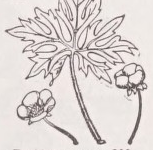
A name given to a species of Ranunculus or crow-foot, with bright yellow flowers; called also golden-cup.
Apt to let things fall, or to let them slip away; slippery; careless.
A yellow flower.
1. BUT'TER-PRINT ,
2. BUT'TER-STAMP, noun A piece of carved wood, used to mark cakes of butter.
A kind of candy, mainly composed of sugar and butter.
A broad fore tooth.
1. BUT'TER-WIFE ,
2. BUT'TER-WOMAN, noun A woman who sells butter.
The European bittern.
A plant of the genus Ranunculus, or crowfoot, particularly R. bulbosus, with bright yellow flowers; -- called also butterflower, golden cup, and kingcup. It is the cuckoobud of Shakespeare.
Height Roget’s Thesaurus §206
N. height, altitude, elevation, eminence, pitch, loftiness, sublimity, tallness, stature, procerity, prominence, colossus, giant, grenadier, giraffe, camelopard, mount, mountain, hill alto, butte, monticle, fell, knap, cape, headland, foreland, promontory, ridge, hog's back, dune, rising ground, vantage ground, down, moor, moorland, alp, uplands, highlands, heights &c. (summit), 210, knob, loma, pena, picacho, tump, knoll, hummock, hillock, barrow, mound, mole, steeps, bluff, cliff, craig, tor, peak, pike, clough, escarpment, edge, ledge, brae, dizzy height, tower, pillar, column, obelisk, monument, steeple, spire, minaret, campanile, turret, dome, cupola, skyscraper, pole, pikestaff, maypole, flagstaff, top mast, topgallant mast, ceiling, high water, high tide, flood tide, spring tide, altimetry, batophobia, satellite, spy-in-the-sky
V. be high, tower, soar, command, hover, hover over, fly over, orbit, be in orbit, cap, culminate, overhang, hang over, impend, beetle, bestride, ride, mount, perch, surmount, cover, overtop, stand on tiptoe, become high, grow higher, grow taller, upgrow, rise, send into orbit, render high, heighten
Adj. high, elevated, eminent, exalted, lofty, tall, gigantic, patagonian, towering, beetling, soaring, hanging, elevated, upper, highest, high reaching, insessorial, perching, upland, moorland, hilly, knobby, mountainous, alpine, subalpine, heaven kissing, cloudtopt, cloudcapt, cloudtouching, aerial, overhanging, incumbent, overlying, superincumbent, supernatant, superimposed, prominent &c. c, 250, tall as a maypole, tall as a poplar, tall as a steeple, lanky
Adv. on high, high up, aloft, up, above, aloof, overhead, airwind, upstairs, abovestairs, in the clouds, on tiptoe, on stilts, on the shoulders of, over head and ears, breast high, over, upwards, from top to bottom
Phr. e meglio cader dalle finistre che dal tetto
Horizontality Roget’s Thesaurus §213
N. horizontality, flatness, level, # plane, stratum, dead level, dead flat, level plane, recumbency, lying down, reclination, decumbence, decumbency, discumbency|, proneness, accubation, supination, resupination, prostration, azimuth, plain, floor, platform, bowling green, cricket ground, croquet ground, croquet lawn, billiard table, terrace, estrade, esplanade, parterre, table land, plateau, ledge, butte, mesa (plain) 344, level, spirit level
V. be horizontal, lie, recline, couch, lie down, lie flat, lie prostrate, sprawl, loll, sit down, render horizontal, lay down, lay out, level, flatten, prostrate, knock down, floor, fell
Adj. horizontal, level, even, plane, flat, flat as a billiard table, flat as a bowling green, alluvial, calm, calm as a mill pond, smooth, smooth as glass, recumbent, decumbent, procumbent, accumbent, lying, prone, supine, couchant, jacent, prostrate, recubant
Adv. horizontally, on one's back, on all fours, on its beam ends
King James Bible KJV Bible
Berean Standard Bible BSB Bible
10 KJV and 2 BSB verses contain “butte”
When I washed my steps with butter, and the rock poured me out rivers of oil;
when my steps were bathed in cream and the rock poured out for me streams of oil!
The words of his mouth were smoother than butter, but war was in his heart: his words were softer than oil, yet were they drawn swords.
His speech is smooth as butter, but war is in his heart. His words are softer than oil, yet they are swords unsheathed.
Butter and honey shall he eat, that he may know to refuse the evil, and choose the good.
By the time He knows enough to reject evil and choose good, He will be eating curds and honey.
And it shall come to pass, for the abundance of milk that they shall give he shall eat butter: for butter and honey shall every one eat that is left in the land.
and from the abundance of milk they give, he will eat curds; for all who remain in the land will eat curds and honey.