
FRO m; away; back or backward; as in the phrase, to and fro that is, to and from, forward or toward and backward, hither and thither.
Word of the Day: Catachrestical
From; away; back or backward; -- now used only in opposition to the word to, in the phrase to and fro, that is, to and from. See To and fro under To.
From.
Froben
Encyclopedia Britannica
FROBEN, Jo annes (Latinized name Frobenius), a G erman printer and scholar, was born at Hammelburg in Franconia about 1460. After completing his university career with great distinction at Basel, he established a printing office in that city about the year 1491, and was the first German who brought the art to anything like perfection. He was on intimate terms of friendship with Erasmus, who not only had his own works printed by him, but superintended Frobenius’s editions of St Jerome, St Cyprian, Tertullian, Hilary of Poitiers, and St Ambrose. It was part of Frobenius’s plan to have printed also editions of the Greek Fathers. He did not live to carry out this project, but it was very creditably executed by his son Jerome and his son-in-law Bisschop or Episcoρius. Frobenius died in 1527, in consequence of an accident which had befallen him some years before. An extant letter of Erasmus, written in the year of Frobenius’s death, gives an epitome of his life and an estimate of his character; andin it Erasmus mentions that his grief for the death of his friend was far more poignant than that which he had felt for the loss of his own brother. The epistle concludes with an epitaph in Greek and Latin.
9th ed. Encyclopædia Britannica, vol. 9, p. 791
[216 words — estimated reading time: 2 minutes]
[216 words — estimated reading time: 2 minutes]
Frobisher
Encyclopedia Britannica
FROBISHER, Sir Martin (c. 1535-1594), English navigator and explorer, was the fourth child of Bernard Frobisher, and was born, it is usually stated, at Doncaster, but more probably at Al tofts in the parish of Norman ton, Yorkshire, some time between 1530 and 1540. The family came originally from North Wales. Martin was sent to London to his mother’s brother, Sir John York, and in 1554 went with a small fleet of merchant ships to Guinea under Admiral John Lock. We next hear of him in 1565 as Captain Martin Frobisher, and again iu 1571 as superintending at Plymouth the building of a ship to be employed against the Irish. As early as 1560 or 1561 Frobisher had conceived the idea of discovering a north-west passage to Cathay, a short route to which was the motive of most of the Arctic voyages undertaken at that period and for long after. For years he schemed and plotted, and solicited in all quarters, from the court downwards, to obtain means to carry his favourite project into execution; and it was only in 1576 that, mainly by help of the earl of Warwick, he was put iu command of two tiny barks, the “Gabriel” and “Michael,” mere cockle shells of about 20 tons each, and a pinnace of 10 tons, with an aggregate crew of 35. On June 7 Frobisher left Blackwall, and having received a good word from Queen Elizabeth at Greenwich, the expedition, if we may apply to it so considerable a term, sailed northwards to the Shetland Islands. Stormy weather had been met with, in which the pinnace was lost, and sometime after the “Michael” deserted. After passing Greenland and being nearly wrecked, the “Gabriel” reached the coast of Labrador on July 28. Some days later Hall’s Island, at the mouth of Frobisher Bay, was reached, and a landing effected. Among the things ...hastily brought away by the men was some “black earth,” which played an important part in connexion with Frobisher’s further career. Sailing up Frobisher Bay, then thought to be a strait, they reached Butcher’s Island on August 18. Here some natives were met with, and intercourse carried on with them for some days, the result being that five of Frobisher’s men were decoyed and captured, and never more seen. After vainly trying to get back his men, Frobisher turned homewards, and reached London on October 9. It seemed as if nothing more was to come of this expedition, when it was noised abroad that the apparently valueless “black earth” was really a lump of gold ore. It is difficult to say how this rumour arose, and whether there was any truth in it, or whether Frobisher was a party to a deception, in order to obtain means to carry out the great idea of his life. The story, at any rate, was so far successful; the greatest enthusiasm was manifested by the court and the commercial and speculating world of the time; and next year a much more important expedition than the former was fitted out, the queen lending Frobisher from the royal navy a ship of 200 tons. A Cathay company was established, with a charter from the crown, giving the company the sole right of sailing in every direction but the east; Frobisher was appointed high admiral of all lands and waters that might be discovered by him. The queen herself subscribed £1000, and the rest required was soon forthcoming. On May 26, 1577, the expedition, which, besides the royal ship, the “Aid” of 200 tons, consisted of the “Gabriel” and “Michael” of the previous year, with boats and pinnaces and an aggregate complement of 120 men, including miners, refiners, &c., left Blackwall, and sailing by the north of Scotland, arrived at Greenland early in July. Hall’s Island was reached on the 18th, and though no more “black earth” was found there, abundance of it was found on other islands, and the ships well loaded with it. The country around, under the name of Meta Incognita, was solemnly taken possession of in the queen’s name. Several weeks were spent in Frobisher Bay collecting ore, but very little was done in the way of discovery. There was much parleying and some skirmishing with the natives, and earnest but futile attempts made on the part of Frobisher to recover the men captured the previous year. The return was begun on August 22, and the “Aid” reached Milford Haven on September 20; the “Gabriel” and “Michael,” having separated, arrived later at Bristol and Yarmouth. Frobisher was received and thanked by the queen at Windsor. Great preparations were made and considerable expense incurred for the assaying of the great quantity of “ore” brought home, in the testing of which the queen manifested a strong personal interest. This took up much time, and led to considerable dispute among the various parties interested. Meantime the faith of the queen and others remained strong in the productiveness of Meta Incognita, and it was resolved to send out a larger expedition than ever, with all necessaries for the establishment of a colony of 100 men. The queen herself contributed two ships of 400 and 200 tons, manned with 150 men, and carrying 120 pioneers. Besides these the fleet contained other 13 vessels of various sizes, carrying other 250 men, and the most elaborate and minute instructions were drawn up for the conduct of the expedition. Frobisher was again received by the queen at Greenwich, and her Majesty threw a fine chain of gold around his neck. On May 31 the expedition left Harwich, and sailing by the English Channel, reached Greenland on June 19. This time Frobisher and some of his men managed to land, “being the first known Christians that we have true notice of that ever set foot upon that ground.” In the first days of July Frobisher Bay was reached, but stormy weather and dangerous ice drove the fleet southwards, and unwittingly Frobisher entered what was afterwards known as Hudson Strait, up which he sailed about 60 miles. When he found that he was sailing away from his destination, he, with apparent reluctance, turned back, and after many buffetings part of the fleet managed to come to anchor in Frobisher Bay. Some attempt was made at founding a settlement, and immense quantities of ore were shipped. But, as might be expected, there was much dissension and not a little discontent among so heterogeneous a company, and on the last day of August the fleet set out on its return to England, which was reached in the beginning of October. Thus ended what was little better than a fiasco, though Frobisher himself cannot be held to blame for the result; the scheme was altogether chimerical, and the “ore” seems to have been not worth smelting. Between 1578 and 1585 we hear little of Frobisher, though he seems to have been doing service at various places, and steadily advancing in the good opinion of those in power. In 1580 he obtained the reversion of the clerkship of the royal navy, of no immediate value. In 1585 he commanded in the “Primrose” in Sir F. Drake’s expedition to the West Indies, in the large booty brought home from which he no doubt had a good share. For the next year or two he was employed in various responsible services against the designs of Spain, and in 1588 he did such excellent work in the “Triumph” against the Spanish Armada that he was rewarded with the honour of knighthood. He continued to cruise about in the Channel until 1589, when he was sent in command of a small fleet to the coast of Spain. In 1591 he visited his native Altofts, and there married a daughter of Lord Wentworth. He had prospered during recent years and was able to become a landed proprieter in Yorkshire and Notts. But he found little leisure for a country life, and was soon on the seas again watching and cutting off the richly laden ships of Spain. In November 1594 he took part in the siege of Crozan, near Brest, and received a wound from which he died at Plymouth on November 22. His body was taken to London and buried at St Giles’s, Cripplegate. Frobisher was brave and skilful as a naval leader, and had the enthusiasm of the true explorer, but was characterized by much of the coarseness, and probably some of the unscrupulousness, of his time, and appears to have been somewhat rough in his bearing, and too strict a disciplinarian to be much loved. He justly takes rank among England’s great naval heroes.
9th ed. Encyclopædia Britannica, vol. 9, p. 791
[1,486 words — estimated reading time: 9 minutes]
[1,486 words — estimated reading time: 9 minutes]
An upper coat, or an outer garment. The word is now used for a loose garment or shirt worn by men over their other clothes, and for a kind of gown open behind, worn by females. The frock was formerly a garment worn by monks.

Froebel
Encyclopedia Britannica
FROEBEL, Friedrich Wilhelm August (1782-1852), philosopher, philanthropist, and educational reformer, was born at Oberweissbach, a village of the Thuringian Forest, on the 21st April 1782. He completed his seventieth year, and died at Marienthal, near Bad-Liebenstein, on the 21 st June 1852. Like Comenius, with whom he had much in common, he was neglected in his youth, and the remembrance of his own early sufferings made him in after life the more eager in promoting the happiness of children. His mother he lost in his infancy, and his father, the pastor of Oberweissbach and the surrounding district, attended to his parish but not to his family. Friedrich soon had a stepmother, and neglect was succeeded by stepmotherly attention; but a maternal uncle took pity on him, and gave him a home for some years at Stadt-Ilm. Here he went to the village school, but like many thoughtful boys he passed for a dunce. Throughout life he was always seeking for hidden connexions and an underlying unity in all things. Nothing of the kind was to be perceived in the piecemeal studies of the school, and FroebeΓs mind, busy as it was for itself, would not work for the masters. His half-brother was therefore thought more worthy of a university education, and Friedrich was apprenticed for two years to a forester (1797-1799). Left to himself in the Thuringian Forest, Froebel now began to study nature, and without scientific instruction he obtained a profound insight into the uniformity and essential unity of nature’s laws. Years afterwards the celebrated Jahn (the “Father Jahn” of the German gymnasts) told a Berlin student of a queer fellow he had met, who made out all sorts of wonderful things from stones and cobwebs. This queer fellow was Froebel; and the habit of making out general ...truths from the observation of nature, especially from plants and trees, dated from the solitary rambles in the Forest. No training could have been better suited to strengthen his inborn tendency to mysticism; and when he left the Forest at the early age of seventeen, he seems to have been possessed by the main ideas which influenced him all his life. The conception which in him dominated all others was the unity of nature; and he longed to study natural sciences that he might find in them various applications of nature’s universal laws. With great difficulty he got leave to join his elder brother at the university of Jena, and there for a year he went from lecture-room to lecture-room hoping to grasp that connexion of the sciences which had for him far more attraction than any particular science in itself. But Froebel’s allowance of money was very small, and his skill in the management of money was never great, so his university career ended in an imprisonment of nine weeks for a debt of thirty shillings. He then returned home with very poor prospects, but much more intent on what he calls the course of “self-completion” (Vervollkommnung meines selbst) than on “getting on” in a worldly point of view. He was soon sent to learn farming, but was recalled in consequence of the failing health of his father. In 1802 the father died, and Froebel, now twenty years old, had to shift for himself. It was some time before he found his true vocation, and for the next three and a half years we find him at work now in one part of Germany now in another,—sometimes land-surveying, sometimes acting as accountant, sometimes as private secretary; but in all this his “outer life was far removed from his inner life,” and in spite of his outward circumstances he became more and more conscious that a great task lay before him for the good of humanity. The nature of the task, however, was not clear to him, and it seemed determined by accident. While studying architecture in Frankfort-on-the-Main, he became acquainted with the director of a model school who had caught some of the enthusiasm of Pestalozzi. This friend saw that FroebeΓs true field was education, and he persuaded him to give up architecture and take a post in the model school. In this school Froebcl worked for two years with remarkable success, but he then retired and undertook the education of three lads of one family. In this he could not satisfy himself, and he obtained the parents’ consent to his taking the boys to Yverdon, near Neuchatel, and there forming with them a part of the celebrated institution of Pestalozzi. Thus from 1807 till 1809 Froebel was drinking in Pestalozzianism at the fountain head, and qualifying himself to carry on the work which Pestalozzi had begun. For the science of education had to deduce from Pestalozzi’s experience principles which Pestalozzi himself could not deduce. And “Froebel, the pupil of Pestalozzi, and a genius like his master, completed the reformer’s system; taking the results at which Pestalozzi had arrived through the necessities of his position, Froebel developed the ideas involved in them, not by further experience but by deduction from the nature of man, and thus he attained to the conception of true human development and to the requirements of true education” (Schmidt’s Geschichte der Pädagogik).
Holding that man and nature, inasmuch as they proceed from the same source, must be governed by the same laws, Froebel longed for more knowledge of natural science. Even Pestalozzi seemed to him not to “honour science in her divinity.” He therefore determined to continue the university course which had been so rudely interrupted eleven years before, and in 1811 he began studying at Göttingen, whence he proceeded to Berlin. But again his studies were interrupted, this time by the king of Prussia’s celebrated call “to my people.” Though not a Prussian, Froebel was heart and soul a German. He therefore responded to the call, enlisted in Lützow’s corps, and went through the campaign of 1813. But his military ardour did not take his mind off education. “Everywhere,” he writes, “as far as the fatigues I underwent allowed, I carried in my thoughts my future calling as educator; yes, even in the few engagements in which I had to take part. Even in these I could gather experience for the task I proposed to myself.” Froebel’s soldiering showed him the value of discipline and united action, how the individual belongs not to himself but to the whole body, and how the whole body supports the individual.
Froebel was rewarded for his patriotism by the friendship of two men whose names will always be associated with his, Langethal and Middendorff. These young men, ten years younger than Froebel, became attached to him in the field, and were ever afterwards his devoted followers, sacrificing all their prospects in life for the sake of carrying out his ideas.
At the peace of Fontainebleau (signed in May 1814) Froebel returned to Berlin, and became curator of the museum of mineralogy under Professor Weiss. In accepting this appointment from the Government he seemed to turn aside from his work as educator; but if not teaching he was learning. More and more the thought possessed him that the one thing needful for man was unity of development, perfect evolution in accordance with the laws of his being, such evolution as science discovers in the other organisms of nature. He at first intended to become a teacher of natural science, but before long wider views dawned upon him. Langethal and Middendorf were in Berlin, engaged in tuition. Froebel gave them regular instruction in his theory, and at length, counting on their support, he resolved to set about realizing his own idea of “the new education.” This was in 1816. Three years before one of his brothers, a clergyman, had died of fever caught from the French prisoners. His widow was still 'iving in the parsonage at Griesheim, a village on the Ilm. Froebel gave up his post, and set out for Griesheim on foot, spending his very last groschen on the way for bread.
Here he undertook the education of his orphan niece and nephews, and also of two more nephews sent him by another brother. With these he opened a school and wrote to Middendorf and Langethal to come and help in the experiment. Middendorf came at once, Langethal a year or two later, when the school had been moved to Keilhau, another of the Thuringian villages, which became the Mecca of the new faith. In Keilhau Froebel, Langethal, Middendorff, and Barop, a relation of Middendorff’s, all married and formed an educational community. Sudi zeal could not be fruitless, and the school gradually increased, though for many years its teachers, with Froebel at their head, were in the greatest straits for money, and at times even for food. After 14 years’ experience he determined to start other institutions to work in connexion with the parent institution at Keilhau, and being offered by a private friend the use of a castle on the Wartensee, in the canton of Lucerne, he left Keilhau under the direction of Barop, and with Langethal he opened the Swiss iustitution. The ground, however, was very ill chosen. The Catholic clergy resisted what they considered as a Protestant invasion, and the experiment on the Wartensee and at Willisau in the same canton, to which the institution was moved in 1833, never had a fair chance. It was in vain that Middendorff at Froebel’s call left his wife and family at Keilhau, and laboured for four years in Switzerland without once seeing them. The Swiss institution never flourished. But the Swiss Government wished to turn to account the presence of the great educator; so young teachers were sent to Froebel for instruction, and finally Froebel moved to Burgdorf (a Bernese town of some importance, and famous from Pestalozzi’s labours there thirty years earlier) to undertake the establishment of a public orphanage, and also to superintend a course of teaching for sclioolmasters. The elementary teachers of the canton were to spend three months every alternate year at Burgdorf, and there compare experiences, and learn of distinguished men such as Froebel and Bitzius. In his conferences with these teachers Froebel found that the schools suffered from the state of the raw material brought into them. Till the school age was reached the children were entirely neglected. Froebel’s conception of harmonious development naturally led him to attach much importance to the earliest years, and his great work on The Education of Man, published as early as 1826, deals chiefly with the child up to the age of seven. At Burgdorf his thoughts were much occupied with the proper treatment of young children, and in scheming for them a graduated course of exercises, modelled on the games in which he observed them to be most interested. In his eagerness to carry out his new plans he grew impatient of official restraints; so he returned to Keilhau, and soon afterwards opened the first Kindergarten or “Garden of Children,” in the neighbouring village of Blankenburg (1837). Firmly convinced of the importance of the Kindergarten for the whole human race, Froebel described his system in a weekly paper (his Sonntagsblatt) which appeared from the middle of 1837 till 1840. He also lectured in great towns; and he gave a regular course of instruction to young teachers at Blankenburg. But although the principles of the Kindergarten were gradually making their way, the first Kindergarten was failing for want of funds. It had to be given up, and Froebel, now a widower (he had lost his wife in 1839), carried on his course for teachers first at Keilhau, and from 1848, for the last four years of his life, at or near Liebenstein, in the Thuringian Forest, and in the duchy of Meiningen. It is in these last years that the man Froebel will be best known to posterity, for in 1849 he attracted within the circle of his influence a woman of great intellectual power, the Baroness von Marenholtz∙ Bülow, who has given us in her Recollections of Friedrich Froebel the only lifelike portrait we possess.
These seemed likely to be Froebel’s most peaceful days. He married again, and having now devoted himself to the training of women as educators, he spent his time in instructing his class of young female teachers. But trouble came upon him from a quarter whence he least expected it. In the great year of revolutions 1848 Froebel had hoped to turn to account the general eagerness for improvement, and Middendorff had presented an address on Kindergartens to the German Parliament. Besides this a nephew of Froebel’s published books which were supposed to teach socialism. True, the uncle and nephew differed so widely that the “new Froebeliaus” were the enemies of “the old.” The distinction was overlooked, and Friedrich and Karl Froebel were regarded as the united advocates of some new thing. In the reaction which soon set in Froebel found himself suspected of socialism and irreligion, and in 1851 the “cultus-minister” Raumer issued an edict forbidding the establishment of schools “after Friedrich and Karl FroebeΓs principles” in Prussia. This was a heavy blow to the old man, who looked to the Government of the u C tdtus-staaV Prussia for support, and was met with denunciation. Of the justice of the charge the minister brought against Froebel the reader may judge from the account of bis principles given below.
Whether from the worry of this new controversy, or from whatever cause, Froebel did not long survive the decree. His seventieth birthday was celebrated with great rejoicings in May 1852, but he died in the following month, and lies buried at Schweina, a village near his last abode, Marienthal.
“AU education not founded on religion is unproductive.” This conviction of Froebel’s followed naturally from his conception of the unity of all things, a unity due to the original Unity from whom all proceed and in whom all “live, move, and have their being.” “In Allem wirkt und schafft Ein Leben, Weil das Leben all’ ein ein’ger Gott gegeben.” “All his come forth from the divine, from God, and is through God alone conditioned. To this it is that all things owe their existence, to the divine working in them. The divine element that works in each thing is the true idea (das Wesen) of the thing.” “The destiny and calling of all things is to develop their true idea, and in so doing to reveal God in outward aud through passing forms.”
As man and nature have one origin they must be subject to the same laws. Hence Froebel did what Comenius had doue two centuries before him, he looked to the course of nature for the principles of human education. This he declares to be his fundamental belief: “In the creation, in nature and the order of the material world, and in the progress of mankind, God has given us the true type (Urbild) of education.”
As the cultivator creates nothing in the trees and plants, io the educator creates nothing in the children,—he merely superintends the development of inborn faculties. So far Froebel agrees with Pestalozzi; but in one respect he went beyond him, and has thus become, according to Michelet, the greatest of educational reformers. Pestalozzi said that the faculties were developed by exercise. Froebel added that the function of education was to develop the faculties by arousing voluntary activity. Action proceeding from inner impulse (Selbstthätigkeit) was the one thing needful. And here Froebel as usual refers to God. “God’s every thought is a work, a deed.” As God is the Creator so must man be a creator also. “He who will early learn to recognize the Creator must early exercise his own power of action with the consciousness that he is bringing about what is good, for the doing good is the link between the creature r.nd the Creator, and the conscious doing of it is the conscious connexion, the true living union of the man with God, of the individual man as of the human race, and is therefore at once the starting point and the eternal aim of all education.” Again he says: “The starting point of all that appears, of all that exists, and therefore of all intellectual conception, is act, action. From the act, from action, must therefore start true human education, the developing education of the man; in action, in acting, it must be rooted and must spring up Living, acting, conceiving,—these must form a triple chord within every child of man, though the sound now of this string, now of that, may preponderate, and then again of two together.”
The prominence which Froebel gave to action, his doctrine that man is primarily a doer and even a creator, and that he learns only through “self-activity,” may produce great changes in educational methods generally, and not simply in the treatment of children too young for schooling. But it was to the first stage of life that Froebel paid the greatest attention, and it is over this stage that his influence is gradually extending. Froebel held with Rousseau that each age has a completeness of its own, and that the perfection of the later stage can be attained only through the perfection of the earlier. If the infant is what he should be as an infant, and the child as a child, he will become what he should be as a boy, just as naturally as new shoots spring from the healthy plant. Every stage, then, must be cared for and tended in such a way that it may attain its own perfection. Impressed with the immense importance of the first stage, Froebel like Pestalozzi devoted himself tu the instruction of mothers. But he would not, like Pestalozzi, leave the children entirely in the mother’s hands. Pestalozzi held that the child belonged to the family; Fichte, on the other hand, claimed it for society and the state. Froebel, whose mind like that of Frederick Maurice delighted in harmonizing apparent contradictions, and who taught that “all progress lay through opposites to their reconciliation,” maintained that the child belonged both to the family and to society, and he would therefore have children spend some hours of the day in a common life and in well-organized common employments. These assemblies of children he would not call schools, for the children in them ought not to be old enough for schooling. So he invented the name Kindergarten, garden of children, and called the superintendents “children’s gardeners.” He laid great stress on every child cultivating its own plot of ground, but this was not his reason for the choice of the name. It was rather that he thought ⅛>f these institutions as enclosures in which young human plants are nurtured. In the Kindergarten the children’s employment should be play. But any occupation in which children delight is play to them; and Froebel invented a series of employments, which, while they are in this sense play to the children, have nevertheless, as seen from the adult point of view, a distinct educational object. This object, as Froebel himself describes it, is “to give the children employment in agreement with their whole nature, to strengthen their bodies, to exercise their senses, to engage their awakening mind, and through their senses to bring them acquainted with nature and their fellow creatures; it is especially to guide aright the heart and the affections, and to lead them to the original ground of all life, to unity with themselves.”
At the end of the first quarter of a century since Froebel’s death, the spread of his ideas, or at least of his methods, seems rapidly extending. Prophets are slowly recognized in their own country, and although he is so thoroughly German in bis mode of thought and exposition that, as Deinhardt says, no other nation could have produced such a man, the Germans as yet are not so ready to learn from Froebel as from the Swiss Pestalozzi. In Austria the Kindergarten has made more way than in Prussia, and it seems to prosper in America. But Froebel’s influence is not limited to the Kindergarten, His conception of education cannot but affect the thoughts and ultimately the practice of all teachers who will be at the pains to understand it.
FroebeΓs own works are—1. Menschenerziehung (there is a French translation by the Baronne de Crombrugghe); 2. Pädagogik d. Kindergartens; 3. Kleinere Schriften, herausgegeben von Wichard Lange; and 4. Mutter-und Koselieder. We have a lengthy but unsatisfactory life in A. B. Hanschmann’s Friedrich Fröbel. An unpretentious but useful little book is F. Froebel, a Biographical Sketch, by Matilda H. Kriege, New York (Steiger). A very good account of FroebeΓs life ana thoughts is given in Karl Schmidt’s Geschichte d. Pädagogik, vol. iv.; also in Adalbert Weber’s Geschichte d. Volksschulpäd. u. d. Kleinkindererziehung (Weber carefully gives authorities). For a less favourable account see K. Strack’s Geschichte d. deutsch. Volksschulwesens. The article “Fröbel” in K. A. Schmid’s Encyklopädic is by Deinhardt. Frau von Marenholtz-Bülow has published her...
9th ed. Encyclopædia Britannica, vol. 9, p. 792 — signed R. H. Q.
[3,731 words — estimated reading time: 25 minutes]
[3,731 words — estimated reading time: 25 minutes]
1. An amphibious animal of the genus Rana, with four feet, a naked body, and without a tail. It is remarkable for swimming with rapidity, and for taking large leaps on land. Frogs lie torpid during winter.
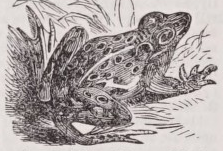
1. An amphibious animal of the genus Rana and related genera, of many species. Frogs swim rapidly, and take long leaps on land. Many of the species utter loud notes in the springtime.
2. The triangular prominence of the hoof, in the middle of the sole of the foot of the horse, and other animals; the fourchette.
3. A supporting plate having raised ribs that form continuations of the rails, to guide the wheels where one track branches from another or crosses it.
To ornament or fasten (a coat, etc.) with trogs. See Frog, n., 4.
Frog
Encyclopedia Britannica
FROG, the common name of an extensive group of Bιtrachians forming, along with the toads, the amphibian order Anoura. They are divided into 9 families, containing 92 genera and 440 species, and are found in all quarters of the globe, being most abundant in the tropical and subtropical regions, but also occurring within the Arctic circle. Most of the families have a very limited distribution, and only two of them, the true frogs (Ranidae), of which there are 150 species, and the Polypedatidae, a family of tree-frogs containing 124 species, can be regarded as almost cosmopolitan. The neotropical or South American region is richest in peculiar forms, while it possesses some only found beyond it in ths widely remote Australian region; thus the Pelodry- ad<x, a family of tree-frogs, is peculiar to the two; the genus Litoria is confined to Australia, with the exception of a single species occurring in Paraguay; while the only frog known in New Zealand has its nearest allies in South America. Those regions bear also a negative resemblance in the total absence from both of the genus Rana, the 60 species of which are distributed throughout the other quarters of the globe. These facts, among others, have been adduced in support of the theory that at one time the continents of South America and Australia had a land connexion. Frogs are almost totally absent from oceanic islands, a single species (Liopelma Hochstetteri) occurring in New Zealand, and one or two others in the Pacific islands, as far east as the Fijis, beyond which they are unknown. On the assumption that those islands obtained their present fauna from the nearest continental land, the absence of frogs can be readily explained by the fact that salt water is alike fatal to the adult frog and to its spawn, and thus ...formed an insuperable barrier to their migration.
Frogs, as is shown by their wide distribution, are capable of enduring a considerable degree of both heat and cold; they are, however, altogether intolerant of long-continued drought, a desert forming as certain a barrier to their migration as an ocean. Both during their larval stage and afterwards, for the purpose of cutaneous respiration, abundant moisture is a necessity of their existence; consequently, whether they live on the ground or on trees, they are never found far from rivers, marshes, or lakes. In winter the frogs of northern climates hibernate, burying themselves in the mud at the bottom of pools, and lying clustered together in a state of complete torpidity. In hot climates they are said to go into a similar condition, known as “aestivation,” during periods of exceptional heat and drought, in order to retard the dissipation of the moisture in their bodies. On reappearing from their long winter sleep the work of reproduction is at once entered upon, the males making their presence known to the females by the vigorous exercise of their vocal organs. The croaking of the common frog can only be regarded as pleasant from its association with the welcome advent of spring; still more unpleasant, however, is the much louder croak of the edible frog of the Continent, the species to which Horace probably refers in the lines
“ranaeque palustres
Avertunt somnos.”
The eggs of the frog, consisting of little black specks surrounded by an albuminous envelope, are fertilized during their extrusion from the body of the female, and are generally deposited at the bottom of the water, ascending, however, soon after to the surface, owing to the swelling and partial decomposition of the glairy substance surrounding the ova. There are several species known in which the eggs are deposited in an exceptional manner. Those of a small frog (Alytes obstetricans) found in France and Germany form a long chain, which the male twines round his thighs, retiring with them into seclusion until the young are ready to leave, when he enters the water, and the tadpoles immediately make their escape. The female of an American tree-frog (Nototrema marsupiatum) has a pouch along the whole extent of its back for the reception of its eggs; and Professor Peters of Berlin has recently drawn attention to a tree-frog of the genus Polypedates found in tropical West Africa, in which the female, after depositing her eggs in the usual mass of albuminous jelly, attaches them to the leaves of trees overhanging a dry water-hole or pool. The albumen speedily dries and forms a horny coating on the leaf, under which lie the unimpregnated eggs. On the advent of the rainy season the albumen becomes softened, and the eggs are washed into the pool below, now filled with water, where they are fecundated by the male.
The development of the egg after impregnation proceeds more or less rapidly according to the temperature, the young of the common frog being hatched, according to Rusconi, in 4 days, in a temperature varying from 70° to 80° Fahr., while in the climate of England this does not take place in less than a month. The creature which emerges from the egg is altogether unlike a frog, consisting mainly of a bulky head and tail, and wholly destitute of limbs. This is the tadpole or larval stage in the development of the frog, when it is essentially a fish, capable only of existing in water, breathing by gills, and having like a fish a twochambered heart. At first the gills or branchiae are external, but they are soon withdrawn within the branchial cavity, and concealed by an opercular membrane. As the process of development proceeds, the limbs begin to bud forth, the posterior pair appearing first; and with their growth the tail begins to dwindle, not falling off, but being gradually absorbed. At the same time vast changes are taking place in the blood-vascular system, the gills gradually disappearing, two lungs being developed, and the heart becoming three-chambered as in reptiles. The young frog must now come to the surface to breathe, and soon leaves the water altogether. On emerging from the egg, the tadpole at first feeds upon the gelatinous mass which before had formed a protective covering. It is unprovided with teeth, but has two minute horny jaws, which enable it to feed on decaying animal and vegetable matter. According to Bell (British Reptiles), tadpoles sometimes kill and feed upon each other. “I observed,” he says, “that almost as soon as one had acquired its limbs it was found dead at the bottom of the water, and the remaining tadpoles feeding upon it. This took place with all of them successively, excepting the last, which lived on to complete its change.” After leaving the water they feed almost entirely on insects and slugs.
The form of the frog is too well known to require description, but there are many almost unique features in its organization that may be noticed. Respiration in the adult frog is partly pulmonary; but as it is destitute of ribs, this operation in the frog cannot be performed by the alternate expansion and contraction of the chest, as in other air-breathing animals. The air has to be swallowed in order to be conveyed to the lungs, and the mechanism by which this operation is performed necessitates the closing of its mouth and the admission of air by the nostrils, so that a frog can be most readily suffocated by having its mouth gagged open. Respiration is also partly cutaneous, experiment having shown that the skin gives off carbonic acid gas in sufficient quantity to enable the creature to live for a very considerable time after pulmonary respiration has been stopped. Moisture is as necessary to the skin in the performance of this function as it is to the gills of a fish, and in order to preserve to the utmost its humidity, frogs avoid as much as possible the hot sunlight, sheltering themselves beneath stones or under loose turf, and reappearing on the advent of rain, sometimes in such numbers in a single locality as to have given rise to stories of frog showers. The skin of the frog, however, readily absorbs water; and this it stores up in an internal reservoir, from which it can in seasons of drought moisten the surface of its skin. When a frog is suddenly caught it frequently ejects a quantity of water, and thus suddenly diminishes its volume. The water avoided is not urine, nor is the receptacle containing it the urinary bladder, as was at one time supposed. The skin of frogs is perfectly smooth, having neither plates nor scales, except in the American genus Cera-lophrys (fig. 1), in certain species of which a few bony plates are enclosed in the skin of the back. The tongue in frogs is probably employed more for the capture of its insect prey than as the organ of taste. It is fixed in front of the mouth, and free behind, and in seizing its prey, the free end, which possesses a viscid secretion, is darted suddenly forward, the captured insect being as suddenly transported to the back part of the mouth. Nothing can exceed the rapidity with which this motion is performed. Minute teeth are present in the upper jaw, and on the palate, in the true frogs. The vocal organs by which the characteristic croaking is produced differ somewhat in different species, a similar variety appearing in the quantity and quality of their song. The male of the edible frog is provided with bladder-like cheek pouches—the so-called vocal sacs—which it distends with air when in the act of croaking, an operation which it performs to such purpose as to have received the name of “Dutch nightingale” on the Continent, and “Cambridgeshire nightingale” in England. The bull-frog {Rana mugiens) has a laryngeal mechanism which Cuvier compared to a kettledrum, by which it produces a sound not unlike the bellowing of a bulL The sound produced by the tree frogs is both loud and shrill, but in certain circumstances it seems to be somewhat pleasing. Thus Darwin says, “Near Rio de Janeiro I used often to sit in the evening to listen to a number of little Hylae, which, perched on blades of grass close to the water, sent forth sweet chirping notes in harmony.” The voice of another tree-frog {Hyla crepitans) has been compared to the sound produced “by the cracking of a large piece of wood;” while another, belonging to Surinam, has an extremely disagreeable voice, and unfortunately so much of it that, when a number of them combine, they at times drown the orchestra of the Paramaribo theatre. No frog, so far as yet known, possesses any poison organs. A species found in France {l , elo- bates fuscus), when disturbed, emits a strong odour, somewhat resembling garlic, and of sufficient pungency to make the eyes water; another {Hyla micans) exudes from the surface of its body a slimy substance having luminous properties, which probably acts as a defence by frightening its enemies. Many of the tree-frogs are of a green colour, while others are brown, “and these,” says Mr Wallace {Tropical Nature, 1878), “usually feed at night, sitting quietly during the day so as to be almost invisible, owing to their colour and their moist shining skins so closely resembling vegetable substances.” The majority of tree-frogs have their colour thus adapted to their surroundings, and are thus enabled the more readily to elude their enemies; for, so far as yet known, all the species protectively coloured are edible, forming the chief food of many mammals, birds, and reptiles. A few, however, are brilliantly and conspicuously coloured, as if courting observation; and such species, there is reason to believe (the reader will find evidence of this in Belt’s Naturalist in Nicaragua), are rejected by frog-eating animals on account of their nauseous secretions, or some other unknown property which renders them unpalatable. The bright colours thus become directly useful to the species by making them readily recognizable as uneatable.
The Common Frog {Rana temporaria) is the most widely distributed species of the group, occurring throughout tho temperate regions of both hemispheres, including North Africa, and Asia as far east as Japan. It does not occur in Iceland. Both in England and in Scotland it is abundant, nor is it uncommon in Ireland, although popularly supposed to be absent from that island. It varies very considerably in colour, being either a reddish, yellowish, or greenish-brown above, with irregular spots and fasciae, and of a lighter colour beneath, but having almost invariably an oblong patch of brown behind the eyes, by which it may be readily distinguished from other European species. Although not an article of human food, the common frog in its various stages of growth forms the staple diet of many other animals. The tadpoles are eaten by newts and the smaller fishes, and frogs of all ages by weasels, waterfowl, pike, and snakes. By those agencies their numbers, which otherwise would be enormous, are greatly reduced. This species is said to take five years in attaining its full growth, and to live for about fifteen years. Like the toad it can be rendered tame and domesticated, having been known to take up its abode in a moist corner of a kitchen, and to come forth regularly at meal time to be fed. The Edible .Frog {Rana esculenta) is very widely distributed throughout the temperate regions of the earth, but is not found in America, where, however, a closely allied species occurs (fig. 2). It is found in England, where it was first observed in a Cambri<lgeshire fen is 1843, to which probably it had been introduced from the Continent. It has since been introduced into various parts of the south of England, but apparently without much success, the summer heat there being, it is said, insufficient to enable the tadpole to attain its full development before the advent of autumnal cold. It may be readily distinguished from the common species by the yellowish mesial line which runs down the whole length of its back, by the absence of the characteristic brown spot behind the eyes, and by the presence in the males of “vocal sacs.” It is also more aquatic than the common frog, seldom leaving the banks of its native pond or stream, into which it is always ready to dip on the slightest appearance of danger. It is very abundant throughout central and southern Europe, and forms, especially in France, a valued article of food, the hind legs when cooked being regarded as a luxury. Regarding a dish of these, Mr F. Buckland says, “Most excellent eating they were, tasting more like the delicate flesh of the rabbit than any thing else I can think of.” The edible frog has been lately introduced into Ireland. The Bull-frog (Rana mugiens) is one of the largest species, measuring sometimes 8 inches in length, exclusive of the hind legs, and having a gape sufficiently wide to swallow ducklings whole. It inhabits North America, where it is said to haunt the pools formed at the origin of springs, the waters of which it was supposed to keep pure—a belief which long afforded it considerable protection; lately, however, the Americans have taken to frog-eating, and the bull-frog, in the absence of R. esculenta, h is been selected among others for this purpose.
The Tree-frogs (fig. 3) are readily distinguished from all others by having the ends of their toes dilated into knobs or discs, generally provided with a sticky secretion, by means of which they can cling to the leaves and branches of trees. They are small, elegant, and exceedingly active creatures, the males possessing loud voices, of which they make copious use during the breeding season and on the approach of rain. Frogs have from remote times been regarded as weather prophets, and at the present day, in some parts of Germany, the European Tree-frog (Hyla arborea) is used as a barometer. A few of them are placed in a tall bottle provided with miniature ladders, the steps of which they ascend during fine weather, seeking the bottom again on the approach of rain. AU frogs, whether arboreal or not, have their hind feet webbed, and in at least one treefrog (Rhacophorus) the webs on all the feet are so largely developed as to render it probable that by their means the frog is able to execute flying leaps. This “flying frog” was brought to Mr Wallace, while travelling in Borneo, by a Chinaman, who assured him “that he had seen it come down in a slanting direction as if it flew.” Its body was about 4 inches in length, and the expanded webs of each hind foot covered a space of 4 square inches, while its forelegs were bordered by a membrane—features highly suggestive of aerial locomotion.
Fossil remains of the frog do not occur in strata older than the Tertiary, being found in greatest abundance in the Miocene deposits. See Amphibia. (j. gi.)
9th ed. Encyclopædia Britannica, vol. 9, p. 795
[2,855 words — estimated reading time: 17 minutes]
[2,855 words — estimated reading time: 17 minutes]
Frog
Watson's Biblical & Theological Dictionary
צפרדע; Arabic, _akurrak_; Greek, βάτραχος; Exod. viii, 2–14; Psalm lxxviii, 45; cv, 30; Rev. xvi, 13. When God plagued Pharaoh and his people, the river Nile, which was the object of great admiration to the Egyptians, was made to contribute to their punishment. “The river brought forth frogs abundantly;” but the circumstance of their coming up into the bed chambers, and into the ovens and kneading troughs, needs explanation to us, whose domestic apartments and economy are so different from those of the ancient nations. Their lodgings were not in upper stories, but in recesses on the ground floor; and their ovens were not like ours, built on the side of a chimney, and adjacent to a fireplace, where the glowing heat would frighten away the frogs, but they dug a hole in the ground, in which they placed an earthen pot, which having sufficiently heated, they stuck their cakes to the inside to be baked. To find such places full of frogs when they came to heat them in order to bake their bread, and to see frogs in the beds where they sought repose, must have been both disgusting and distressing in the extreme. Frogs were reckoned unclean by the Hebrews.
Watson's Biblical & Theological Dictionary
[203 words — estimated reading time: 2 minutes]
[203 words — estimated reading time: 2 minutes]
A plant, the Hydrocharis.
1. A European plant (Hydrocharis Morsus-ranae), floating on still water and propagating itself by runners. It has roundish leaves and small white flowers.
2. An American plant (Limnobium Spongia), with similar habits.
1. An animal of surinam, which is said to change from a fish to a frog and then to a fish again. It is cartilaginous, and exquisite food.
2. The Lophius, or fishing frog.
1. See Angler, n., 2.
Provided or ornamented with frogs; as, a frogged coat. See Frog, n., 4.
A plant.
Having frogs.
Abounding in frogs.
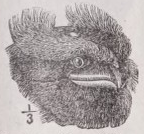
One of several species of Asiatic and East Indian birds of the genus Batrachostomus (family Podargidae); -- so called from their very broad, flat bills.
One of numerous species of marine gastropod shells, belonging to Ranella and allied genera.
Froissart
Encyclopedia Britannica
FROISSART, Jean (1337-14101). The personal history of Froissart, the circumstances of his birth and education, the incidents of his life, must all be sought in his own verses and chronicles. He possessed in his own lifetime no such fame as that which attended the steps of Petrarch; when he died it did not occur to his successors that a chapter might well be added to his Chronicle setting forth what manner of man he was who wrote it. The village of Lestines, where he was curé, has long forgotten that a great writer ever lived there. They cannot point to any house in Valenciennes as the lodging in which he put together his notes and made history out of personal reminiscences. It is not certain when or where he died, or where he was buried. One church, it is true, doubtfully claims the honour of holding his bones. It is that of St Monegundaof Chimay.
Gallorum sublimis honos et fama tuorum, Hic Froissante, jaces, si modo forte jaces....
It is fortunate, therefore, that the scattered statements in his writings may be so pieced together as to afford a tolerably connected history of his life year after year. The personality of the man, independently of his adventures, may be arrived at by the same process. It will be found that Froissart, without meaning it, has pourtrayed himself in clear and well-defined outline. His forefathers were jurés of the little town of Beaumont, lying near the river Sambre, to the west of the forest of Ardennes. Early in the 14th century the castle and seigneurie of Beaumont fell into the hands of Jean, younger son of the count of Hainault. With this Jean, sire de Beaumont, lived a certain canon of Liège called Jean le Bel, who, fortunately, was not content simply to enjoy life. Instigated by his seigneur he set himself to write contemporary history, to tell “la pure veriteit de tout li fait entièrement al manire de chroniques.” With this view, he compiled two books of chronicles. And the chronicles of Jean le Bel were not the only literary monuments belonging to the castle of Beaumont. A hundred years before him Baldwin D’Avemes,the then seigneur, had caused to be written a book of chronicles or rather genealogies. It must therefore be remembered that when Froissart undertook his own chronicles, he was not conceiving a new idea, but only following along familiar lines.
Some 20 miles from Beaumont stood the prosperous city of Valenciennes, possessed in the 14th century of important privileges and a flourishing trade, second only to places like Bruges or Ghent in influence, population, and wealth. Beaumont, once her rival, now regarded Valenciennes as a place where the ambitious might seek for wealth or advancement, and among those who migrated thither was the father of Froissart. He appears from a single passage in his son’s verses to have been a painter of armorial bearings. There was, it may be noted, already what may be called a school of painters at Valenciennes. Among them were Jean and Colin de Valenciennes and André Beau-Neveu, of whom Froissart says that he had not his equal in any country.
The date generally adopted for his birth is 1337. In after years Froissart pleased himself by recalling in verse the scenes and pursuits of his childhood. These are presented in vague generalities. There is nothing to show that he was unlike any other boys, and, unfortunately, it did not occur to him that a photograph of a schoolboy’s life amid bourgeois surroundings would be to posterity quite as interesting as that faithful portraiture of courts and knights which he has drawn up in his Chronicle. As it is, we learn that he loved games of dexterity and skill rather than the sedentary amusements of chess and draughts, that he was beaten when he did not know his lessons, that with his companions he played at tournaments, and that he was always conscious—a statement which must be accepted with suspicion—that he was born
“Loer Dieu et servir le monde.”
In any case he was born in a place, as well as at a time, singularly adapted to fill the brain of an imaginative boy. Valenciennes, at the present day a dull town, was then a city extremely rich in romantic associations. Not far from its walls was the western fringe of the great forest of Ardennes, sacred to the memory of Pepin, Charlemagne, Roland, and Ogier. Along the banks of the Scheldt stood, one after the other, not then in ruinsj but bright with banners, thegleam of armour, and the liveries of the men at arms, castles whose seigneurs, now forgotten, were famous in their day for many a gallant feat of arms. The castle of Valenciennes itself was illustrious in the romance of Perceforest∙. there was born that most glorious and most luckless hero, Baldwin, first emperor of Constantinople. All the splendour of mediaeval life was to be seen in Froissart’s native city: on the walls of the Salle le Comte glittered—perhaps painted by his father—the arms and scutcheons beneath the banners and helmets of Luxembourg, Hainault, and Avesnes; the streets were crowded with knights and soldiers, priests, artisans, and merchants·; the churches were rich with stained glass, delicate tracery, and precious carving; there were libraries full of richly illuminated manuscripts on which the boy could gaze with delight; every year there was the/éteof the∕>wy d' Amour de Valenciennes, at which he would hear the verses of the competing poets; there were festivals, masques, mummeries, and moralities. And, whatever there might be elsewhere, in this happy city there was only the pomp, and not the misery, of war; the fields without were tilled, and the harvests reaped, in security; the workman within plied his craft unmolested for good wage. But the eyes of the boy were turned upon the castle and not upon the town; it was the splendour of the knights which dazzled him, insomuch that he regarded and continued ever afterwards to regard a prince gallant in the field, glittering of apparel, lavish of largesse, as almost a god.
The moon, he says, rules the first four years of life; Mercury the next ten; Venus follows. He was fourteen when the last goddess appeared to him in person, as he tells us, after the manner of his time, and informed him that he was to love a lady, “belle, jone, et gente.” Awaiting this happy event, he began to consider how best to earn his livelihood. They first placed him in some commercial position—impossible now to say of what kind—which he simply calls “la marchandise.” This undoubtedly means some kind of buying and selling, not a handicraft at all. He very soon abandoned merchandise—“car vaut mieux science qu’ argens ”—and resolved on becoming a learned clerk. He then naturally began to make verses, like every other learned clerk. Quite as naturally, and still in the character of a learned clerk, he fulfilled the prophecy of Venus, and fell in love. He found one day a demoiselle reading a book of romances. He did not know who she was, but stealing gently towards her, he asked her what book she was reading, lt was the romance of Cleomades. He remarks the singular beauty of her blue eyes and fair hair, while she reads a page or two, and then—one would almost suspect a reminiscence ,of Dante—
“Adont laissâmes nous le lire.”
He was thus provided with that essential for soldier, knight, or poet, a mistress,—one for whom he could write verses. She was rich and he was poor; she was nobly born and he obscure; it was long before she would accept the devotion, even of the conventional kind which Froissart offered her, and which would in no way interfere with the practical business of her life. And in this hopeless way, the passion of the young poet remaining the same, and the coldness of the lady being unaltered, the course of this passion ran on for some time. Nor was it .until the day of Froissart’s departure from his native town that she gave him an interview and spoke kindly to him, even promising, with tears in her eyes, that “Doulce Pensée” would assure him that she would have no joyous day until she should see him again.
He was eighteen years of age; he had learned all that he wanted to learn; he possessed the mechanical art of verse; he had read the slender stock of classical literature accessible; he longed to see the world. He must already have acquired some distinction, because, on setting out for the court of England, he was able to take with him letters of recommendation from the king of Bohemia and the count of Hainault to Queen Philippa, niece of the latter. He was well received by the queen, always ready to welcome her own countrymen; he wrote ballades and virelays for her and her ladies. But after a year he began to pine for another sight of “la très douce, simple, et quoie,” whom he loved loyally. Good Queen Philippa, perceiving his altered looks and guessing the cause, made him confess that he was in love and longed to see his mistress. She gave him his congé on the condition that he was to return. It is clear that the young clerk had already learned to ingratiate himself with princes.
The conclusion of his single love adventure is simply and unaffectedly told in his Trettie de l , Espinette Amoureuse. It was a passion conducted on the well-known lines of conventional love; the pair exchanged violets and roses, the lady-accepted ballads; Froissart became either openly or in secret her recognized lover, a mere title of honour, which conferred distinction on her who bestowed it, as well as upon him who received it. But the progress of the amour was rudely interrupted by the arts of “Malebouche,” or Calumny. The story, whatever it was, that Malebouche whispered in the ear of the lady, led to a complete rupture. The damoi-selle not only scornfully refused to speak to her lover or acknowledge him, but even seized him by the hair and pulled out a handful. Nor would she ever be reconciled to him again. Years afterwards, when Froissart writes the story of his one love passage, he shows that he still takes delight in the remembrance of her, loves to draw her portrait, and lingers with fondness over the thought of what she once was to him.
Perhaps to get healed of his sorrow, Froissart began those wanderings in which the best part of his life was to be consumed. He first visited Avignon, perhaps to ask for a benefice, perhaps as the bearer of a message from the bishop of Cambray to pope or cardinal. It was in the year 1360, and in the pontificate of Innocent VI. From the papal city he seems to have gone to Paris, perhaps charged with a diplomatic mission. In 1361 he returned to England after an absence of five years. He certainly interpreted his leave of absence in a liberal spirit, and it may have been with a view of averting the displeasure of his kind-hearted protector that he brought with him as a present a book of rhymed chronicles written by himself. He says that notwithstanding his youth, he took upon himself the task “à rimer et à dicter”— which can only mean to “turn into verse ”—an account of the wars of his own time, which he carried over to England in a book “tout compilé,”—complete to date,—and presented to his noble mistress Philippa of Hainault, who joyfully and gently received it of him. Such a rhymed chronicle was no new thing. One Colin had already turned the battle of Crécy into verse. The queen made young Froissart one of her secretaries, and he began to serve her with “beaux dittiés et traités amoureux.”
Froissart would probably have been content to go on living at ease in this congenial atmosphere of flattery, praise, and caresses, pouring out his virelays and chansons according to demand with facile monotony, but for the instigation of Queen Philippa, who seems to have suggested to him the propriety of travelling in order to get information for more rhymed chronicles. It was at her charges that Froissart made his first serious journey. He seems to have travelled a great part of the way alone, or accompanied only by his servants, for he was fain to beguile the journey by composing an imaginary conversation in verse between his horse and his hound. This may be found among his published poems, but it does not repay perusal. In Scotland he met with a favourable reception, not only from King David but from William of Douglas, and from the Earls of Fife, Mar, March, and others. The souvenirs of this journey are found scattered about in the chronicles. He was evidently much impressed with the Scotch; he speaks of the valour of the Douglas, the Campbell, the Ramsay, and the Graham; he describes the hospitality and rude life of the Highlanders; he admires the great castles of Stirling and Roxburgh, and the famous abbey of Melrose. His travels in Scotland lasted for six months. Returning southwards he rode along the whole course of the Roman wall, a thing alone sufficient to show that he possessed the true spirit of an archaeologist; he thought that Carlisle was Carlyon, and congratulated himself on having found King Arthur’s capital; he calls Westmoreland, where the common people still spoke the ancient British tongue, North Wales; he rode down the banks of the Severn, and returned to London by way of Oxford—“Γescole d’Asque-Suffort.”
In London Froissart entered into the service of King John of France as secretary, and grew daily more courtly, more in favour with princes and great ladies. He probably acquired at this period that art, in which he has probably never been surpassed, of making people tell him all they knew. No newspaper correspondent, no American interviewer, has ever equalled this mediaeval collector of intelligence. From Queen Philippa, who ccnfided to him the tender story of her youthful and lasting love for her great husband, down to the simplest knight—Froissart conversed with none beneath the rank of gentlemen—all united in telling this man what he wanted to know. He wanted to know everything: he liked the story of a battle from both sides and from many points of view; he wanted the details of every little cavalry skirmish, every capture of a castle, every gallant action and brave deed. And what was more remarkable he forgot nothing. “I had,” he says, “thanks to God, sense, memory, good remembrance of everything, and an intellect clear and keen to seize upon the acts which I could learn.” But as yet he had not begun to write in prose.
At the age of twenty-nine, in 1366, Froissart once more left England. This time he repaired first to Brussels, whither were gathered together a great concourse of minstrels from all parts, from the courts of the kings of Denmark, Navarre, and Aragon, from those of the dukes of Lancaster, Bavaria, and Brunswick. Hither came all who could “rimer et dieter.” "What distinction Froissart gained is not stated; but he received a gift of money as appears from the accounts, “uni Fritsardo, dictori, qui est cum regina Angliae, dicto die, vi. mottones.”
After this congress of versifiers, he made his way to Brittany, where he heard from eye-witnesses and knights who had actually fought there details of the battles of Cotsherel and Auray, the Great Day of the Thirty and the heroism of Jeanne de Montfort. Windsor Herald told him something about Auray, and a French knight, one Antoine de Beaujeu, gave him the details of Cocherel. From Brittany he went southwards to Nantes, La Rochelle, and Bordeaux, where he arrived a few days before the visit of Richard, afterwards second of that name. He accompanied the Black Prince to Dax, and hoped to go on with him into Spain, but was despatched to England on a mission. He next formed part of the expedition which escorted Lionel duke of Clarence to Milan, to marry the daughter of Galeazzo Visconti. Chaucer was also one of the prince’s suite. At the wedding banquet Petrarch was a guest sitting among the princes.
From Milan Froissart, accepting gratefully a coite hardie with 20 florins of gold, set out upon his travels in Italy. At Bologna, then in decadence, he met Peter king of Cyprus, from whose follower and minister, Eustache de Conflans, he learned many interesting particulars of the king’s exploits. He accompanied Peter as far as Venice, where he left him after receiving a gift of 40 ducats. With them and his cotte hardie, still lined we may hope with the 20 florins, Froissart betook himself to Rome. The city was then at its lowest point: the churches were roofless; there was no pope; there were no pilgrims; there was no splendour; and yet, says Froissart sadly,
“Ce furent jadis en Rome, Li plus ρreu et li plus sage homme Car par sens tons les arts passèrent.
It was at Rome that he learned the death of his friend King Peter of Cyprus, and, worse still, an irreparable loss to him, that of the good Queen Philippa, of whom he writes, in grateful remembrance—
“Propices li soit Diex à l’âme! J’en suis bien tenus de pryer Et ses larghesces escuyer, Car elle me fist et créa.” Philippa dead, Froissart looked around for a new patron. Then he hastened back to his own country and presented himself, with a new book in French, to the duchess of Brabant, from whom he received the sum of 16 francs, given in the accounts as paid uni Frissardo dictatori. The use of the word uni does not imply any meanness of position, but is simply an equivalent to the modern French sieur. Froissart may also have found a patron in Yolande de Bar, grandmother of King René of Anjou. In any case he received a substantial gift from some one in the shape of the benefice of Lestines, a village some three or four miles from the town of Binche. Also, in addition to his cure, he got placed upon the duke of Brabant’s pension list, and was entitled to a yearly grant of grain and wine, with some small sum in money.
It is clear, from Froissart’s own account of himself, that he was by no means 3 man who would at the age of four or five and thirty be contented to sit down at ease to discharge the duties of parish priest, to say mass, to bury the dea l, to marry the villagers, and to baptize the young. In these days, and in that country, it does not seem that other duties were expected. Preaching was not required, godliness of life, piety, good works, and the graces of a modern ecclesiastic were not looked for. Therefore, when Froissart complains to himself that the taverns of Lestines got 500 francs of his money, we need not at once set him down as cither a bad priest, or exceptionally given to drink. The people of the place were greatly addicted to wine; the taverniers de Lestines proverbially sold good wine; the Flemings were proverbially of a joyous disposition—
“Ceux de Hainaut chantent à pleines gorges.”
Froissart, the parish priest of courtly manners, no doubt drank with the rest, and listened if they sang his own, not the coarse country songs. Mostly he preferred the society of Gerard d’Obies, provost of Binche, and the little circle of knights within that town. Or, for it was not incumbent on him to be always in residence, he repaired to the court of Coudenberg, and became “moult frère et accointé” with the duke of Brabant. And then came Gui de Blois, one of King John’s hostages in London in the old days. He had been fighting in Prussia with the Teutonic knights, and now, a little tired of war, proposed to settle down for a time in his castle of Beaumont. This prince was a member of the great house of Chatillon. He was count of Blois, of Soissons, and of Chimay. He had now, about the year 1374, an excellent reputation as a good captain. In him Froissart, who hastened to resume acquaintance, found a new patron. More than that, it was this sire de Beaumont, in emulation of his grandfather, the patron of Jean le Bel, who advised Froissart seriously to take in hand the history of his own time. Froissart was then in his thirty-sixth year. For twenty years he had been rhyming, for eighteen he had been making verses for queens and ladies. Yet during all this time he had been accumulating in his retentive brain the materials for his future work.
He began by editing so to speak, that is, by rewriting with additions...
9th ed. Encyclopædia Britannica, vol. 9, p. 797 — signed W. BE.
[6,462 words — estimated reading time: 40 minutes]
[6,462 words — estimated reading time: 40 minutes]
No thesaurus entries found for "fro".
King James Bible KJV Bible
Berean Standard Bible BSB Bible
3,747 KJV and 4,623 BSB verses contain “fro” — showing the first 20. Show all 5,903 verses (searchable)
And God saw the light, that it was good: and God divided the light from the darkness.
And God saw that the light was good, and He separated the light from the darkness.
And God said, Let there be lights in the firmament of the heaven to divide the day from the night; and let them be for signs, and for seasons, and for days, and years:
And God said, “Let there be lights in the expanse of the sky to distinguish between the day and the night, and let them be signs to mark the seasons and days and years.
And to rule over the day and over the night, and to divide the light from the darkness: and God saw that it was good.
to preside over the day and the night, and to separate the light from the darkness. And God saw that it was good.
And on the seventh day God ended his work which he had made; and he rested on the seventh day from all his work which he had made.
And by the seventh day God had finished the work He had been doing; so on that day He rested from all His work.
And God blessed the seventh day, and sanctified it: because that in it he had rested from all his work which God created and made.
Then God blessed the seventh day and sanctified it, because on that day He rested from all the work of creation that He had accomplished.
But there went up a mist from the earth, and watered the whole face of the ground.
But springs welled up from the earth and watered the whole surface of the ground.
And the LORD God formed man of the dust of the ground, and breathed into his nostrils the breath of life; and man became a living soul.
Then the LORD God formed man from the dust of the ground and breathed the breath of life into his nostrils, and the man became a living being.
And the LORD God commanded the man, saying, Of every tree of the garden thou mayest freely eat:
And the LORD God commanded him, “You may eat freely from every tree of the garden,
But of the tree of the knowledge of good and evil, thou shalt not eat of it: for in the day that thou eatest thereof thou shalt surely die.
but you must not eat from the tree of the knowledge of good and evil; for in the day that you eat of it, you will surely die.”
And the rib, which the LORD God had taken from man, made he a woman, and brought her unto the man.
And from the rib that the LORD God had taken from the man, He made a woman and brought her to him.
Now the serpent was more subtil than any beast of the field which the LORD God had made. And he said unto the woman, Yea, hath God said, Ye shall not eat of every tree of the garden?
Now the serpent was more crafty than any beast of the field that the LORD God had made. And he said to the woman, “Did God really say, ‘You must not eat from any tree in the garden?’”
And they heard the voice of the LORD God walking in the garden in the cool of the day: and Adam and his wife hid themselves from the presence of the LORD God amongst the trees of the garden.
And the man said, The woman whom thou gavest to be with me, she gave me of the tree, and I did eat.
And the man answered, “The woman whom You gave me, she gave me fruit from the tree, and I ate it.”
And the LORD God said, Behold, the man is become as one of us, to know good and evil: and now, lest he put forth his hand, and take also of the tree of life, and eat, and live for ever:
Then the LORD God said, “Behold, the man has become like one of Us, knowing good and evil. And now, lest he reach out his hand and take also from the tree of life, and eat, and live forever...”