
CIRC , [ See Circus .]
Word of the Day: Catachrestical
Circar
Encyclopedia Britannica
CIRCAR is an Indian term applied to the component parts of a Subah or province, each of which is administered by a deputy-governor. In English it is principally employed in the name of the Northern Circars, used to designate a now obsolete division of the Madras presidency, which consisted of a narrow slip of territory lying along the western side of the Bay of Bengal from 15° 40' to 20° 17' N. lat. These Northern Circars were five in number, Cicacole, Rajamundry, Ellore, Condapilly, and Guntoor, and their total area was about 30,000 square miles. The district corresponds in the main to that now occupied by the modern divisions of Guntoor, Masulipatam, Rajamundry, Vizagapatam, and Gunjam. It was first invaded by the Mahometans in 1471; in 1541 they conquered Condapilly, and nine years later they extended their conquests over all Guntoor and the districts of Masulipatam. But the invaders appear to have acquired only an imperfect possession of the country, as it was again wrested from the Hindu princes of Orissa about the year 1571, during the reign of Ibrahim Kutub, shah of Hyderabad or Golcondah. In 1687 the Circars were added, along with the empire of Hyderabad, to the extensive empire of Aurungzebe. Salabut Jung, the son of Nizam ul Mulk, who was indebted for his elevation to the throne to the French East India Company, granted them in return for their services the district of Condavir or Guntoor, and soon afterwards the other Circars. In 1759, by the conquest of the fortress of Masulipatam, the dominion of the maritime provinces on both sides, from the River Gondegama to the Chilca Lake, was necessarily transferred from the French to the British. But the latter left them under the administration of the Nizam, with the exception of the town and fortress of ...Masulipatam, which were retained by the English East India Company. In 1765 Lord Clive obtained from the Mogul a grant of four of the Circars, which in the following year was confirmed by a treaty entered into with Nizam Ali, who had by this time superseded Salabut Jung in his authority. The remaining Circar of Guntoor devolved to the East India Company in 1788.
9th ed. Encyclopædia Britannica, vol. 5, p. 787
[368 words — estimated reading time: 3 minutes]
[368 words — estimated reading time: 3 minutes]
Circassia
Encyclopedia Britannica
CIRCASSIA. The name of Circassia is commonly given to the whole of the north-western portion of the Caucasus, including the district between the mountain range and the Black Sea, and extending to the north of the central ridge as far as the River Kuban. In this sense the term is still in use as a geographical appellation, though the Circassians, as a nation, may be regarded as extinct. The region thus defined may be considered as extending from the neighbourhood of Anapa on the Black Sea to the frontiers of Mingrelia, and having a seaboard of about 280 English miles. Throughout this extent the country is almost wholly mountainous,—the great range of the Caucasus, which begins in the neighbourhood of Anapa at a moderate elevation, rising gradually as it extends towards the south-east, till it culminates in the lofty summit of Mount Elbruz, at an elevation of 18,526 feet. The strip of land between the dividing ridge or watershed of these mountains and the sea, a tract varying from twenty to forty miles in width, is extremely rugged, traversed by successive offshoots of the mountains, extending quite down to the sea, and covered for the most part with extensive forests. The slopes on the northern side of the Caucasus are more gentle, and here the valleys afford abundant pasturage, but hardly any portion of Circassia, properly so called, is a level or open country....
The Tcherkesses or Circassians, who gave name to this region, of which they were until lately the sole inhabitants, are a peculiar race, differing from the other tribes of the Caucasus in origin and language. They designate themselves by the name of Adighe, that of Tcherkesses being a term of Russian origin. By their long-continued struggles with the power of Russia, during a period of nearly forty years, they attracted the attention of the other nations of Europe in a high degree, and were at the same time an object of interest to the student of the history of civilization, from the strange mixture which their customs exhibited of clιivalrous sentiment with savage customs. For this reason it may be still worth while to give a brief summary of their national characteristics and manners, though these must now be regarded as in great measure things of the past.
In the patriarchal simplicity of their manners, the mental qualities with which they were endowed, the beauty of form and regularity of feature by which they were distinguished, they surpassed most of the other tribes of the Caucasus. At the same time they were remarkable for their warlike and intrepid character, their independence, their hospitality to strangers, and that love of country which they manifested in their determined resistance to an almost overwhelming power during the period of a long and desolating war. The government under which they lived was a peculiar form of the feudal system. The free Circassians were divided into three distinct ranks, the princes or pschi, the nobles or uork (Tartar usdeιι), and the peasants or hοkotl. Like the inhabitants of the other regions of the Caucasus, they were also divided into numerous families, tribes, or clans, some of which were very powerful, and carried on war against each other with great animosity ; Γhe slaves, of whom a large proportion were prisoners of war, were generally employed in the cultivation of the soil, or in the domestic service of some of the principal chiefs.
The will of the people was acknowledged as the supreme source of authority; and every free Circassian had a right to express his opinion in those assemblies of his tribe in which the questions of peace and war, almost the only subjects which engaged their attention, were brought under deliberation. The princes and nobles, the leaders of the people in war and their rulers in peace, were only the administrators of a power which was delegated to them. As they had no written laws, the administration of justice was regulated solely by custom and tradition, and in those tribes professing Mahometanism by the precepts of the Koran. The most aged and respected inhabitants of the various aοuls or villages frequently sat in judgment, and their decisions were received without a murmur by the contending parties. The Circassian princes and nobles were professedly Mahometans; but in their religious services many of the ceremonies of their former heathen and Christian worship were still preserved. A great part of the people had remained faithful to the worship of their ancient gods,—Shible, the god of thunder, of war, and of justice, Tleps, the god of fire, and Seosseres, the god of water and of winds. Although the Circassians are said to have possessed minds capable of the highest cultivation, the arts and sciences, with the exception of poetry and music, were completely neglected. They possessed no written language. The wisdom of their sages, the knowledge they had acquired, and the memory of their warlike deeds were preserved in verses, which were repeated .from mouth to mouth and descended from father to son.
The education of the young Circassian was confined to riding, fencing, shooting, hunting, and such exercises as were calculated to strengthen his frame, and prepare him for a life of active warfare. The only intellectual duty of the αtalik i or instructor with whom the young men lived until they had completed their education, was that of teaching them to express their thoughts shortly, quickly, and appropriately. One of their marriage ceremonies was very strange. The young man who had been approved by the parents, and had paid the stipulated price in money, horses, oxen, or sheep, for his bride, was expected to come with his friends fully armed, and to carry her off by force from her father’s house. Every free Circassian had unlimited right over the lives of his wife and children. Although polygamy was allowed by the laws of the Koran, the custom of the country forbade it, and the Circassians were generally faithful to the marriage bond. The respect for superior age was carried to such an extent, that the young brother used to rise from his seat when the elder entered an apartment, and was silent when he spoke. Like all the other inhabitants of the Caucasus, the Circassians were distinguished for two very opposite qualities, the most generous hospitality, and implacable vindictiveness. Hospitality to the stranger was considered one of the most sacred duties. Whatever were his rank in life, all the members of the family rose to receive him on his entrance, and conduct him to the principal seat in the apartment. The host was considered responsible with his own life for the security of his guest, upon whom, even although his deadliest enemy, he would inflict no injury while under the protection of his roof. The chief who had received a stranger was also bound to grant him an escort of horse to conduct him in safety on his journey, and confide him to the protection of those nobles with whom he might be on friendly terms. The law of vengeance was no less binding on the Circassian. The individual who had slain any member of a family was pursued with implacable vengeance by the relatives, until his crime was expiated by death. The murderer might, indeed, secure his safety by the payment of a certain sum of money, or by carrying off from the house of his enemy a newly-born child, bringing it up as his own, and restoring it when its education was finished. In either case, the family of the slain individual might discontinue the pursuit of vengeance without any stain upon its honour. The man closely followed by his enemy, who, on reaching the dwelling of a woman, had merely touched her hand, was safe from all other pursuit so long as he remained under the protection of her roof. The opinions of the Circassians regarding theft resembled those of the ancient Spartans. The commission of the crime was not considered so disgraceful as its discovery; and the punishment of being compelled publicly to restore the stolen property to its original possessor, amid the derision of his tribe, was much dreaded by the Circassian who would glory in a successful theft. The greatest stain upon the Circassian character was the custom of selling their children, the Circassian father being always willing to part with his daughters, many of whom were bought by Turkish merchants for the harems of Eastern monarchs. But no degradation was implied in this transaction, and the young women themselves were generally willing partners in it. Herds of cattle and sheep constituted the chief riches of the inhabitants. The princes and nobles, from whom the members of the various tribes held the land which they cultivated, were the proprietors of the soil. The Circassians carried on little or no commerce, and the state of perpetual warfare in which they lived prevented them from cultivating any of the arts of peace.
The early history of Circassia is exceedingly obscure, This part of the coasts of the Black Sea was inhabited in ancient times only by wild and barbarous tribes, whose names are very differently given by ancient writers. No Greek colonies were planted within the limits of Circassia proper, though the Greeks carried on an extensive trade with the nations of the interior at Dioscurias, near Sukhum Kaleb. In the 12th and 13th centuries the princes of Georgia were successful in reducing Circassia into the condition of a province; and are said to have also been the first to introduce Christianity into the country—a religion which they continued to profess (in name at least) till the 18th century, when they were converted to Islamism by the teaching of a fanatical devotee named Mansur. The common people, however, retain to a great extent their pagan customs and beliefs. After they had succeeded in throwing off the Georgian yoke, the Circassians passed for a time under the rule of the Tartar khans of the Crimea, from whom they emancipated theraselves, with the assistance of Ivan I., czar of Russia. But the Russian monarchs do not appear to have regarded their conquest as a matter of much importance, until the time of Peter the Great. That powerful monarch, perceiving how much the possession of the Caucasus would contribute to his political and commercial influence in Western and Central Asia, made an unsuccessful attempt to reduce it permanently under his dominion. Catherine II. pursued a similar line of policy. Georgia having been harassed by the successive invasions of the Persians and Turks, the prince of that country at last threw himself under the protection of the Russians, and became tributary to their power. The River Kouban being afterwards fixed as the southern boundary of the Muscovite empire, the Russians became ambitious of extending their dominion uninterruptedly to the extreme limits of Georgia. In the wars which now took place between the Russians and the Turks, the latter used every exertion, by exciting the fanatical feelings of the Circassians against the infidels, to induce them to harass the Russians by frequent incursions into their territory. After various vicissitudes of fortune, the Turks were worsted, and compelled by the treaty of Adrianople in 1829 to cede a considerable portion of their territory to the czar. Assuming a right of political sovereignty which they had never possessed, they included Circassia in this cession. The Circassians, refusing to acknowledge the right of the sultan (whom they had never recognized as their sovereign, though acknowledging him as head of their religion) thus to dispose of their country, were now exposed to the hostility of the Russians, who determined to become masters of the territory on the coasts of the Black Sea, and indeed of the whole Caucasian region, by force of arms. This was the origin of that remorseless war which was carried on with so much animosity down to a very recent period, and cost the Russians an incredible amount of blood and treasure.
A brief outline of the leading events which characterized this long-protracted struggle will be found in the article Caucasus. After the Circassians were finally reduced to submission, the inhabitants of the sea-coast, rather than submit to the regulations imposed by the Russian Government, determined to quit their country, and emigrate in a mass to Turkey. Not less than half a million of people carried out this resolution, and were settled in different parts of the Turkish empire,—the greater part of them in Asia Minor, but some also in the mountain country on the borders of Bulgaria and Servia. Since that period the whole tract along the sea-coast from Anapa to Sukhum Kaleh, which was that best known as Circassia, has been almost entirely destitute of inhabitants. But the northern slopes of the Caucasus, and the valleys descending towards the Kuban, are still occupied by tribes of Circassian race; and the Kabardans, a kindred tribe, but of less warlike character, extending eastwards to beyond the Terek, have long settled down quietly in the condition of Russian subjects. (e. h. b.)
9th ed. Encyclopædia Britannica, vol. 5, p. 787
[2,193 words — estimated reading time: 13 minutes]
[2,193 words — estimated reading time: 13 minutes]
Of or pertaining to Circassia, in Asia.
A native or inhabitant of Circassia.
Circe
Encyclopedia Britannica
CIRCE, in classical mythology, the daughter of Sol and Perse, or of Hyperion and Aërope, or, according to some, of Aeetes, king of Colchis (whom others call her brother), was a famous sorceress. Having murdered her husband, the prince of Colchis, she was expelled by her subjects, and placed by her father on the solitary island of Aeaea, on the coast of Italy. Here she was found by Ulysses and his companions; the latter she changed into swine, but the hero, protected by the herb moly which he had received from Mercury, not only forced her to restore them, but also gained her love. For a year he relinquished himself to her endearments; but at length he aroused himself, and after descending at her advice to the lower world, to consult the prophet Tiresias as to the fate which awaited him, he left her. The metamorphoses by Circe of Scylla and of Picus, king of the Ausonians, are celebrated by Ovid.
9th ed. Encyclopædia Britannica, vol. 5, p. 789
[162 words — estimated reading time: 1 minute]
[162 words — estimated reading time: 1 minute]
Having the characteristics of Circe, daughter of Sol and Perseis, a mythological enchantress, who first charmed her victims and then changed them to the forms of beasts; pleasing, but noxious; as, a Circean draught.
Circeii
Encyclopedia Britannica
CIRCEII, a town of ancient Italy, in Latium, at the foot of Mons Circeius, or Capo Circello, a short distance from the sea, and 10 or 12 miles along the coast from Terracina. It was originally colonized by the Romans in the reign of Tarquin the Proud, who deemed the position favourable for commerce and for repressing the inroads of the Volsci. From its foundation till the date of the Latin War, 340 b.c., it seems at one time to have been subject to the Romans, at another to have espoused the cause of the Volsci, and sometimes to have been independent of both powers. After the Latin War it was recolonized by the Romans; but it continued gradually to decline till the emperors Tiberius and Domitian, attracted to it by the pleasantness of its situation and the excellence of its oysters, erected villas in the neighbourhood. Its ruins are still distinctly visible on the Monte della Cittadella, and consist of walls and gateways built of polygonal blocks.
9th ed. Encyclopædia Britannica, vol. 5, p. 789
[169 words — estimated reading time: 1 minute]
[169 words — estimated reading time: 1 minute]
Alt. of Circensian
Pertaining to the Circus, in Rome, where were practiced games of various kinds, as running, wrestling, combats, etc. The circensian games accompanied most of the feasts of the Romans; but the grand games were held five days, commencing on the 15th of September.
Of or pertaining to, or held in, the Circus, In Rome.
To make a circle; to compass.
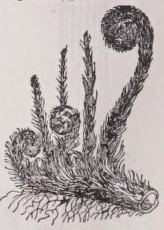
Rolled together downward, the tip occupying the center; -- a term used in reference to foliation or leafing, as in ferns.
An orbicular motion.
1. An orbicular motion.
2. A circle; a concentric layer.
1. In geometry, a plane figure comprehended by a single curve line, called its circumference, every part of which is equally distant from a point called the center. Of course all lines drawn from the center to the circumference or periphery, are equal to each other.
2. In popular use, the line that comprehends the figure, the plane or surface comprehended, and the whole body or solid matter of a round substance, are denominated a circle; a ring; an orb; the earth.
3. Compass; circuit; as the circle of the forest.
4. An assembly surrounding the principal person. Hence, any company, or assembly; as a circle of friends, or of beauties. Hence the word came to signify indefinitely a number of persons of a particular character, whether associated or not; as a political circle; the circle of ones acquaintance; having however reference to a primary association.
5. A series ending where it begins, and perpetually repeated; a going round.
6. Thus in a circle runs the peasants pain.
7. Circumlocution; indirect form of words.
8. In logic, an inconclusive form of argument, when the same terms are proved in orbem by the same terms, and the parts of the syllogism alternately by each other, directly and indirectly; or when the foregoing proposition is proved by the following, and the following is inferred from the foregoing; as, that heavy bodies descend by gravity, and that gravity is a quality by which a heavy body descends.
9. Circles of the sphere, are such as cut the mundane sphere, and have their periphery either on its movable surface, as the meridians; or in another immovable, conterminous and equidistant surface, as the ecliptic, equator, and its parallels.
10. Circles of altitude or almucantars, are circles parallel to the horizon, having their common pole in the zenith, and diminishing as they approach the zenith.
11. Circles of latitude, are great circles perpendicular to the plane of the ecliptic, passing through its poles and through every star and planet.
12. Circles of longitude, are lesser circles parallel to the ecliptic, diminishing as they recede from it.
13. circle of perpetual apparition, one of the lesser circles, parallel to the equator, described by any point of the sphere touching the northern point of the horizon, and carried about with the diurnal motion. The stars within this circle never set.
14. circle of perpetual occultation, another lesser circle at a like distance from the equator, which includes all the stars which never appear in our hemisphere.
15. Diurnal circles, are immovable circles supposed to be described by the several stars and other points in the heavens, in their diurnal rotation round the earth, or rather in the rotation of the earth round its axis.
17. Circles of the empire, the provinces or principalities of the German empire, which have a right to be present at the diets. Maximilian I. divided the empire into six circles at first, and afterwards into ten; Austria, Burgundy, Lower Rhine, Bavaria, Upper Saxony, Franconia, Swabia, Upper Rhine, Westphalia, and Lower Saxony.
18. Druidical circles, in British Topography, are certain ancient inclosures formed by rude stones circularly arranged; as Stone-henge near Salisbury.
To move circularly; as, the bowl circles; the circling years.
1. To move round; to revolve round.
2. And other planets circle other suns.
4. To circle in, to confine; to keep together.
1. A plane figure, bounded by a single curve line called its circumference, every part of which is equally distant from a point within it, called the center.
2. The line that bounds such a figure; a circumference; a ring.
3. An instrument of observation, the graduated limb of which consists of an entire circle.
4. A round body; a sphere; an orb.
5. Compass; circuit; inclosure.
6. A company assembled, or conceived to assemble, about a central point of interest, or bound by a common tie; a class or division of society; a coterie; a set.
7. A circular group of persons; a ring.
8. A series ending where it begins, and repeating itself.
9. A form of argument in which two or more unproved statements are used to prove each other; inconclusive reasoning.
10. Indirect form of words; circumlocution.
11. A territorial division or district.
12. To move around; to revolve around.
To move circularly; to form a circle; to circulate.
Having the form of a circle; round; as the moons circled orb.
Surrounded; encompassed; inclosed.
Having the form of a circle; round.
A mean poet, or circular poet.
1. A little circle; esp., an ornament for the person, having the form of a circle; that which encircles, as a ring, a bracelet, or a headband.
2. A round body; an orb.
3. A circular piece of wood put under a dish at table.
Circular; round.
Surrounding; going round; inclosing.
1. The act of moving or passing round; as the periodical circuit of the earth round the sun, or of the moon round the earth.
2. The space inclosed in a circle, or within certain limits.
3. Any space or extent measured by traveling round.
4. That which encircles; a ring; a diadem.
5. In England, the journey of judges through several counties or boroughs, for the purpose of holding courts. In the United States, the journey of judges through certain states or counties for the same purpose.
6. The counties or states in which the same judge or judges hold courts and administer justice. It is common to designate a certain number of counties to form a circuit and to assign one or more judges to each circuit The courts in the circuits are called circuit courts. In the government of the United States, a certain number of states form a circuit
7. A long deduction of reason.
8. In law, a longer course of proceedings than is necessary to recover the thing sued for.
To move in a circle; to go round.
To move or go round.
1. The act of moving or revolving around, or as in a circle or orbit; a revolution; as, the periodical circuit of the earth round the sun.
2. The circumference of, or distance round, any space; the measure of a line round an area.
3. That which encircles anything, as a ring or crown.
4. The space inclosed within a circle, or within limits.
5. A regular or appointed journeying from place to place in the exercise of one's calling, as of a judge, or a preacher.
6. A certain division of a state or country, established by law for a judge or judges to visit, for the administration of justice.
7. A district in which an itinerant preacher labors.
8. Circumlocution.
To move in a circle; to go round; to circulate.
To travel around.
Circuit
Encyclopedia Britannica
CIRCUIT, a law term, signifying the periodical progress of a legal tribunal for the sake of carrying out the administration of the law in the several provinces of a country. It has long been applied to the journey or progress which the judges have been in the habit of making twice every year, through the several counties of England, to hold courts and administer justice, where recourse could not be had to the king’s court at Westminster. The country, including Wales, is now, by Order in Council (under the Judicature Act, 1875), dated 5th February 1876, divided into seven circuits, viz., the Northern, North-Eastern, Midland, SouthEastern, Oxford, Western, North Wales, and South Wales Circuits. Counsel are not expected to practice on a circuit other than that to which they have attached themselves, unless they receive a special retainer. This and similar regulations are enforced by the discipline of the circuit bar mess only. In Scotland the judges of the supreme criminal court, or High Court of Justiciary, form also three separate circuit-courts, consisting of two judges each; and the country, with the exception of the Lothians, is divided into corresponding districts, called the Northern, Western, and Southern Circuits. In certain burghs of each circuit two courts are held in the year, in spring and autumn, called Circuit Courts. One more is held at Glasgow during the Christmas recess. Ireland is divided into the North-East and the North-West Circuits, the Home Circuit, and those of Leinster, Connaught, and Munster.
9th ed. Encyclopædia Britannica, vol. 5, p. 789
[253 words — estimated reading time: 2 minutes]
[253 words — estimated reading time: 2 minutes]
One that travels a circuit.
A circuiter.
No thesaurus entries found for "circ".
King James Bible KJV Bible
Berean Standard Bible BSB Bible
94 KJV and 99 BSB verses contain “circ” — showing the first 20. Show all 119 verses (searchable)
This is my covenant, which ye shall keep, between me and you and thy seed after thee; Every man child among you shall be circumcised.
This is My covenant with you and your descendants after you, which you are to keep: Every male among you must be circumcised.
And ye shall circumcise the flesh of your foreskin; and it shall be a token of the covenant betwixt me and you.
You are to circumcise the flesh of your foreskin, and this will be a sign of the covenant between Me and you.
And he that is eight days old shall be circumcised among you, every man child in your generations, he that is born in the house, or bought with money of any stranger, which is not of thy seed.
Generation after generation, every male must be circumcised when he is eight days old, including those born in your household and those purchased from a foreigner—even those who are not your offspring.
He that is born in thy house, and he that is bought with thy money, must needs be circumcised: and my covenant shall be in your flesh for an everlasting covenant.
Whether they are born in your household or purchased, they must be circumcised. My covenant in your flesh will be an everlasting covenant.
And the uncircumcised man child whose flesh of his foreskin is not circumcised, that soul shall be cut off from his people; he hath broken my covenant.
But if any male is not circumcised, he will be cut off from his people; he has broken My covenant.”
And Abraham took Ishmael his son, and all that were born in his house, and all that were bought with his money, every male among the men of Abraham’s house; and circumcised the flesh of their foreskin in the selfsame day, as God had said unto him.
On that very day Abraham took his son Ishmael and all those born in his household or purchased with his money—every male among the members of Abraham’s household—and he circumcised them, just as God had told him.
So Abraham was ninety-nine years old when he was circumcised,
and his son Ishmael was thirteen;
Abraham and his son Ishmael were circumcised on the same day.
And all the men of his house, born in the house, and bought with money of the stranger, were circumcised with him.
And all the men of Abraham’s household—both servants born in his household and those purchased from foreigners—were circumcised with him.
And Abraham circumcised his son Isaac being eight days old, as God had commanded him.
When his son Isaac was eight days old, Abraham circumcised him, as God had commanded him.
But in this will we consent unto you: If ye will be as we be, that every male of you be circumcised;
We will consent to this on one condition, that you become circumcised like us—every one of your males.
But if ye will not hearken unto us, to be circumcised; then will we take our daughter, and we will be gone.
But if you will not agree to be circumcised, then we will take our sister and go.”
Only herein will the men consent unto us for to dwell with us, to be one people, if every male among us be circumcised, as they are circumcised.
But only on this condition will the men agree to dwell with us and be one people: if all our men are circumcised as they are.
And unto Hamor and unto Shechem his son hearkened all that went out of the gate of his city; and every male was circumcised, all that went out of the gate of his city.
All the men who went out of the city gate listened to Hamor and his son Shechem, and every male of the city was circumcised.
So he let him go: then she said, A bloody husband thou art, because of the circumcision.
So the LORD let him alone. (When she said, “bridegroom of blood,” she was referring to the circumcision.)
But every man’s servant that is bought for money, when thou hast circumcised him, then shall he eat thereof.
But any slave who has been purchased may eat of it, after you have circumcised him.
And when a stranger shall sojourn with thee, and will keep the passover to the LORD, let all his males be circumcised, and then let him come near and keep it; and he shall be as one that is born in the land: for no uncircumcised person shall eat thereof.
If a foreigner resides with you and wants to celebrate the LORD’s Passover, all the males in the household must be circumcised; then he may come near to celebrate it, and he shall be like a native of the land. But no uncircumcised man may eat of it.
And in all things that I have said unto you be circumspect: and make no mention of the name of other gods, neither let it be heard out of thy mouth.
Pay close attention to everything I have said to you. You must not invoke the names of other gods; they must not be heard on your lips.
And in the eighth day the flesh of his foreskin shall be circumcised.
And on the eighth day the flesh of the boy’s foreskin is to be circumcised.