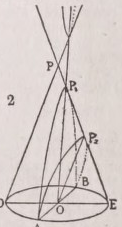
A CONIC section is the curve in which a plane cuts a cone, which is defined in Euclid’s Elements as “a solid figure described by the revolution of a right-angled triangle about one of the sides containing the right angle, which side remains fixed.” Though the properties of conic sections can be investigated from this point of view, we consider it more advantageous to start from the following definition, which is derived from one of the properties which all conic sections possess in common.
Definition.— If a point move in such a way in a plane that its distance from a fixed point in the plane always bears a fixed ratio to its distance from a fixed straight line in the plane, the point will trace out a conic section.
The fixed point is called a focus, and the fixed straight line a directrix of the curve.
The fixed ratio of the distance from the focus to the distance from the directrix is called the eccentricity of the curve.
The discovery of the conic sections seems to have originated in the school of Plato. It is probable that the followers of that philosopher were led to the discovery of these curves, and to the investigation of many of their properties, in seeking to resolve the two famous problems of the duplication of the cube and the trisection of an angle, for which the artifices of the ordinary or plane geometry were insufficient. Two solutions of the former problem, by the help of the conic sections, are preserved by Eutocius, and are attributed by him to Menaechmus, the scholar of Eudoxus, who lived a little after the time of Plato....
The writings of Archimedes that have reached us show that the geometers before his time had advanced a great length in investigating the properties of the conic sections. This author expressly mentions numerous demonstrations of preceding writers, and often refers to properties as known to mathematicians. His own discoveries are worthy of the most profound and inventive genius of antiquity. In the quadrature of the parabola he gave the first and the most remarkable instance that has yet been discovered of the exact equality of a curvilinear to a rectilinear space. He determined the proportion of the elliptic spaces to the circle; and he invented many propositions respecting the mensuration of the solids formed by the revolution of the conic sections about their axes.
It is chiefly from the writings of Apollonius of Perga that we know how far the ancient mathematicians carried their speculations concerning these curves. (See Apollonius.) His work on the conic sections, written in eight books, was held in such high estimation by the ancients as to procure for him the name of the Great Geometer. The first four books of this treatise only have come down to us in the original Greek; in these the author claims no further merit than that of having collected, amplified, and arranged the discoveries of preceding mathematicians. One improvement he introduced deserves particular notice. The geometers who preceded him derived each curve from a right cone, which they conceived to be cut by a plane perpendicular to its slant side; and Apollonius was the first to show that all the curves are produced from any sort of cone, whether right or oblique, according to the different inclinations of the cutting plane. An Arabic MS. discovered in 1658, and two others brought from the East a few years later, contain the first seven books of the treatise of Apollonius; the eighth book appears to be irrecoverably lost. Dr Halley, who in 1710 put forth a correct edition of the Conics of Apollonius, guided by the account of the different books preserved by Pappus, has given a very able restoration of the eighth book. The last four books of the Conics of Apollonius, containing the higher or more recondite parts of the science, are generally supposed to be the fruit of the author’s own researches, and do much honour to his geometrical skill and invention. Even in our times the whole treatise must be regarded as a very extensive work on the conic sections,—modern mathematicians having made few discoveries of which there are not some traces to be found in the work of Apollonius.
The geometers who followed Apollonius seem to have contented themselves with commenting on his treatise. It was only about the middle of the 16th century that the study of this branch of mathematical science was revived; since that time no part of mathematics has been more cultivated, or has fc been illustrated by a greater variety of ingenious writings. The applications of the properties of these curves in natural philosophy have, in modern times, given them a degree of importance which they did not formerly possess; and a knowledge of them is now indispensable to any one who seeks to acquaint himself with the remarkable physical discoveries of the present age.
Apollonius and all the earlier writers on conic sections derived the elementary properties of the curves from the nature of the cone; but in 1665 Dr Wallis, in his De Sectionibus Conicis, laid aside the consideration of the cone, deriving the properties of the curves from a description in piano. In the following treatise, as has been already stated, the properties of the conic sections are deduced from their description in a plane.
An assemblage of points, all of which satisfy some condition, whether or not they form a continuous curve, is called a locus ; as, for example, we could define a circle as the locus of a point whose distance from a fixed point is constant, or a conic section as the locus of a point whose distance from a fixed point always bears a constant ratio to its distance from a fixed straight line.
The following is a proposition which is very useful in the discussion of the properties of conic sections.
Lemma. —The locus of a point in a plane whose distances from two fixed points in the plane always bear a constant ratio to one another is a circle.
Let A, B (fig. 1) be the two fixed points, m the common ratio, and P any point on the locus.
Divide BA internally and exter∙ in the given ratio, so that CA DA_ _PA CB - DB ~ m, - PB *
Join PC, PD.
Then, because PA: PB = CA: CB,
PC is the internal bisector of the angle APB (Eucl. vi. 3); and because PA: PB = DA: DB ,
PD is the external bisector of the angle APB (Euch vi. A).
Therefore the angle CPD is a right angle, and the locus of P a circle described on the line CD as diameter.
PART I.—THE PARABOLA.
Definitions.
A straight line perpendicular to the directrix, terminated at one extremity by the parabola, and produced indefinitely within it, is called a diameter.
The point in which the diameter meets the parabola is called its vertex.
The diameter which passes through the focus is called the axis of the parabola; and the vertex of the axis is called the principal vertex. Corollary. A perpendicular drawn from the focus to the directrix is bisected at the vertex of the axis.
A straight line terminated both ways by the parabola, and bisected by a diameter, is called an ordinate to that diameter.
The segment of a diameter between its vertex and an ordinate, is called an abscissa.
A straight line meeting the parabola in two points P, Q, is called a chord.
The focal chord which is bisected by a diameter is called the parameter of that diameter.
The limiting position of the chord PQ, which it assumes when the point Q moves up to and coincides with P, is called the tangent at P.
A line through P at right angles to the tangent is called the normal at P.
Proposition T.
To find where a parabola of given focus and directrix is cut by a straight line parallel to the directrix.
Let S (fig. 2) be the focus, and XK the directrix. Draw SX perpendicular to KX, and bisect SX in A; draw AZ at right angles to SX, and equal to AS. Join XZ.
Let QN be any straight line parallel to the directrix, cutting XZ in Q and the axis in N.
With centre S and radius equal to QN, describe a circle cutting QÑ in P and P'; these will be points on the parabola, because
SP: XN = QN: XN = ZA: AX = 1: 1.
.∙. SP = XN = distance of P from the directrix.
It is clear that if the point P exists, the point P' on the opposite side of the axis also exists, and therefore the parabola is symmetrical with respect to the axis.
Again, the point P will exist, or, in other words, the circle will cut QN, as long as SP or QN is greater than SN, which is always the case as long as QN lies on the same side of AZ as the focus.
The whole of the curve, therefore, lies to the right of AZ, and branches off to an infinite distance from the directrix.
Prop. II.
To find where a parabola of given focus and directrix is cut by a straight line parallel to the axis.
Let S (fig. 3) υe the focus, and XK the directrix; draw AY bisecting SX at right angles.
Let KQ be any line parallel to the axis cutting the directrix , in K. Join SK cutting AY in Y, and draw YP at right angles to SK cutting KQ in P. P will be a point on the curve.
It is easily shown that the triangles SPY, KP Y are equal in all respects, and that SP = PK.
Now, the point P will exist, or, in other words, YP will intersect KQ, for all positions of KQ.
The parabola, therefore, branches off on either side of the axis to an infinite distance, and is cut by a straight line parallel to the axis in one point only.
It appears from what has gone before that the general shape of the curve is of the form given in fig. 4, which shows the focus, directrix, and axis.
It can be easily seen that all points within the curve are nearer to the focus than to the directrix, and all points without the curve are nearer to the directrix than to the focus.
A parabola can be described mechanically in the following planner (see fig. 5) :—
Suppose a bar KQ to move always parallel to itself, with its end K on a line at right angles to it; then, if a string of length equal to KQ, attached to the bar at Q, and also to a fixed point S, be always kept tight by means of a ring P sliding on KQ, a pencil at P would, trace a parabola whose focus is S and directrix XK.
Prop. III.
If a chord PQ (fig. 6) intersect the directrix in Z, then SZ will be the external bisector of the angle PSQ.
Join SP, SQ, and draw PM, QN perpendicular to the directrix.
Then, because the triangles PMZ, QNZ are similar,
PZ: QZ = PM: QN = SP: SQ.
.∙. (Eucl. vi. A) SZ bisects the external angle of the triangle PSQ.
Corollary.— If the point Q move up to and become coincident with P, or if, in other words, the chord PQ become the tangent to the parabola at P, then the angle PSZ will become a right angle.
Prop. IV.
The tangent at any point of a parabola bisects the angle between the focal distance of the point and the perpendicular from the point on the directrix.
Let PZ (fig. 7) be the tangent at P, meeting the directrix in Z; then, if PM be drawn perpendicular to the directrix, it is easily seen that the two triangles SPZ, MPZ are equal in all respects, and the angle SPZ equal to the angle MPZ.
If SM be joined, it can be shown that it is bisected at right angles by PZ, and that its middle point is the point Y in Prop. ii.
The line AY, it will be observed, is the tangent to the parabola at the vertex A.
It appears, therefore, that the locus of the foot of the perpendicular from the focus on the tangent at any point is the tangent at the vertex.
It can also be seen that, if the tangent at P meet the axis in T, then SP= ST. For the angles STP, SPT are each equal to the angle MPT, and therefore (Euch i. 6) SP, ST are equal.
It may further be remarked that, if 0 be any point in the tangent at P, then the triangles SPO, MPO are equal in all respects.
If PN be drawn perpendicular to the axis to meet it in N, then it will be seen that PN = 2AY and TN = 2AN = 2AT.
Now, in the right-angled triangle TYS,—
TA: AY = AY: AS (Euch vi. 8), and therefore YA 2 = TA . AS
Therefore PN 2 = 4YA 2 = 4TA. AS
= 4AS.AN.
If the normal PG be drawn meeting the axis in G, then the triangles PNG, YAS are similar, and therefore—
NG-AS = PN:YA = 2:1
.∙. NG = 2AS
Prop. V,
To draw a tangent to a parabola at a point on the curve.
First Method.— Take a point T in the axis (fig. 7), such that ST is equal to SP, and join TP. Then STP will be the tangent at P.
Second Method.— Draw SZ at right angles to SP, meeting the directrix in Z. ZP is the tangent at P.
Third Method— On SP as diameter describe a circle; this will touch the tangent at the vertex AY in a point Y. YP is the tangent r,t P.
Prop. VI.
To draw a pair of tangents to a parabola from an external point.
First Method.— Let 0 (fig. 8) be the point. Join OS, and with centre 0 and radius OS describe a circle cutting the directrix (which it will always do) in Μ and M'.
Draw MP, M'P', parallel to the axis, cutting the parabola in P and P'. Join OP, OP ’. They are tangents to the parabola at P and P'.
Join SP, SP'.
In the triangles OPS, OPM,
OP, PM = OP, PS each to each, and OM = OS by the construction; therefore the angles OPS, OPM are equal, and therefore OP is a tangent to the curve at P (Prop, iv.)
Second Method.— Let 0 (fig. 9) he the point. Upon OS as diameter describe a circle cutting the tangent at the vertex (which it will always do) in Y and Y'.
Join YO, YO, and, if necessarj produce them to meet the curve in P, P'. They will be tangents to the curve at P, Pi
Because OYS is a semicircle, therefore the - angle OYS is a right angle, and therefore YO is a tangent to the parabola (Prop, iv.)
Prop. VII.
If OP, OP' (fig. 8) be tangents to the parabola at P, P', then the triangles OSP, P'SO are similar, and SO 2 = SP. SP'.
Because the angle OSP=angle 0MP=angle 0M'P'=angle OSP', and the angle OPS = angle 0PM= angle SMM ’ =⅛ angle SOM' (Eucl. ιii. 20) = angle SOP' (Prop, vi.); therefore the remaining angles OPS, P'OS are equal, and the triangles OPS, P'OS similar; and therefore (Euch vi. 4)
SP:SO = SO:SP', or
SO 2 - SP. SP'.
Pkop. VIII.
If 0 be the intersection of OP, OP', the tangents to the parabola at P and P', then OV drawn parallel to the axis will bisect PP'. From fig. 8 we see that, if a line through 0 meet MM' in Z, MM' is bisected in Z; and, because MP. Z0V, and M'P' are parallel, therefore PP' is bisected in V.
Prop. IX.
The angle between two tangents is equal to half the angle subtended at the focus by the chord of contact.
From fig. 9 we see that angle YOY' = angle YSY' = angle YSA - angle Y'SA = ⅜ anglo PSA - ⅛ angle P'SA = ⅛ anglo PSP'.
It may be shown, by means of this proposition, that the circle which is described about the triangle formed by any three tangents to a parabola passes through the focus.
Prop. X.
If OV (fig. 10) meet the parabola in Q, the tangent at Q is parallel to PP', and OV will be bisected in Q.
Draw the tangent RQR' at Q, meeting OP,OP r in R, R ’. Join PQ, and let RW be drawn parallel to OQV meeting PQ in W.
Then PW = WQ (Prop, viii.) Therefore OR = RP (Euch vi. 2). Similarly we can shew that OR' ≡ R'P'. Therefore
OR:RP≈OR':R'F, and therefore RR' is parallel to PP' (Euch vi. 2); and also .∙. OQ = QV. OQ:QV-OB:BP.
Prop. XL
If V be the middle point of a chord PP', and Q be the point at which the tangent is parallel to PP', then PV 2 -=4SO. QV.
Suppose in fig. 10 SQ, SR joined, and PO produced to meet the axis in T.
Then angle ORQ = J angle QSP (Prop, ix.) =angle QSR (Prop, yn.), and angle QRS =angle RPS (Prop, vii.) =angle STP (Prop, iv.) = angle QOR (Eucl. i. 29); therefore the two triangles 00E, SQR are similar, and
OQ:QR≈QR;SQ
therefore QR 2 = SQ. OQ.
But PV=2QR, and OQ=QV, therefore PV 2 =4SQ. QV.
Pkop XII.
The^parameter of the diameter QV is
If the tangent at Q (fig. 11) meets the axis in T,
SQ = ST = QV.
Therefore the equality PV 2 = 4SQ. QV becomes PV 2 = 4SQ 2 therefore PV-2SQ
or PP' = 4SQ.
Prop. XIII.
If POP' (fig. 12) ⅛e any chord, and OR be drawn parallel to the axis through any point O to meet the curve in R, then PO. OP'≡ 4SQ . Rθ, where 4SQ is the parameter of diameter PP'.
Draw RW parallel to PP' to meet QV in W.
Then PV 2 =4SQ.QV
and RW 2 = 4SQ.QW, and RO = W V and RW=OV.
Therefore PO. OP'= PV 2 - OV 2 (Eucl.ii. 5).
= PV 2 -RW 2
= 4SQ.QV-4SQ.QW
≈4SQ. WV=4SQ. RO Prop. XIV.
If POP', pθp' be any two chords intersecting in 0, and Q, q are the points of contact of the tangents parallel to them, then PO . OP': pθ. Op'=SQ: Sq.
By Prop, xiii., PO . OP'=4SQ. RO and similarly pθ. Op'=4Sq. RO. Therefore
PO . OP': pθ . Op'=4SQ. RO: 4Sq. RO = SQ: Sq Pkop. XV.
The area included between any chord of a parabola and the curve is two-thirds of the area of the triangle formed by the chord and the tangents to the curve at its extremities.
It is easily seen in fig. 10 that the area of the triangle ORR' is one quarter the area of the triangle OPP', and therefore one half the area of the triangle QPP'.
Now if we draw tangents where RW, R'w meet the curve, we shall have two pairs of triangles whose areas are in the ratio 1: 2, and so we may go on indefinitely. The sum of all the external triangles will be half the sum of all the internal triangles.
The sum of the external triangles is the curvilinear area OPQPi and the sum of the internal triangles is the curvilinear area PQpζ Therefore
2 × area OPQP'=area PQP'
.∙. 2 × triangle OPP'=3 area PQP ’ or area PQP =f triangle OPP'.
PART II.-THE ELLIPSE.
Definitions.
A straight line passing through the centre, and terminated both ways by the ellipse, is called a diameter.
The extremities of a diameter are called its vertices.
The diameter which passes through the foci is called the transverse axis, also the major axis.
The diameter which is perpendicular to the transverse axis is called the conjugate axis, also the minor axis.
Any straight line not passing through the centre, but terminated both ways by the ellipse, and bisected by a diameter, is called an ordinate to that diameter.
Each of the segments of a diameter intercepted between its vertices and an ordinate, is called an abscissa.
A chord, tangent, and normal are defined exactly in the same words as in the case of the parabola.
Prop. I.
To find where an ellipse of given focus, directrix, and eccentricity is cut by a straight line parallel to the...