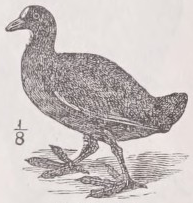
A fowl of the genus Fulica, frequenting lakes and other still waters. The common coot has a baldforehead, a black body, and lobated toes, and is about fifteen inches in length. It makes its nest among rushes, with grass and reeds, floating on the water.
COOT, a well-known British water-fowl, the Fulica atra of Linnaeus, belonging to the family Rallidae or Rails. The word Coot, in some parts of England pronounced Cute, or Scute, is of uncertain origin, but perhaps cognate with Scout and Scoter—both names of aquatic birds—a possibility which seems to be more likely since the name “Macreuse,” by which the Coot is known in the south of France, being in the north of that country applied to the Scoter (Oedemia nigra) shews that, though belonging to very different families, there is in popular estimation some connection between the two birds. The Latin Fulica (in polite French, Foulque) is probably allied to fuligo, and has reference to the bird’s dark colour. The Coot breeds abundantly in many of the larger inland waters of the northern parts of the Old World, in winter commonly resorting, and often in great numbers, to the mouth of rivers or shallow bays of the sea, where it becomes a general object of pursuit by gunners whether for sport or gain. At other times of the year it is comparatively unmolested, and being very prolific its abundance is easily understood. The nest is a large mass of flags, reeds, or sedge, piled together among rushes in the water or on the margin, and not unfrequently contains as many as ten eggs. The young, when first hatched, are beautiful little creatures, clothed in jet-black down, with their heads of a bright orange-scarlet, varied with purplish-blue. This brilliant colouring is soon lost, and they begin to assume the almost uniform sooty-black plumage which is worn for the rest of their life; but a characteristic of the adult is a bare patch or callosity on the forehead, which being nearly white gives rise to the epithet “bald” often prefixed to the bird’s name. The Coot is ...about 18 inches in length, and will sometimes weigh over 2 lb. Though its wings appear to be short in proportion to its size, and it seems to rise with difficulty from the water, it is capable of long-sustained and rather rapid flight, which is performed with the legs stretched out behind the stumpy tail. It swims buoyantly, and looks a much larger bird in the water than it really is. It dives with ease, and when wounded is said frequently to clutch the weeds at the bottom with a grasp so firm as not even to be loosened by death. It does not often come on dry land, but when there, marches leisurely and not without a certain degree of grace. The feet of the Ccot are very remarkable, the toes being fringed by a lobed membrane, which must be of considerable assistance in swimming as well as in walking over the ooze—acting as they do like mud-boards.
In England the sport of Coot-shooting is pursued to some extent on the broads and back-waters of the eastern counties—in Southampton Water, Christchurch Bay, and at Slapton Lay—and is often conducted battuefashion by a number of guns. But even in these cases the numbers killed in a day seldom reach more than a few hundreds, and come very short of those that fall in the officially-organized chasses of the lakes near the coast of Languedoc and Provence, of which an excellent description is given by the Vicomte Louis de Dax. The flesh of the Coot is very variously regarded as food. To prepare the bird for the table, the feathers should be stripped, and the down, which is very close, thick, and hard to pluck, be rubbed with powdered resin; the body is then to be dipped in boiling water, which dissolving the resin causes it to mix with the down, and then both can be removed together with tolerable ease. After this the bird should be left to soak for the night in cold spring-water, which will make it look as white and delicate as a chicken. Without this process the skin after roasting is found to be very oily, with a fishy flavour, and if the skin be taken off the flesh becomes dry and good for nothing (Hawker’s Instructions to Young Sportsmen; Hele’s Notes about Aldeburgh).
The Coot is found throughout the Palaearctic Region from Iceland to Japan, and in most other parts of the world is represented by nearly allied species, having almost the same habits. An African species (F. cristata), easily distinguished by a red caruncle on its forehead, is of rare appearance in the south of Europe. The Australian and North American species (F. australis and F. americana) have very great resemblance to our own bird; but in South America half-a-dozen or more additional species are found which range to Patagonia, and vary much in size, one (F. gigantea) being of considerable magnitude. The remains of a very large species (F. newtoni) have been discovered in Mauritius, where it must have been a contemporary of the Dodo, but like that bird is now extinct. (a. n.)
9th ed. Encyclopædia Britannica, vol. 6, p. 341 [848 words — estimated reading time: 5 minutes]
COOTE, Sir Eyre (1726-1783), a celebrated general, born at Limerick in 1726, was the son of a clergyman. He served against the Pretender in 1745, and in 1754 sailed for India to join the army of Clive. In 1760, having attained the rank of colonel for his services at Plassy and Calcutta, he was sent to the Carnatic, where he took Wandewash and defeated Lally. For these exploits he received on his return to England a jewelled sword from the East India Company, and a vote of thanks from the House of Commons. In 1769 he was appointed to the chief command in Madras; but in the next year, having quarrelled with the governor, he returned to England. He was made Knight of the Bath, colonel of the 7th Foot, and governor of Fort St George. In 1780 he returned to Calcutta as commander-in-chief in Bengal and member of the supreme council. Soon after he was sent by WarrenHastings into the Carnatic, where Hyder Ali was seriously threatening the British possessions; and on the 1st July 1781 he won a decided victory at Ponto Novo, which checked the advance of his antagonist. But there was a serious deficiency of supplies, and in the next year Coote returned to Calcutta. Notwithstanding his feeble health, he again set sail in the spring of 1783 for Madras. His ship was pursued by the French; and this annoyance, acting upon his broken constitution and now extremely irritable temper, brought on a third fit of apoplexy, causing his death on the 26th April 1783. A monument was erected to his memory in Westminster Abbey.
A very flattering account of Coote is given by Wilks in his Historical Sketches of Mysore, 1810; see also Mill’s British India.
9th ed. Encyclopædia Britannica, vol. 6, p. 342 [296 words — estimated reading time: 2 minutes]
This site uses cookies to remember your display preferences (search sources and editions, Bible version, auto-link, images, light/dark theme). No personal data whatsoever is collected. Privacy Policy