
FLAMBARD, Ranulph(Ralph), (d. 1128), bishop of Durham, and justiciar under William Rufus, was a Norman of low birth, who came to England in the train of William the Conqueror in 1066. He took holy orders, obtained several church preferments, and was appointed chaplain to the bishop of London, and made prebendary of St Paul’s. He demanded the deanery also, and this being refused him, he left the bishop’s service. He afterwards passed into the service of the king, William II., who made him his chaplain. Ambitious, greedy, and unscrupulous, ho flattered and ministered to the vices of his master, and thereby raised himself to the highest places in church and state. To fill the royal coffers he suggested various arbitrary and oppressive measures, by which he earned the hatred of the people, and at the same time the eulogy of the king, that he was the only man who, to please a master, dared to brave the vengeance of mankind. Flambard appears to have been the first to apply the feudal theory to the estates of the church. He suggested that they should be considered as fiefs or benefices held of the king, and that as such at every vacancy they devolved to the crown till the vacancy was supplied. The lesson was quickly learnt, and the immediate consequence was that benefices were kept vacant during the king’s pleasure, and refilled only on payment of a large sum of money. It was not till after the death of Lanfranc that the king gave himself up unreservedly to the influence of Flambard. The justiciar obtained for himself the custody of the vacant abbeys of Winchester and Chertsey, the bishopric of Lincoln, and the archbishopric of Canterbury. His extortion and oppressions drew upon him the curses of the clergy as well as of the people, and in 1099 an attempt was made to ...murder him at sea. But a storm arose and his murderers quarrelled, and Flambard was allowed to land again. Ho then reappeared at court and was rewarded with the see of Durham, But he was at last “hoist with his own petard”; forat his consecration he had to make the king a present of £1000. On the death of William IL, in the following year, the bishop, to satisfy the outcries of the people, was sent to the Tower, “the first man,” says Mr Freeman, “recorded to have dwelled as a prisoner in the Conqueror’s fortress.” He fared sumptuously in his confinement, treated his keepers, and at length, in February 1101, managed to escape from the Tower, and fled to Normandy. There he joined Duke Robert, instigated him to the invasion < f England, and returned to England with him. He was ultimately restored to his see, and appears to have occupied himself thenceforward with its duties, and in various architectural works—the completion of his cathedral, the building of Norham Castle, and the fortification of Durham. He endowed the college of Christchurch and founded the priory of Mottisford. Flambard died September 5, 1128.
[509 words — estimated reading time: 3 minutes]

FLAMEL, Nicolas, a reputed French alchemist, and a caligrapher to the university of Paris, was born about 1330. Becoming a money lender, he amassed immense wealth, with which he built a large number of churches and endowed various charities. He died at Paris 22d March 1418, and was buried in the church of Saint-Jacques-la-Boucherie, to which he bequeathed the bulk of his property. His unusual prosperity acquired for him, either during his life or shortly after his death, the reputation of being an alchemist, and gradually his history became incrusted with legend. It was said that he accidentally discovered the secret of alchemy in an old book by a Jewish astrologer which happened to come into his hands, and that after reaching a good old age in France, he and his wife mysteriously disappeared, presumably to live in splendour in the East through the aid of the philosopher’s stone. A book on alchemy exists in the imperial library of Paris with an inscription professing to have been written by Nicolas Flamel, but plainly a forgery. In 1561 also, a small treatise entitled Sommaire Philosophique de Nicolas Flamel was published among a collection of alchemist treatises entitled Transformation métallique. These and similar inventions were, however, exploded by Vilain’s Essai sur V Histoire de Saint-Jacques-la-Boucherie, 1758, which contains an account of the life of Flamel, derived from the archives and other authentic documents of the parish. See also Description de la Ville de Paris au quinzième Siècle, par Guillebert de Metz, published for the first time from De Metz’s manuscript by Leroux de Lincy, Paris, 1855.
[276 words — estimated reading time: 2 minutes]
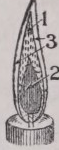
FLAMEN, a Roman sacrificial priest. The flamens were under the direction of the pontifices, and were consecrated to the service of some particular deity. The highest in rank were the Flamen Dialis, Flamen Martialis, and Flamen Quirinalis, who were always selected from among the patricians. When the number of flamens was raised from three to fifteen, those already mentioned were entitled majores, in contradistinction to the other twelve, who were called minores, and were chosen from the plebs. The flamens were held to be elected for life, but they might be compelled to resign office for neglect of duty, or on the occurrence of some ill-omened event during the performance of their rites. The official dress of the flamens w as the apex or cap (surmounted with a piece of pointed olive-wood, round the base of which a lock of wool was twisted), the lcena or mantle, and a laurel wreath. The highest of all these priests was the Flamen Dialis, or flamen of Jupiter, who in virtue of his office was entitled to a lictor, to a seat in the senate, to a curule chair, and to the toga praetexta, woven by his wife of thick wool. The sight of fetters being forbidden him, his toga was not allowed to be tied in a knot but was fastened by means of clasps, and the only kind of ring permitted to be worn on his finger was a broken one. If a person in fetters took refuge in his house he was immediately loosed from his bonds; and if a criminal on his way to the scene of his punishment met him and threw himself at his feet he was respited for that day. The flamen Dialis was not allowed to leave the city for a single night, to ride or even touch a horse (a restriction which incapacitated him for the consulship), to swear an oath, to look at an army, or to witness the business of daily life. His ...marriage was dissoluble only by death. His wife was called Flaminica, and was obliged to assist her husband at the sacrifices and other religious duties which he performed. She wore long woollen robes, a purple veil, and shoes made of the leather of sacrificed animals, and like her husband she carried the sacrificial knife. Some of the municipal towns in Italy had flamens as well as Rome. When it became customary to deify the emperors, flamens were appointed in all the provincial towns to superintend their worship.
[420 words — estimated reading time: 3 minutes]