
To be melted; to be reduced from a solid to a fluid state by heat.
Word of the Day: Catachrestical
1. s as z. [Latin fundo, fusum, to pour out.]
A tube or casing filled with combustible matter, by means of which a charge of powder is ignited, as in blasting; -- called also fuzee. See Fuze.
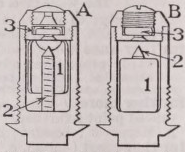
2. To be blended, as if melted together.
2. To unite or blend, as if melted together.
1. s as z. [Latin fusus, a spindle, from fundo, fudi, fusum.]
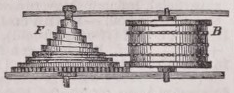
2. The cone or conical part of a watch or clock, round which is wound the chain or cord.
3. s as z.
5. fusee or fuse of a bomb or granade, a small pipe filled with combustible matter by which fire is communicated to the powder in the bomb; but as the matter burns slowly, time is given before the charge takes fire, for the bomb to reach its destination.
4. A small packet of explosive material with wire appendages allowing it to be conveniently attached to a railroad track. It will explode with a loud report when run over by a train, and is used to provide a warning signal to the engineer.
6. The cone or conical wheel of a watch or clock, designed to equalize the power of the mainspring by having the chain from the barrel which contains the spring wind in a spiral groove on the surface of the cone in such a manner that the diameter of the cone at the point where the chain acts may correspond with the degree of tension of the spring.
7. A similar wheel used in other machinery.
Fusel
Webster's Dictionary 1913
Alt. of Fusel oil
Fusel oil
Webster's Dictionary 1913
Fusel oil
Encyclopedia Britannica
FUSEL OIL, the name applied to the volatile oily liquids, of a nauseous fiery taste and smell, which are obtained in the rectification of spirituous liquors made by the fermentation of grain, potatoes, the marc of grapes, and other material, aud which, as they are of higher boiling-point than ethylic alcohol, occur in largest quantity in the last portions of the distillate. Besides ethylic or ordinary alcohol, and amylic or pentylic alcohol, which are present in them all, there have been found in fusel oils several other bodies of the C n H 2n+1 .OH series, also certain ethers, and members of the C s H 2n O 2 series of fatty acids. Normal propylic alcohol, C s H 7 .OH, is contained in the fusel oil of the marc brandy of the south of France, and isoprimary butylic alcohol, CH (CH 3 ) 2 .CHjj.OH, in that of beet-root molasses. The chief constituent of the fusel oil procured in the manufacture of alcohol from potatoes and grain, usually known as fusel oil and potato-spirit, is isoprimary amylic alcohol, or isobutylcarbinol, CH(CH 3 ) 2 .CH 2 .CH 2 .OH, boiling at 129°-130° C., and inactive as regards polarized light. Ordinary fusel oil yields besides another isomeric amylic alcohol, boiling at about 128°, and laevorotatory. The formation of amylic alcohol is stated by Liebig {Familiar Letters on Chemistry, p. 217, 4th ed., 1859) never to take place in fermenting fluids in the presence of tartar, of racemic, tartaric, or citric acid, or of certain bitter substances, as hops. It is produced principally in alkaline or neutral liquids, and in such as contain lactic or acetic acid. Schorlemmer {Proc. Roy. Soc., xv., 1866, p. 131) has shown that amyl-compounds prepared from fusel oil and from American petroleum agree in specific gravity and boiling point, and are therefore to ...be regarded as identical. Variable quantities of fusel oil, less or greater according to the stage of ripening, exist in commercial spirits. Administered in small amount, it exercises a poisonous action, causing thirst and headache, with furred tongue {Brit, and For. Med.-Chir. Rev., xxviii., 1861, p. 101). In crude spirit made from potatoes, after its purification in the cold from noxious gases by means of charcoal, Μ. Rabuteau found 50 per cent, of ethylic, and 1 - 5 per cent of isopropylic alcohol, and traces of propylic, and of ordinary and a more complex amylic alcohol. He discovered that in - 5 ⅛ aqueous solution ethylic alcohol was not injurious to frogs, isopropylic alcohol killed after some hours, and propylic alcohol in a single hour, whilst the vapours of a similar solution of amylic alcohol were instantaneously fatal to them, and even diluted to as much as 500 times its bulk that body exercised on them a poisonous influence. The widely different actions of common alcohol and of such compounds as the potato-oils in intoxicating drinks, he points out, render it necessary to distinguish between the excitable ethylism produced by the former, and the dull and heavy amylism, or more properly polyalcoholism of the latter. (See Le Progrès Médical, 1878, p. 979, “Société de Biologie.”) To remove fusel oil from spirits, a matter of prime importance to the distiller, a great number of methods have been resorted to. A practically pure spirit can be obtained by rectification several times after dilution with water, or by the use of specially constructed stills, as Coffey’s (see Distillation, vol. vii. pp. 265-6). Among the materials which have been employed for the complete defuselation of spirit are the powder of freshly burnt charcoal, which acts best when the vapour of the liquid is passed through it, and charcoal with manganese peroxide, with slaked lime, and with soap-boilers’ lye; also saturated solution of chloride of lime, alone or with zinc chloride; and calcium chloride, olive oil, soda-soap, and milk. The presence of fusel oil in spirit may be suspected when the addition of four parts of water causes milkiness. It is detected by its odour when the spirit is diluted with warm water, or when its ethylic alcohol has been allowed to evaporate. To remove the last-named body and water from fusel oil calcium chloride has been employed. The estimation of the alcohols of fusel oil may be effected by Dupré’s process, in which their corresponding acids are obtained by oxidizing with sulphuric acid and potassium dichromate, and eventually the quantity of barium in the barium salts of the purified acids is determined (see Analyst, Mar. 31, 1871). Fusel oil is employed in the arts as a source of amylic alcohol.
9th ed. Encyclopædia Britannica, vol. 9, p. 853
[776 words — estimated reading time: 5 minutes]
[776 words — estimated reading time: 5 minutes]
Fuseli
Encyclopedia Britannica
FUSELI, Henry (1741-1825), an eminent painter and writer on art, was born at Zurich in Switzerland on the 7th February 1741; he himself asserted, in 1745, but this appears to have been a mere whim. He was the second child in a family of eighteen. His father was John Caspar Fiissli, of some note as a painter of portraits and landscapes, and author of Lives of the Helvetic Painters. This parent destined his son for the church, and with this view sent him to the Caroline college of his native town, where he received an excellent classical education. One of his schoolmates there was Lavater, with whom he formed an intimate friendship. After taking orders in 1761, Fuseli was obliged to leave his country for a while in consequence of having aided Lavater to expose an unjust magistrate, whose family was still powerful enough to make its vengeance felt. He first travelled through Germany, and then, in 1763, visited England, where he supported himself for some time by miscellaneous writing; there was a sort of project of promoting through his means a regular literary communication between England and Germany. He became in course of time acquainted with Sir Joshua Reynolds, to whom he showed his drawings. By Sir Joshua’s advice he then devoted himself wholly to art. In 17 70 he made an art-pilgrimage to Italy, where he remained till 1778, changing his name from Füssli to Fuseli, as more Italian-sounding. Early in 1779 he returned to England, taking Zurich on his way. He found a commission awaiting him from Alderman Boydell, who was then organizing his celebrated Shakespeare gallery. Fuseli painted a number of pieces for this patron, and about this time published an English edition of Lavater’s work on physiognomy. He likewise gave Cowper some valuable assistance in preparing ...the translation of Homer. In 1788 Fuseli married Miss Sophia Rawlins (who it appears was originally one of his models, and who proved an affectionate wife), and he soon after became an Associate of the Royal Academy. Two years later he was promoted to the grade of Academician. In 1799 he exhibited a series of paintings from subjects furnished by the works of Milton, with a view to forming a Milton gallery corresponding to Boydell’s Shakespeare gallery. The number of the Milton paintings was fortyseven, many of them very large; they were executed at intervals within nine years. This exhibition, which closed in 1800, proved a failure as regards profit In 1799 also he was appointed professor of painting to the Academy. Four years afterwards he was chosen keeper, and resigned his professorship; but he resumed it in 1810, and continued to hold both offices till his death. In 1805 he brought out an edition of Pilkington’s Lives of the Painters, which however, did not add much to his reputation. Canova, when on his visit to England, was much taken with Fuseli’s works, and on returning to Rome in 1817 caused him to be elected a member of the first class in the Academy of St Luke. Fuseli, after a life of uninterrupted good health, died at Putney Hill, 16th April 1825, at the advanced age of eighty-four, and was buried in the crypt of St Paul’s Cathedral. He was comparatively rich at his death, though his professional gains had always appeared to be meagre.
As a painter, Fuseli had a daring invention, was original, fertile in resource, and ever aspiring after the highest forms of excellence. His mind was capable of grasping and realizing the loftiest conceptions, which, however, he often spoiled on the canvas by exaggerating the due proportions of the parts, and throwing his figures into attitudes of fantastic and over-strained contortion. He delighted to select from the region of the supernatural, and pitched everything upon an ideal scale, believing a certain amount of exaggeration necessary in the higher branches of historical painting. “Damn Nature! she always puts me out,” was his characteristic exclamation. In this theory he was confirmed by the study of Michelangelo’s works and the marble statues of the Monte Cavallo, which, when at Rome, he used often to contemplate in the evening, relieved against a murky sky or illuminated by lightning. But this idea was by him carried out to an excess, not only in the forms, but also in the attitudes of his figures; and the violent and intemperate action which he often displays destroys the grand effect which many of his pieces would otherwise produce. A striking illustration of this occurs in his famous picture of Hamlet breaking from his Attendants to follow the Ghost: Hamlet, it has been said, looks as though he would burst his clothes with convulsive cramps in all his muscles. This intemperance is the grand defect of nearly all Fuseli’s compositions. On the other hand, his paintings are never either languid or cold. His figures are full of life and earnestness, and seem to have an object in view which they follow with rigid intensity. Like Rubens he excelled in the art of setting his figures in motion. Though the lofty and terrible was his proper sphere, Fuseli had a fine perception of the ludicrous. The grotesque humour of his fairy scenes, especially those taken from the Midsummer Nighfis Dream, is in its way not less remarkable than the poetic power of his more ambitious works. As a colourist Fuseli has but small claims to distinction. He scorned to set a palette as most artists do; he merely dashed his tints recklessly over it. Not unfrequently he used his paints in the form of a dry powder, which he rubbed up with his pencil with oil, or turpentine, or gold size, regardless of the quantity, and depending for accident on the general effect. This recklessness may perhaps be explained by the fact that he did not paint in oil till he was twenty-five years of age. Despite these drawbacks, he possessed the elements of a great painter.
Fuseli painted more than 200 pictures, but he exhibited only a minority of them. His earliest painting represented Joseph interpreting the Dreams of the Baker and Butler; the first to excite particular attention was The Nightmare, exhibited in 1781. He produced only two portraits. His sketches or designs numbered about 800; they have admirable qualities of invention and design, and are frequently superior to his paintings.
His general powers of mind were large. He was a thorough master of French, Italian, English, and German, and could write in all these tongues with equal facility and vigour, though he preferred German as the vehicle of his thoughts. His writings contain passages of the best art-criticism that English literature can show. The principal work is his series of Lectures in the Royal Academy, twelve in number, commenced in 1801.
Many interesting anecdotes of Fuseli, and his relations to contemporary artists, are given in his Life by John Knowles, who also edited his works in 3 vols. 8vo, London, 1831. He was a man of abrupt temper, sharp of tongue, energetic in all his ways, in stature short, but robust, with a head full of fire and character.
9th ed. Encyclopædia Britannica, vol. 9, p. 852
[1,203 words — estimated reading time: 7 minutes]
[1,203 words — estimated reading time: 7 minutes]
Combination Roget’s Thesaurus §48
N. combination, mixture, junction, union, unification, synthesis, incorporation, amalgamation, embodiment, coalescence, crasis, fusion, blending, absorption, centralization, alloy, compound, amalgam, composition, tertium quid, resultant, impregnation
V. combine, unite, incorporate, amalgamate, embody, absorb, reembody, blend, merge, fuse, melt into one, consolidate, coalesce, centralize, impregnate, put together, lump together, cement a union, marry
Adj. combined, impregnated with, ingrained, imbued inoculated
Calefaction Roget’s Thesaurus §384
N. increase of temperature, heating, calefaction, tepefaction, torrefaction, melting, fusion, liquefaction, burning, ambustion, combustion, incension|, accension, concremation, cremation, scorification, cautery, cauterization, ustulation, calcination, cracking, refining, incineration, cineration, carbonization, cupellation, ignition, inflammation, adustion, flagration|, deflagration, conflagration, empyrosis, incendiarism, arson, auto dafe, boiling, coction, ebullition, estuation, elixation|, decoction, ebullioscope, geyser, distillation (vaporization) 336, furnace, blanket, flannel, fur, wadding, clothing, still, refinery, fractionating column, fractionating tower, cracking tower, match, incendiary, petroleuse, cauterizer, caustic, lunar caustic, alkali, apozem, moxa, acid, aqua fortis, aqua regia, catheretic, nitric acid, nitrochloro-hydric acid, nitromuriatic acid, radioactivity, gamma rays, alpha particles, beta rays, x-rays, radiation, cosmic radiation, background radiation, radioactive isotopes, tritium, uranium, plutonium, radon, radium, sunstroke, coup de soleil, insolation, pottery, ceramics, crockery, porcelain, china, earthenware, stoneware, pot, mug, terra cotta, brick, clinker, cinder, ash, scoriae, embers, soot, slag, coke, carbon, charcoal, wood alcohol, turpentine, tea tree oil, gasoline, kerosene, naptha, fuel oil (fuel) 388, wax, paraffin, residue, tar, inflammability, combustibility, diathermancy, transcalency, conduction, convection, radiation, radiant heat, heat conductivity, conductivity, thermal expansion, coefficient of expansion
V. heat, warm, chafe, stive, foment, make hot, sun oneself, sunbathe, go up in flames, burn to the ground (flame) 382, fire, set fire to, set on fire, kindle, enkindle, light, ignite, strike a light, apply the match to, apply the torch to, rekindle, relume, fan the flame, add fuel to the flame, poke the fire, stir the fire, blow the fire, make a bonfire of, melt, thaw, fuse, liquefy, burn, inflame, roast, toast, fry, grill, singe, parch, bake, torrefy, scorch, brand, cauterize, sear, burn in, corrode, char, calcine, incinerate, smelt, scorify, reduce to ashes, burn to a cinder, commit to the flames, consign to the flames, boil, digest, stew, cook, seethe, scald, parboil, simmer, do to rags, take fire, catch fire, blaze
Adj. heated, molten, sodden, rchauff, heating, adust, inflammable, combustible, diathermal, diathermanous, burnt, volcanic, radioactive
Fuel Roget’s Thesaurus §388
N. fuel, firing, combustible, coal, wallsend, anthracite, culm, coke, carbon, charcoal, bituminous coal, tar shale, turf, peat, firewood, bobbing, faggot, log, cinder, ingle, tinder, touchwood, sulphur, brimstone, incense, port-fire, fire-barrel, fireball, brand, amadou, bavin, blind coal, glance coal, german tinder, pyrotechnic sponge, punk, smudge, solid fueled rocket, wax, paraffin wax, paraffin oil, lamp oil, whale oil, oil, petroleum, gasoline, high octane gasoline, nitromethane, petrol, gas, juice, gasohol, alcohol, ethanol, methanol, fuel oil, kerosene, jet fuel, heating oil, number 2 oil, number 4 oil, naphtha, rocket fuel, high specific impulse fuel, liquid hydrogen, liquid oxygen, lox, natural gas, synthetic gas, synthesis gas, propane, butane, hydrogen, brand, torch, fuse, wick, spill, match, light, lucifer, congreve, vesuvian, vesta, fusee, locofoco, linstock, candle, oil
No Bible verses found for "fuse".