
Elegant; pretty; gentle. [Not in use.]
Word of the Day: Catachrestical
1. Gentle; noble; of gentle birth.
2. Neat; pretty; fine; elegant.
1. Polite; well bred; easy and graceful in manners or behavior; having the manners of well bred people; as genteel company; genteel guests.
2. Polite; easy and graceful; becoming well bred persons; as genteel manners or behavior; a genteel address.
3. Graceful in mein or form; elegant; as the lady has a genteel person.
4. Elegantly dressed.
5. Decorous; refined; free from any thing low or vulgar; as genteel comedy.
1. Possessing or exhibiting the qualities popularly regarded as belonging to high birth and breeding; free from vulgarity, or lowness of taste or behavior; adapted to a refined or cultivated taste; polite; well-bred; as, genteel company, manners, address.
2. Graceful in mien or form; elegant in appearance, dress, or manner; as, the lady has a genteel person. Law.
3. Suited to the position of lady or a gentleman; as, to live in a genteel allowance.
Somewhat genteel.
1. Gracefulness of manners or person; elegance; politeness. We speak of the genteelness of a person or of his deportment.
2. Qualities befitting a person of rank.
The quality of being genteel.
A genus of plants, of many species. The common gentian is a native of the mountainous parts of Germany. The root, the only part used, has a yellowish brown color and a very bitter taste, and is used as an ingredient in stomachic bitters. It is sometimes called felwort.
Any one of a genus (Gentiana) of herbaceous plants with opposite leaves and a tubular four- or five-lobed corolla, usually blue, but sometimes white, yellow, or red. See Illust. of Capsule.
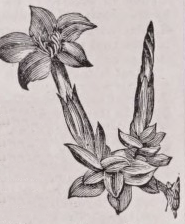
Gentian
Encyclopedia Britannica
GENTIAN, botanically Gentiana, a large and typical genus of herbaceous plants forming the type of the natural order Gentianaceoe. The genus comprises about 180 species, —most of them perennial plants growing in hilly or mountainous districts, chiefly in the northern hemisphere, some of the blue-flowered species ascending to a height of 16,000 feet in the Himalaya mountains. The leaves are opposite, entire, and smooth, and often strongly ribbed. The flowers are furnished with a persistent calyx and corolla, which is usually 4- or 5-parted, but occasionally 10-parted; the stamens are equal in number to the lobes of the corolla. The ovary is one-celled, with two stigmas, either separate and rolled back or contiguous and funnel-shaped. The fruit when ripe separates into two valves, and contains numerous small seeds. The majority of the genus are remarkable for the deep or brilliant blue colour of their blossoms, comparatively few having yellow, white, or more rarely red flowers; the last are almost exclusively found in the Andes....
Only a few species occur in Britain. G. Anιαrellα and G. campestris are small annual species growing on chalky or calcareous hills, and bear, in autumn, somewhat tubular pale purple flowers; the latter is most easily distinguished by having two of the lobes of the calyx larger than the other two, while the former has the parts of the calyx in fives, and equal in size. Some intermediate forms between these two species occur, although rarely, in England; one of these, G. germanica, Willd., has larger flowers of a more blue tint, spreading branches, and a stouter stem. Some of these forms flower in spring. G. Bneumοnanthe, the Calathian violet, is a rather rare perennial species, growing in moist heathy places from Cumberland to Dorsetshire. Its average height is from 6 to 9 inches. It has linear leaves, and a bright blue corolla 1⅜ inches long, marked externally with five greenish bands, is without hairs in its throat, and is found in perfection about the end of August. It is the handsomest of the British species; two varieties of it are known in cultivation, one with spotted and the other with white flowers. G. verna and G. nivalis are small species with brilliant blue flowers and small leaves. The former is a rare and local perennial, occurring, however, in Teesdale and the county of Clare in Ireland in tolerable abundance. It has a tufted habit of growth, and each stem bears only one flower. It is sometimes cultivated as an edging for flower borders. G. nivalis in Britain occurs only on a few of the loftiest Scotch mountains. It differs from the last in being an annual, and having a more isolated habit of growth, and in the stem bearing several flowers. On the Swiss mountains these beautiful little plants are very abundant; and the splendid blue colour of masses of gentian in flower is a sight which, when once seen, can never be forgotten. For ornamental purposes several species are cultivated. The great difficulty of growing them successfully renders them, however, less common than would otherwise be the case; although very hardy when once established, they are very impatient of removal, and rarely flower well until. the third year after planting. Of the ornamental species found in British gardens some of the prettiest are G. acaulis, G. verna, G. pyrenaica, G. bavarica, G. scρtemfida, and G. gelida. Perhaps the handsomest and most easily grown is the first named, often called Gentianella, which produces its large intensely blue flowers early in the spring.
All the species of the genus are remarkable for possessing an intense but pure bitter taste and tonic properties. About forty species are used in medicine in different parts of the world. The name of felwort given to G. Amarella, but occasionally applied to the whole genus, is stated by Dr Prior to be given in allusion to these properties— fel meaning gall, and τvort a plant. In the same way the Chinese call the G. asclepiadea, and the Japanese the G. Bucτgcri, “dragon’s gall plants,” in common with several other very bitter plants whose roots they use in medicine. G. campestris is sometimes in Sweden and other northern countries a substitue for hops.
By far the most important of the species used in medicine is the G. lutea, a large handsome plant 3 or 4 feet high, growing in open grassy places on the Alps, Apennines, and Pyrenees, as well as on some of the mountainous ranges of France and Germany, extending as far east as Bosnia and thβ Danubian principalities. It has large oval strongly-ribbed leaves and dense whorls of conspicuous yellow flowers. Its use in medicine is of very ancient date. Pliny and Dioscorides mention that the plant was noticed by Gentius, a king of the Illyrians, living 180-167 b.c., from whom the name Gentiana is supposed to be derived. During the Middle Ages it was much employed in the cure of disease, and as an ingredient in counter-poisons. In 1552 Tragus mentions the use of the root as a means of dilating wounds.
The root, which is the part used in medicine, is tough and flexible, scarcely branched, and of a brownish colour and spongy texture. It has a pure bitter taste and faint distinctive odour. On account of its porous nature it has been used in modern surgery, as in the time of Tragus, as a substitute for sponge tents. The root has been several times analysed with varying results, but Kromayer in 1862 first obtained the bitter principle in a state of purity. This substance, to which the bitterness of the root is due, he called gentiopicrin (C 20 H 30 O 12 ). It is a neutral glucoside, crystallizing in colourless needles, and is contained in the fresh root in the proportion of about τ ⅛th per cent., but has not been obtained in a crystalline state from the dried root. It is soluble in water and spirit of wine, but it does not dissolve in ether. It is easily decomposed, dilute mineral acids splitting it up into glucose and gentiοgenin, the latter being an amorphous yellowish-brown neutral substance. It is not precipitated by tannin or subacetate of lead. A solution of caustic potash or soda forms with gentiopicrin a yellow solution, and the tincture of the root to which either of theβe alkalies ha3 been added loses its bitterness in a few days. Gentian root also contains gentianic acid (C 14 H 10 O 5 ), which is inert and tasteless. It forms pale yellow silky crystals, very slightly soluble in water or ether, but soluble in hot strong alcohol and in aqueous alkaline solutions. This substance, which is also called gentianin, gentisin, and gentisic acid, has been shown by Ville to partake of the nature of tannin, giving the reactions of that substance with ferric chloride, gelatin, and albumen. On this account he proposes to change the name to gentiano-tannic acid.
The root also contains 12 to 15 per cent, of an uncrystallizable sugar, of which fact advantage has long been taken in Switzerland and Bavaria, for the production of a bitter cordial spirit called Enzianbranntwein. The use of this spirit, especially in Switzerland, has sometimes been followed by poisonous symptoms, which have been doubtfully attributed to inherent narcotic properties possessed by some species of gentian, the roots of which may have been indiscriminately collected with it; but it is quite possible that it may be due to the contamination of the root with that of Veratrιιrn album, a poisonous plant growing at the same altitude, and having leaves extremely similar in appearance and size to those of G. lutea. Gentian is considered by therapeutists to be one of the most efficient of the simple bitter tonics, that is, of that class of substances which act upon the stomach so as to invigorate digestion and thereby increase the general nutrition, without exerting any direct influence upon any other portion of the body than the alimentary canal. It is used in dyspepsia, chlorosis, anaemia, and various other diseases, in which the tone of the stomach and alimentary canal is deficient, and is sometimes added to purgative medicines to increase and improve their action. In veterinary medicine it is also used as a tonic, and enters into a well-known compound called diapente as a chief ingredient.
See Sowerby, English Botany, 3d edit., vol. vi. p. 74-81; Hemsley, Handbook of Hardy Trees, Shrubs, and Herbaceous Plants, p. 303; Journal of Botany, 1864, p. 65; 1872, p. 166; 1878, p. 265; Pharmacographia, p. 389; Pharmaccιιtical Journal (1), vol. xii. p. 371; (3) vol. iii. p. 42; (3) vol. vi. p. 90; (3) vol. viii. p. 182; Wood and Bache, United States Dispensatory, 14th edit., p. 438; Porter Smith, Chinese Materia Medica, p. 102. (E. Μ. H.)
9th ed. Encyclopædia Britannica, vol. 10, p. 159
[1,487 words — estimated reading time: 9 minutes]
[1,487 words — estimated reading time: 9 minutes]
Of or pertaining to a natural order of plants (Gentianaceae) of which the gentian is the type.
A kind of blue color.
Pertaining to or derived from the gentian; as, gentianic acid.
A bitter, crystallizable substance obtained from gentian.
Gentle.
Pertaining to pagans or heathens.
In the scriptures, a pagan; a worshipper of false gods; any person not a Jew or a christian; a heathen. The Hebrews included in the term goim or nations, all the tribes of men who had not received the true faith, and were not circumcised. The christians translated goim by the Latin gentes, and imitated the Jews in giving the name gentiles to all nations who were not Jews nor christians. In civil affairs, the denomination was given to all nations who were not Romans.
1. One of a non-Jewish nation; one neither a Jew nor a Christian; a worshiper of false gods; a heathen.
2. Belonging to the nations at large, as distinguished from the Jews; ethnic; of pagan or heathen people.
3. Denoting a race or country; as, a gentile noun or adjective.
Gentile
Watson's Biblical & Theological Dictionary
The Hebrews called the Gentiles גויים, ἔθνη, _the nations_, that is, those who have not received the faith or law of God. All who are not Jews, and circumcised, are _goiim_. Those who were converted, and embraced Judaism, they called proselytes. Since the Gospel, the true religion is not confined to any one nation or country, as heretofore, God, who had promised by his prophets to call the Gentiles to the faith, with a superabundance of grace, has fulfilled his promise; so that the Christian church is now composed principally of Gentile converts; and the Jews, too proud of their particular privileges, and abandoned to their reprobate sense of things, have disowned Jesus Christ, their Messiah and Redeemer, for whom, during so many ages, they had looked so impatiently. In the writings of St. Paul, the Gentiles are generally denoted as Greeks, Rom. i, 14, 16; ii, 9, 10; iii; x, 12; 1 Cor. i, 22–24; Gal. iii, 28. St. Luke, in the Acts, expresses himself in the same manner, Acts vi, 1; xi, 20; xviii, &c....
St. Paul is commonly called the Apostle of the Gentiles, 1 Tim. ii, 7, or Greeks; because he, principally, preached Jesus Christ to them; whereas Peter, and the other Apostles, preached generally to the Jews, and are called Apostles of the circumcision, Gal. ii, 8. The prophets declared very particularly the calling of the Gentiles. Jacob foretold that the Messiah, he who was to be sent, the Shiloh, should gather the Gentiles to himself. Solomon, at the dedication of his temple, prays for “the stranger” who should there entreat God. The Psalmist says, that the Lord would give the Gentiles to the Messiah for his inheritance; that Egypt and Babylon shall know him; that Ethiopia shall hasten to bring him presents; that the kings of Tarshish, and of the isles, the kings of Arabia and Sheba, shall be tributary to him, Psalm ii, 8; lxvii, 4; lxxii, 9, 10. Isaiah abounds with prophecies of the like nature, on which account he has justly been distinguished by the name of “the prophet of the Gentiles.”
Watson's Biblical & Theological Dictionary
[177 words — estimated reading time: 2 minutes]
[177 words — estimated reading time: 2 minutes]
Gentiles
Watson's Biblical & Theological Dictionary
COURT OF THE. Josephus says there was, in the court of the temple, a wall, or balustrade, breast-high, with pillars at particular distances, and inscriptions on them in Greek and Latin, importing that strangers were forbidden from entering farther; here their offerings were received, and sacrifices were offered for them, they standing at the barrier; but they were not allowed to approach to the altar. Pompey, nevertheless, went even into the sanctuary, but behaved with strict decorum; and the next day he commanded the temple to be purified, and the customary sacrifices to be offered. A little before the last rebellion of the Jews, some mutineers would have persuaded the priests to accept no victim not presented by a Jew; and obliged them to reject those which were offered by command of the emperor, for the Roman people. The wisest in vain remonstrated with them on the danger this would bring on their country; urged that their ancestors had never rejected the presents of Gentiles; and that the temple was mostly adorned with the offerings of such people; at the same time, the most learned priests, who had spent their whole lives in the study of the law, testified that their forefathers had always received the sacrifices of strangers. From the above particulars, we learn the meaning of what the Apostle Paul calls “the middle wall of partition,” between Jews and Gentiles broken down by the Gospel.
Watson's Biblical & Theological Dictionary
[237 words — estimated reading time: 2 minutes]
[237 words — estimated reading time: 2 minutes]
Gentileschi
Encyclopedia Britannica
GENTILESCHI, Artemisia and Orazio de’, painters. Orazio (1565-1646) is generally named Orazio Lomi de’ Gentileschi; it appears that De’ Gentileschi was his correct surname, Lomi being the surname which his mother had borne during her first marriage. He was born at Pisa, and studied under his half-brother Aurelio Lomi, whom in course of time he surpassed. He afterwards went to Rome, and was associated with the landscape-painter Agostino Tasi, executing the figures for the landscape backgrounds of this artist in the Palazzo Rospigliosi, and it is said in the great hall of the Quirinal Palace, although by some authorities the figures in the last-named building are ascribed to Lanfranchi. His best works are Saints Cecilia and Valerian, in the Palazzo Borghese, Rome; David after the death of Goliath, in the Palazzo Doria, Genoa; and some works in the royal palace, Turin, noticeable for vivid and uncommon colouring. At an advanced age Gentileschi went to England at the invitation of Charles I., and he was employed in the palace at Greenwich. Vandyck included him in his portraits of a hundred illustrious men. His works generally are strong in shadow and positive in colour. He died in England in 1646. Artemisia (1590-1642), Orazio’s daughter, studied first under Guido, acquired much renown for portrait-painting, and considerably excelled her father’s fame. She was a beautiful and elegant woman; her likeness, limned by her own hand, is to be seen in Hampton Court. Her most celebrated composition is Judith and Holofernes, in the Pitti palace; certainly a work of singular energy, and giving ample proof of executive faculty, but repulsive and unwomanly in its physical horror. She accompanied her father to England, but did not remain there long; the best picture which she ...produced for Charles I. was David with the head of Goliath. Artemisia refused an offer of marriage from Agostino Tasi, and bestowed her hand on Pier Antonio Schiattesi, continuing however to use her own surname. She settled in Naples, whither she returned after her English sojourn; she lived there in no little splendour, and there she died in 1642. She had a daughter and perhaps other children.
9th ed. Encyclopædia Britannica, vol. 10, p. 160
[363 words — estimated reading time: 3 minutes]
[363 words — estimated reading time: 3 minutes]
Complaisance. [Not in use.]
Gentleness; courtesy; kindness; nobility.
Gentili
Encyclopedia Britannica
GENTILI, Alberico (1552-1608), may fairly be called the founder of the science of international law. He was the second son of Matteo Gentili, a physician of noble family and scientific eminence, and was born 14th January 1552’ at Sanginesio,.a small town of the march of Ancona which looks down from the slopes of the Apennines upon the distant Adriatic. After taking the degree of doctor of law at the university of Perugia, and holding a judicial office at Ascoli, he returned to his native city, and was entrusted with the task of recasting its statutes, but, sharing the Protestant opinions of his father, shared also his flight to Carniola, where Matteo was appointed physician to the duchy. The Inquisition condemned the fugitives as contumacious, and they soon received orders to quit the dominions of Austria. Alberico set out for England, travelling by way of Tübingen and Heidelberg, and everywhere meeting with the reception to which his already high reputation entitled him. He arrived at Oxford in the autumn of 1580, with a commendatory letter from the earl of Leicester, at that time chancellor of the university, and was shortly afterwards qualified to teach by being admitted to the same degree which he had taken at Perugia. His lectures on Roman law soon became famous, and the dialogues, disputations, and commentaries, which he published henceforth in rapid succession, established his position as an accomplished civilian, of the older and severer type, and secured his appointment in 1587 to the regius professorship of civil law. It was, however, rather by an application of the old learning to the new questions suggested by the modern relations of states that his labours have produced their most lasting result. In 1584 he was consulted by Government as to the proper ...course to be pursued with Mendoza, the Spanish ambassador, who had been detected in plotting against Elizabeth. He chose the topic to which his attention had thus been directed as a subject for a disputation when Leicester and Sir Philip Sidney visited the schools at Oxford in the same year; and this was six months later expanded into a book, the De legationιbzιs libri tres. In 1588 Alberico selected the law of war as the subject of the law disputations at the annual “Act” which took place in July; and in the autumn published in London the De Jure Belli commentatio prima. A second and a third Commentatio followed, and the whole matter, with large additions and improvements, appeared at Hanau, in 1598, as the De Jure Belli libri 1res. It was doubtless in consequence of the reputation gained by these works that Gentili became henceforth more and more engaged in forensic practice, and resided chiefly in London, leaving his Oxford work to be partly discharged by a deputy. In 1600 he was admitted to beamember of Gray’s Inn, and in 1605 was appointed standing counsel to the king of Spain. He died 19th June 1608, and was buried, by the side of Dr Matteo Gentili, who had followed his son to England, in the churchyard of St Helen’s, Bishopsgate. By his wife, Hester de Peigni, he left two sons and a daughter. His notes of the cases in which he was engaged for the Spaniards were posthumously published in 1613 at Hanau, as 2‰ panicoe advocationis libri duo. This was in accordance with his last wishes; but his direction that the remainder of his MSS. should be burnt was not complied with, since fifteen volumes of them found their way, at the beginning of this century, from Amsterdam to the Bodleian library.
The true history of Gentili and of his principal writings has only been ascertained quite recently, in consequence of a revived appreciation of the services which he rendered to international law. The movement to do him honour, which originated four or five years since, has in spreading through Europe encountered two curious cross-currents of opinion,—one the ultra-Catholic, which three centuries ago ordered his name to be erased from all public documents and placed his works in the Index·, another the narrowly-Dutcb, which is, it seems, needlessly careful of the supremacy of Grotius. Preceding writers had dealt with various international questions, but they dealt with them singly, and with a servile submission to the decisions of the church. It was left to Gentili to grasp as a whole the relations of states one to another, to distinguish international questions from questions with which they are more, or less intimately connected, and to attempt their solution by principles entirely independent of the authority of Rome. He uses, without yielding to them implicit deference, the reasonings of the civil and even the canon law, but he proclaims as his real guide the Jus Haturce, the highest common sense of mankind, by which historical precedents are to be criticized, and, if necessary, set aside.
His faults are not few. His style is prolix, obscure, and to the modern reader pedantic enough; but a comparison of his greatest work with what had been written upon the same subject by, for instance, Belli, or Soto, or even Ayala, will show that he greatly improved upon his predecessors, not only by the fulness with which he has worked out points of detail, but also by clearly separating the law of war from martial law, and by placing the subject once for all upon a non-theological basis. If, on the other hand, the same work be compared with De Jure Belli et Pacis of Grotius, it is at once evident that the later writer is indebted to the earlier, not only for a large portion of his illustrative erudition, but also for all that is commendable in the method and arrangement of the treatise.
The following is probably a complete list of the writings of Gentili, with the places and dates of their first publication :— Be Juris interpretibus diαlοgi sex, Lond., 1582; Lectionum et epist. quae ad pus civile pertinent libri ires, Lond., 1583-4: Be divers, temp, appellationibus, Hanau, 1584; Be Legationibus libri tres, Lond., 1585; Legal, comitiorum Oxon. actio, Lond., 1585-6; Be nascendi tempore disputatio, Witteb., 1586; Disputationum decas prima, Lond., 1587; Conditiornim liber singularis, Lond., 1587; Be Jure Belli comm. prima, Lond., 1588; secunda, ib., 1588 -9; ferh'α, 1589; Be injustitia bellica Romanorum, Oxon., 1590; Be Armis Romanis, &c., Hanau, 1599; Be ludis scenicis epist. duce, Middleburg, 1599; Be actoribus et de abusu mendacii, Hanau, 1599; Lectiones Virgilianae, Hanau, 1600; Be nuptiis libri septem, 1601; Ad 1 Maccab. et de linguarum mistura, Lond., 1604; In tit. si quis principi, et ad leg. Jul. maiest., Hanau, 1604; In tit. de Malef. ct Math., ct de Prof, ct Med., Hanau, 1604; Be latin, vet. Bibl., Hanau, 1604; Be libro Pyano, Oxon., 1604; Laudes Acad. Penis, ct 0xon., Hanau, 1605; Be unione Anglioe et Scotioe, Lond., 1605; Disputationes tres, de libris jur. can., de libris jur. civ., de latinitate vet. vcrs., Hanau, 1605; Regales disput. tres, depot, regis absoluta, de unione regnorum, de vi civium, Lond., 1605; Hispanicae advocationis libri duo, Hanau, 1613; In tit. de verb, signif., Hanau, 1614; Be legatis in test., Amsterd., 1661. An edition of the Opera Omnia, commenced at Naples in 1770, was cut short by the death of the publisher, Gravier, after the second volume. Of his numerous unpublished writings, Gentili complained that four volumes were lost “pessimo pontificiorum facinore,” meaning probably that they were left behind in his flight to Carniola.
Authorities.— Several tracts by the Abate Benigni in Colucci, Antichità Picene, 1790; a Dissertation by W. Reiger annexed to the Program of the Groningen Gymnasium for 1867; an Inaugural Lecture delivered in 1874 by T. E. Holland, and the preface to a new edition of the Jus Belli, 1877, by the same; works by Valdarnini and Foglietti, 1875; Speranza and De Giorgi, 1876; Fiorini (a translation of the Jus Belli, with essay), 1877; A. Saffi, 1878. See also E. Comba, in the Rivista Christiana, 1876-7; and Sir T. Twiss, in the Law Review, 1878.
9th ed. Encyclopædia Britannica, vol. 10, p. 160 — signed T. E. H.
[1,348 words — estimated reading time: 8 minutes]
[1,348 words — estimated reading time: 8 minutes]
Vulgarity Roget’s Thesaurus §851
N. vulgarity, vulgarism, barbarism, vandalism, gothicism|, mauvis gout, bad taste, gaucherie, awkwardness, want of tact, ill-breeding, courseness, indecorum, misbehavior, lowness, homeliness, low life, mauvais ton, rusticity, boorishness, brutality, rowdyism, blackguardism, ribaldry, slang, bad joke, mauvais plaisanterie, gaudiness, tawdriness, false ornament, finery, frippery, trickery, tinsel, gewgaw, clinquant, baroque, rococo, rough diamond, tomboy, hoyden, cub, unlicked cub, clown, goth, vandal, boeotian, snob, cad, gent, parvenu, frump, dowdy, slattern
V. be vulgar, misbehave, talk shop, smell of the shop
Adj. in bad taste vulgar, unrefined, coarse, indecorous, ribald, gross, unseemly, unbeseeming, unpresentable, contra bonos mores, ungraceful, dowdy, slovenly, ungenteel, shabby genteel, low, common, hoi polloi, uncourtly, uncivil, ill bred, ill mannered, underbred, ungentlemanly, ungentlemanlike, unladylike, unfeminine, wild, wild as an unbacked colt, untutored, unschooled (ignorant) 491, unkempt, uncombed, untamed, unlicked, unpolished, uncouth, plebeian, incondite, heavy, rude, awkward, homely, homespun, home bred, provincial, countrified, rustic, boorish, clownish, savage, brutish, blackguard, rowdy, snobbish, barbarous, barbaric, gothic, unclassical, doggerel, heathenish, tramontane, outlandish, uncultivated, bohemian, obsolete, unfashionable, newfangled, odd, particular, affected, meretricious, extravagant, monstrous, horrid, shocking, gaudy, tawdry, overornamented, baroque, rococo, bedizened, tricked out, gingerbread, obtrusive
Commonalty Roget’s Thesaurus §876
N. commonalty, democracy, obscurity, low condition, low life, low society, low company, bourgeoisie, mass of the people, mass of society, brown jones and robinson, lower classes, humbler classes, humbler orders, vulgar herd, common herd, rank and file, hoc genus omne, the many, the general, the crowd, the people, the populace, the multitude, the million, the masses, the mobility, the peasantry, king mob, proletariat, fruges consumere nati, demos, hoi polloi, great unwashed, man in the street, mob, rabble, rabble rout, chaff, rout, horde, canaille, scum of the people, residuum of the people, dregs of the people, dregs of society, swinish multitude, foex populi, trash, profanum vulgus, ignobile vulgus, vermin, riffraff, ragtag and bobtail, small fry, commoner, one of the people, democrat, plebeian, republican, proletary, proletaire, roturier, mr. snooks, bourgeois, epicier, philistine, cockney, grisette, demimonde, peasant, countryman, boor, carle, churl, villain, villein, terrae filius, serf, kern, tyke, tike, chuff, ryot, fellah, longshoreman, swain, clown, hind, clod, clodhopper, hobnail, yokel, bog-trotter, bumpkin, plowman, plowboy, rustic, hayseed*, lunkhead, chaw-bacon*, tiller of the soil, hewers of wood and drawers of water, groundling, gaffer, loon, put, cub, tony lumpkin, looby, rube*, lout, underling, gamin, rough, pot-wallopper, slubberdegullion|, vulgar fellow, low fellow, cad, curmudgeon, upstart, parvenu, skipjack, nobody, nobody one knows, hesterni quirites, pessoribus orti, bourgeois gentilhomme, novus homo, snob, gent, mushroom, no one knows who, adventurer, man of straw, beggar, gaberlunzie, muckworm, mudlark, sans culotte, raff, tatterdemalion, caitiff, ragamuffin, pariah, outcast of society, tramp, vagabond, bezonian, panhandler*, sundowner, chiffonnier, cinderella, cinderwench, scrub, jade, gossoon, goth, vandal, hottentot, zulu, savage, barbarian, yahoo, unlicked cub, rough diamond|, barbarousness, barbarism, boeotia
V. be ignoble, be nobody
Adj. ignoble, common, mean, low, base, vile, sorry, scrubby, beggarly, below par, no great shakes, homely, homespun, vulgar, low-minded, snobbish, plebeian, proletarian, of low parentage, of low origin, of low extraction, of mean parentage, of mean origin, of mean extraction, lowborn, baseborn, earthborn, mushroom, dunghill, risen from the ranks, unknown to fame, obscure, untitled, rustic, uncivilized, loutish, boorish, clownish, churlish, brutish, raffish, rude, unlicked, barbarous, barbarian, barbaric, barbaresque, cockney, born within sound of bow bells, underling, menial, subaltern
Adv. below the salt
Phr. dummodo sit dives barbarus ipse placet
King James Bible KJV Bible
Berean Standard Bible BSB Bible
154 KJV and 124 BSB verses contain “gent” — showing the first 20. Show all 192 verses (searchable)
By these were the isles of the Gentiles divided in their lands; every one after his tongue, after their families, in their nations.
From these, the maritime peoples separated into their territories, according to their languages, by clans within their nations.
So that the man that is tender among you, and very delicate, his eye shall be evil toward his brother, and toward the wife of his bosom, and toward the remnant of his children which he shall leave:
The most gentle and refined man among you will begrudge his brother, the wife he embraces, and the rest of his children who have survived,
Thou hast also given me the shield of thy salvation: and thy gentleness hath made me great.
You have given me Your shield of salvation, and Your gentleness exalts me.
Are the consolations of God small with thee? is there any secret thing with thee?
Are the consolations of God not enough for you, even words spoken gently to you?
For he saith to the snow, Be thou on the earth; likewise to the small rain, and to the great rain of his strength.
For He says to the snow, ‘Fall on the earth,’ and to the gentle rain, ‘Pour out a mighty downpour.’
Thou hast also given me the shield of thy salvation: and thy right hand hath holden me up, and thy gentleness hath made me great.
You have given me Your shield of salvation; Your right hand upholds me, and Your gentleness exalts me.
By long forbearing is a prince persuaded, and a soft tongue breaketh the bone.
Through patience a ruler can be persuaded, and a gentle tongue can break a bone.
I the LORD have called thee in righteousness, and will hold thine hand, and will keep thee, and give thee for a covenant of the people, for a light of the Gentiles;
“I, the LORD, have called you for a righteous purpose, and I will take hold of your hand. I will keep you and appoint you to be a covenant for the people and a light to the nations,