
A nun of the order of St. clare
Word of the Day: Catachrestical
Clare
Encyclopedia Britannica
CLARE, a maritime county in the south-west of Ireland, in the province of Munster, bounded N.W. by the Atlantic, S. by the estuary of the Shannon, S.E. and N.E. by Limerick, Tipperary, Lough Dearg, and Galway, having an area of 1293 square miles, or 827,994 acres.
Although the surface of the county is hilly, and in some parts even mountainous, it nowhere rises to a great elevation. Much of the western baronies of Moyarta and Ibrickan is composed of bog land. Bogs are frequent also in the mountainous districts elsewhere, except in the limestone barony of Burren, the inhabitants of some parts of which supply themselves with turf from the opposite shores of Connemara. Generally speaking, the eastern parts of the county are mountainous, with tracts of rich pasture land interspersed; the west abounds with bog; and the north is rocky and best adapted for grazing sheep. In the southern part, along the banks of the Fergus and Shannon, are the bands of rich low grounds called corcasses, of various breadth, indenting the land in a great variety of shapes. They are composed of deep rich loam, and are distinguished as the black corcasses, adapted for tillage, and the blue, used more advantageously as meadow land....
The coast is in general rocky, and occasionally bold and precipitous in the extreme, as may be observed at the picturesque cliffs of Moher within a few miles of Ennistymon and Lisdoonvarna, which rise perpendicularly at O’Brien’s tower to an elevation of 580 feet. The coast of Clare is indented with several bays, the chief of which are Ballyvaghan, Liscannor, and Malbay; but from Black Head to Loop Head, that is, along the entire western boundary of the county formed by the Atlantic, there is no safe harbour except Liscannor Bay. The county possesses only one large river, the Fergus; but nearly 100 miles of its boundary-line are washed by the River Shannon, which, after almost dividing Ireland from north to south, and dispensing its bounties to the adjoining counties of Roscommon, Leitrim, Longford, Westmeath, Galway, King’s County, Kerry, Tipperary, and Limerick, enters the Atlantic Ocean between this county and Kerry. The numerous bays and creeks on both sides of this noble river render its navigation safe in every wind; but the passage to and from Limerick is often tedious, and the port of KiΓrush has from that cause gained in importance. The River Fergus is navigable from the Shannon to the town of Clare, which is the terminating point of its natural navigation, and the port of all the central districts of the county. A railway traverses Clare county via Ennis, connecting Limerick with Athenry and Galway.
There are upwards of one hundred lakes and tarns in the county, of which the largest are Loughs O’Grady, Graneg, Tedane, Inchiquin, Inniscronan, and Clonlea; but they are more remarkable for picturesque beauty than size or utility, with the exception of the extensive and navigable Lough Derg, formed by the River Shannon between this county and Tipperary.
Although metals and minerals have been found in many places throughout the county, they do not often show themselves in sufficient abundance to induce the application of capital for their extraction. The principal metals are lead, iron, and manganese. Lead mines were recently worked at Kilbricken in the barony of Bunratty (about six miles from Ennis), and at Annaglough. The Milltown lead mine in the barony of Tulia is probably one of the oldest mines in Ireland, and at one time, if the extent of the ancient excavations may be taken as a guide, there must have been a very rich deposit. The richest lead mine worked in recent times is that of Ballyhickey, about two miles from Kilbricken. Copper pyrites occurs in several parts of Burren, but in small quantity. Coal exists at Labasheeda on the right bank of the Shannon, but the seams are thin. Limestone occupies all the central and northern parts of the county in a tract bounded on the S. by the Shannon, on the E. by a line running parallel with the Ougarnee River to Scariff Bay, on the N. by the mountain of Talla and the confines of Galway, on the W. by Galway Bay and aline including Kilfenora, Corofin, and Ennis, and meeting the Shannon at the mouth of the Fergus. Within half a mile of the Μ ill town lead mine are immense natural vaulted passages of limestone, through which the River Ardsullas winds a singular course. The lower limestone of the eastern portion of the county has been found to contain several very large deposits of argentiferous galena. Flags, easily quarried, are procured near Kilrush, and thinner flags near Ennistymon. Slates are quarried in several places, the best being those of Broadford and Killaloe, which are nearly equal to the finest procured in Wales. A species of very fine black marble is obtained near Ennis; it takes a high polish, and is free from the white spots with which the black Kilkenny marble is marked.
The mineral springs, which are found in many places, are chiefly chalybeate. That of Lisdoonvarna, about eight miles from Ennistymon, has long been celebrated for its medicinal qualities. There are chalybeate springs of less note at Scool, Colneen, Käkishen, Burren, Kilcoran, Broadford, Lahinch, Kilkee, Kilrush, Killadysart, and Cas· sino, near Miltown Malbay. Springs called by the people “holy” or “blessed” wells, generally mineral waters, are common; but the belief in their power of performing cures in inveterate maladies is nearly extinct.
The Atlantic Ocean and the estuary of the Shannon afford many situations admirably adapted for summer bathing-places. Among the best frequented of these localities are Burren, Miltown Malbay, with one of the best beaches on the western coast, Lahinch, about two miles from Ennistymon, and near the interesting cliffs of Moher, which has a magnificent beach, on Liscannor Bay, and forms a delightful summer residence, Kilkee, perhaps the most fashionable watering-place on the western coast of Ireland, and Kilrush on the Shannon estuary.
The soil and surface of the county is in general better adapted for grazing than for tillage. Agriculture is in a backward state, there not being a fifth part of its area under cultivation. In 1870 the acreage of the county under crops amounted to 147,662 acres, and in 1875 little advance had been made. The number of acres under the principal crops in these two years stood as follows :— [table]
As regards live stock the same stationary condition of its agricultural industry will be apparent from the following figures :— [table]
As regards the property in the county, the land in 1874 was divided among 1025 separate owners, of whom 243 possessed less than one acre, and 782 one acre and upwards. Twelve proprietors owned more than 10,000 acres each, the most extensive demesnes being in the hands of Lord Leconfield, with 37,292 acres; the marquis of Conyngham, with 27,613; E. P. Westby, 25,779; Lord Inchiquin, 20,321; Colonel Vandeleur, 19,790; and the Hon. C. W. White, 18,266. The value of the land was at the same date rated at an average of 8s. 3d. per acre, while that of all Munster was 11s. 2d.
There are no extensive manufactures in the county of Clare, although flannels and friezes are made for home use, and hosiery of various kinds, chiefly coarse and strong, is made around Corofin, Ennistymon, and other places. The Shannon, west of Scattery Island, and the sea along the coasts, are good fishing stations, abounding with cod, haddock, ling, sole, turbot, ray, mackerel, and other fish, but the rugged nature of the coast and the tempestuous sea greatly hinder the operations of the fishermen. Near Pooldoody is the great Burren oyster bed called the Red Bank, where a large establishment is maintained, and from which a constant supply of the excellent Red Bank oysters is furnished to the Dublin and other large markets. Crabs and lobsters are caught on the shores of the Bay of Galway in every creek from Blackhead to Ardfry. The salmon fishery of the Shannon is very considerable, and eels, which abound in every rivulet, form an important article of consumption.
The population of the county shows a remarkable decrease within the 30 years between 1841 and 1871, although, after all, this is exceeded by the neighbouring counties of Cork, Limerick, and Tipperary. In 1841 the inhabitants numbered 286,394; in 1851, 212,440; in 1861, 166,305; and in 1871, 147,864. Of these 144,440 were Roman Catholics, 8027 Episcopalians, 220 Presbyterians, and 177 of other denominations. In 1874 there were 8709 persons who had obtained parochial relief throughout the year, while during the twenty-four years ending 1875 there had emigrated from the county 90,154 persons. At the date of the last census (1871) 64,566 persons could read and write, and 15,972 could read but could not write; and 4432 were returned as speaking Erse only. There were 12 superior and 253 primary schools in the county. The principal towns in Clare are Ennis, population (1871) 6503; Kilrush, 4424; and Kilkee, 1600. The county returns three members to the Imperial
Parliament,—two for the county and one for the borough of Ennis.
The county of Clare, which is divided into 11 baronies, contains 80 parishes, and includes the diocese of Kilfenora, the greater part of Killaloe, and a very small portion of the diocese of Limerick. It is within the military district of Cork, with barracks for infantry at Clare Castle, Ennis, Killaloe, and Kilrush, and for artillery in the forts at Scattery Island, Donnaha, Kilcredano, Blackwater, and Kilkerrin. The assizes are held at Ennis, where the county prison, the county infirmary, and the district lunatic asylum are situated. There are eight poor-law unions.
This county, together with some of the neighbouring district, was anciently called Thomond or Tuadmuin, that is, North Munster, and formed part of the monarchy of the celebrated Brian Boroihme, who held his court at Kincora near Killaloe, where his palace was situated on the banks of the Shannon. The site is still distinguished by extensive earthern ramparts. Settlements were effected by the Danes, and in the 13th century by the Anglo-Normans, but without permanently affecting the possession of the district by its native proprietors. In 1543 Murrogh O’Brien, after dispossessing his nephew, and vainly attempting a rebellion against the English rule, proceeded to England, and submitted to Henry VIII., resigning his name and possessions. He soon received them back by an English tenure, together with the title of earl of Thomond, on condition of adopting the English dress, manners, and customs, and maintaining no kerns or gallowglasses. In 1565 this part of Thomond (sometimes called O’Brien’s country) was added to Connaught, and made one of the six new counties into which that province was divided by Sir Henry Sidney under the Act 11 Eliz. c. 9. It was then named Clare, probably from the name of an English adventurer, Thomas de Clare, who obtained a grant from Henry III. of all the lands he should conquer from the Irish, and whose family for some time maintained a precarious position in the district. In 1602 the county was re-annexed to Munster. The O’Briens and other native chieftains had many fierce contests to preserve their independence against the Anglo-Norman and English adventurers, and generally succeeded in maintaining their position as native kings and chieftains of Thomond. From some cause or other the comparative immunity of Clare in ancient times from foreign rule and settlement, and from absenteeism, has proved of doubtful advantage to its modern condition. The chief ancient families of note in the district were the O’Briens, now represented by Lord Inchiquin of Dromoland, the Macnamaras, and the O’Loghlens.
The county abounds with remains of antiquities, both military and ecclesiastical. There still exist above a hundred fortified castles, several of which are inhabited. They are mostly of small extent, a large portion being fortified dwellings. The chief of them is Bunvatty Castle, built in 1277. Raths or Danish forts are to be found in every part. They are generally circular, composed either of large stones without mortar, or of earth thrown up and surrounded by one or more ditches. The list of abbeys and other religious houses formerly flourishing here (some now only known by name, but many of them surviving in ruins) comprehends upwards of twenty. The most remarkable are •—Quin, considered one of the finest and most perfect specimens of ancient monastic architecture in Ireland; Corcomroe; Ennis, in which is a very fine window of uncommonly elegant workmanship; and those on Inniscattery, or Scattery Island, in the Shannon, said to have been founded by St Senanus. On the same island there is a round tower, and also the ruins of what are called the seven churches. It is called Holy Island, and is still one of the most popular burial-places in the county. Four other round towers are to be found in various stages of preservation— at I)rumcliffe, Dysert, Kilnby, aud Inniscaltra. The cathedral of the diocese of Killaloe, at the town of that name, is a plain massive building originally erected in 1160; aud uear it are the ruins of the mausoleum of Brian Boroihme. Cromlechs are found, chiefly in the limestone rocky district of Burren, though there are some in other baronies. That at Ballygannor is formed of a stone 40 feet long and 10 broad. The celebrated tomb of Conan, on Mount Callan, is still extant.
CLARE, John (1793-1864), commonly known as “the Northamptonshire Peasant Poet,” was the son of a farm labourer, and was born at Helpstone, near Peterborough, on 13th July 1793. At the age of seven he was taken from school to tend sheep and geese ; five years after he wrought on a farm, paying with his own meagre savings for the education he received in the evening. He endeavoured to enter a lawyer’s office but failed, studied algebra, and fell in love, became a pot-boy in a public-house, and subsequently was apprenticed to a gardener, from which employment he ran away. Among the neighbours his manners and habits made an unfavourable impression. He enlisted in the militia, tried camp life with gipsies, and wrought as a lime burner in 1817, but the following year he was obliged to accept parish relief. In 1820 appeared his Poems Descriptive of Rural Life and Scenery, which were very indulgently received, and the year following his Village Minstrel and other Poems were published. He was greatly patronized; fame, with many curious visitors, broke the tenor of his life, and dangerous habits were formed. From subscriptions he became possessed of £45 annually, a sum far beyond what he had ever earned, but new wants made his income insufficient, and in 1823 he was nearly penniless. His next volume, the Shepherd's Calendar, 1827, met with little success, which was not increased by his hawking it himself. As he wrought again on the fields his health improved; but farm operations being unsuccessful he was “as dull as a fog in November,” and became seriously unwell. Although a noble patron presented him with a new cottage and a piece of ground, Clare was full of anguish to leave the “old home of homes.” The removal to Northborough was his culminating period, and gradually his mind gave way. His last and best work, the Rural Muse, published in 1835, was noticed by “Christopher North” alone. Bursts of insanity followed, of which he had for some time shown symptoms; and in July 1837 he was kept in confinement, and was subsequently lodged in Northampton General Lunatic Asylum, where he died May 20, 1864. The neglect of friends and relatives to visit him, together with the non-success of his later poems, preyed heavily upon his mind. In the asylum he penned his most thrilling poem, beginning—“I am! yet what I am who cares or knows î” In its exceeding sadness of thought there is sublime feeling, —a strain of divine music in the wail of woe,—and the poet longed to
“Sleep as I in childhood sweetly slept Full of high thoughts, unborn. So let me lie, The grass below, above the vaulted sky.”
Clare was one of our most uneducated poets, and sung from the fulness of his heart; he is one of England’s sweetest singers of nature, whose thoughts “gild life’s brambles with a flower,” and whose songs were gathered from the fields. Many of his sonnets, which display great power of word-painting, are sweet as “sunshine in summer dream.” His ballads and love-songs are wild flowers strewn at will, which “art and fashion fling as weeds away,” and his Eternity of Nature, and First Love's Recollections display deftness of touch, pastoral beauty, and genuine poetic ability. All his love and genius were showered on beautifying the rural scenes and humble incidents of his surroundings. His poems, drawn with a delicate hand, are those of a keen observer, but they greatly want that vigour which is essential to popularity; in his own words, “the tide of fashion is a stream too strong for pastoral brooks that gently flow and sing.”
See the Life of John Clare by Frederick Martin, 1865, and Life and Remains of John Clare, by J. L. Cherry, 1873, the latter of which, though not so complete, contains some of the poet’s asylum verses and prose fragments.
9th ed. Encyclopædia Britannica, vol. 5, p. 802
[2,280 words — estimated reading time: 14 minutes]
[2,280 words — estimated reading time: 14 minutes]
Light and shade in painting; or the particular distribution of the lights and shades of a piece, with respect to the ease of the eye and the effect of the whole piece; also, a design of two colors.
See Chiaroscuro.
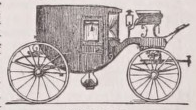
A close four-wheeled carriage, with one seat inside, and a seat for the driver.
1. CLARENCEUX ,
2. CLARENCIEUX, noun In Great Britain, the second king at arms, so called from the duke of Clarence, and appointed by Edward IV. His office is to marshal and dispose the funerals of all baronets, knights and esquires, on the south of the river Trent.
Alt. of Clarencieux
See King-at-arms.
A style of type having a narrow and heave face. It is made in all sizes.
Clarendon
Encyclopedia Britannica
CLARENDON, Edward Hyde, first Earl of (1609- 1674), historian and statesman, born at Dinton in Wiltshire, on the 18th February 1609, was the third son of Henry Hyde, a gentleman belonging to an ancient Cheshire family. The profession first chosen for him was the church; and consequently, after being educated at home by the vicar of the parish up to the age of thirteen, he was sent to Magdalen College, Oxford. But his eldest brother having died young, the death of his second brother in 1625 left him heir to his father’s estate; and the law being now considered a more appropriate profession, he was entered at the Middle Temple by his uncle, Sir Nicholas Hyde, then treasurer of that society. At the age of twenty he married a daughter of Sir George Ayliffe; but in six months he was left a widower; and three years later he took as his second wife a daughter of Sir Thomas Aylesbury, Master of Requests.
While yet a young man Hyde had the happiness, as he boasts in his autobiography, of being admitted into the most brilliant literary society of his time. Among poets he knew Ben Jonson, Waller, and Carew; he was acquainted with Selden, and with nearly every other scholar of eminence in his day; and he had a rare opportunity of acquiring, from the conversation of the subtle and impartial Chillingworth and the outspoken but liberal-minded Hales, a breadth of sympathy which unhappily his natural temper and the rough pressure of the times combined to prevent him from ever displaying. The brilliant, tenderhearted Falkland also was his most intimate friend. And, fortunately for his professional advancement, besides possessing considerable family influence, he enjoyed the favour of Laud, who, as commissioner of the treasury, regularly consulted him in regard to mercantile affairs....
When, therefore, in April 1640, Hyde took his seat in the Short Parliament as representative of Wootton-Basset, he was already known as a lawyer of mark. During its session of barely three weeks, he made himself prominent as a zealous supporter of the popular party; and his maiden speech consisted of a vigorous attack upon the Earl Marshal’s Court, which had become notorious for the savage manner in which it resented the least affront offered to a man of rank.
In the Long Parliament (in which he sat as member for Saltash) his zeal for reform was at first in no degree diminished. He effected the final overthrow of the Earl Marshal’s Court. He sat as chairman of the committee which collected evidence against the Councils of York and of the Marshes, and of the committee which was appointed to consider the advisability of remodelling the government of the church. He went entirely with the popular party in their condemnation of ship-money; and it was largely through the earnest speech which Hyde delivered against him that Lord Keeper Finch was driven into exile. When, however, Episcopacy was threatened, and it became apparent that the popular leaders were not to be satisfied with merely temporary reform, but were resolved on gaining a permanent triumph, Hyde, in perfect accordance with both his religious and his political principles, went over to the royalist party. He uttered an open and determined protest against the Grand Remonstrance, and drew up an answer to it which was adopted and published by the king, and which procured for him the offer of the post of solicitorgeneral. This he declined; but he complied with the request that he would watch over his Majesty’s interests in the House of Commons, in conjunction with Falkland and Colepepper. The king’s deepest policy, however, was not disclosed to him, and there is no reason to doubt that the arrest of the five members surprised him as much as he professes. After the retreat of Charles from London, Hyde remained for some weeks in his seat in the Commons, maintaining constant but secret communication with the court; but in May, having been summoned by the king, and being besides alarmed for his own safety, he fled to York. In March 1643 he was made chancellor of the exchequer. He was also chosen one of the royal commissioners at Uxbridge, and was employed in many other matters of importance; and the most persuasive and dignified of the state papers on the royalist side are from his pen.
In 1645, after the final ruin of the king’s cause at Naseby, Hyde was appointed, with Lord Capel, Lord Hopton, and Sir John Colepepper, to watch over the safety of the prince of Wales. In the spring of the next year they were compelled to take refuge in Scilly, whence, after six weeks’ stay, they passed to Jersey. Soon the prince was called by his mother to Paris, against the will of the council, none of whom accompanied him except Colepepper. Hyde resided at Jersey for nearly two years, solacing himself by studying the Psalms and recording the meditations which they suggested, and also by composing the first four books of his greatest work, the History of the Rebellion. In April 1648 he drew up an answer to the ordinance which had been issued by the parliament declaring the king guilty of the civil war, and forbidding all future addresses to him. At length, in May, his attendance was required by the prince, who about this time assumed the command of the seventeen ships which had gone over to his side; but various accidents, of which the most serious was his capture by privateers, prevented him from meeting Charles till August, when he found him at Dunkirk.
In the agreement with the Covenanters and in the Scottish expedition of 1649 Hyde had no share, as he was then absent with Lord Cottington on a fruitless embassy to Spain. The two years which he passed there were not unpleasantly spent; for he was free from all serious cares, and had little to do but study Spanish etiquette and write his Animadversions on ths Supremacy of the Pope. In 1651, the slights offered by the Spanish ministers having been crowned by a request that he would leave the country, he rejoined Charles at Paris. During the nine weary years which had to elapse before the Restoration he was not the least unfortunate of the exiles. It was no easy matter to fulfil the duty which his office imposed upon him of supplying the wants of his careless master; and his family and himself were often scarcely able to procure the necessaries of life. Besides, he was far from popular. His attachment to the English church, admitting of compromise with no other sect, brought upon him the aversion alike of the Presbyterians and of the queen aud the Papists. Charles, however, was wise enough to appreciate his disinterested fidelity. He was recognized as chief adviser of the king, and all state papers were drawn up by him; he conducted the correspondence with the English Royalists; and, in 1658, the dignity of lord chancellor was conferred upon him.
On the Restoration, Hyde retained his posts of lord chancellor and chancellor of the exchequer, and at once assumed the direction of the Government. What the Episcopalian Royalists now required was not so much a leader to stimulate, as a guide to control. Their fervour and their strength were more than sufficient to replace the king firmly on the throne, and to raise the church to a loftier position than it had ever before attained. The parliament hastened to restore to the Crown the command of the militia, to repeal the Triennial Act, and to vote a revenue of £1,200,000. The Corporation Act, the Act of Uniformity, and the Five Mile Act avenged the church on her enemies, and forced all but the most determined of the clergy into her ranks. Thousands showed as much enthusiasm for monarchy as Hyde himself, and he was no longer the most Episcopalian of Episcopalians. To some extent, if not to as great an extent· as was to be desired, he has the credit of having restrained his party from too insolent a triumph. Desirous as he was of the re-establishment of the full royal prerogative, he had no wish tσ see it transgress the limits which he believed to be assigned to it by the constitution, for which he cherished the true lawyer’s reverence. Strongly as he held that all were guilty who had in any way countenanced the government of Cromwell, he was statesman enough to see that it was necessary to carry out the Declaration of Breda by pressing the Acts of Oblivion and Indemnity on the reluctant parliament. On the other hand, with regard to the triumph of the church over dissent, if he was somewhat alarmed at its completeness, his fear arose from no pity for the dissenters. His opinion of them, and of the policy which ought to be observed towards them, is emphatically stated in his Life (vol. ii. p. 121) :—“Their faction is their religion; nor are those combinations ever entered into upon real and substantial motives of conscience, how erroneous soever, but consist of many glutinous materials of will, and humour, and folly, and knavery, and ambition, and malice, which make men cling inseparably together, till they have satisfaction in all their pretences, or till they are absolutely broken and subdued, which may always be more reasonably done than the other.”
But, notwithstanding his exaggerated reverence for the sovereign, his passionate attachment to the church, and his real worth, Hyde rapidly became the most unpopular man in the kingdom. The settlement of landed property which had been made by the Act of Indemnity deeply offended hundreds of the cavaliers; for, while it restored all they had lost to those who, like Hyde himself, had both escaped the necessity of selling their land and refused to bow to the government of Cromwell, it did nothing for those who had sold their property, even though they had ruined themselves to support the cause of the king. By the people, who had no means of judging for what he was responsible and of what he was innocent, he was blamed for every misfortune. The sale of Dunkirk was the chief crime with which they charged him; but there is no reason to disbelieve his own declaration that he was at first opposed to the scheme, while it must be allowed that there is force in his excuses that the fortress was expensive to maintain, that the money offered for it was sorely needed, and that its worth to England was by no means great. Still its surrender was a great political mistake; it displayed to the popular eye in far too striking a light the difference between the government of Clarendon and the government of Cromwell. He was also held responsible for the marriage of the king with the childless and Catholic princess of Portugal, and he was even accused of having selected her in order that his own descendants might inherit the throne. And, though his worst political weakness—his allowing Charles to accept the bribes of France—was not then made known, it was the general belief that his splendid mansion in Piccadilly had been erected with foreign gold. Of all dissenters, Catholic and Protestant, his bitter dislike had made determined enemies; and his repellent hauteur, his somewhat conceited austerity, offended the courtiers, aud aroused their derision. All these enemies, however, he could afford to scorn so long as he retained the regard of the king, who, to do him justice, was unusually mindful of his debts to Hyde. In 1661 the chancellor, on the disclosure of the marriage of his daughter to the duke of York, was created Baron Hyde of Hindon, and shortly after earl of Clarendon, at the same time receiving a gift of £20,000; he had already refused the offer of a garter and 10,000 acres. Two years later the attempt to impeach him, made by the earl of Bristol, resulted in a miserable failure, and the accuser sought safety in flight. But in 1667 a second impeachment found him powerless to resist. His dignified censoriousness must always have been disagreeable to the king, who was also annoyed by his strenuous opposition to every scheme for tolerating the Catholics; and when Clarendon ventured to thwart his plans and interfere with his pleasures, annoyance was turned into hatred. Charles, having become enamoured -of Miss Fanny Stewart, resolved to marry her, and therefore determined to effect a divorce from the queen. This scheme, which threatened to exclude his descendants from the throne, Clarendon was bold enough to oppose; and it was insinuated by his enemies that the marriage of Miss Stewart to the duke of Richmond, which put an end to the project, had been brought about partly by his contrivance. Misfortunes now pressed thick upon him. About the middle of 1667 his wife died; and a few days after the duke of York was sent to him with a message requesting him to resign the chancellorship. This he could not be persuaded to do; he so far forgot his dignity as to plead personally with his master to be allowed to retain his office; and he also addressed to him a humble letter, in which he denied that he had been in any way concerned with Miss Stewart’s marriage, and declared that he had no acquaintance with either herself or her husband. But his humiliation was in vain; and on the 30th of August Secretary Morrice was sent to take from him the great seal. On the 6th November the Commons drew up seventeen articles of impeachment against him. It would not have been easy to convict him of high treason. Several of the charges were exaggerated, and one or two were altogether false; there were some, however, sufficiently serious. The chief articles were :—that he had sought to govern by means of a standing army, and without parliament; that he had confined prisoners uncondemned in places where they could not appeal to the law; that he had sold Dunkirk; that he had made a sale of offices, and obtained money by means of his position in various illegal ways; that he had introduced arbitrary government into the colonies; and that he had deceived the king with regard to foreign affairs, and had betrayed his plans to the enemy. It was, however, a general charge of high treason, without specified grounds, which was presented to the Lords, and this they refused to accept. Nevertheless it became plain even to Clarendon himself that he was deserted, and that his cause was hopeless. On the 29th November 1667 he left England for ever, after addressing a vindication of his conduct to the Lords, which, being communicated to the Commons, was voted seditious, and burned by the hangman. A bill of attainder was brought in against him, but the Lords rejected it; and the matter was finally compromised by the passing of an Act which condemned him to perpetual banishment, unless he should appear for trial within six weeks.
Meanwhile, sick in body and in mind, he had landed in France; but, before reaching Rouen, he was stopped, and informed that he could not be allowed to remain in the country. After several refusals, however, permission to stay was granted; and he was conducted to Avignon by a French officer. At Evreux an incident occurred which shows the bitterness of the feeling with which he was regarded by his countrymen. A party of English sailors who happened to be working in the town, on hearing of his arrival, broke into his bed-room, burst open his trunks, attacked and wounded him with their swords, and were only prevented from murdering him by the arrival of a body of French troops. From Avignon he passed to Montpellier; and the rest of his life was spent chiefly in this town and in Rouen. His time was thenceforth passed in the quiet pursuit of literature. He resumed his Meditations on the Psalms, concluded his History of the Rebellion, and wrote his Life, Ä Short View of the State of Ireland, most of his Essays, and his Survey of Hobbeds Leviathan. Twice he humbly appealed to Charles that he might be allowed to die in his native land; but not even a reply was vouchsafed, and it was at Rouen that he expired on the 9th December 1674.
The character of Clarendon is well-marked. In the court of Charles II. he was almost the only man who lived chastely, drank moderately, and swore not at all. Three principles guided his life. The first, from which he never swerved, was a passionate attachment to the religion and polity of the Church of England. The second, to which he was faithful on the whole, though with some declensions, was the determination to maintain what he regarded as the true and ideal English constitution. The third, which he more than once nobly sacrificed to the other two, was a desire for personal advancement. In political practice he sadly wanted both insight and tact, and, though he could plead most cleverly and affectingly in a state paper, he was too apt, when confronted by opposition in Parliament, to lose his temper. He was, however, ready in debate; he could speak well; and for business he was admirably adapted. In political theory he was intensely conservative; no royalist squire who had never seen the king but in moments of dignified ceremony could have cherished a deeper reverence for him than did this courtier, who had watched his every act of crime and selfishness. Cold and haughty as he was towards his equals, at least in the end of his life, in his bearing towards the royal family, he sometimes appeared to abjure every feeling of manly independence. On two occasions this was miserably exemplified. He was too proud to allow his own wife to visit any woman of disreputable character, whatever her position; yet, at the command of his master, ho was base enough to urge the queen to admit her husband’s favourite mistress as one of her ladies in waiting. And there is another scene in which we cannot help regarding him with still deeper scorn. In his Life he calmly tells us the story. About the time of the Restoration the duke of York had fallen in love with his eldest daughter, Anne Hyde, and before their intimacy had been discovered had given her a written promise of marriage. Of this Clarendon professes to have been completely ignorant; and when the affair could no longer be concealed, he tells us he was the last to be informed of it. Nor is this surprising if his own account of the manner in which he received the news is to be credited in the least. He broke into “a very immoderate passion.” He would turn his daughter from his house. He hoped she was the duke’s mistress, and not his wife, for then he could refuse to harbour her. He would have her sent to the Tower; he would have an Act passed to execute her; nay, he would be the first to propose such an Act. “Whoever knew the man,” he adds, “will know that he said all this very heartily.” Modern historians are perhaps too kind in doubting him. Soon after he told the king that he “so much abominated” the thought of his daughter’s becoming the wife of the prince, that he “had much rather see her dead, with all the infamy that is due to her presumption.” He even informed the duke himself—when an infamous conspiracy was hatched against her honour, and Sir Charles Berkley swore that she had granted him favours incou-sistent with her duty to her husband—that since she had deceived himself he could not answer for her fidelity to any other man. The conclusion of the affair displays a depth of meanness which could not have been credited on any other testimony than his own. In fear of death Mary of Orange confessed that the accusation was false, and Berkley admitted his perjury; but in Clarendon’s breast there does not appear to have been kindled a spark of the burning indignation which an honourable stranger could not have repressed; Berkley himself had only to ask forgiveness. It is possible that this humiliating story— this basest display of the “besotted loyalty” of the time, is altogether true. Much of it is beyond denial; and if we hold that in the rest Clarendon was merely acting a part, we miserably save a very small portion of his manliness at the expense of all his sincerity.
It is in literature that Clarendon’s name best deserves to be remembered. His Essays (which are chiefly didactic) and his Survey of Hobbes's Leviathan scarcely rise above the commonplace, but his History of the Rebellion and his Life of Edward, Earl of Clarendon have a high and permanent value. That he was a historian of wide grasp and deep insight...
9th ed. Encyclopædia Britannica, vol. 5, p. 804
[3,734 words — estimated reading time: 25 minutes]
[3,734 words — estimated reading time: 25 minutes]
A species of French wine, of a clear pale red color.
No thesaurus entries found for "Clare".
No Bible verses found for "Clare".